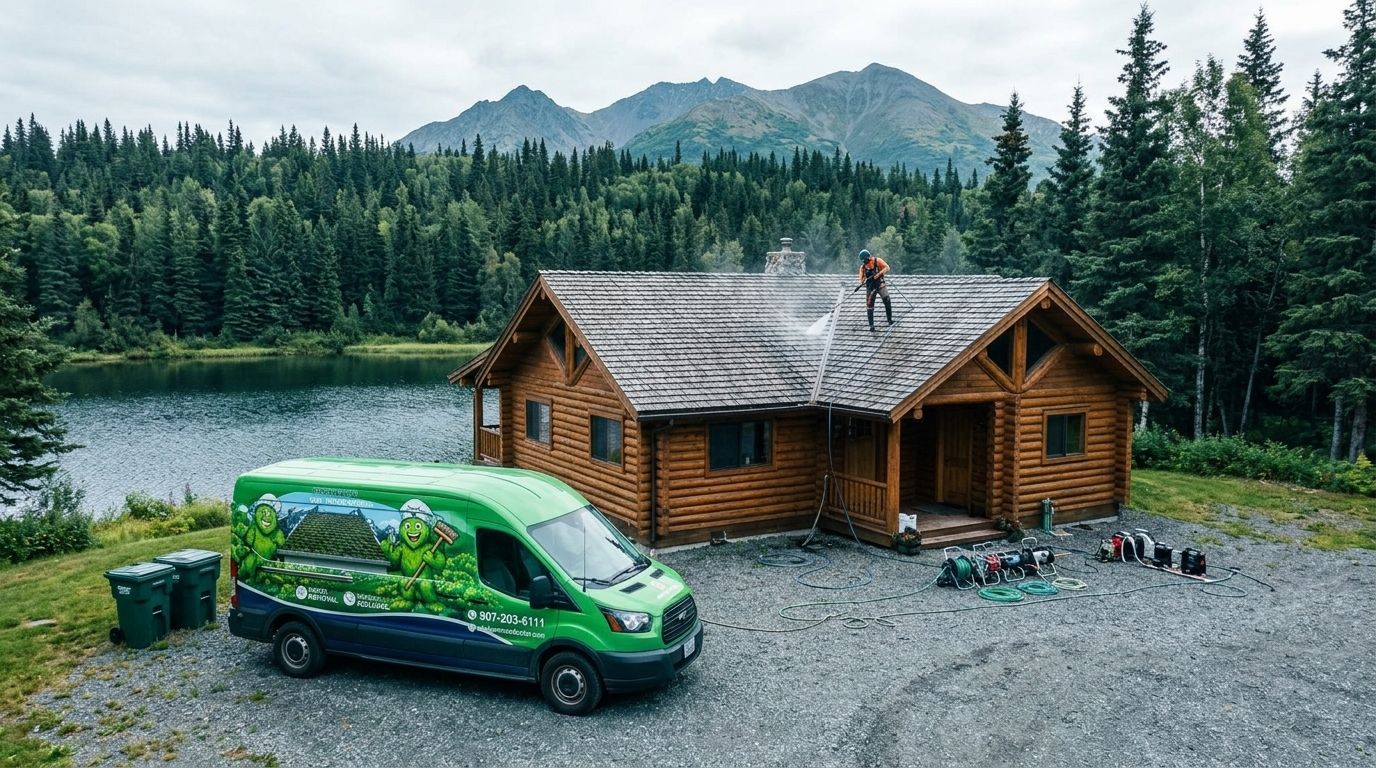
Alaska hunting and fishing lodge exterior cleaning is roof, siding, dock, and walkway maintenance built around the guiding season instead of a homeowner's calendar, with the goal of protecting bookings and guest safety rather than just curb appeal. Lodges carry different pressure than a residential property: steep or metal roofs over great rooms, log siding that stains fast in shade, docks and walkways that see wet boots and gear all summer, and a business that can't close for a week to let a roof dry.
- Exterior cleaning fishing lodge Alaska work should happen in the shoulder windows before and after peak guiding season, not mid-season.
- Log siding and shaded roofs on lodges collect moss and algae faster than standard homes because tree cover blocks drying wind.
- Alaska Moss Doctor uses soft-wash methods on asphalt, metal, and log exteriors to avoid pressure damage on lodge structures.
- Gutter guards and a standing maintenance plan cut the number of emergency cleanings a lodge needs each year.
- Docks, walkways, and steep roof sections carry the highest guest-safety risk from moss buildup and need priority attention.
Why exterior cleaning matters for hunting and fishing lodges
A residential homeowner in Wasilla can put off roof cleaning for a season. A lodge owner running back-to-back guided weeks in 2026 doesn't have that option — a slick walkway or a moss-covered dock step is a liability the day a guest slips carrying a rifle case or a cooler of halibut.
Lodges also sit in the exact conditions that grow moss and algae fastest: heavy tree cover for privacy and game access, north-facing roof pitches that stay damp, and log or cedar siding that traps moisture in the grain. That combination means a lodge roof can show the same moss growth in two seasons that a suburban roof shows in four or five.
Booking pressure changes the math too. A roof cleaning service built for remote Alaska cabins has to work around access logistics — float planes, gravel roads, limited staging space — that a standard residential job never deals with. Scheduling around those constraints, not just around the weather, is what separates a lodge-ready cleaning plan from a generic quote.
Inspect the roof and siding before the season opens
Start every season with a walk-around, not a guess. Most lodge damage gets caught late because nobody looks up during the scramble to open for guests.
- Check north- and east-facing roof slopes first — they hold shade and moisture longest
- Look for black streaks near ridge lines, which signal algae rather than moss
- Inspect log siding joints and chinking for green or gray growth
- Check flashing around chimneys, skylights, and roof-to-wall transitions for lifted moss mats
- Note any soft spots on the roof deck near valleys — early sign of moisture intrusion
Clear gutters and downspouts before spring bookings
Gutters clogged with needle litter and moss debris back up during spring melt and dump water straight down the siding. On a lodge with multiple roof planes and dormers, that's a lot of exposed edge to check.
- Pull debris from valleys and downspout inlets, not just the gutter troughs
- Check for standing water, which means a pitch problem, not just a clog
- Flush downspouts with a hose to confirm full flow
- Consider gutter guard installation for Mat-Su Valley homes on roofs with heavy tree cover, since guards cut manual clearing trips roughly in half on moss-heavy properties
Schedule a soft-wash roof cleaning in the shoulder window
Doing this yourself with a pressure washer is the fastest way to strip granules off an asphalt roof or split cedar shakes. A soft-wash treatment uses low pressure and a moss-killing solution instead of force, which matters on a lodge roof that has to last through Alaska winters without a mid-season repair.
- Book cleaning in late spring before the first guided trips or early fall after the season closes
- Confirm the crew uses soft-wash, not pressure-wash, on shingle and metal sections
- Ask whether the treatment includes a moss-inhibiting rinse for regrowth control
- Alaska Moss Doctor runs soft-wash roof cleaning specifically because pressure washing voids shingle warranties and can strip metal roof coatings — for a lodge that can't afford a mid-season leak, that distinction is the whole decision
Wash log and cedar siding to stop staining before it sets
Log cabin exteriors hold algae in the wood grain longer than vinyl or fiber cement, and once staining sets into the wood it takes more than a rinse to lift. Algae removal for log cabin homes requires a gentler chemical mix than asphalt roof treatments because raw or stained wood scars easily under strong cleaners.
- Test any cleaning solution on a hidden section of siding first
- Rinse from top to bottom to avoid streaking
- Re-seal or re-stain exposed log sections after cleaning if the finish looks chalky
- Skip anything above 1,500 PSI on bare wood — that's where scarring starts
Clear docks, walkways, and steps of moss and algae
This is the safety-first step. A moss-slick dock plank or stone walkway is the single most common guest-injury risk on a fishing lodge property, and it's also the fastest thing to fix.
- Scrub or soft-wash dock decking at the start and end of season
- Treat shaded walkway sections separately — they regrow faster than sun-exposed stone
- Check stair treads and ramp surfaces after every heavy rain week
- Re-apply a slip-resistant coating on high-traffic steps if the surface still feels slick after cleaning
Handle storm debris before it feeds new moss growth
Alaska storms drop branches, needles, and organic debris that sit on a lodge roof for weeks if nobody's checking between guided trips. That debris holds moisture against the roof surface and speeds up regrowth in exactly the spots you just cleaned.
- Clear debris within a few days of any major wind event
- Check valleys and behind chimneys first — debris collects there
- Pair storm cleanup with a moss inspection rather than treating them as separate jobs
- Storm debris cleanup paired with roof moss removal catches both problems in one visit instead of two truck rolls
Set up a standing maintenance plan instead of one-off calls
A lodge that books a cleaning crew only when moss is already visible is always playing catch-up. A standing plan — spring and fall visits at minimum — keeps the roof and siding ahead of regrowth instead of behind it.
- Lock in shoulder-season dates before the booking calendar fills
- Bundle gutter, roof, and siding checks into the same visit to cut trip costs
- Track which roof sections regrow fastest and adjust the schedule around them
- Exterior maintenance plans built for new Alaska homeowners apply the same logic to a working lodge: fewer emergency calls, more predictable costs
Comparison: cleaning options for Alaska lodges
| Option | Best for | Key limitation |
|---|---|---|
| DIY pressure washing | Owners with time and a low roof pitch | Strips shingle granules and can scar log siding |
| General handyman or landscaping crew | Basic gutter clearing between visits | Rarely equipped for steep-pitch or soft-wash roof work |
| Alaska Moss Doctor soft-wash service | Lodges needing roof, siding, and gutter work done without shingle or wood damage | Requires scheduling around access and weather windows |
| Standing seasonal maintenance plan | Lodges running back-to-back bookings all summer | Needs a locked-in schedule set before the season starts |
Verdict: a soft-wash service scheduled in the spring and fall shoulder windows is the only option that protects both the roof warranty and the booking calendar for an Alaska hunting and fishing lodge in 2026.
Common mistakes lodges make with exterior cleaning
- Waiting until guests complain. By the time a guest mentions a green roof or slick dock, the moss has usually been established for a full season.
- Using a general pressure-washing crew on log siding. Standard pressure settings scar raw wood and strip stain, creating a bigger repair than the algae problem itself.
- Scheduling cleaning during peak guiding weeks. Crews need staging space and drying time that conflicts directly with active bookings — the fix is scheduling around the gaps between groups, the same way short-term rental operators build cleaning into guest turnover cleaning between bookings rather than during a stay.
- Ignoring dock and walkway moss because the roof looks fine. Guest injuries happen at ground level far more often than roof-related damage does.
- Treating storm debris and moss removal as separate service calls. That doubles the truck trips and the disruption to a working lodge.
Book your lodge's shoulder-season cleaning
Soft-wash roof, siding, and gutter service scheduled around your guiding calendar.
FAQ
What is the best time of year for exterior cleaning on an Alaska fishing lodge?
Late spring before the first guided trips and early fall after the season closes are the two windows that avoid conflict with active bookings. Both fall outside the heaviest moss-growth months, which makes treatments last longer into 2026 and beyond.
Is soft washing safe for log cabin siding?
Soft washing is safer than pressure washing for log and cedar siding because it uses low water pressure with a targeted cleaning solution instead of force. Pressure washing above roughly 1,500 PSI on bare wood scars the surface and strips stain.
How often should a hunting lodge get roof moss removal?
Lodges with heavy tree cover typically need two treatments a year, spring and fall, versus one a year for a home with better sun exposure. Shaded roof sections should get checked more often since they regrow moss faster than sun-facing slopes.
Can moss on a roof cause real damage to a lodge?
Yes — moss holds moisture against shingles and underlayment, which shortens roof life and can lead to leaks in valleys and around flashing. Left unchecked over multiple seasons, it becomes a structural repair instead of a cleaning job.
Does gutter cleaning matter as much as roof cleaning for a lodge?
Clogged gutters back up water onto siding and foundations, which causes damage faster than roof moss alone. Lodges with heavy tree cover should treat gutter clearing as part of the same visit as roof cleaning, not a separate task.
What's the biggest guest-safety risk from moss at a fishing lodge?
Slick dock decking and stone or wood walkways cause more guest injuries than any roof-level issue. Those surfaces should get priority attention at the start and end of each season.
One last thing
The roof section that looks the cleanest from the ground — usually the south-facing slope that gets full sun — is rarely the one causing problems. It's the shaded, north-facing valley behind a chimney or dormer that holds moisture through an Alaska summer and turns into next year's leak. Check that section first, every season, before it becomes a guest complaint.