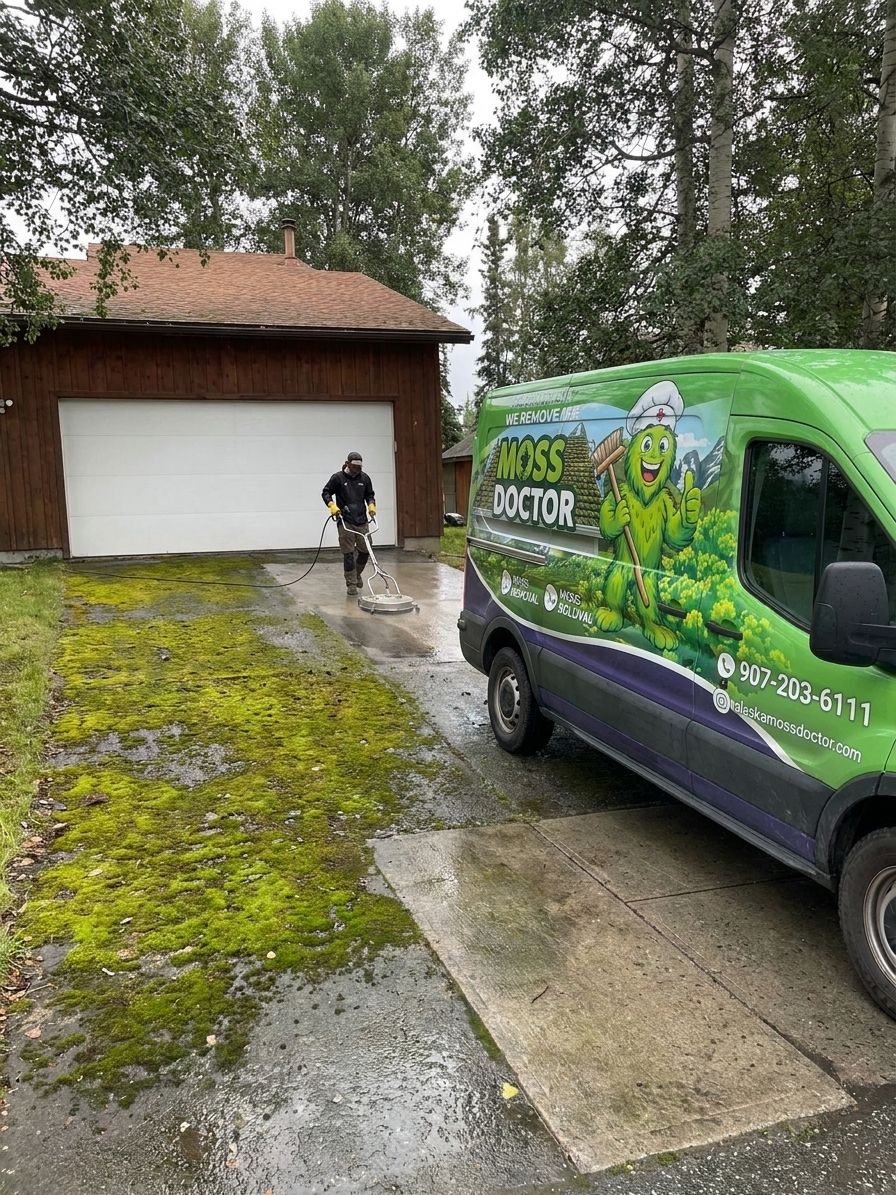
Concrete and paver driveways in Wasilla collect moss and green algae faster than roofs do, because runoff pools on flat, shaded surfaces through spring breakup. This guide covers what actually clears driveway moss and algae cleaning jobs for good, what makes the problem worse, and when a professional soft wash beats a rented pressure washer.
- Soft washing with a controlled chemical solution clears driveway moss and algae without pitting concrete; pressure washing alone lets moss regrow within months.
- Wasilla driveways under spruce and birch cover need attention every spring, ideally April through June before growth thickens.
- Skip bleach-only DIY treatments on pavers with polymeric sand joints — the chemical strips the sand and voids most sealant coverage.
- A soft wash plus sealant plan is the buy; a one-time rental pressure blast is a temporary fix at best.
Why this matters
Moss on a driveway isn't just cosmetic. Wet moss and algae film turn concrete and pavers slick, and a walkway coated in green growth is a fall risk every time it rains or frosts over. In Wasilla's climate, shaded driveways under tree canopy stay damp long after the rest of the yard dries out, which is exactly the condition moss needs to spread.
The surface also matters for how you treat it. What works on an asphalt shingle roof or a metal roof panel doesn't automatically transfer to a broom-finished driveway or a paver walkway with sand joints. Get the method wrong and you either strip a sealant coat, discolor stamped concrete, or blast sand out of paver joints that then need refilling.
Who this is for
This is for Wasilla homeowners with a driveway or walkway that stays green, black-streaked, or slick from October through April — usually because trees, a north-facing slope, or a shaded carport keep the concrete or pavers from drying out between rain events. If your driveway sits in full sun most of the day, moss is rarely the problem; if it sits under spruce cover or against a north-facing wall, this is written for you.
What to look for in driveway and walkway moss and algae cleaning
Surface material determines the safe method
Broom-finished concrete tolerates higher pressure than stamped or colored concrete, and pavers with sand joints tolerate almost none. A method that's fine for a plain concrete slab can blow sand out of paver joints or streak a stamped pattern, so match the approach to what's actually underfoot before you pick a tool.
Chemical treatment does the killing, pressure does the rinsing
Moss and algae have root structures that survive a surface blast. A sodium hypochlorite-based soft wash solution with a 10 to 15 minute dwell time kills the growth at the root; a pressure washer alone just knocks the visible layer off the top, which is why DIY jobs regrow fast.
Timing around Alaska's freeze-thaw cycle
Cleaning a driveway right before a hard freeze traps moisture in surface pores, which accelerates cracking over winter. Spring, once daytime temperatures hold above freezing, is the safer window for driveway and walkway work in the Wasilla area.
Slip safety on walkways specifically
A walkway gets foot traffic every day, so a film of algae there is a higher-stakes hazard than the same film on a driveway you only cross by car. Walkways deserve a texture-safe cleaning method and, ideally, a non-slip sealant afterward rather than a bare cleaned surface that regrows slick within a season.
A sealant and prevention plan, not just a one-time clean
A cleaned driveway with no sealant or follow-up plan starts collecting moss again the following wet season. Concrete sealants typically need reapplication every 2 to 3 years, and that schedule is what actually keeps the surface clean between cleanings rather than treating each spring as a fresh problem.
If your property also falls under an HOA, exterior cleaning for HOA compliance covers what associations typically flag on hardscape, not just roofs and siding.
Get your driveway assessed
Alaska Moss Doctor evaluates driveway and walkway moss the same visit as a roof check.
Cleaning methods ranked
Professional soft wash service — the safe pick. A controlled chemical application with a 10 to 15 minute dwell time followed by a low-pressure rinse kills moss and algae roots without stripping polymeric sand or eroding stamped finishes. This is the method that actually holds through a full Wasilla wet season instead of regrowing by August. Buy.
Rental pressure washer at 2,000 to 3,000 PSI — the fast fix that doesn't last. It strips the visible green layer off plain concrete in an afternoon, but it does nothing to the root structure and can blow sand straight out of paver joints. Fine as a one-time touch-up on broom-finished concrete only, wrong for pavers or walkways. Consider.
Store-bought moss and algae spray — the low-effort stopgap. Consumer sprays slow growth but generally need reapplication every 4 to 6 weeks through the wet months to hold the line, which adds up in time and product cost over a full season. Workable as a bridge between professional treatments, not a standalone plan. Consider.
Straight bleach and water mix — the one to skip. It bleaches surface growth white but doesn't address the root, discolors stamped or colored concrete, and is corrosive to nearby landscaping and metal edging. Skip.
What to avoid
- Full-pressure blasting on paver joints. It looks clean for a week, then the joints need re-sanding and the pavers start shifting.
- Bleach on stamped or colored concrete. The color coat lifts unevenly and the patch job is more visible than the moss ever was.
- Cleaning right before freeze-up. Wet, opened pores plus a hard freeze is a common cause of spring cracking that homeowners blame on "old concrete" when the timing was the real issue.
If you're prepping a property for sale, the same timing and method rules apply to the rest of the exterior — moss removal before selling your Alaska home walks through what buyers and inspectors actually notice.
Verdict comparison
| Method | Kills roots | Safe for pavers | Typical upkeep | Verdict |
|---|---|---|---|---|
| Professional soft wash | Yes | Yes | Every 1-2 years plus sealant | Buy |
| Rental pressure washer | No | No | Monthly regrowth check | Consider |
| Store-bought spray | Partial | Yes | Reapply every 4-6 weeks | Consider |
| Bleach and water DIY | No | No | Reapply frequently, staining risk | Skip |
FAQ
What's the best way to clean moss off a driveway?
A soft wash with a sodium hypochlorite-based solution and a 10 to 15 minute dwell time kills moss at the root, then a low-pressure rinse clears the debris. Pressure washing alone only removes the surface layer and moss typically regrows within months.
Is pressure washing bad for a paver driveway?
High-pressure washing can blow polymeric sand out of paver joints, which leads to shifting and weeds. Soft washing at low pressure is the safer method for any paver surface.
How often should a Wasilla driveway be cleaned for moss and algae?
Shaded driveways in the Wasilla area generally need attention once a year, ideally in spring between April and June before growth thickens. Sunnier driveways may go two years between cleanings.
Does bleach kill driveway moss for good?
Bleach whitens surface growth but doesn't kill the root structure, so moss returns. It can also discolor stamped or colored concrete and damage nearby plants.
Is a wet driveway with moss actually dangerous?
Yes. Moss and algae film gets slick when wet or frosted, and a walkway coated in growth is a real fall risk during Alaska's wet and freezing months.
Should I seal my driveway after cleaning it?
Sealing after cleaning slows regrowth and protects the surface from freeze-thaw damage. Concrete sealants typically need reapplication every 2 to 3 years.
Can I clean my driveway myself instead of hiring a pro?
Plain broom-finished concrete can handle a careful DIY pressure wash, but stamped concrete and pavers are easy to damage without the right pressure and chemical mix. A professional soft wash avoids that risk on either surface.
One last thing
The walkway usually gets cleaned last, if at all, because it's smaller than the driveway — but it's the surface people actually walk on every day, which makes it the higher-priority fix for slip risk, not the lower one. Start there if you're only tackling one section this spring.