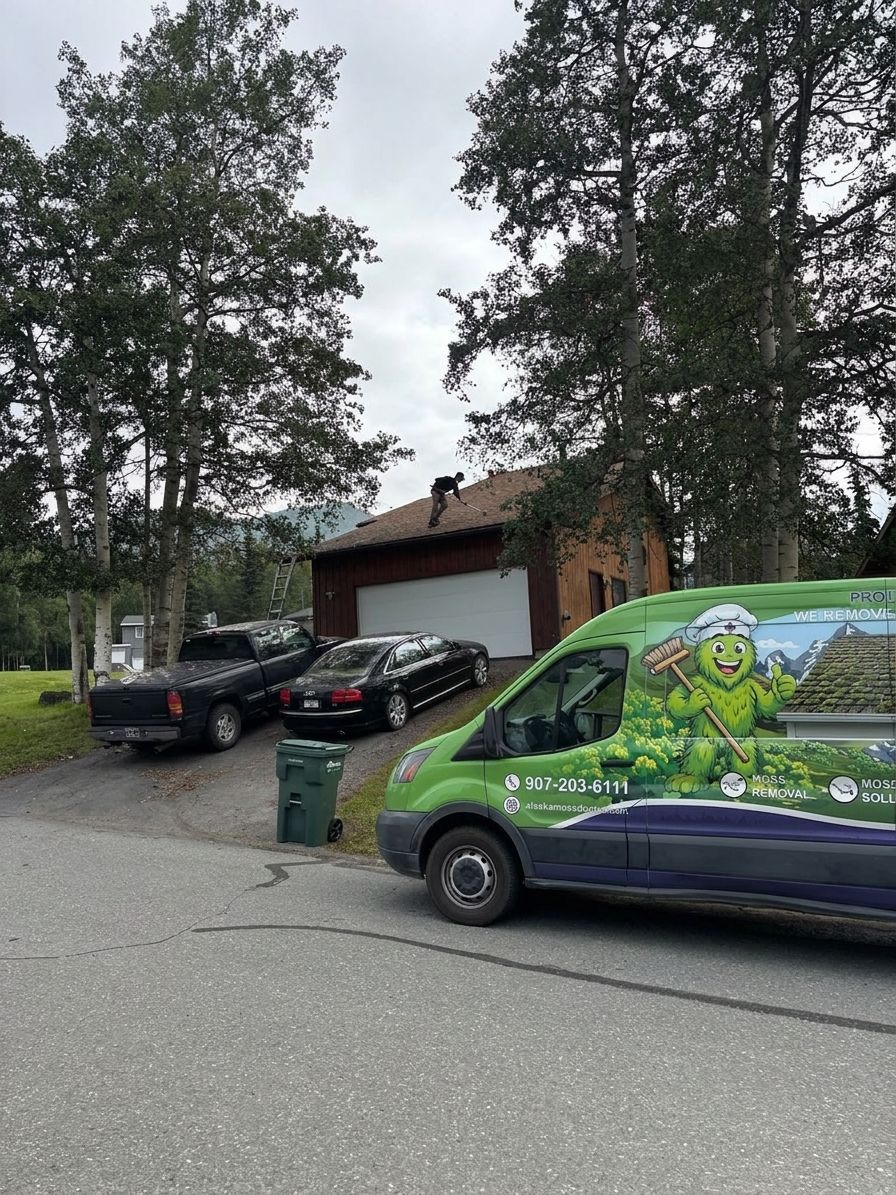
Roof moss removal in Alaska works when you time it around the thaw-to-freeze calendar, not around whenever the moss looks bad. Book it wrong and you either can't get a crew on the roof safely or the treatment never cures before the next freeze locks moss back in.
- Late April through early June is the best time of year for roof moss removal in Alaska because moss is saturated and weak from snowmelt. Buy.
- June through late July gives 19+ hours of daylight in Wasilla for soft washing and preventative treatment. Buy.
- Late September through October is the worst window because freezing temps return before treatment fully cures. Skip.
- November through March roof access is unsafe under snow load and moss goes dormant, not dead. Skip.
Why timing matters for roof moss removal in Alaska
Moss on an Alaska roof isn't a cosmetic problem you can schedule around like mowing a lawn. It holds moisture against shingles year-round, and in a climate with a short frost-free season, the window to treat it and let the treatment cure is genuinely narrow.
Wasilla sits near 61 degrees north, which means daylight swings from roughly 19 hours around the summer solstice to under 6 hours in December. That daylight curve dictates when a crew can safely work a pitched roof, and it dictates how much cure time a moss treatment gets before the first hard frost sets back in, typically by mid-to-late September in the Mat-Su Valley.
Homeowners who treat moss in October or later often see it look dead for a few weeks, then watch it green back up the following spring because the treatment never fully penetrated before the roof froze. The roof moss removal guide for Wasilla homeowners covers why moss establishes so aggressively on north-facing and shaded pitches in this climate specifically.
How the ranking works
Each window below is scored on four factors that actually determine outcomes for roof moss removal in Alaska: daylight hours available for safe roof work, precipitation frequency during and after treatment, cure time before the first fall freeze, and roof access safety given snow or ice conditions. A window that scores well on daylight but poorly on cure time still gets marked down. A treatment that doesn't finish working before winter isn't a win, it's a deferred problem.
This isn't a guess based on a calendar page. It's based on how moss biology and Alaska's freeze-thaw cycle interact: moss is most vulnerable right after it rehydrates from snowmelt and most resistant once it's gone dormant for winter.
Best time of year for roof moss removal in Alaska, ranked
1. Late April to early June — the safe pick
This is the top window for roof moss removal in Alaska, and it's not close. Snowmelt leaves moss fully saturated and structurally weak, which means treatment kills it faster and with less product than at any other point in the year.
Daylight is already climbing past 15 hours by mid-May, giving crews a full working window without the heavy rain that shows up later in summer. Verdict: Buy — this is the window to book first if your roof has visible moss going into winter.
2. June through late July — the reliable pick
Peak daylight in Wasilla runs close to 19 hours around the June solstice, and this stretch is typically the driest of the year. That combination makes it the best window for soft wash roof cleaning on asphalt shingle roofs, where you need dry conditions for the treatment to bond and cure properly.
The tradeoff is that moss has had all spring to dry out and toughen up, so it takes slightly more contact time than the April-June window. Verdict: Buy — the second-best slot, and often the only realistic option if spring is booked out.
3. Early August to mid-September — the shrinking window
Daylight is still workable, but it's dropping fast, and Southcentral Alaska's rain frequency climbs noticeably through August. Crews can still get roofs done, but scheduling gets tighter and treatment cure time before the first freeze starts running short.
This window works for shaded and north-facing roofs that need attention before winter — see the algae removal guide for north-facing roofs for why those pitches can't wait until next spring. Verdict: Hold — fine if you're already on the schedule, not worth chasing if you have a choice.
4. Late September through October — the one to skip
This is the window homeowners default to because moss looks worst right before winter, and it's the wrong call. Freezing temperatures typically return to the Mat-Su Valley by mid-to-late September, which cuts treatment cure time to almost nothing before the roof locks under frost and snow.
Shaded properties are especially exposed here — the roof algae removal guide for shaded properties explains why those roofs regrow moss fastest when treatment gets rushed. Verdict: Skip — book spring or summer instead and use fall for a gutter check.
5. November through March — dormant, not dead
Moss doesn't die in an Alaska winter — it goes dormant, sitting under snow load waiting for spring thaw to reactivate. Roof access during this stretch is also a genuine safety issue, with ice and snow load making pitched-roof work unsafe for most of the season.
Any treatment applied in this window won't cure, won't penetrate frozen moss structure, and puts crews at unnecessary risk for zero added benefit. Verdict: Skip — this window exists for planning next year's schedule, not for booking work.
Timing comparison at a glance
| Window | Daylight | Precipitation risk | Cure time before freeze | Verdict |
|---|---|---|---|---|
| Late April – early June | 15-18 hrs | Low-moderate | Full season ahead | Buy |
| June – late July | 18-19 hrs | Lowest of the year | Full season ahead | Buy |
| Early Aug – mid-Sept | 13-16 hrs | Rising | Shrinking fast | Hold |
| Late Sept – October | 9-12 hrs | High | Almost none | Skip |
| November – March | Under 9 hrs | Snow/ice | None (dormant) | Skip |
Lock in a spring or summer slot
Book roof moss removal before the fall rush fills the calendar.
When to book your roof moss removal
Three scheduling rules follow directly from the ranking above:
- Book April-June work in February or March. Spring slots fill first because every homeowner with visible winter moss wants the same six-week window.
- Pair summer treatment with gutter maintenance. If moss is heavy enough to hold water, gutters are usually clogged too — the gutter cleaning guide for moss-prone roofs covers why the two jobs go together in a single visit.
- Treat fall as inspection season, not treatment season. Use September to flag problem areas and get on next spring's calendar rather than rushing a treatment that won't cure.
Steep-pitch and cedar shake roofs add their own access constraints on top of the seasonal calendar, so if either applies to your house, budget extra lead time regardless of which window you pick.
FAQ
What is the best time of year for roof moss removal in Alaska?
Late April through early June is the best time of year for roof moss removal in Alaska because snowmelt leaves moss saturated and easiest to kill. June through late July is the second-best window, with the driest conditions and longest daylight of the year.
Can you remove roof moss in the winter in Alaska?
No, winter treatment doesn't work because moss goes dormant under snow load rather than dying, and roof access is unsafe under ice and snow. Wait for late April or later when the roof is clear and moss reactivates.
Is fall a bad time for roof moss removal in Alaska?
Late September through October is one of the worst windows because freezing temperatures typically return to the Mat-Su Valley before treatment can fully cure. Treatments applied this late often look effective for a few weeks, then the moss regrows the following spring.
How long does roof moss treatment take to cure in Alaska?
Cure time depends on temperature and moisture, which is exactly why spring and summer windows outperform fall applications. A treatment applied in April or June gets a full season of warm, dry weather to finish working; one applied in October gets almost none.
Does shade affect when I should schedule roof moss removal?
Yes, north-facing and heavily shaded roofs hold moisture longer and regrow moss faster, so they benefit most from early scheduling in the April-July range. Waiting until fall on a shaded roof shortens the cure window even further.
Should I treat moss before or after winter in Alaska?
Before winter, ideally in spring or summer, not right before the first freeze. Treating in late fall gives moss almost no time to fully die off before dormancy resets the clock.
How often should Alaska homeowners schedule roof moss removal?
Most Wasilla-area roofs need treatment every 1-2 years depending on shade exposure and roofing material, with shaded and north-facing roofs needing more frequent attention. A summer soft wash combined with a fall inspection is a reasonable baseline schedule.
One last thing
The fall booking rush is the single biggest scheduling mistake Alaska homeowners make. Moss looks its worst in September and October right as the calendar window for effective treatment is closing, which pushes the smart move — booking a spring slot in February or March — down the priority list until it's too late for the year.