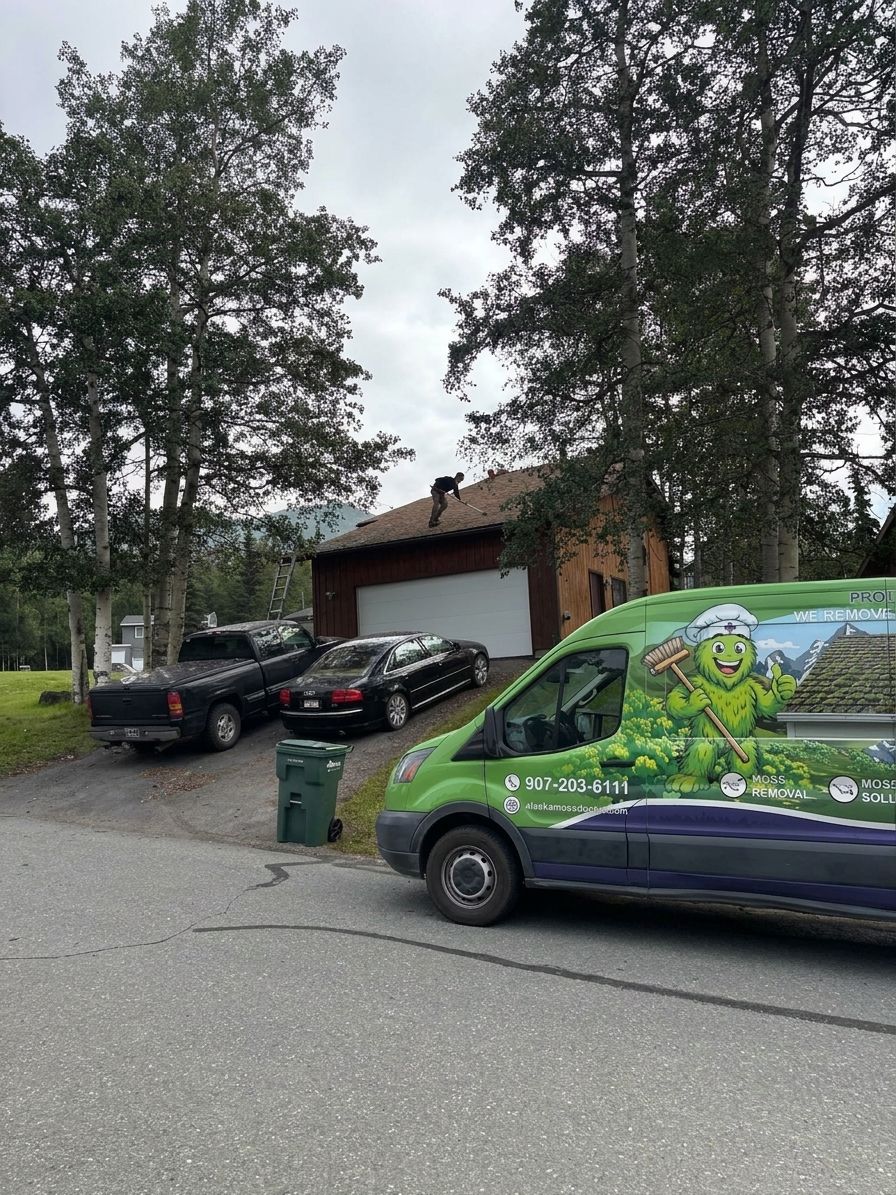
Steep-pitch roofs in Wasilla grow moss fast and punish anyone who tries to clean them the wrong way. This guide breaks down what actually matters when you're dealing with roof moss removal on a steep roof, and which approach fits your roof material.
- Roof moss removal steep roof jobs over 8/12 pitch require fall protection, not a ladder and a scrub brush.
- Soft-wash chemical treatment beats pressure washing on steep asphalt shingle and cedar shake roofs in 2026.
- North-facing steep roofs in Wasilla regrow moss faster and need a maintenance treatment on a shorter cycle.
- Alaska Moss Doctor treats cedar shake, metal, and asphalt shingle steep roofs with method matched to the material.
Why this matters
A steep roof isn't just a harder version of a flat one — it's a different job. Anything above a 6/12 pitch (6 inches of rise per 12 inches of run) changes how moss removal has to happen: standing on the surface gets dangerous, pressure equipment can knock shingles loose on contact, and gravity works against whoever's up there with a hose.
Wasilla's shade cover, tree lines, and long wet shoulder seasons push moss growth on steep roofs harder than on flat commercial roofs in the same neighborhood. Ignore it past one season and moss roots start lifting shingle tabs and holding moisture against cedar shake, which is how a $400 cleaning turns into a $4,000 patch job. Getting the method right the first time on a steep roof matters more than on almost any other roof shape.
Who this is for
This guide is for Wasilla-area homeowners with a roof pitch of 6/12 or steeper — think A-frame cabins, chalet-style builds, and traditional gable roofs common across the Mat-Su Valley. If your roof is walkable without rope access, most of this still applies, but the fall-protection section matters less. If you're staring at green-black streaking on a roof you can't safely climb, keep reading before you call anyone with a pressure washer.
What to look for in roof moss removal for a steep roof
Fall-protection planning
Anyone working a pitch steeper than 6/12 without harnesses, rope anchors, or roof jacks is cutting a corner that gets people hurt. Ask specifically how the crew accesses a 10/12 or 12/12 roof — a real answer names anchor points and tie-off methods, not "we're careful."
Pressure vs. soft-wash method
High-pressure washing strips granules off asphalt shingles and can split cedar shake on contact, and that damage gets worse the steeper the surface because water and debris have nowhere to go but down fast. Soft-wash treatment — low-pressure application of a moss-killing solution — is the standard for steep roofs in 2026 because it kills moss at the root without blasting the roofing material.
Roof material sensitivity
Cedar shake, metal, and asphalt shingle all react differently to cleaning chemicals and pressure. A method that's safe on architectural asphalt shingle can strip the natural oils out of cedar shake or dull a metal roof's coating, so the right approach depends on what's actually up there.
Access and equipment reach
Steep roofs often need extension wands, roof anchors, and sometimes a lift rather than a straight ladder pitch. A crew that shows up with only a garden hose attachment and a 24-foot ladder isn't equipped for a 10/12 pitch two-story home.
Timing around Alaska's freeze-thaw cycle
Moss treatment applied right before a hard freeze doesn't get the working time it needs to kill root systems, and ice on a steep roof turns any access plan dangerous. Spring and fall windows, before snow load and after thaw, are when steep-roof treatment holds up best.
Top picks by roof type
The safe pick — asphalt shingle steep roofs. Asphalt shingle is the most common roofing material on steep-pitch homes in the Wasilla area, and it responds predictably to soft-wash treatment: a properly diluted solution clears surface moss in one application and leaves granules intact. Check the asphalt shingle soft-wash cleaning approach before booking anything with a pressure attachment. Book it.
The material-sensitive pick — cedar shake steep roofs. Cedar shake holds moisture differently than shingle and can split or gray prematurely if the wrong chemical concentration or pressure level touches it. A steep cedar shake roof needs a treatment built around wood preservation, not just moss removal — see the specifics on cedar shake roof moss removal. Book it, but confirm the crew has cedar-specific experience first.
The durable pick — metal roofing on steep pitches. Metal roofs shed water fast on a steep pitch, which actually limits moss growth to seams, valleys, and shaded panel edges rather than broad coverage. Soft-wash treatment tuned for metal roof soft-washing protects factory coatings that pressure washing can dull or scratch. Book it.
The wildcard — north-facing shaded sections. A steep roof with a north-facing slope under tree cover regrows moss on a compressed timeline compared to sun-exposed slopes on the same house, regardless of material. That section usually needs its own maintenance interval separate from the rest of the roof. Consider a shorter follow-up cycle for that slope specifically — don't treat the whole roof on one schedule if only one face is the repeat offender.
What to avoid
- A quote based only on square footage with no pitch mentioned. Pitch changes labor, equipment, and time on the roof — a flat per-square-foot number that ignores a 10/12 pitch is a red flag.
- Pressure washing sold as "deep cleaning." On a steep roof this strips protective granules and coatings and voids some shingle manufacturer warranties. If pressure is the pitch, walk away.
- DIY moss scraping from a ladder. Scraping without root-kill chemical treatment leaves spores behind, and doing it on a steep pitch from a straight ladder is one of the more common fall-injury scenarios in residential roof work.
Verdict comparison
| Roof type | Best method | Pressure washing risk | 2026 verdict |
|---|---|---|---|
| Asphalt shingle | Soft-wash chemical treatment | Strips granules | Book it |
| Cedar shake | Soft-wash, wood-safe solution | Splits shake, strips oils | Book it (confirm cedar experience) |
| Metal roofing | Soft-wash, coating-safe solution | Dulls/scratches coating | Book it |
| North-facing shaded slope | Soft-wash on shorter interval | Same as base material | Consider shorter cycle |
Get a steep-roof moss quote
Alaska Moss Doctor treats steep-pitch roofs across the Wasilla area with soft-wash methods matched to your roofing material.
More detail on the local conditions driving this is in the Wasilla, Alaska roof moss removal guide, which covers seasonal timing beyond just steep-pitch specifics.
FAQ
What's the best method for roof moss removal on a steep roof?
Soft-wash chemical treatment is the best method for roof moss removal on a steep roof in 2026 because it kills moss at the root without the pressure that can strip shingles or split cedar shake on a steep pitch.
Is pressure washing ever safe on a steep roof?
Pressure washing is not recommended on steep roofs because water and debris move fast on a steep pitch and pressure strips granules from asphalt shingle and can split cedar shake. Soft-wash treatment is the safer standard for pitches above 6/12.
How much does roof moss removal cost for a steep-pitch roof?
Cost for steep-pitch roof moss removal varies by roof size, material, and access difficulty since fall-protection setup adds labor time. Get a quote based on your specific roof pitch and material rather than a flat per-square-foot estimate.
Can I remove moss from a steep roof myself?
DIY moss removal on a steep roof carries real fall risk, especially above a 6/12 pitch where standing balance and ladder angles become unsafe. Scraping without a root-kill chemical treatment also leaves moss spores behind, so it regrows within one season.
Does roof pitch affect how often moss removal is needed?
Yes, steeper roofs shed water and debris faster, which can slow moss growth on sun-exposed slopes but doesn't stop it on shaded or north-facing sections. A single steep roof can need different treatment intervals for different slopes.
Is cedar shake harder to treat for moss than asphalt shingle?
Cedar shake requires a wood-safe soft-wash solution because it absorbs moisture and chemicals differently than asphalt shingle. The wrong concentration can gray or split cedar shake, so material-specific experience matters more on shake roofs.
When is the best time of year for steep roof moss treatment in Wasilla?
Spring after snowmelt and early fall before hard freeze are the best windows for steep roof moss treatment in Wasilla, giving the solution working time to kill root systems before ice returns.
Does moss damage a steep roof if left untreated?
Yes, moss roots lift shingle tabs and hold moisture against the roofing surface, which accelerates rot on cedar shake and granule loss on asphalt shingle. Left untreated for multiple seasons on a steep roof, a cleaning job can turn into a repair job.
One last thing
The slope that never sees direct sun is almost always the one that regrows moss first — if your steep roof has a north-facing valley or a tree-shaded section, treat that face on its own schedule instead of waiting for the whole roof to look bad again.