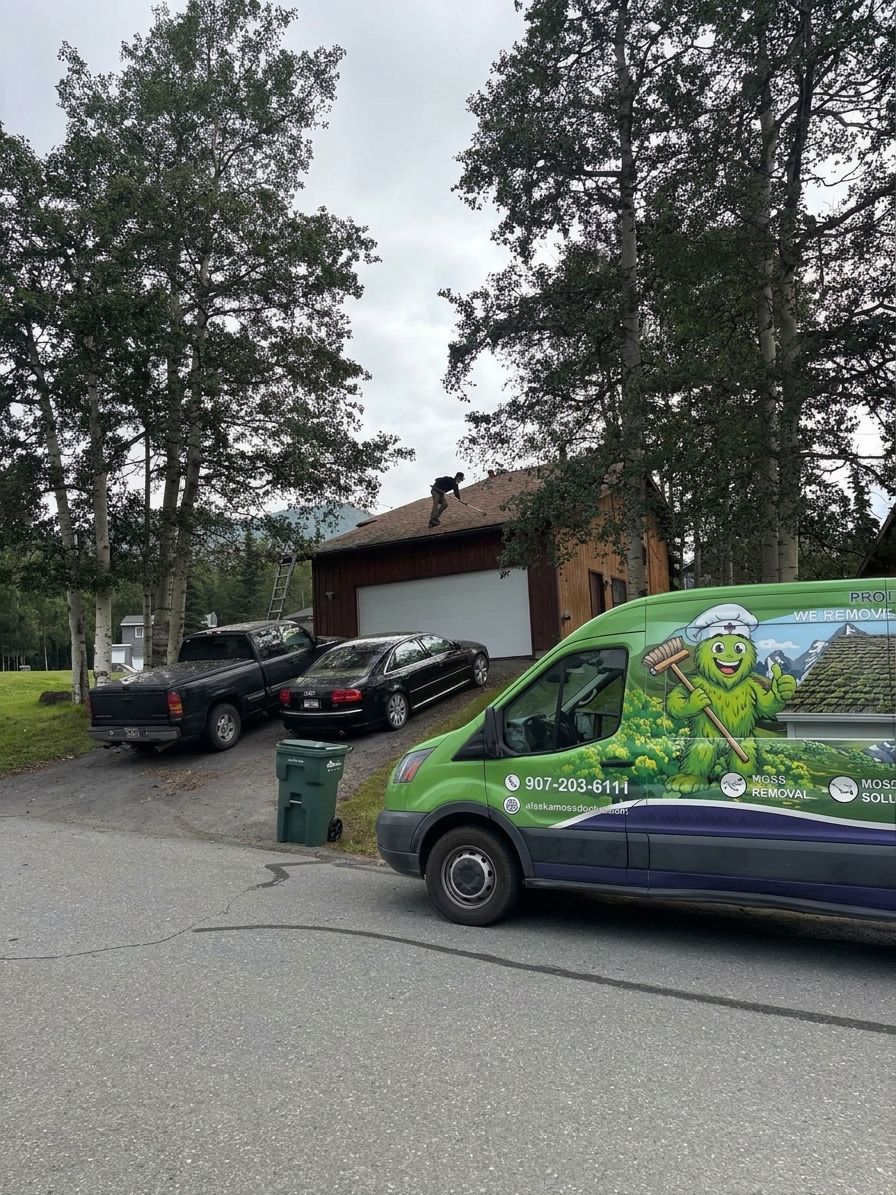
Older roofs in the Wasilla area hold moss differently than new construction — softer shake, thinner granule coats, and roof decks that were never engineered for a 3,000 psi pressure washer. Roof moss removal for older homes in Alaska needs a method matched to what's actually up there, not a generic power-wash job.
- Soft washing under 100 psi is the safe call for roof moss removal on older homes in Alaska in 2026 — Buy.
- Standard pressure washing above 2,500 psi strips granules off asphalt shingles and splits softened cedar shake — Skip.
- Steep-pitch roofs on pre-1990s Wasilla homes need rope-and-harness crews, not a ladder and a garden hose attachment.
- Zinc or copper control strips slow moss regrowth after cleaning, but only where rain actually runs over them.
- Metal roofs resist rooting but still hold moss in valleys and around screws on older Mat-Su Valley homes.
Why this matters
Moss doesn't just sit on a roof — it holds water against the surface long after the rest of the yard has dried out. On an older Wasilla home, that moisture sits on shingles that have already lost some of their granule coating or on cedar shake that's had 20-plus winters of freeze-thaw cycling. The moss isn't the damage. The trapped moisture underneath it is.
Alaska's short summer daylight window and shaded, tree-lined lots in the Mat-Su Valley keep roof surfaces damp longer than most of the Lower 48 ever sees. That's exactly the environment moss needs, and it's why the same roof that was clean five years ago can be solid green by 2026 if nobody's touched it.
Who this is for
This guide is for homeowners in the Wasilla and greater Mat-Su area with a roof built before the mid-1990s — cedar shake, older three-tab asphalt, or a steep-pitched roof design that was common in that era. If you're seeing moss concentrated on the north-facing slope, near valleys, or under overhanging spruce, this covers what to look for before you hire anyone.
What to look for in roof moss removal for older homes in Alaska
Wash pressure matched to roof age
A roof built in the 1980s or 1990s has already lost some of its structural margin. Soft washing, which uses under 100 psi combined with a cleaning solution, lifts moss and algae without blasting granules off asphalt or driving water under aged shake. Anyone quoting a standard 2,500-4,000 psi pressure wash on a roof this old is quoting the wrong job.
Roof material identification before treatment
Cedar shake, asphalt shingle, and metal all respond differently to cleaning chemistry and pressure. A crew that treats every roof the same way, regardless of material, is guessing. Ask what specific process applies to your roof moss removal service in Wasilla, Alaska before scheduling anything.
Pitch and fall-protection on the crew
Older homes in this area often carry steeper roof pitches than modern builds — a design choice for snow shed, not walkability. A crew working a 8/12 or 10/12 pitch without harness gear is a liability on your property, not just a safety problem for them.
Preventive treatment, not just a one-time clean
A single cleaning removes what's there today. Zinc or copper control strips installed along the ridge release ions with every rain that slow regrowth for multiple seasons — but only on the section of roof the water actually crosses before running off.
Local climate experience
A crew that's worked Mat-Su Valley roofs through freeze-thaw cycles and short summer drying windows knows when a roof surface is dry enough to treat and when moisture is trapped under a snow layer that hasn't fully melted. That timing call matters more here than in a milder climate.
Gutter and drainage cleared the same visit
Moss that's washed off a roof and then sits in a clogged gutter just re-seeds the roof edge next season. Roof moss removal that skips gutter cleaning for moss-prone roofs is only doing half the job.
Top picks by roof type
Cedar shake roofs — the moisture trap. Shake absorbs and holds water for days after a rain event, which is exactly why moss roots faster here than on any other common roofing material in the area. Roof moss removal for cedar shake roofs requires soft washing paired with a wood-safe treatment, never a pressure wash. Verdict: Buy — this is the highest-priority roof type for a professional soft wash in 2026.
Steep pitch roofs — the safety call. Pitches over 6/12 on older two-story Wasilla homes need rope access, not a ladder propped against the fascia. Roof moss removal for steep pitch roofs is where DIY attempts most often end in a fall or a damaged gutter. Verdict: Consider — hire only a crew that specifies harness equipment in the quote.
Standard asphalt shingle roofs — the common case. Most Wasilla homes built between the 1970s and 1990s carry three-tab or early architectural asphalt shingles rated for a 20-25 year service life. Soft washing extends what's left of that life instead of stripping the remaining granules. Verdict: Buy, provided the crew confirms soft-wash-only on the quote.
Metal roofing — the low-maintenance outlier. Moss struggles to root on a smooth metal panel, but it still collects in valleys, around fasteners, and under snow guards on older retrofit installs. Verdict: Skip urgent treatment unless moss is visibly established in a valley — metal buys you more time than shingle or shake.
What to avoid
- DIY pressure washing with a rental unit. Consumer-grade pressure washers run well above the 100 psi ceiling that's safe for aged shingle or shake — one pass can void what's left of a shingle warranty.
- Bleach-only spray with no rinse step. It kills the surface growth you can see but leaves the root structure and doesn't address the moisture retention causing regrowth.
- Treating the roof and ignoring drainage. A clean roof draining into a clogged gutter re-seeds itself within a season — the moss just moves eight inches lower and starts over.
Get your roof assessed before winter
See which wash method and treatment fit your roof's age and material.
Verdict comparison
| Roof type | Wash method | Pitch risk | Verdict |
|---|---|---|---|
| Cedar shake | Soft wash + wood-safe treatment | Moderate | Buy |
| Steep pitch asphalt | Soft wash, rope-access crew | High | Consider |
| Standard asphalt shingle | Soft wash | Low to moderate | Buy |
| Metal roofing | Spot treatment in valleys | Low | Skip urgent action |
FAQ
What is the best way to remove moss from an older roof in Alaska?
Soft washing under 100 psi is the safest method for roof moss removal on older Alaska homes. Standard pressure washing above 2,500 psi risks stripping shingle granules or splitting aged cedar shake.
Is pressure washing safe for older shingle roofs?
No, standard pressure washing above 2,500 psi is too aggressive for shingles over 15-20 years old. It strips the granule coating that protects the shingle from UV and moisture, shortening its remaining life.
How much does roof moss removal cost in Wasilla, Alaska?
Cost depends on roof pitch, material, and square footage, so it varies home to home. Getting an assessment based on your specific roof gives a more accurate number than any flat estimate.
How often should older Alaska homes get roof moss removal?
Most older homes in the Mat-Su Valley need a professional check every 1-2 years, more often on north-facing or heavily shaded roof slopes. Regrowth speed depends on shade, roof material, and drainage.
Can moss cause roof leaks on older homes?
Yes, moss holds water against the roof surface and can lift shingle edges over time, creating entry points for water. On cedar shake, trapped moisture accelerates rot in the wood itself.
Is soft washing better than pressure washing for cedar shake roofs?
Yes, soft washing is the only recommended method for cedar shake. High-pressure water drives moisture under the shake and can split boards that have already aged 20-plus years.
Do zinc strips actually stop moss from coming back?
Zinc and copper control strips slow regrowth by releasing ions into rainwater as it runs down the roof. They only work on the sections of roof the water actually crosses, so placement matters.
Should I clean moss off my roof myself?
DIY moss removal is risky on older, steep-pitched roofs due to fall hazards and the temptation to use a rented pressure washer. A professional soft wash avoids both the safety risk and the shingle damage.
One last thing
Zinc and copper strips only do their job where rainwater physically runs across them on the way down the slope — a strip installed above a chimney cricket or a dormer that redirects water around it provides zero protection to the section behind it. Check the roof's water path before assuming a strip installed years ago is still working.