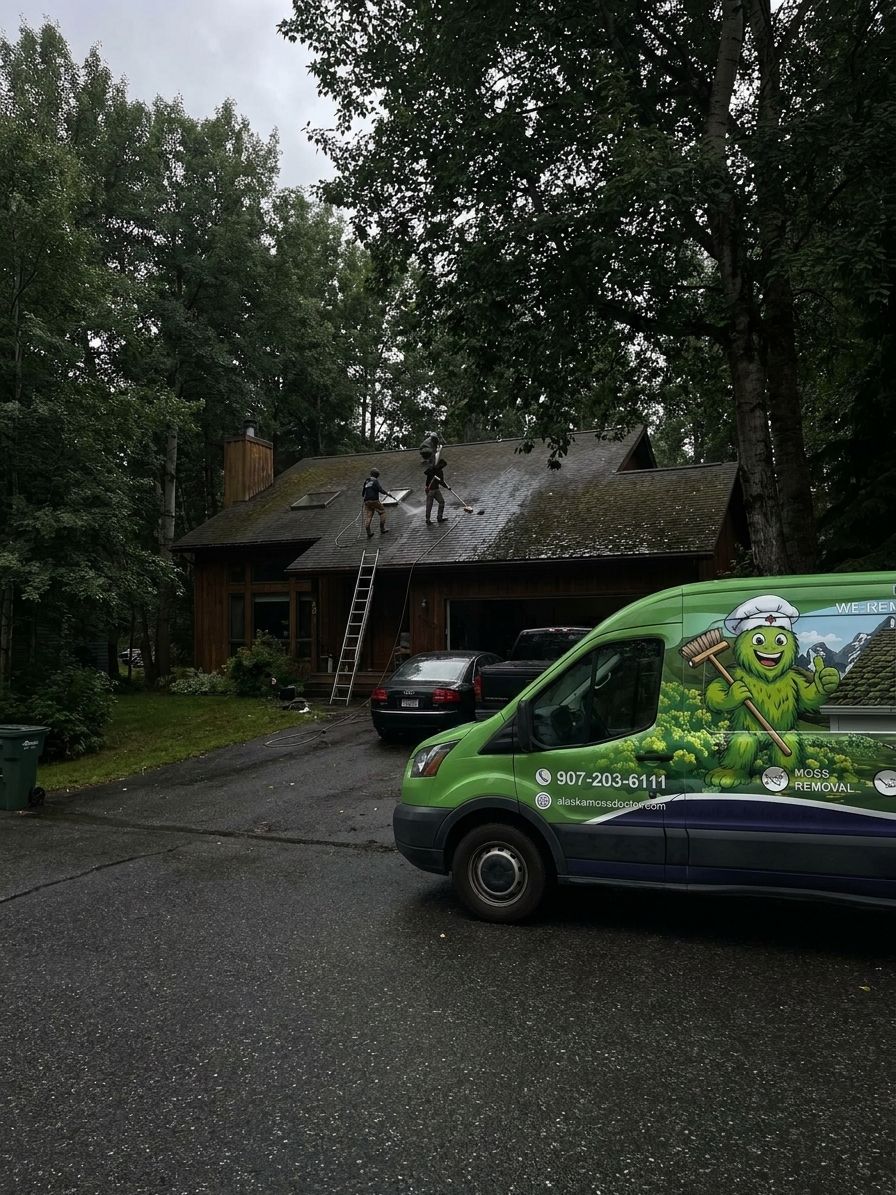
Shaded roofs in Wasilla grow moss and algae faster than roofs that sit in full sun, and treating them with the wrong method strips granules, voids shingle warranties, and brings the growth back inside a season.
- Roof algae removal shaded yard jobs need soft washing under roughly 500 PSI, not pressure washing that strips shingle granules.
- North-facing and tree-covered roofs in Wasilla hold moisture longer than sun-exposed slopes, which is why algae and moss return faster on those sections.
- Alaska Moss Doctor treats shaded asphalt shingle, cedar shake, and metal roofs differently because chemical dwell time and rinse pressure vary by material.
- Skip DIY pressure washing on a shaded roof over 4/12 pitch — it's the fastest way to void a shingle warranty.
- Gutter cleaning on moss-prone roofs matters as much as the roof treatment itself for properties under spruce cover.
Why this matters
Gloeocapsa magma, the black-green algae behind most Alaska roof staining, needs shade and moisture to establish. A roof under spruce cover or facing north holds both far longer than a roof in open sun, which is why the same asphalt shingle roof can look clean on the south slope and streaked on the north slope within the same year.
Wasilla's latitude, roughly 61.5°N, compounds the problem. Winter daylight runs under 6 hours in December, and even in summer, tree-shaded roof sections never get the direct UV exposure that naturally slows algae growth on open roofs. That's the core reason generic "roof cleaning" advice from Lower 48 sources doesn't hold up here — shade duration and moisture retention run longer on an Alaska property than almost anywhere else in the country.
Alaska Moss Doctor treats shaded roofs as a distinct category, not a variation on standard roof cleaning, because the growth pattern, the material sensitivity, and the reinfestation timeline all behave differently under tree cover.
Who this is for
This guide is for Wasilla homeowners with a roof that sits partly or fully under spruce, birch, or cottonwood canopy, or with a north-facing slope that rarely gets direct sun. If your roof has visible black or green streaking concentrated on one side, near valleys, or under overhanging branches, you're dealing with a shade-driven growth pattern, not a uniform aging issue — and the fix looks different from a standard full-roof clean.
What to look for in roof algae removal for shaded properties
Roof orientation and sun exposure
A north-facing slope or a roof section shaded by mature trees dries out slower after rain or snowmelt, which is the single biggest driver of algae and moss growth on an otherwise healthy roof. Any contractor quoting a shaded roof job should ask about orientation before quoting a price, because the shaded sections need more attention than the sun-exposed ones.
Growth type: moss versus algae versus lichen
Moss forms raised, spongy patches that trap moisture against shingles; algae shows as flat black or green streaking; lichen is the crusty, slower-growing variant that's hardest to remove without damaging the roofing material underneath. Treating moss and algae with the same chemical mix and dwell time under-treats one or over-treats the other.
Roofing material sensitivity
Asphalt shingles lose granules under high pressure, cedar shake splits and grays faster with harsh chemical mixes, and metal roofing can streak or corrode if the wrong cleaner sits too long. A shaded roof job has to account for material first, growth type second.
Treatment method: soft wash versus pressure wash
Soft washing runs under roughly 500 PSI and relies on the cleaning solution's dwell time to kill algae at the root, rather than blasting it off the surface. Pressure washing above that range strips granules and shortens the roof's remaining service life, which matters more on a shaded roof that will regrow faster anyway.
Timing and Alaska's growing season
Alaska's active growth window for moss and algae runs roughly May through September, and shaded roof sections keep growing into early fall after sun-exposed sections have already dried out for the year. Scheduling a shaded-roof treatment in late spring, before growth peaks, gets more value than waiting until streaking is already visible.
Prevention after treatment
Zinc or copper strip flashing near the ridge lets metal ions wash down with rain and slow regrowth on shaded sections, but it doesn't replace periodic gutter and valley cleaning where debris collects and holds moisture.
Top picks for shaded-roof treatment
North-facing roof algae treatment — the shade specialist. This approach targets sections that never get direct sun, using a longer chemical dwell time than a standard full-roof clean. One spec that matters: dwell time on a shaded north slope typically needs to run longer than on a sun-exposed south slope because there's no UV assist finishing the kill. Read the specifics in algae removal for north-facing roofs. Verdict: Buy if your streaking is concentrated on one slope.
Soft wash for asphalt shingle roofs — the safe pick for granule protection. Asphalt shingles make up most Wasilla roofs, and soft washing at low PSI protects the granule layer that gives shingles their remaining UV resistance. See the method breakdown at soft wash roof cleaning for asphalt shingle roofs. Verdict: Buy for any shaded asphalt shingle roof showing black streaking.
Gutter cleaning for moss-prone roofs — the maintenance multiplier. Clogged gutters and valleys under tree cover hold standing water against the roof edge, which restarts moss growth even after a full treatment. Details on the service scope are covered in gutter cleaning for moss-prone roofs. Verdict: Buy as a pairing with any shaded-roof treatment, not a standalone fix.
Cedar shake and metal roof treatment under shade — the wildcard. Both materials need a different chemical mix and rinse approach than asphalt shingle, and getting it wrong on cedar shake shortens the wood's service life fast. This isn't a DIY category regardless of roof size. Verdict: Consider only with a contractor who names the specific chemical and dwell time for your roofing material before starting.
Get a shaded-roof quote
Tell Alaska Moss Doctor your roof material and shade pattern for an accurate quote.
What to avoid on a shaded roof
- Pressure washing above soft-wash range — it looks like a faster fix, but it strips granules on asphalt shingle and can crack cedar shake, both of which speed up regrowth instead of slowing it.
- Bleach-only DIY treatments — bleach kills surface algae without penetrating the root structure, so shaded sections streak again within one Alaska growing season.
- Skipping gutter and valley cleaning — a roof can look treated and clean while the gutters underneath keep feeding moisture back onto the shingles, undoing the work within months.
Verdict comparison
| Approach | Best roof type | Method | Verdict |
|---|---|---|---|
| North-facing algae treatment | Shaded asphalt, any slope | Extended dwell soft wash | Buy for one-sided streaking |
| Soft wash for asphalt shingle | Standard asphalt shingle | Under ~500 PSI soft wash | Buy for granule protection |
| Gutter cleaning pairing | Any roof under tree cover | Manual debris removal | Buy alongside treatment |
| Cedar shake / metal under shade | Cedar shake, metal roofing | Material-specific chemical mix | Consider with a specialist |
FAQ
What's the best method for roof algae removal on a shaded yard?
Soft washing under roughly 500 PSI with an extended chemical dwell time works best on shaded roofs because there's no UV assist to finish the kill. Pressure washing alone strips shingle granules without addressing the algae root.
Is roof algae removal different for shaded properties versus sun-exposed roofs?
Yes, shaded roof sections hold moisture longer and need longer chemical dwell time than sun-exposed slopes. A treatment plan that ignores orientation under-treats the shaded side and wastes the service call.
How often does a shaded roof in Wasilla need algae treatment?
Shaded roofs typically need treatment more often than sun-exposed roofs because Alaska's growth window runs from roughly May through September and shaded sections keep growing into early fall. Annual or biennial treatment is common for roofs under heavy tree cover.
Does pressure washing damage asphalt shingle roofs?
Yes, pressure washing above soft-wash range strips the granule layer that protects shingles from UV damage. Losing that layer shortens the roof's remaining service life and can void manufacturer warranties.
Can moss regrow after professional roof cleaning?
Moss can regrow on shaded sections if gutters and valleys aren't cleaned alongside the roof treatment. Zinc or copper strip flashing near the ridge slows regrowth but doesn't replace periodic debris removal.
Is cedar shake roof cleaning the same as asphalt shingle cleaning?
No, cedar shake needs a different chemical mix and shorter dwell time than asphalt shingle because harsh treatments split and gray the wood faster. Material-specific treatment matters more under shade, where growth returns quicker.
What causes black streaking on a north-facing roof?
Gloeocapsa magma algae causes black streaking, and it thrives on north-facing slopes because they hold moisture longer than sun-exposed sections. The streaking concentrates where shade duration is highest.
Should gutter cleaning happen before or after roof algae treatment?
Gutter and valley cleaning should happen alongside or right after roof treatment so debris isn't holding fresh moisture against the shingles. Skipping this step is the most common reason treated roofs streak again within a season.
One last thing
The roof section homeowners skip most often is the valley under a tree canopy, and it's usually the first place moss comes back. If your shaded roof has a valley collecting needles or leaves, that spot needs attention every time the gutters get cleaned, not just once a year during the full treatment.