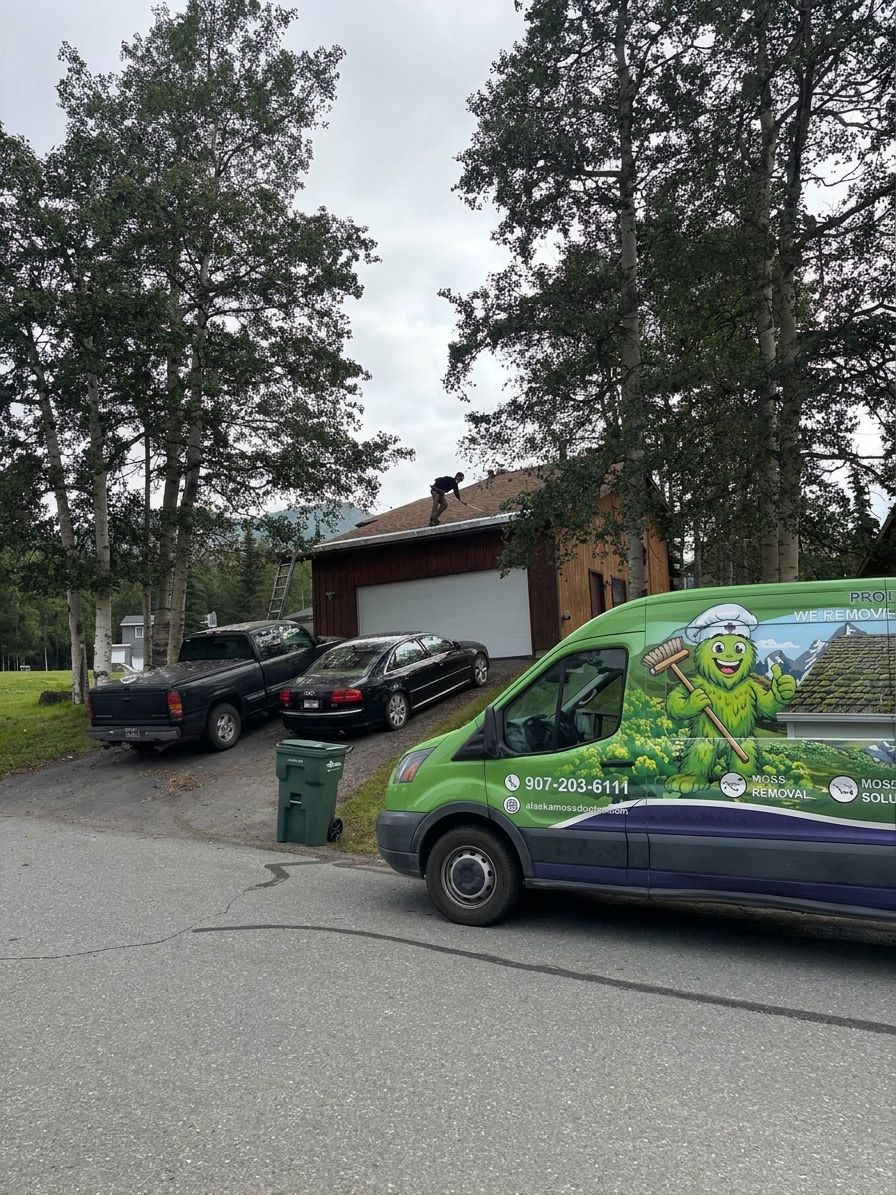
Gutter guard installation for Mat-Su Valley homes covers the mesh, screen, and reverse-curve covers homeowners fit over gutters to block spruce needles, birch leaf litter, and roof moss debris from clogging runoff during the region's long freeze-thaw season. Mat-Su Valley homes face a narrower window than most of the Lower 48: heavy conifer cover, wet spring melt, and roofs that already carry moss growth mean guards here work differently than guards in a dry, deciduous-only climate.
- Micro-mesh guards outlast standard screens on spruce-heavy Mat-Su lots; screens clog with needles within one season.
- Alaska Moss Doctor doesn't install guards, but its gutter and roof cleaning keep guard-topped runoff clear year-round.
- Clean gutters and strip roof moss before installing any guard; guards over dirty channels just trap the mess.
- Reverse-curve guards handle heavy Southcentral snow load better than flat mesh on steep Mat-Su roof pitches.
- No guard stops all debris — budget one mid-season gutter check even after installation in 2026.
Why gutter guard installation matters for Mat-Su Valley homeowners
Spruce needles and birch leaves fall onto Wasilla and Palmer-area roofs almost year-round, and once they mix with roof moss, they form a mat that holds water against the fascia through freeze-thaw cycles. That combination is why gutter cleaning for moss-prone roofs is a recurring search for homeowners here, not a one-time fix.
A gutter guard doesn't remove moss already growing on your shingles or shakes — it only manages what falls into the trough below. Skip that distinction and you'll install a guard system over a roof that keeps shedding moss clumps onto it anyway.
Ice is the second variable most guard manufacturers don't design for. Southcentral Alaska's freeze-thaw pattern from October through April means water backs up under snowpack, and a guard installed with the wrong slope can make ice dams worse instead of better. Reading up on how to prevent ice dams after roof moss removal before you commit to a guard style saves a callback in January.
The verdict: gutter guard installation makes sense for Mat-Su Valley homes with heavy tree cover, but only after the roof and gutters are already clean — guards are a maintenance reducer, not a substitute for moss removal.
Inspect your gutters and roofline before you buy anything
Walk the roofline first. A five-minute inspection tells you whether you're dealing with a needle problem, a moss problem, or both, and that changes which guard style makes sense.
- Check for standing water or sagging sections along the gutter run
- Look for moss clumps sitting in the trough, not just on the shingles
- Note which sides of the roof face north or stay shaded most of the day
- Check fascia boards for soft spots or water staining
- Measure roof pitch — steep pitches shed debris faster and need different guard profiles
Clear existing debris and roof moss first
Installing a guard over a gutter packed with needles and moss just locks the clog in place. Clean the channel down to bare metal or vinyl before any guard goes on.
- Scoop out standing debris by hand or with a gutter scoop
- Flush the run with a hose to confirm water reaches the downspout
- Remove any moss clumps sitting on the roof edge above the gutter line
- Check downspouts for blockages separately from the gutter run itself
- Photograph problem areas so you can compare after guard installation
Match guard type to your tree cover and roof pitch
Not every guard handles Mat-Su Valley debris the same way. Homes surrounded by black spruce need a tighter mesh than homes with mostly birch and cottonwood overhead.
- Micro-mesh guards for heavy needle drop and fine debris
- Reverse-curve (surface tension) guards for steep pitches and heavy snow load
- Foam inserts for budget jobs on low-slope, low-tree-cover homes
- Brush inserts for gutters that see mostly leaves, not needles
- Standard screen guards only for homes with light debris and minimal moss history
Address roof moss before covering the gutters
If your roof already shows dark green or black patches, that moss will keep shedding into the gutter regardless of the guard installed below it. Homeowners researching roof moss removal for Wasilla, Alaska homeowners typically find this out after a guard clogs within a few months of installation.
- Schedule roof moss removal before guard installation, not after
- Ask the installer whether guard warranties require a clean roof surface
- Note any granule loss on asphalt shingles during the moss check
- Flag areas where moss overhangs the gutter line directly
Install with slope and snow load in mind
Most DIY guard failures in the Mat-Su Valley trace back to slope, not the guard material itself. A guard installed flat instead of angled toward the downspout backs up water fast once snow starts compacting on top of it.
- Confirm a consistent downward slope toward each downspout
- Use fasteners rated for the local freeze-thaw cycle, not standard aluminum clips
- Avoid guard systems with exposed seams on the uphill side of steep roofs
- Test water flow with a hose before the first snowfall
Schedule a mid-winter and post-thaw check anyway
Guards reduce cleaning frequency — they don't eliminate it. Pollen, grit, and small needle fragments still pass through even fine mesh over a full Alaska winter.
- Check gutters after the first hard freeze in late fall
- Check again after spring breakup once snowpack clears
- Look specifically for ice buildup at the guard's leading edge
- Confirm downspouts drain freely once the ground thaws
Watch for ice dam warning signs after installation
A guard that traps snowmelt at the roof edge instead of channeling it away is a bigger problem than the clog it was meant to prevent.
- Icicles forming directly under the guard line, not just off the eave
- Water staining on interior ceilings near exterior walls
- Visible ice ridges building up on top of the guard itself
- Gutters pulling away from the fascia under ice weight
Gutter guard options for Mat-Su Valley homes
| Guard Type | Best For | Key Limitation |
|---|---|---|
| Micro-mesh | Heavy spruce needle drop | Needs cleaning of fine grit twice a year |
| Reverse-curve / surface tension | Steep pitches, heavy snow load | Higher installation precision required |
| Foam insert | Low-slope roofs, light tree cover | Can compress and lose effectiveness over time |
| Brush insert | Leaf-heavy lots (birch, cottonwood) | Less effective against fine needles |
| Standard screen | Light debris, minimal moss history | Clogs with needles within a season in spruce areas |
| Professional gutter cleaning, no guards | Homes with moderate debris and easy roof access | Requires recurring service instead of a one-time install |
Best for spruce-heavy Mat-Su lots: micro-mesh or reverse-curve guards. Skip standard screens if black spruce overhangs the roofline.
Common mistakes Mat-Su Valley homeowners make
- Installing standard screen guards over spruce-heavy roofs — needles pack the mesh solid by the second season, and the clog sits above the gutter where it's easy to miss.
- Skipping roof moss treatment before guard installation — moss mats keep sliding off the shingle edge into the trough no matter what guard sits below it.
- Choosing guards rated for milder climates — a product spec sheet written for a temperate market doesn't account for Southcentral Alaska's freeze-thaw cycle or snow load.
- Assuming guards mean zero gutter maintenance — pollen and fine grit still pass through micro-mesh over a full winter and need flushing each spring.
- DIY installation on steep or icy roofs between November and March — the same conditions that make winter roof work risky for moss removal apply directly to guard installation.
“A gutter guard installed over an unclean roof just moves the clog from the trough to the surface — you still have to deal with it.”
Alaska Moss Doctor doesn't install gutter guards, but its roof and gutter cleaning work is what keeps a guard system from clogging in the first place. If your roof already shows moss or your gutters haven't been cleared this year, that's the step that comes before any guard purchase in 2026.
Clear moss before you install guards
Roof and gutter cleaning for Wasilla-area homes ahead of guard installation.
FAQ
What's the best gutter guard for Mat-Su Valley homes?
Micro-mesh or reverse-curve guards work best for Mat-Su Valley homes with heavy spruce or birch cover, because they resist needle clogging and handle steep-pitch snow load better than standard screens. Standard screens are only a fit for homes with light debris and no moss history.
Do gutter guards stop roof moss?
No, gutter guards only manage debris falling into the gutter channel, not moss growing on the shingles or shakes above it. Roof moss still needs separate removal, or it keeps shedding onto the guard and rebuilding the clog it was meant to prevent.
How much snow load can gutter guards handle?
Snow load tolerance depends on the guard style, not a fixed number — reverse-curve and surface-tension guards generally handle heavier Southcentral Alaska snowpack better than flat foam or standard screen guards. Check the manufacturer's climate rating before buying, since many products are engineered for milder markets.
Is gutter guard installation worth it in Wasilla, Alaska?
Gutter guard installation is worth it for Wasilla-area homes with heavy tree cover and a history of clogged gutters, since it reduces how often the gutters need manual clearing. It's a poor investment on a roof that still has active moss growth, since the moss will keep shedding into the gutter regardless.
How often do gutters need cleaning even with guards installed?
Plan on checking gutters twice a year even with guards installed — once after the first hard freeze and once after spring breakup. Fine grit, pollen, and small needle fragments still pass through most mesh systems over a full Alaska winter.
Can Alaska Moss Doctor install gutter guards?
Alaska Moss Doctor focuses on roof and exterior moss and algae cleaning rather than gutter guard installation. Its cleaning work is typically the step homeowners take right before installing guards, since a clean roof and gutter system is what keeps a new guard from clogging immediately.
Do gutter guards cause ice dams?
A gutter guard installed with the wrong slope can worsen ice dam risk by trapping snowmelt at the roof edge instead of channeling it into the downspout. Icicles forming directly under the guard line, rather than off the eave, are the first warning sign.
What's the best time of year to install gutter guards in the Mat-Su Valley?
Late summer through early fall, before the first hard freeze, is the best window for gutter guard installation in the Mat-Su Valley. That timing gives you a chance to clear debris and address any roof moss before snow load becomes a factor.
One last thing
The biggest guard failure in the Mat-Su Valley isn't a clog you can see — it's the one hidden under the guard's leading edge that you only find after fascia rot shows up. Pair any guard installation with an annual roof moss check, not just a gutter check, since the two problems feed each other in this climate.