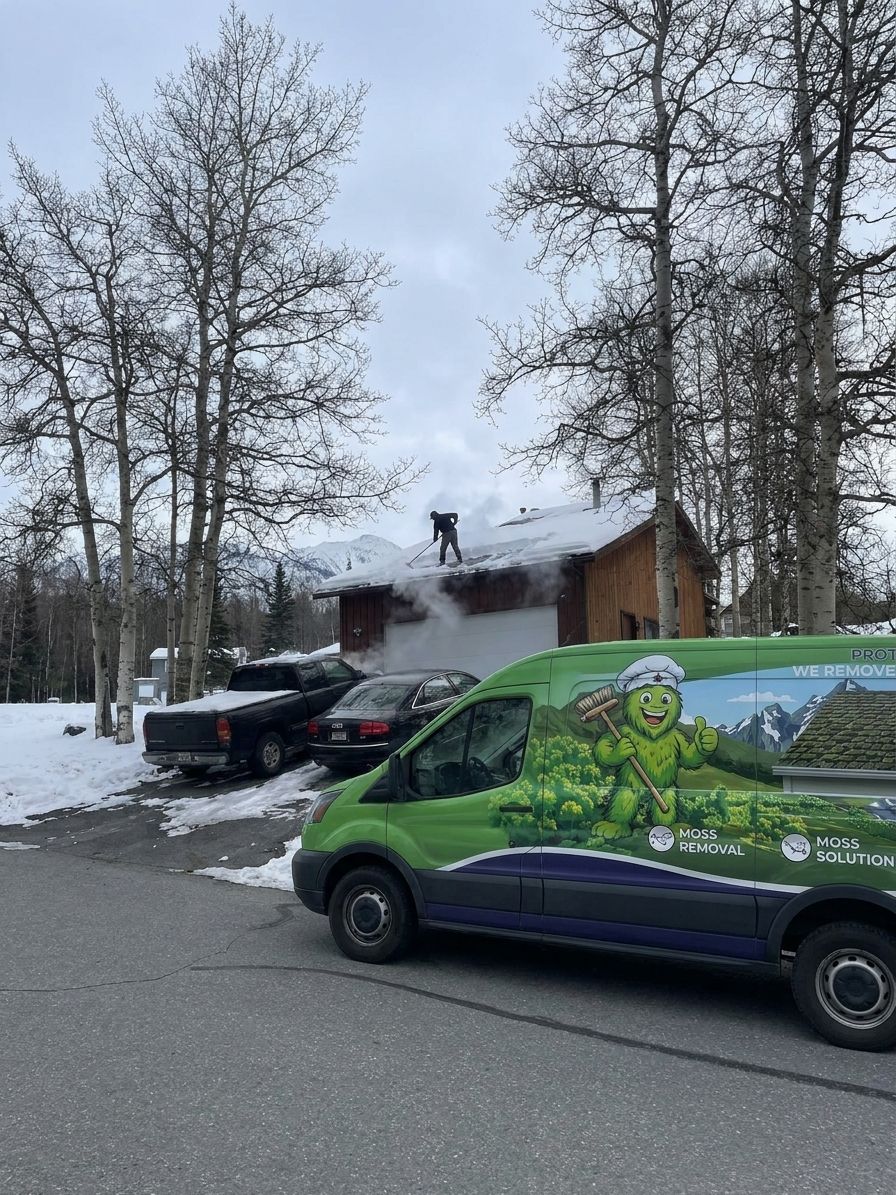
Ice dams form when heat escapes into the attic, melts snow on the upper roof, and that runoff refreezes the moment it hits a cold, unheated eave — moss removal doesn't cause that cycle, but a freshly cleaned roof shows you every clogged gutter and blocked drainage channel that used to hide under the debris. Fix those exposed problems before the first hard freeze of the 2026-2027 season and you cut your ice dam risk more than any single treatment applied after the fact. Skip the gutter and attic work and a clean roof ices over exactly the same way a mossy one did.
- Clear gutters and downspouts right after roof moss removal — blocked flow is the top ice dam trigger in Wasilla winters.
- Bring attic insulation to R-49 or higher and seal air leaks so the roof deck stays uniformly cold.
- Extend ice and water shield membrane at least 3 feet past the eave before the first snow lands.
- Alaska Moss Doctor's cleaning process exposes clogged drainage points moss was hiding — fix them in fall, not spring.
- Heat cables are a backup fix for known trouble spots, not a substitute for insulation and ventilation.
Why this matters
Moss holds moisture against shingles and blocks gutters, so homeowners often assume removing it solves their winter water problems too. It doesn't — moss is a symptom of a shaded, damp roof, while ice dams are a heat-loss and drainage problem underneath the shingles. Roof moss removal for Wasilla, Alaska homeowners gets rid of the growth that traps water, but the gutters, vents, and attic insulation still need their own attention before winter 2026 sets in.
Homeowners who schedule a cleaning in fall and skip the follow-up drainage check are the ones who call about ice dams in January. The cleaning is the easy part — inspecting what it revealed is the part that actually prevents damage.
How to prevent ice dams after roof moss removal
Work through these steps in order, ideally within a week or two of the cleaning while the roof surface is fully exposed:
- Flush every gutter and downspout. Moss sheds granules and debris during removal — confirm nothing settled at the downspout elbows before winter.
- Check flashing and roof penetrations. Moss growth often hides lifted flashing around vents and chimneys; a cleaned roof makes gaps easy to spot.
- Measure attic insulation depth. Alaska's climate zone 7 calls for attic insulation around R-49; thin or compressed insulation lets heat escape and melt snow unevenly.
- Seal attic air leaks. Recessed lights, bathroom fan housings, and attic hatches leak warm air straight into the roof deck — foam or caulk these before the snow flies.
- Confirm soffit and ridge ventilation is clear. Blocked soffit vents starve the attic of the cold outside air it needs to stay uniform in temperature.
- Add or verify ice and water shield at the eaves. Code-standard coverage extends at least 24 inches past the interior wall line, with 3 feet of eave protection in snow-load regions like the Mat-Su Valley.
Gutter clearing and downspout flow
Gutters clogged with moss debris, needles, and granules are the single most common ice dam trigger after a roof cleaning, because the meltwater has nowhere to go except back up under the shingles. Walk the gutter line after any cleaning and confirm water moves freely to the downspout — a garden hose test works fine outside of freezing temperatures. How to protect gutters during roof moss removal covers what to check immediately after a job, and the recommended gutter cleaning schedule for moss-heavy homes tells you how often to repeat it going forward.
Verdict: clean gutters twice a year on a moss-prone roof, once in early fall right before freeze and once in spring after runoff — Skip this and every other fix underperforms.
Attic insulation and ventilation checks
Ice dams are fundamentally a heat-loss problem. If the attic floor holds heat in around R-30 or less, the roof deck above it warms unevenly and melts snow at the ridge while the eaves stay frozen — that's the exact setup that grows an ice dam. Bringing insulation to the R-49 level recommended for Alaska's climate zone, combined with sealing bypasses around lights and vent stacks, keeps the whole roof deck close to outdoor air temperature so snow melts (or doesn't) uniformly.
Ventilation matters as much as insulation. Blocked soffit vents force warm, moist attic air to escape through the roof deck instead of the ridge vent, which speeds up ice dam formation even on a well-insulated attic. Buy: a $200-range attic inspection from an insulation contractor before winter if you've never checked depth — Wait: on full re-insulation if depth already reads R-49 or better.
Roof heat cables and ice/water shield
Heat cables run along the eave and through gutters, using electric resistance to melt a channel for water to escape even when an ice dam has already formed. They work as a targeted fix for a roof's known trouble spots — a north-facing valley, a low-slope section over an addition — but they draw continuous power through the coldest months and don't address the heat-loss cause.
Ice and water shield membrane, installed under the shingles at the eave during a re-roof or repair, is the more permanent layer of protection. Code minimums call for the membrane to extend from the eave edge to at least 24 inches past the interior wall line, with heavier snow-load areas often running the coverage out to 3 feet or more. Buy: heat cables for one or two chronic trouble spots — Skip: relying on cables as a whole-roof fix when insulation and ventilation are the real gap.
Why ice dams vary from roof to roof
- Roof pitch — low-slope sections hold snow longer and give meltwater more time to refreeze at the edge.
- Attic insulation depth — thinner insulation lets more heat escape into the roof deck.
- Shade and sun exposure — north-facing slopes stay colder and melt unevenly compared to sun-exposed sections.
- Gutter and downspout condition — clogged systems back water up under the shingle line instead of draining it away.
- Roof age and flashing condition — older flashing around vents and chimneys gives meltwater more entry points.
- Ventilation balance — soffit intake without matching ridge exhaust traps warm air against the roof deck.
Get your roof checked before winter
See what your moss cleaning exposed before the first freeze hits.
Related questions
Does moss removal cause ice dams?
Moss removal does not cause ice dams — ice dams come from attic heat loss and blocked drainage, not from cleaning the shingles. A cleaning does expose clogged gutters and lifted flashing that moss was hiding, which is exactly why fall 2026 cleanings should be followed by a quick drainage check.
How soon after roof cleaning should I check for ice dams?
Check gutter flow and attic insulation within one to two weeks of a fall cleaning, before overnight temperatures drop consistently below freezing. Waiting until after the first snowfall means you're inspecting a roof you can't see clearly anymore.
Do heat cables stop ice dams for good?
Heat cables stop water from backing up at a specific trouble spot but don't stop ice dams from forming — they manage the symptom, not the heat-loss cause. Pair them with attic insulation and ventilation fixes for a permanent reduction, not just a targeted patch.
FAQ
How do I prevent ice dams after roof moss removal?
Prevent ice dams after roof moss removal by clearing gutters and downspouts, sealing attic air leaks, and bringing insulation up to around R-49 for Alaska's climate zone. Check ice and water shield coverage at the eaves too, since a cleaned roof makes gaps in that membrane easy to spot.
Is roof moss removal the same as ice dam prevention?
No, roof moss removal and ice dam prevention are different jobs that happen to overlap on the same roof. Moss removal clears growth and debris; ice dam prevention deals with attic heat loss, ventilation, and drainage.
What causes ice dams on a clean roof?
Ice dams on a clean roof come from uneven roof deck temperature, usually from thin attic insulation or blocked ventilation, not from moss or debris. Heat escaping into the attic melts snow at the upper roof, and that water refreezes at the colder eave.
How much attic insulation do I need to stop ice dams in Alaska?
Alaska's climate zone 7 calls for attic insulation around R-49 to keep the roof deck at a uniform temperature. Less than that, especially compressed or unevenly distributed insulation, is a common driver of ice dams even on well-maintained roofs.
Should I install heat cables or fix attic insulation first?
Fix attic insulation and ventilation first, then add heat cables only for chronic trouble spots that persist afterward. Heat cables manage a symptom at one location; insulation and ventilation address the whole roof.
When should I schedule roof moss removal to avoid winter ice dam problems?
Schedule roof moss removal in late summer or early fall, well before overnight freezes start in the Mat-Su Valley, so you have time to inspect and fix drainage issues the cleaning reveals. Waiting until winter means working around snow and ice instead of ahead of it.
Does gutter cleaning help prevent ice dams?
Gutter cleaning helps prevent ice dams because blocked gutters and downspouts are one of the most common places meltwater backs up under shingles. Clear gutters twice a year on a moss-prone roof, once in fall and once in spring.
One last thing
Most ice dam calls in the Mat-Su Valley trace back to a gutter that was clogged before the snow ever fell, not to a roof that lacked treatment. Alaska Moss Doctor's cleaning process clears that debris as a side effect of removing moss, which means the best time to check your drainage is the same week the crew leaves — not after the first cold snap of 2026 exposes the gap for you.