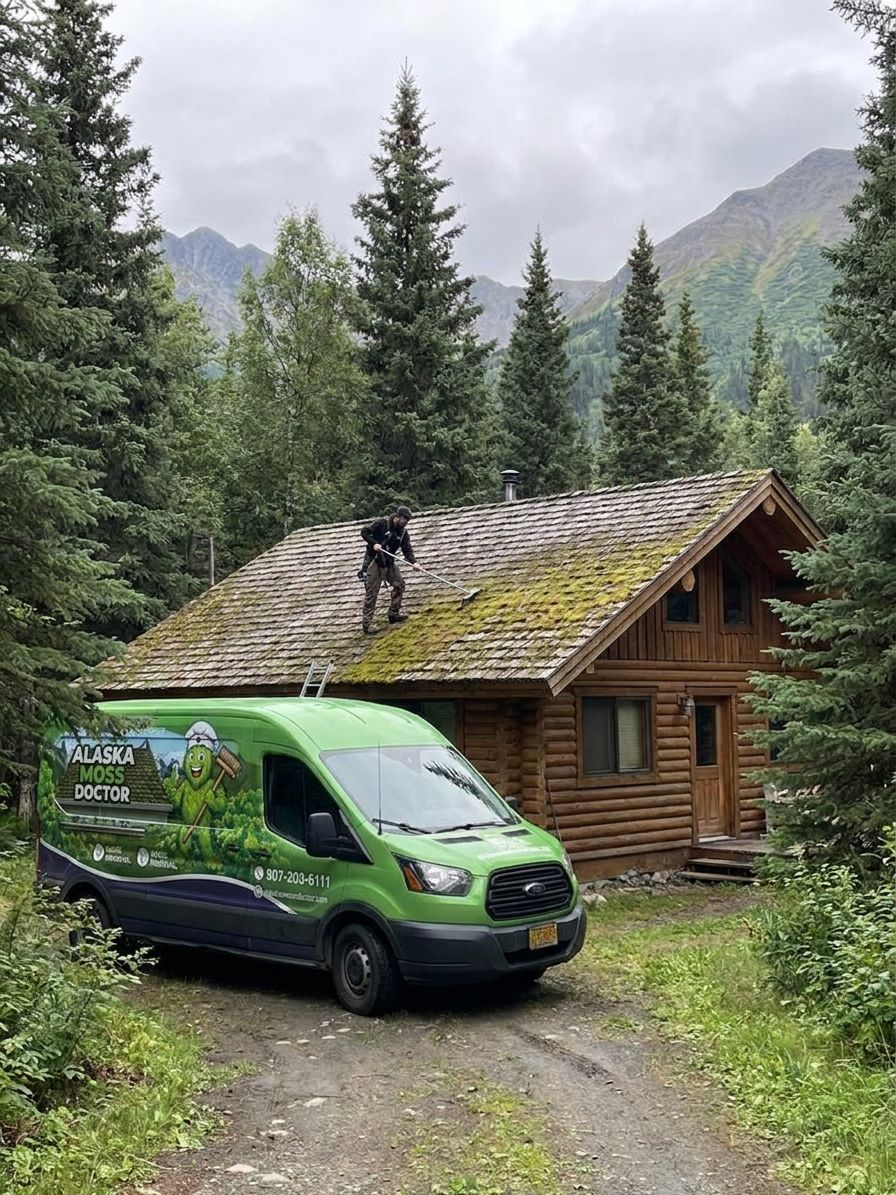
Roof cleaning service for remote Alaska cabins is professional moss and algae removal scheduled around limited road access, short weather windows, and the heavier moisture load off-grid properties carry compared to a house on a maintained street. A cabin buried in spruce shade with no plowed driveway needs a different playbook than a subdivision roof in Wasilla.
- Roof cleaning remote Alaska cabin jobs need scheduling around breakup mud season and snowmachine-only access windows.
- Soft washing is the safe method for cedar shake and log cabin roofs; pressure washing strips granules and shake surfaces.
- Alaska Moss Doctor books cabin jobs around the same dry-season window that governs Wasilla-area roof cleaning.
- Moss left on a north-facing cabin roof past one season traps moisture against the deck and accelerates rot.
- Steep-pitch cabin roofs above 8/12 require anchor points and rope access, not a ladder and a garden hose.
Why this matters
A remote cabin roof holds moisture longer than a roof in town because there's usually more shade, less airflow, and no gutter maintenance between visits. Moss on asphalt shingles rated for 20-30 years of service can cut that lifespan hard if it sits through two or three Alaska winters untouched. The owner isn't there weekly to check for a soft spot or a black streak line creeping down from the ridge, so damage compounds between visits.
Cabins built from log or cedar shake carry an extra risk: bleach-based cleaners and high-pressure rinsing lift the natural oils out of the wood and leave it gray and brittle. Algae removal for log cabin homes requires a lower-pressure, chemical-matched approach that a standard house-washing crew doesn't always stock in the truck.
Why roof cleaning matters for remote cabin owners
Most remote cabin owners aren't googling roof cleaning because of curb appeal. They're googling it because a listing photo showed black streaks, a neighbor mentioned moss voiding a roof warranty, or a spring visit revealed standing moisture on the north slope. The search intent behind roof cleaning remote alaska cabin skews toward damage prevention and access logistics, not price shopping.
That changes what matters in a quote: road condition in the last two weeks, whether the crew hauls its own water, and whether the roof pitch requires rope work. A cabin quote that ignores those three questions isn't built for this segment.
Check access before you schedule anything
Remote cabins lose their scheduling flexibility to the road, not the calendar. Confirm this before calling anyone.
- Note whether the access road is maintained year-round or seasonal only
- Flag any sections that wash out or turn to mud during spring breakup, typically March through May in the Mat-Su area
- Confirm whether a water source exists on-site or the crew needs to haul its own
- Check for locked gates, bear activity closures, or private easement rules that need advance notice
- Ask if the driveway supports a work truck or if equipment has to be carried in
Inspect the roof from the ground first
Before paying for a truck roll, look at what you can see without climbing anything.
- Scan for green or black patches concentrated on the north or shaded slope
- Look for moss cushions thick enough to hold visible standing water after rain
- Check valleys and the base of the chimney flashing for buildup
- Note any shingle granules collecting in the gutter line or on the ground below downspouts
- Photograph anything that looks like a soft spot or a sag in the roof deck
If what you see matches the signs in how to tell if your roof needs moss removal, the manual option below still applies for light cases, but a heavier mat calls for a professional soft wash.
Time the job around Alaska's dry window
Moss removal timing matters more for cabins than town houses because a missed window means waiting a full year, not a few weeks.
- Target late spring through early fall once ground access firms up
- Avoid scheduling during active freeze-thaw cycles, when a wet roof near 32°F refreezes and turns slick
- Book before the first hard frost so treatment has time to work before winter locks the roof under snow
- Check whether the crew tracks the best time of year for roof moss removal in Alaska rather than just taking any open slot
- Build in a buffer week in case a breakup closure delays the crew
Choose a cleaning method that matches your roof material
A cabin roof is rarely standard asphalt shingle. Method choice has to follow material, not habit.
- Soft wash (low pressure, chemical treatment) for asphalt shingle and cedar shake
- Hand-scraping combined with soft wash for heavy moss cushions on log cabin roofs
- Manual rinse-only for light dust-level growth on metal roofing
- Skip high-pressure washing entirely on cedar shake, log siding, or aged asphalt
- Confirm the crew uses a solution rated for the specific stain, since black streak algae and green moss respond to different treatments
This is the point where a DIY hose-and-brush approach on a single-story, easy-access cabin can work fine for light growth. Once the roof is steep, shaded, or coated in a thick moss mat, a professional crew like Alaska Moss Doctor becomes the faster and safer route because they carry the right chemical concentration and the harness gear a ladder job can't replace.
Protect gutters and the ground below during cleanup
Cabin gutters clog faster than town gutters because there's no fall cleanup crew swinging by every October.
- Cover or seal downspouts before treatment runs into them
- Check that gutters aren't already packed with needles and moss debris before rinsing starts
- Confirm runoff won't pool against the foundation or a nearby well
- Ask whether landscaping or a garden bed under the drip line needs covering first
- Flag any retaining wall or walkway nearby that could pick up green staining from runoff
Schedule around winter cutoff dates
Alaska winters end the cleaning season hard, and a remote cabin can't just squeeze in one more weekend once the road freezes.
- Confirm the crew's last available date before snow load season starts
- Ask how they schedule roof cleaning around Alaska winters for cabins with seasonal-only road access
- Build in a fallback date in case an early snowfall closes the road
- Avoid booking the absolute last slot of the season with no buffer
- Ask whether a partial job (roof only, no gutters) is available if time runs short
Plan for steep-pitch or hard-to-reach roofs
A lot of Alaska cabin roofs are built steep on purpose to shed snow load, which changes the labor completely.
- Confirm the crew has rope-and-harness certification for steep-pitch roof moss removal
- Ask whether anchor points are installed on the structure or brought in
- Check if a lift or extended ladder system is needed for a two-story cabin on a slope
- Confirm insurance coverage for rope-access work specifically, not just general liability
- Ask how weather delays (wind, rain) affect a rope job differently than a ladder job
Get a cabin roof assessed before the road closes
Alaska Moss Doctor books remote Wasilla-area cabin jobs around access and weather windows.
Comparing cleaning options for remote cabin owners
| Option | Best for | Key limitation |
|---|---|---|
| DIY hose rinse | Light dust-level moss on single-story, easy-access cabins | Doesn't kill root structure; unsafe on wet or steep roofs |
| High-pressure washing | Not recommended for any cabin roof material | Strips granules, damages cedar shake and log finishes |
| Professional soft wash (Alaska Moss Doctor) | Steep-pitch, log cabin, cedar shake, or heavy-shade roofs | Requires advance scheduling around road and weather access |
| Waiting another season | Cabins with minimal growth and reliable road access | Moss compounds moisture damage each winter it's left |
Verdict: for anything beyond light surface dust, a professional soft wash from a crew that already understands remote-access scheduling, like Alaska Moss Doctor, beats a DIY attempt on a steep or shaded cabin roof.
Common mistakes remote cabin owners make
- Booking around the calendar instead of the road. A date that works on paper falls apart when breakup mud closes the last mile.
- Using a pressure washer on cedar shake or log siding. It strips the natural oil layer and leaves wood gray and porous within one season.
- Ignoring clogged gutters because no one's there weekly. A packed gutter backs water under the shingle edge and feeds ice dams once temperatures drop below 32°F.
- Treating moss removal as a one-time fix. Shaded roofs regrow moss within a year without a follow-up plan.
- Skipping the pitch conversation with the crew. A quote based on a photo, without confirming rope-access needs on an 8/12 or steeper roof, gets revised on-site and delays the job.
FAQ
How much does roof cleaning cost for a remote Alaska cabin?
Cost depends on roof size, pitch, access difficulty, and whether the crew has to haul water. Check current rates directly with a provider like Alaska Moss Doctor for an accurate quote based on the specific property.
Is soft washing safe for a log cabin roof?
Soft washing is safer than pressure washing for log cabin roofs because it uses low water pressure and a chemical treatment instead of force. High pressure strips the natural oils out of log and cedar shake surfaces.
What's the best time of year to clean moss off a cabin roof in Alaska?
Late spring through early fall, once ground access firms up after breakup and before the first hard frost, gives treatment time to work before winter. Scheduling around road conditions matters as much as the calendar for remote cabins.
Can I clean moss off my own cabin roof?
A light, dust-level moss layer on a single-story, easy-access roof can be handled with a manual rinse. Heavier moss mats, steep pitches, or shaded roofs are safer left to a crew with soft wash equipment and rope access gear.
Does moss on a roof void a warranty?
Some asphalt shingle manufacturers list moss and algae damage as an exclusion in their warranty terms. Check the specific warranty document for the roofing product installed on the cabin.
How often does a shaded cabin roof need moss removal?
Roofs in heavy shade regrow moss faster than roofs in open sun and often need attention every one to two years. A roof with little shade and good airflow can go longer between cleanings.
What roof pitch requires professional rope access instead of a ladder?
Roofs pitched steeper than roughly 8/12 typically require harness and anchor point equipment rather than a standard ladder setup. Confirm this with the crew before scheduling if the cabin roof looks steep from the ground.
One last thing
The detail most cabin owners miss: moss doesn't just sit on the shingle surface, it holds moisture against the roof deck underneath, which is where rot actually starts. By the time a soft spot shows up from inside the cabin, the moss has usually been doing damage for more than one season. Checking the north-facing slope every time you visit, even a quick look from the ground, catches the problem before it reaches the deck.