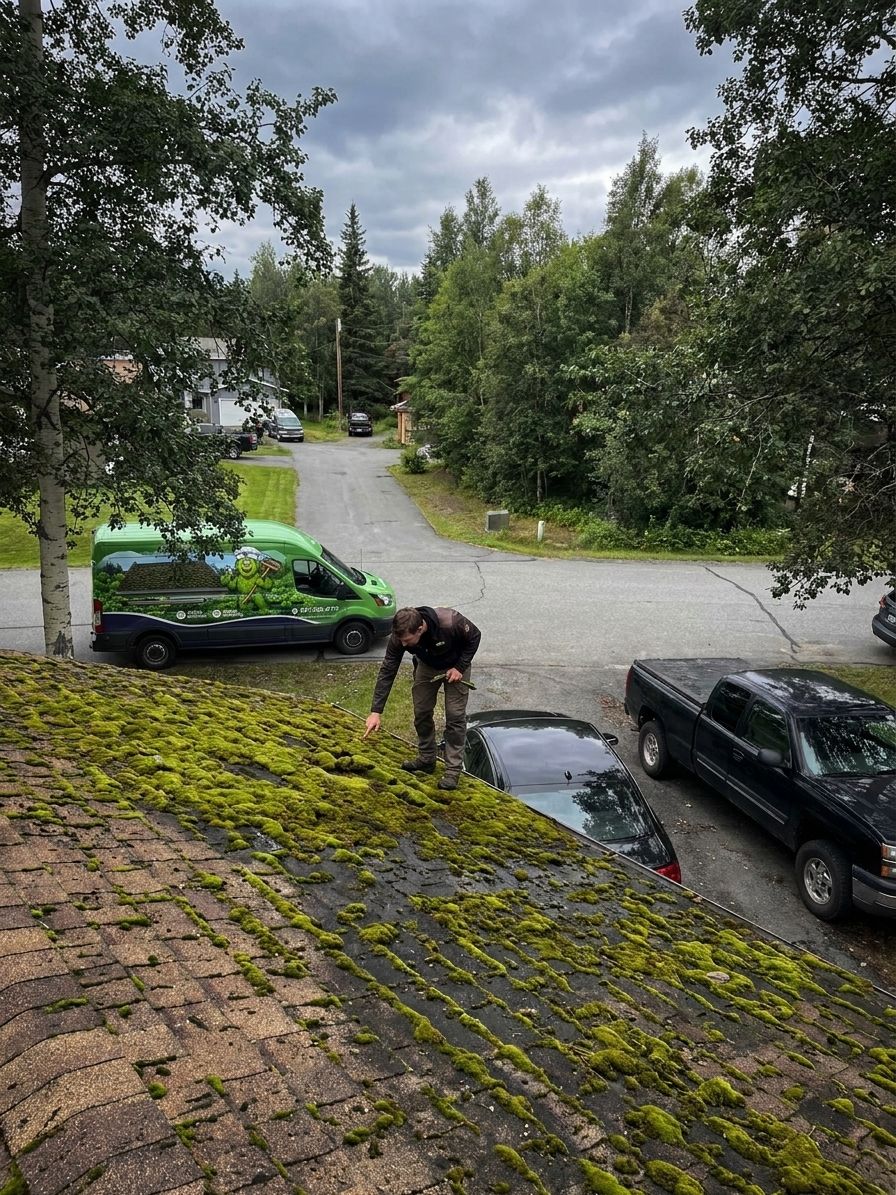
A moss-covered roof in Wasilla doesn't always look dramatic before it starts costing you money — the damage usually starts under the surface, weeks before you notice the green tint from the driveway. This guide walks through the exact signs that tell you a roof needs moss removal now versus one that can wait until next season.
- Dark streaking plus raised shingle edges means moss has already worked into the granule layer — schedule removal within 30 days.
- Green patches on north-facing slopes in Wasilla, Alaska show up first because those sections stay shaded and wet longest.
- Soft or spongy roof sections during a walk-through are a moisture-retention warning sign, not just a cosmetic moss problem.
- Alaska Moss Doctor recommends checking gutters and valleys first — that's where moss spores collect and spread fastest.
Why this matters
Moss isn't just a cosmetic problem on an asphalt shingle roof. It holds moisture against the shingle surface long after rain or snowmelt has cleared everywhere else, and that trapped moisture accelerates granule loss, which is what actually protects the shingle from UV breakdown.
A shingle roof rated for 20 to 25 years of service can lose years off that lifespan when moss sits uncleared through multiple freeze-thaw cycles. In Southcentral Alaska, where snow load sits on shaded roof sections for months, that cycle repeats every winter. Alaska Moss Doctor sees the same pattern across Wasilla neighborhoods: moss that looks minor in September has usually doubled in coverage by the following spring thaw.
Catching the signs early means a soft wash treatment. Catching them late means shingle replacement. That's the entire cost difference this guide is built around.
What you'll need
- A ladder rated for roof-edge inspection, or binoculars if you're not comfortable climbing
- A flashlight for checking attic-side moisture staining
- A garden hose (for a simple runoff test, not for cleaning)
- A notepad or phone camera to document affected areas by roof section
- 20-30 minutes for a full perimeter walk-around
If you find active growth, do not reach for a pressure washer. High-pressure spray strips granules along with the moss, which is the fastest way to turn a $400 cleaning job into a $9,000 roof replacement. The safer approach is outlined in Alaska Moss Doctor's guide on removing moss without damaging shingles.
The steps
1. Check the north-facing and shaded slopes first
Moss needs consistent moisture and low sunlight to establish, so it colonizes north-facing roof planes and any section shaded by trees before it touches the rest of the roof. Standing on the ground and looking at these sections with binoculars usually reveals the first sign: a dull green or gray-green tint that looks almost like dirt at a glance. This matters because these early-stage patches are the cheapest and fastest to remove.
Common mistake: Homeowners scan the whole roof evenly and miss the shaded corner because it's not visible from the front yard. Walk the full perimeter of the house, not just the street-facing side.
2. Look for raised or lifted shingle edges
Moss doesn't just sit on top of shingles — its rhizoids work down into the tab seams and granule surface, physically lifting the shingle edge over time. Run your eye along shingle rows looking for a shadow line under the tab that shouldn't be there. This is the point where moss has moved from a cosmetic problem to a structural one, because lifted edges let wind-driven rain underneath.
Common mistake: Assuming lifted edges are just normal shingle aging. Aging shingles curl evenly across a whole section; moss-lifted edges show up in patches that match the green growth pattern.
3. Check gutters and valleys for moss debris
Roof valleys and gutter lines trap runoff, leaves, and shed moss fragments, and that debris re-seeds new growth every time it rains. Clear a section of gutter by hand and check for dark, fibrous clumps mixed with granules — that granule loss is coming straight off your shingles. Alaska Moss Doctor pairs this inspection with gutter service specifically because moss-heavy homes need the debris cleared before treatment holds.
Common mistake: Cleaning gutters without checking what's actually in them. The composition of the debris tells you how advanced the moss problem is upstream.
4. Run a simple water test on suspect shingles
Spray a light stream of water from a garden hose (never a pressure washer for this test) onto a moss-affected section and watch how the water behaves. On a healthy shingle, water sheets off within seconds. On a moss-compromised section, water beads, pools, or gets absorbed slower because the granule surface underneath has already thinned.
Common mistake: Testing right after rain, when every surface holds water evenly. Wait for at least a 24-hour dry window before running this test.
5. Check the attic for staining or moisture odor
Go into the attic with a flashlight and look at the underside of the roof deck, focusing on areas below the moss patches you identified outside. Dark staining, a musty smell, or visible dampness on the plywood means moisture has already moved past the shingle layer. This is the clearest sign that moss removal needs to happen this season, not next year.
Common mistake: Only checking the attic once. Moisture intrusion is seasonal — check again after the next heavy rain or spring melt to confirm the pattern.
6. Compare growth against last year's photos
If you photographed the roof last fall or spring, pull those images up and compare coverage. Moss spreads outward from its original colony, and a patch that's grown noticeably wider or darker in 2026 compared to 2025 tells you the growth rate, which determines urgency better than a single snapshot.
Common mistake: Skipping documentation entirely. Without a photo baseline, it's easy to underestimate how fast a small patch became a roof-wide problem.
7. Check the timing against Alaska's seasonal window
Even if you spot every sign above, timing the removal matters as much as catching the problem. Wasilla's wet spring and fall windows are when moss is most active and most removable without risking shingle damage from cold, brittle conditions. Alaska Moss Doctor's seasonal guide breaks down exactly when to schedule based on Southcentral Alaska's weather pattern.
Troubleshooting
The moss looks like it wiped off easily, but it's back in two weeks. You removed surface growth without treating the rhizoids underneath. Surface scraping alone almost never solves the problem — a soft wash treatment designed for shingle roofs addresses the root structure, not just visible growth.
One section keeps growing back faster than the rest of the roof. That section likely has a shade or drainage issue independent of general moss pressure — an overhanging branch, a low spot holding water, or a section with reduced sun exposure most of the day. Removing the moss without addressing the shade source means it returns within a season.
You found moss but no attic staining. This is actually the ideal scenario — it means moisture hasn't breached the shingle layer yet, and a straightforward cleaning treatment now prevents the attic staining problem entirely.
The roof has moss but it's a steep pitch and you can't inspect it safely. Don't climb a steep-pitch roof without fall protection. Steep-pitch roofs need a professional inspection rather than a DIY ladder check.
You're seeing moss on a metal roof, not asphalt shingles. Metal roofing holds moss differently than asphalt — it doesn't lose granules, but seam corrosion and coating breakdown are the equivalent risk, and the inspection approach differs.
The house is about to go on the market and there's visible moss. Buyers and inspectors flag roof moss as a deferred-maintenance red flag during showings, and it's worth resolving before listing rather than negotiating a price reduction over it.
Get a roof moss inspection scheduled
Serving Wasilla, Alaska homeowners with soft wash roof and moss removal.
Tools and resources
- Ladder or binoculars for a ground-level roof scan
- Flashlight for attic moisture checks
- Garden hose for the water-behavior test (not a pressure washer)
- Photo documentation from prior seasons, if available
- A professional soft wash service once moss is confirmed — DIY scraping or pressure washing risks shingle damage that costs more to fix than the moss itself
What to do next
Once you've confirmed moss is present using the checks above, the next move is scheduling removal before the next wet season locks the growth in further. Alaska Moss Doctor's homeowner checklist covers what to ask a roof cleaning company before booking, including questions about pressure settings, chemical treatments, and warranty terms specific to shingle roofs.
FAQ
How do I know if my roof needs moss removal?
Check for dark green or gray-green patches on shaded roof slopes, lifted shingle edges, and moss debris in gutters and valleys. If water beads instead of sheeting off during a light hose test, or you see staining in the attic below the affected area, moss removal is overdue in 2026.
Is moss on a roof actually harmful, or just cosmetic?
Moss is more than cosmetic because it holds moisture against the shingle surface, accelerating granule loss and shortening the roof's usable life. Left untreated through repeated freeze-thaw cycles, moss growth can move from surface discoloration to actual shingle lifting and moisture intrusion.
How much does roof moss removal cost in 2026?
Cost varies by roof size, pitch, and how established the moss growth is, so check current pricing directly with a local provider like Alaska Moss Doctor. Early-stage moss on an accessible roof typically costs far less to treat than growth that's already lifted shingles.
Can I remove roof moss myself with a pressure washer?
No — pressure washing strips granules along with the moss and can void a shingle manufacturer's warranty. A soft wash method using low pressure and a targeted treatment is the standard approach for asphalt shingle roofs in 2026.
How often should a Wasilla, Alaska roof be checked for moss?
Check shaded and north-facing roof sections twice a year, ideally in spring and fall, since Southcentral Alaska's wet seasons are when moss establishes fastest. Homes surrounded by trees or with steep shade coverage may need more frequent checks.
Does moss removal damage shingles?
Improper removal — scraping, pressure washing, or using the wrong chemical treatment — does damage shingles. A soft wash process designed for asphalt shingles removes moss and rhizoids without stripping granules.
What's the best time of year to remove moss from a roof in Alaska?
Late spring through early fall is the safest window because shingles aren't brittle from cold and the growth is active enough to fully treat. Scheduling during Alaska's wet spring or fall shoulder seasons also catches moss before winter snow load compounds the problem.
Does moss on the roof affect a home sale?
Yes — visible roof moss is a common flag during home inspections and can lead buyers to negotiate a lower price or request remediation before closing. Clearing it before listing in 2026 avoids that negotiation entirely.
One last thing
The roof section homeowners skip most often during a DIY check is the valley where two roof planes meet — it holds moisture longest and is where moss establishes before it's visible anywhere else on the roof. If you check one spot before deciding whether to call a professional, check the valleys first.