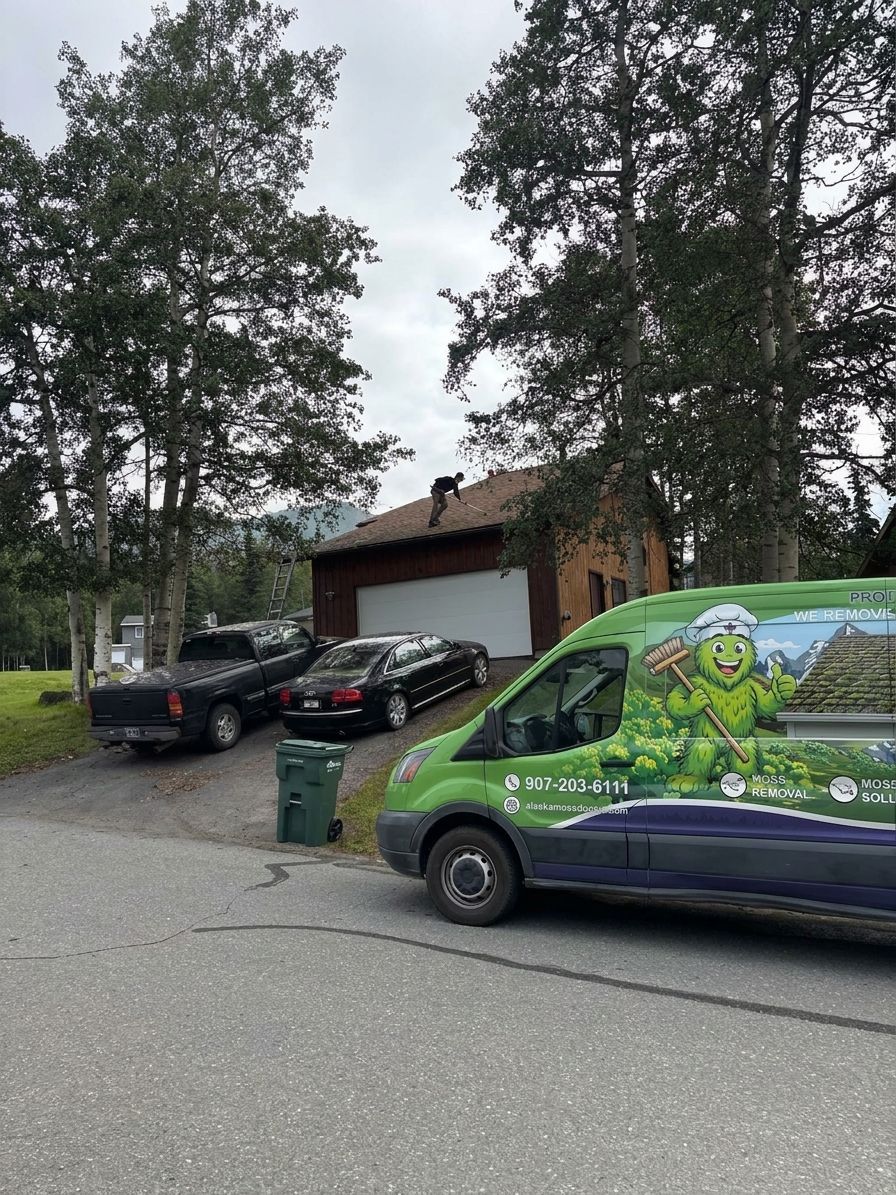
Moss on an asphalt shingle roof lifts the tabs and traps moisture underneath, but going after it with a pressure washer strips granules faster than the moss itself ever would. The best way to remove moss without damaging shingles in 2026 is low-pressure soft washing paired with manual pre-clearing and a repeat schedule — not a gas-powered pressure washer.
- Soft washing under 100 psi is the best way to remove moss without damaging shingles in 2026 — Buy.
- Pressure washing above 100-150 psi strips granules and can void the shingle manufacturer's warranty — Skip.
- Hand-loosening heavy moss mats before rinsing cuts chemical dwell time and protects the shingle mat — Consider.
- Zinc strips slow regrowth for a year or more but do nothing to remove moss that's already there — Consider as a follow-up, not a fix.
Why this matters
A moss mat holds water against the shingle surface long after the rest of the roof has dried. That constant moisture softens the asphalt mat, accelerates granule loss, and works its way under tabs where it rots the decking beneath. The shingle itself usually isn't the weak point — the removal method is.
Pressure washers are built for concrete and siding, not for a granulated asphalt surface. A wand at 2,000-3,000 psi (typical for a consumer gas unit) blasts protective granules off the shingle in seconds, exposing the asphalt mat to UV and rain. Once granules are gone, they don't come back, and the shingle's remaining lifespan drops. Moss removal should extend a roof's life, not shorten it.
How these methods are ranked
Each method below is scored on three things: how much stress it puts on the shingle surface, how well it actually clears moss rather than just killing it, and how much effort or risk it takes on a steep Wasilla roof. Methods that trade a fast result for shingle damage rank low even if they clear moss quickly. Methods that protect the shingle mat and hold up over more than one season rank higher.
The ranked list of moss removal methods
1. Soft washing with a roof-safe cleaning solution — the safe pick
Soft washing runs a sodium hypochlorite or similar roof-rated solution through a low-pressure sprayer, typically held under 100 psi, with a 10-15 minute dwell time before a gentle rinse. The chemical does the work; the water just rinses it off. No granule loss, no lifted tabs, and moss releases its grip on its own instead of being scraped free. This is the method built into soft wash roof cleaning for asphalt shingle roofs, and it's the baseline every other method on this list gets compared against. Verdict: Buy.
2. Manual removal with a soft-bristle brush or plastic scraper — the DIY starting point
For small, isolated moss patches, a soft brush or a plastic (never metal) scraper worked gently from the ridge downward can loosen moss without a chemical step. The key rule: work with the shingle grain, never against it, and never scrub — lift, don't grind. This works fine on light growth but gets risky fast on anything past a few square feet, since repeated scraping wears the granule coat even when done carefully. Verdict: Consider, for spot treatment only.
3. Zinc or copper control strips at the ridge — the long-game pick
Metal strips installed along the ridge release ions that wash down the roof with every rain and slow new moss growth for a year or more. They do nothing for moss that's already established — this is a prevention tool, not a removal method. Pair it with a soft wash and the combination holds up longer than either step alone. Verdict: Consider, as a follow-up after removal, not a substitute for it.
4. High-pressure washing — the one that looks like a shortcut
A pressure washer clears moss visibly fast, which is exactly why homeowners reach for it. The cost shows up later: pressure above 100-150 psi on an asphalt shingle strips the protective granule layer, and once granules are gone the shingle's UV protection is gone with them. Most shingle manufacturers explicitly warn against pressure washing in their care guidance, and doing it can void a warranty claim down the line. Verdict: Skip — this is the method most likely to turn a moss problem into a roof-replacement problem.
5. Chemical moss killer sprays without a rinse step — the wildcard
Over-the-counter moss killers based on sodium hypochlorite or potassium salts kill moss over roughly 2-4 weeks without any pressure at all, which protects the shingle surface completely. The catch: dead moss doesn't fall off the roof by itself. It still needs a gentle rinse or light brushing afterward, and skipping that step just leaves a dead moss mat holding moisture in place. Verdict: Consider, only if you follow through with the rinse.
6. Scheduled professional soft-wash service — the pick for steep or older roofs
Once a roof pitch goes past 6/12, DIY moss removal turns into a fall-risk problem before it's even a shingle-damage problem. A scheduled service that applies the same low-pressure soft-wash approach, timed to Alaska's moss growth cycle, keeps the shingle intact and keeps the homeowner off a wet, mossy roof. This is the approach covered in roof moss removal for steep pitch roofs, and it's the method Alaska Moss Doctor uses on steep and older Wasilla roofs where ladder access alone is a liability. Verdict: Buy for any roof over 6/12 pitch or with moss covering more than a small patch.
“If you can see granules collecting in the gutter after a wash, the pressure was too high.”
Comparison table
| Method | Shingle Risk | Removes Existing Moss | Verdict |
|---|---|---|---|
| Soft washing (under 100 psi) | Low | Yes | Buy |
| Manual scrape/brush | Low-Medium | Yes, small areas | Consider |
| Zinc/copper strips | None | No — prevention only | Consider |
| High-pressure washing | High | Yes, but damages surface | Skip |
| Chemical spray, no rinse | Low | Partial — needs follow-up | Consider |
| Scheduled pro soft-wash service | Low | Yes | Buy |
How to source the job right
- Confirm the crew runs true soft-wash equipment rated under 100 psi — ask directly, because a rental pressure washer with a wide-fan tip can look identical from the ground.
- Local growth patterns matter more than generic advice: freeze-thaw cycles and shaded, north-facing sections change which moss shows up and how fast it returns, which is why roof moss removal for Wasilla, Alaska homeowners treats timing differently than a generic national guide would.
- Bundle gutter clearing with the roof wash. Trapped debris in the gutters holds moisture right at the eave line and feeds the next moss cycle even after a clean roof wash — see gutter cleaning for moss-prone roofs for what that combination looks like in practice.
Get your Wasilla roof assessed
See which removal method fits your shingle type and pitch before moss spreads further.
FAQ
What is the best way to remove moss without damaging shingles?
Low-pressure soft washing, under 100 psi, with a roof-safe cleaning solution and a gentle rinse is the best way to remove moss without damaging shingles in 2026. Pressure washing above 100-150 psi strips granules and shortens shingle life.
Is pressure washing bad for asphalt shingles?
Yes. Pressure above roughly 100-150 psi strips the protective granule coating off asphalt shingles, and most manufacturers warn against it in their care guidance. Once granules are gone, the shingle loses UV protection permanently.
Can I remove roof moss myself?
Small, isolated patches can be handled with a soft brush or plastic scraper worked with the shingle grain. Larger moss coverage or steep pitches over 6/12 are better left to a scheduled soft-wash service because of fall risk and the chance of over-scraping.
How often should moss be removed from a roof in Alaska?
Shaded and north-facing roof sections in areas like Wasilla typically need a fresh soft wash on a repeat schedule since moisture and shade drive regrowth faster than on sun-exposed slopes. A single treatment rarely solves the problem permanently without a follow-up.
Do zinc strips stop moss from coming back?
Zinc and copper strips slow new moss growth for a year or more as metal ions wash down the roof with rain, but they don't remove existing moss. They work best installed right after a soft wash, not as a standalone fix.
How much pressure is safe for a soft wash on shingles?
Soft washing typically runs under 100 psi, relying on the cleaning solution's dwell time rather than water force to lift moss. That's a fraction of the 2,000-3,000 psi a standard gas pressure washer produces.
Is moss removal worth it before selling a house?
Yes — visible roof moss reads as deferred maintenance to buyers and inspectors, even when the shingles underneath are sound. Clearing it before listing avoids a negotiation point during inspection.
What time of year is best for moss removal in Wasilla?
Moss removal works best once the roof has had a stretch of dry weather so the cleaning solution isn't diluted mid-treatment. Scheduling before heavy snow load season also prevents wet moss from adding weight to the roof through winter.
One last thing
Killing moss and removing moss are two different steps — a lot of homeowners stop after the first one. Chemical sprays kill moss in place over a few weeks, but the dead mat still sits on the shingle holding moisture until it's rinsed or brushed off. Skip that second step and the roof looks better for a month, then the same wet mat starts the cycle over.