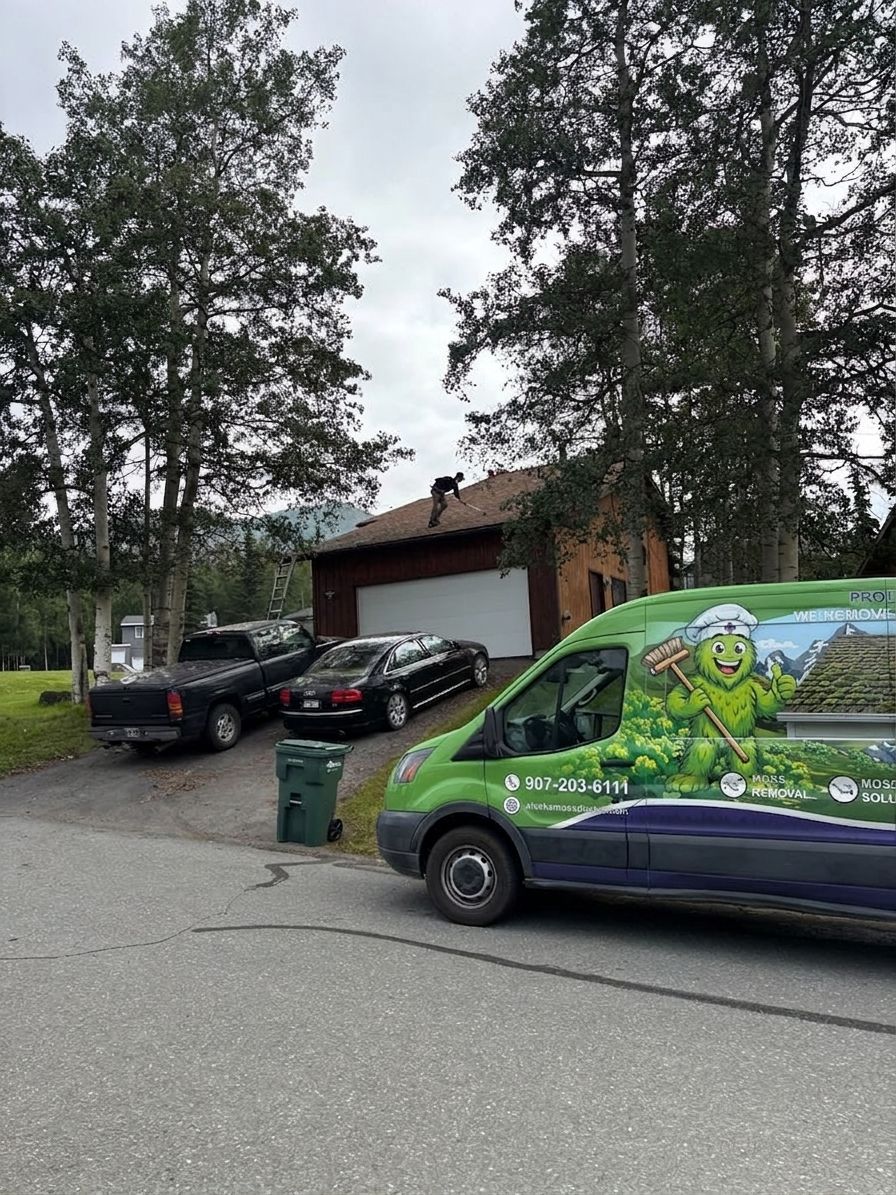
Roof cleaning for insurance compliance in Alaska means documenting and removing moss, algae, and black streak buildup so a homeowner's policy stays active and a claim doesn't get denied over neglect. Wasilla and Mat-Su Valley homeowners face a specific version of this problem: heavy moss growth from damp shoulder seasons that insurers increasingly flag during renewal inspections and storm-damage claims.
- Alaska Moss Doctor documents roof condition before and after cleaning for insurance file records — verdict: get photo documentation with every job, not just a clean roof.
- Soft washing, not pressure washing, is the method insurers and shingle manufacturers accept for roof cleaning insurance compliance in Alaska.
- Moss left untreated traps moisture under shingles and can be cited as deferred maintenance during a claim review.
- Spring and early fall are the workable cleaning windows in Alaska before freeze-thaw cycles complicate scheduling.
- DIY chemical treatments without documentation rarely satisfy an insurer asking for proof of maintenance.
Why roof cleaning matters for insurance compliance in Alaska homeowners
Insurers evaluate roof condition at renewal and during claims, and a moss-covered roof reads as deferred maintenance even when the shingles underneath are structurally sound. Moss retains moisture against the shingle mat, which accelerates granule loss and can shorten the lifespan an insurer expects from a roof of a given age.
Homeowners in the Mat-Su Valley deal with a compressed cleaning season and shaded, north-facing roof sections that hold moss longer than roofs in drier climates. That combination means insurance-driven roof cleaning in Alaska isn't a one-time fix — it's a maintenance record you build over multiple seasons.
A roof that shows active moss growth during an adjuster's inspection can also trigger a request for a maintenance history, and homeowners without dated before/after photos have nothing to hand over. Building that record starts with the first cleaning and continues every year the policy renews.
Update your roof condition documentation
Before any cleaning happens, get a dated record of what the roof looks like. This is the single most overlooked step homeowners skip, and it's the one insurers ask for first.
- Take wide-angle photos of every roof plane, not just the mossy sections
- Note the date, the roof's approximate age, and the last cleaning if known
- Photograph gutters, valleys, and flashing separately from the shingle field
- Keep a folder (digital or physical) specifically labeled for insurance records
- Repeat this documentation step every 12 months regardless of whether cleaning happens
Identify moss and algae growth before it's a compliance flag
Moss doesn't need to cover a roof to matter to an insurer — patchy growth on north-facing slopes or around chimneys is enough to raise a question during inspection. Knowing what moss buildup actually looks like versus normal weathering saves a homeowner from either ignoring a real problem or paying for cleaning that wasn't urgent.
- Check north- and shade-facing roof sections first, since moss establishes there earliest
- Look for green or black streaking near vents, valleys, and chimney flashing
- Press gently on any raised moss mats to check for shingle lift underneath
- Compare current growth against last year's documentation photos
- If moss is thick enough to trap standing water after rain, treat it as a priority section
At this stage, a professional inspection from a crew that works Alaska roofs daily, like Alaska Moss Doctor, catches growth patterns a homeowner walking the yard with binoculars will miss.
Schedule a soft wash cleaning method, not pressure washing
Pressure washing strips granules and can void a shingle manufacturer's warranty outright — insurers know this and some adjusters ask directly which method was used. Soft washing uses low pressure with a cleaning solution designed to kill moss and algae roots without stripping the shingle surface.
- Confirm any cleaning crew uses soft wash equipment, not a gas pressure washer
- Ask what solution is applied and whether it's rated safe for asphalt shingles
- For asphalt shingle roofs specifically, confirm the crew treats granule loss as a stop-work signal
- Request the method be noted in writing on the invoice for your insurance file
- Avoid any service quoting pressure washing as the primary roof method
Alaska Moss Doctor uses soft wash roof cleaning as the default method on asphalt and metal roofs across Wasilla, which keeps the job aligned with what most manufacturers and insurers expect to see.
Get before-and-after documentation from the cleaning crew
A clean roof with no paper trail doesn't help during a claim dispute. The documentation from the cleaning itself is what closes the loop an insurer opens when they flag moss during inspection.
- Request timestamped before-and-after photos from the crew, not just your own
- Get an itemized invoice listing the cleaning method and any treatments applied
- Ask whether a moss-prevention treatment was applied and get that noted separately
- Save all documentation in the same insurance folder started in step one
- Keep a copy accessible for the life of the policy, not just the current renewal
Address gutters and drainage tied to moss buildup
Moss doesn't stay on the roof plane — it sheds into gutters, and clogged gutters back water up under shingles, which is a separate maintenance issue insurers can cite. Gutter guards designed for Mat-Su Valley homes reduce how often this becomes a repeat problem.
- Clear gutters of moss debris immediately after roof cleaning, not weeks later
- Check downspouts for clogs that trap water at the roofline
- Inspect valleys where moss sheds and collects during runoff
- Note gutter condition in the same documentation folder as the roof photos
- Consider gutter guards if the property has heavy tree cover shedding debris regularly
Time the cleaning around Alaska's weather window
Alaska's freeze-thaw cycle limits when cleaning can actually happen without risking ice damage or solution runoff freezing on the roof. Scheduling around this window matters for compliance timing too — a cleaning done right before winter gives an insurer a fresh record heading into the season with the highest ice and snow load risk.
- Target late spring through early fall for the main cleaning window
- Avoid scheduling cleaning during active freeze periods when solution won't cure properly
- Plan the annual cleaning timing around your policy's renewal date if possible
- Build in a buffer month between cleaning and the first hard freeze
- Confirm with the crew what temperature range their soft wash solution requires
Get your roof insurance-ready
Soft wash cleaning with documented before-and-after photos for your policy file.
Maintain a year-round compliance schedule
One cleaning satisfies one renewal cycle. Insurance compliance is really about showing a pattern over multiple years, which means the schedule matters as much as any single job.
- Set a recurring annual or biannual cleaning date tied to your policy renewal
- Re-photograph the roof each spring before moss season accelerates
- Reapply moss-prevention treatment on the schedule the treatment manufacturer recommends
- Review your documentation folder every renewal cycle before your insurer asks
- Flag any new moss growth immediately rather than waiting for the annual cleaning
Comparing roof cleaning options for insurance compliance
| Option | Best for | Key limitation |
|---|---|---|
| DIY scrubbing/chemical spray | Minor spot treatment on easily reached, low-slope roofs | No professional documentation; risk of shingle damage from improper technique — Wait unless you can document the process yourself |
| Pressure washing | Concrete driveways and walkways, not roofs | Strips granules and can void shingle warranties — Skip for any roof section |
| Chemical moss treatment only, no physical removal | Prevention between full cleanings | Doesn't remove existing dead moss mats or provide before/after photo proof — Hold as a supplement, not a standalone fix |
| Professional soft wash cleaning (Alaska Moss Doctor) | Full roof compliance documentation and moss/algae removal in one visit | Requires scheduling within Alaska's workable weather window |
Alaska Moss Doctor's soft wash roof cleaning is the option that pairs moss removal with the documentation insurers actually ask for — DIY methods and pressure washing don't generate either.
Common mistakes Alaska homeowners make with insurance compliance
- Pressure washing the roof to save money. This is the fastest way to turn a compliance cleaning into a warranty and insurance liability at the same time.
- Cleaning once and assuming it's permanent. Moss regrows within a season or two in Alaska's climate; a single cleaning without a schedule doesn't hold up as an ongoing maintenance record.
- Skipping photo documentation entirely. A clean roof with no dated proof gives an insurer nothing to review if a claim question comes up later.
- Ignoring gutters during the cleaning. Moss debris left in gutters causes a separate drainage issue that can surface as a second maintenance flag.
- Scheduling too close to freeze-up. Cleaning solution applied right before a hard freeze doesn't cure properly and can leave the roof looking worse than before.
FAQ
Does homeowners insurance in Alaska require roof cleaning?
Most policies don't mandate cleaning outright, but insurers can flag visible moss or algae during inspection or claim review as evidence of deferred maintenance. Documented, regular roof cleaning protects a homeowner if that question comes up.
Is pressure washing acceptable for insurance roof compliance?
No. Pressure washing strips shingle granules and can void the manufacturer's warranty, which works against a homeowner trying to show good maintenance. Soft washing is the accepted method for asphalt and most shingle types.
How often should I clean my roof for insurance purposes in Alaska?
Annual cleaning is standard for Mat-Su Valley homes with regular moss growth, timed for late spring through early fall. Heavily shaded or north-facing roofs may need attention twice a year.
Can moss buildup void my roof warranty?
Yes, in some cases manufacturers consider untreated moss buildup a maintenance failure that voids shingle warranty coverage. Documented cleaning on a regular schedule is the standard way to keep that coverage intact.
What documentation does an insurer want for roof maintenance?
Dated before-and-after photos, an invoice listing the cleaning method used, and a record of when the work was performed. Keeping this in one folder makes it easy to produce during a renewal or claim.
What's the best time of year to clean a roof in Alaska?
Late spring through early fall works best, before freeze-thaw cycles complicate scheduling and solution curing. Cleaning too close to winter risks the treatment not setting properly.
Will roof cleaning stop moss from coming back?
Cleaning removes existing moss and algae but doesn't prevent regrowth on its own; a preventive treatment applied afterward extends the window before moss returns. In Alaska's climate, most roofs need cleaning again within 12 to 18 months without prevention.
Do I need a professional for roof cleaning insurance compliance, or can I DIY?
DIY cleaning can remove moss but rarely produces the documentation an insurer wants, and improper technique risks shingle damage. A professional soft wash service that provides photos and an itemized invoice covers both the cleaning and the paper trail.
One last thing
The detail most homeowners miss isn't the cleaning itself — it's that insurers look for a pattern, not a single clean roof. A homeowner who can produce three years of dated photos and invoices is in a stronger position during a claim dispute in 2026 than one who cleaned once and has nothing to show for the years before.