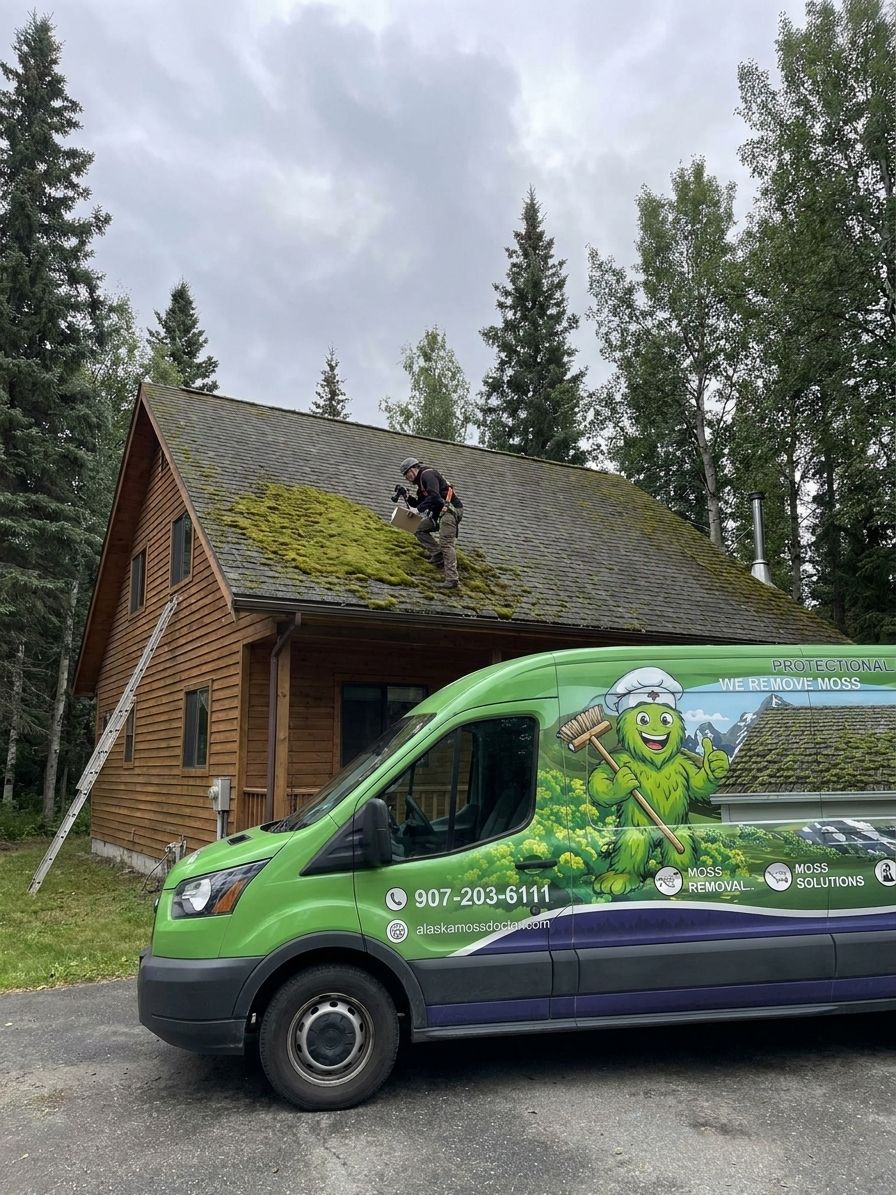
Moss on your roof isn't just a cosmetic problem in Wasilla — it can hand your shingle manufacturer a documented reason to deny your next warranty claim. Here's what actually voids coverage, what doesn't, and how to check before moss turns into a five-figure repair with no manufacturer backup.
- Yes — moss voids most roof warranties: manufacturers exclude damage tied to neglected moss and algae growth.
- GAF, Owens Corning and CertainTeed warranties carry maintenance clauses requiring moss removal, separate from material-defect coverage.
- Granule loss from moisture trapped under moss is classified as lack of maintenance, not a covered defect, in 2026.
- Alaska Moss Doctor documents roof condition before cleaning, giving Wasilla homeowners proof of maintenance for warranty disputes.
Why this matters
A roofing warranty is a contract, and every contract has exclusions. Manufacturers write those exclusions to protect themselves from paying out on damage caused by things they can't control — including moss that a homeowner let sit for two or three winters. If you file a claim in 2026 for a leak and the adjuster or manufacturer rep finds moss mats on the shingles, the claim conversation changes from "defective product" to "deferred maintenance," and deferred maintenance is almost never covered.
The distinction matters because moss damage looks a lot like normal aging from the ground. Learning to spot the early signs before a manufacturer inspector does is the only leverage a homeowner actually has here.
Does moss void your roof warranty?
Moss voids the maintenance portion of most asphalt shingle warranties, but it does not automatically void the material-defect portion — the two are separate clauses, and manufacturers evaluate them separately during a claim review.
| Warranty type | What it covers | What moss typically excludes |
|---|---|---|
| Manufacturer material warranty (often 25 to 30 years) | Defects in shingle material or workmanship at the factory | Granule loss, shingle lifting, and rot tied to trapped moisture under moss |
| Algae-resistant (AR) shingle warranty (commonly capped at 10 years) | Discoloration from blue-green algae | Moss growth itself — most AR warranties address algae streaking, not moss colonies |
| Contractor workmanship warranty (typically 1 to 10 years) | Installation errors: flashing, nailing pattern, underlayment | Any damage tied to homeowner neglect of visible growth |
| Homeowners insurance | Sudden storm or wind damage | Gradual deterioration — moss-related rot is treated as a maintenance failure, not a covered peril |
The pattern across all four rows: coverage protects against defects and sudden events, not slow damage you could have prevented. Moss falls squarely in the second category once it's been visible for more than a season.
What warranty documents actually say about moss
Most major manufacturer warranties — GAF, Owens Corning, CertainTeed, Malarkey — include a maintenance clause requiring the homeowner to keep the roof free of debris, moss, and standing organic growth. The language usually doesn't name moss specifically as a voiding event; instead it excludes damage "resulting from failure to maintain the roof in accordance with normal roofing practices." Moss retention is the textbook example adjusters point to.
Here's the mechanism that actually causes the denial:
- Moss holds moisture against the shingle surface for days after rain or snowmelt.
- Trapped moisture accelerates granule loss, which is the shingle's UV and weather barrier.
- Granule loss exposes the asphalt mat, which then cracks, curls, or lets water through.
- When the leak shows up, the manufacturer traces it back to granule loss — and moss is the documented cause.
- The claim gets classified as maintenance failure, not material defect, and gets denied.
That five-step chain is why insurers and manufacturers both treat visible moss the same way: as evidence the roof wasn't maintained, regardless of how old the shingles actually are.
If moss has been visible on your roof for more than one Alaska winter, assume the maintenance clause is now in play on any future claim.
Why moss-related warranty denials vary
Not every moss-covered roof gets denied outright — the outcome depends on several factors:
- How long the moss has been visible. A single season of light growth reads differently to an adjuster than three years of thick mats.
- Roof pitch and exposure. Steep, sun-facing sections rarely hold moss long enough to matter; shaded, low-pitch, north-facing sections accumulate faster and get scrutinized harder.
- Documentation history. Homeowners who can show receipts for periodic cleaning have a maintenance record; homeowners with no history have nothing to point to.
- Whether the damage is isolated or roof-wide. A single stained section is easier to argue as cosmetic than granule loss spread across multiple slopes.
- The specific manufacturer's clause wording. Some warranties use broad "maintenance" language; others list moss and algae explicitly, which makes denial easier to justify.
- Roofing material. Asphalt shingle warranties reference granule loss directly; metal roofing warranties and cedar shake warranties use different failure language entirely.
Related questions
Does algae on shingles void a roof warranty too?
Algae streaking alone rarely voids a warranty because algae-resistant shingle lines carry a dedicated warranty (commonly 10 years) specifically for discoloration. Moss is different — it's organic growth that traps moisture and causes physical damage, which is why it triggers the maintenance clause while algae streaking usually doesn't.
Will removing moss myself void my warranty?
Improper DIY removal can void your warranty faster than the moss itself, because pressure-washing or scraping shingles strips protective granules and can crack the mat underneath. Manufacturers generally accept soft-washing methods that don't use high-pressure spray directly on the shingle surface, which is why the cleaning method matters as much as the removal timing.
How long does moss have to grow before it voids coverage?
There's no fixed timeline written into most warranties, but industry practice treats moss visible for one full growing season or longer as evidence of neglect. In the Mat-Su Valley's wet, shaded conditions, moss can reach that threshold within a single Alaska summer if a roof sits unaddressed.
Get your roof inspected before it's an issue
Alaska Moss Doctor documents roof condition before every cleaning in Wasilla.
A documented, professional moss removal is the cheapest insurance policy against a warranty dispute you'll ever buy. Alaska Moss Doctor's pre-cleaning documentation gives Wasilla homeowners a paper trail showing the roof was maintained — the exact evidence a manufacturer or adjuster asks for when a claim is contested.
FAQ
Does moss void roof warranty coverage in 2026?
Moss voids the maintenance portion of most manufacturer warranties in 2026 by triggering exclusion clauses for neglected debris and organic growth. It does not automatically void material-defect coverage, but claims involving visible moss get reclassified as maintenance failures far more often than approved.
What voids a GAF roof warranty?
GAF warranties are voided by improper installation, use of incompatible materials, and failure to maintain the roof free of debris and organic growth like moss. The material-defect portion stays separate from the maintenance clause, but adjusters cite visible moss as evidence of the latter.
Is moss covered by homeowners insurance?
Moss-related roof damage is not covered by homeowners insurance because insurers classify it as gradual deterioration rather than a sudden covered peril like wind or hail. Insurance responds to storm damage, not slow damage from moss holding moisture against shingles.
How often should you remove moss to keep a warranty valid?
Most manufacturer maintenance clauses expect moss removal before it accumulates for a full season, which in Alaska's climate often means checking shaded and north-facing slopes annually. Roofs in heavy shade may need attention more than once a year to stay ahead of regrowth.
Can pressure washing void a roof warranty?
Yes, high-pressure washing directly on asphalt shingles can void a warranty because it strips granules and can crack the shingle mat, which manufacturers treat as physical damage rather than acceptable maintenance. Soft-washing is the method most warranty documents implicitly accept.
Does moss cause actual structural damage to a roof?
Moss causes real damage by trapping moisture against shingles, accelerating granule loss and, over multiple seasons, allowing water to reach the decking underneath. It's the granule loss and moisture intrusion that void coverage, not the moss plant itself.
Do all roof types have the same moss warranty rules?
No, asphalt shingle warranties reference granule loss directly while metal and cedar shake warranties use different damage language for moss-related claims. The maintenance-clause principle — neglect voids coverage — applies across roof types even though the specific wording differs.
One last thing
The warranty risk isn't the moss you can see from the driveway — it's the moss on the north-facing slope you never look at, because that's the section that holds moisture longest and racks up the most undocumented growing seasons. Check the shaded slopes first, not the ones facing the road.