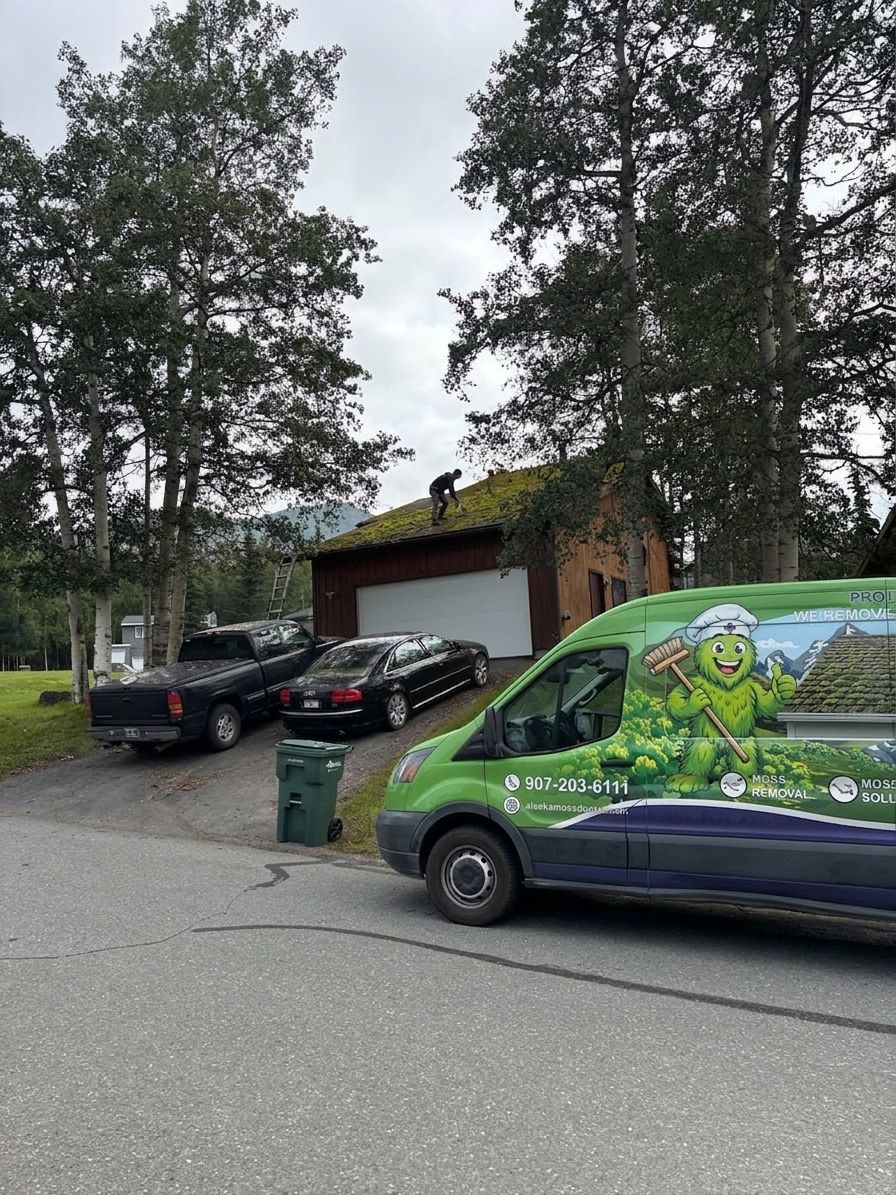
Moss on a roof isn't just cosmetic — by the time you notice green patches from the driveway, moisture has often been working under the shingles for one or two seasons already. This guide walks through exactly what to check, in what order, and what separates surface moss from structural trouble.
- How to spot roof damage from moss starts at the gutters: granules in the downspout mean the shingle surface is already breaking down.
- Moss mats thicker than 1/4 inch trap moisture against the shingle and accelerate rot within one to two Wasilla winters.
- Soft or spongy decking under a moss patch is a structural warning sign, not a cleaning problem — call a professional immediately.
- DIY pressure washing on moss-covered asphalt shingles strips granules faster than the moss itself damages the roof.
- Alaska Moss Doctor recommends inspecting Mat-Su Valley roofs twice a year, before spring thaw and after fall leaf-drop.
Why this matters
Asphalt shingles carry a manufacturer-rated lifespan of 20 to 25 years under normal conditions. Moss shortens that window because it holds water against the granule layer long after rain or snowmelt has drained off the rest of the roof. In Wasilla and across the Mat-Su Valley, shaded north-facing slopes stay damp for weeks at a stretch during spring breakup, which is exactly the environment moss needs to spread.
The problem isn't the moss itself — it's what the moss hides. A thin green film is mostly cosmetic. A raised, spongy mat is a sign the shingle underneath has already started to lift, crack, or rot. Knowing how to tell if your roof needs moss removal before that mat forms saves you a shingle replacement instead of a cleaning bill.
What you'll need
- Binoculars or a phone camera with zoom (skip the ladder for the first pass)
- A flashlight for attic and eave inspection
- A notepad or phone notes app to log dates and locations of moss patches
- A garden hose (for the gutter test below, not for cleaning moss off shingles)
- Access to your attic hatch or crawlspace
- A stable ladder rated for your height, only if you plan to get close to the eaves
The steps
1. Start at the gutters, not the roof
Granules from asphalt shingles wash into gutters and downspouts as the surface degrades. Pull back the gutter guard or peek into the downspout after a rain — a handful of black, sand-like grit means the shingle surface is already thinning. This is the fastest way to catch damage before you ever touch a ladder.
Common mistake: homeowners assume granule loss only happens on very old roofs. Moss-covered sections shed granules faster than exposed ones because the trapped moisture breaks down the asphalt binder underneath.
2. Scan the north and shaded slopes with binoculars
Moss grows where sun doesn't reach long enough to dry the surface — usually the north-facing plane, valleys, and anything shaded by trees. Look for color: healthy shingle is uniform gray or brown, while moss shows as green-black patches that thicken over a season.
Expected outcome: you should be able to map every visible moss patch on your roof from the ground within 10 minutes. If you can't see the whole roof from any angle, that's your cue to bring in a professional with the right ladder setup instead of climbing yourself.
3. Check shingle edges for curling or lifting
Zoom in on any moss patch and look at the edges of the shingles underneath. Curling or lifting at the tab edges means water has been getting under the shingle repeatedly — moss holds that water in place instead of letting it run off.
Why it matters: a lifted shingle edge is a direct path for wind-driven rain and melting snow to reach the decking. Once water gets under the shingle layer, the damage moves from cosmetic to structural.
4. Press-test any raised or spongy-looking patch
From a stable ladder position, gently press a gloved hand against any area where moss has formed a raised mat. Firm resistance is normal. Give or softness under your hand means the decking below has started to absorb moisture and rot.
Common mistake: people confuse a thick moss mat's natural springiness with the shingle itself flexing. If you're not sure which you're feeling, treat it as a red flag and get how to remove moss from a roof without damaging shingles reviewed before doing anything yourself.
5. Check the attic for light spots and water stains
Go up into the attic with a flashlight on a dry day and look at the underside of the roof decking, especially below sections where you spotted moss from outside. Water stains, dark rings, or daylight coming through pinholes mean water has already made it past the shingle layer.
Expected outcome: a dry, unstained attic deck under a moss-affected section is a good sign — the moss hasn't broken through yet. Stains mean you're past prevention and into repair territory.
6. Inspect gutters and downspouts for standing water
Moss debris and shingle granules clog gutters faster than leaves alone. Standing water in a gutter section backs up under the shingle edge above it, which speeds up rot at the eaves — often the first place roofs fail on moss-heavy homes.
Why it matters: an eave that's rotting from gutter backup looks identical to moss damage from the ground, but the fix is different. Clearing and resloping gutters solves one problem; removing moss solves the other.
7. Photograph and date everything you find
Take wide shots of each slope and close-ups of every moss patch, lifted edge, or soft spot, with the date. This record matters for two reasons: it lets you track whether a patch is growing between checks, and it gives any roof cleaning company a clear starting point instead of guessing where the trouble spots are.
Expected outcome: a simple photo log, checked twice a year, shows you exactly how fast moss is spreading on your specific roof — some slopes barely change year to year, others double in coverage in a single wet season.
Troubleshooting
Moss keeps coming back after I scraped it off. Scraping removes the visible growth but leaves spores and root structures (rhizoids) embedded in the granule layer. Regrowth within the same season is common without a treatment step — see how to prevent moss regrowth after roof cleaning for what actually stops the cycle.
I can't tell if it's moss or black algae streaks. Moss is raised and textured, usually green to dark green. Algae streaks are flat, black, and run in vertical lines from the ridge down. They're different organisms and need different treatment approaches, though both signal a roof holding too much moisture.
The roof feels soft in one spot but there's no visible moss there. Soft decking can trail behind the moss patch that caused it, since water travels sideways under shingles before it shows on the surface. Treat any soft spot as a priority inspection point regardless of what's growing directly above it.
Pressure washing knocked the moss off but the shingles look worse now. High-pressure washing strips protective granules along with the moss, exposing the asphalt layer to UV damage. This is the single most common DIY mistake on moss-covered roofs — soft washing at low pressure with the right solution avoids it.
I don't know if this is worth paying a professional for. If you're seeing granules in the gutter, any soft spot, or attic staining, the cost of waiting usually exceeds the cost of a cleaning. Review how to budget for professional roof cleaning before deciding to wait another season.
Tools and resources
- Binoculars or a zoom camera for the initial ground survey
- A flashlight for attic inspection
- A photo log app or simple folder to track moss patches by date
- Roof moss removal for Wasilla, Alaska homeowners for what a local professional service actually covers
- A second-opinion inspection if you're unsure whether a spot is cosmetic or structural
Get a Free Roof Moss Inspection
A trained eye catches soft decking and lifted shingles before they become a repair bill.
What to do next
Once you've logged your moss patches and flagged anything soft or stained, the next move is lining up a professional look before the next wet season starts. Work through the best roof cleaning company checklist for homeowners so you know what questions to ask before anyone gets on your roof in 2026.
FAQ
How do I know if moss has already damaged my roof?
Check for granules collecting in your gutters, shingle edges that curl or lift under the moss patch, and any soft or spongy feel when you press on a raised mat. Attic water stains directly under a moss patch confirm the water has already reached the decking.
Is a little moss on my roof normal in Alaska?
Light, flat moss growth on shaded or north-facing slopes is common in Wasilla's climate and not urgent on its own. It becomes a problem once the mat thickens past about 1/4 inch, because that's when it holds enough moisture to start breaking down the shingle underneath.
Can I pressure wash moss off my roof myself?
High-pressure washing strips protective granules along with the moss and often does more damage than the moss itself. Soft washing at low pressure is the method professionals use specifically to avoid stripping the shingle surface.
How often should I inspect my roof for moss damage?
Twice a year works for most Mat-Su Valley homes: once before spring thaw and once after fall leaf-drop. Roofs with heavy tree cover or consistently shaded slopes may need a mid-summer check as well.
What's the difference between moss and black algae streaks on a roof?
Moss is raised, textured, and green to dark green in color, while black algae streaks are flat and run vertically down the roof from the ridge. Both signal excess moisture retention, but they call for different removal approaches.
How much does professional roof moss removal cost in Alaska?
Cost depends on roof size, pitch, and how established the moss growth is, so getting a specific quote is more useful than a rule of thumb. A budgeting breakdown is available for homeowners planning ahead for the 2026 cleaning season.
Will moss removal damage my shingles?
Done correctly with a soft wash approach, moss removal should not strip granules or crack shingles. Damage typically comes from scraping, high-pressure washing, or delaying removal until the mat has already rotted the decking underneath.
Does moss on the roof mean I need a full roof replacement?
Not usually — most moss damage caught early is limited to the affected shingle sections and can be cleaned and repaired without a full tear-off. Replacement becomes necessary only when soft decking or rot has spread across multiple slopes.
One last thing
The fastest tell most homeowners overlook: check the gutter, not the roof. Granules showing up in your downspout before you ever see a visible moss mat means the shingle surface is already thinning underneath growth you can't fully see from the ground yet in 2026's wet season.