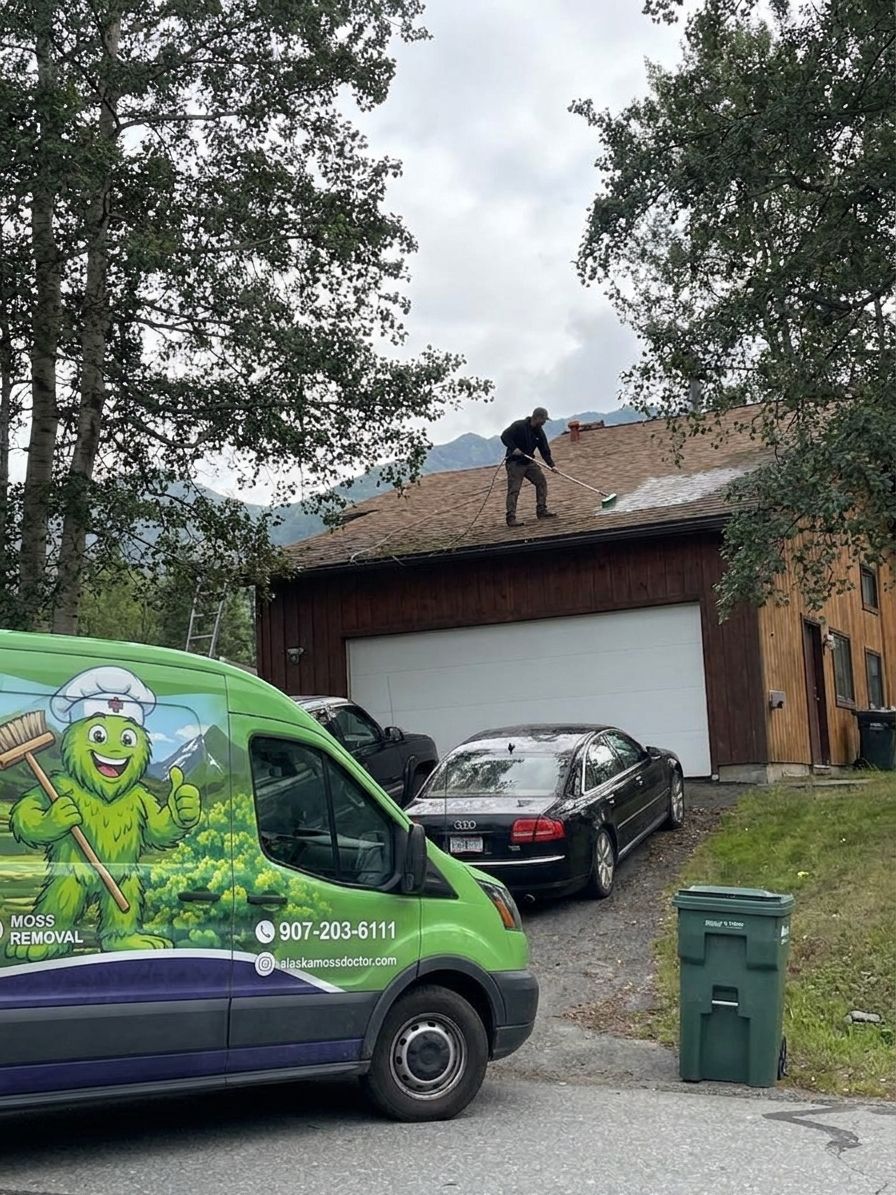
Moss looks harmless sitting on your shingles, but a pressure washer or a wire brush turns a cosmetic problem into a roof replacement. This guide walks through the exact sequence that gets moss off without stripping granules or lifting shingle tabs.
- Soft washing under 500 psi with a 10-15 minute chemical dwell time removes moss without granule loss.
- Scraping or pressure-washing asphalt shingles voids most warranties and shortens roof life by years.
- Alaska Moss Doctor treats Wasilla-area roofs with zinc strip prevention after every soft wash job.
- Moss regrows fastest on shaded, north-facing slopes common in Mat-Su Valley homes.
Why this matters
Moss holds moisture against the roof deck long after the surrounding shingle dries. In the Wasilla area, where shaded tree cover and cool, damp conditions persist through much of the year, that trapped moisture works into shingle seams and accelerates granule loss faster than sun exposure alone. By the time moss is visible from the ground, it's usually already lifted a few tabs at the edges.
The damage doesn't come from the moss itself — it comes from how homeowners try to remove it. A pressure washer set above 1,500 psi strips the protective granule layer off asphalt shingles in seconds, and once that layer is gone, UV exposure degrades the shingle mat underneath within a season or two. Wire brushes and putty knives do the same thing mechanically. The safe method is low-pressure soft washing with a targeted moss-killing solution, not brute force.
What you'll need
- Soft-bristle roof brush or synthetic roof rake (never metal bristles or wire brushes)
- Garden sprayer or pump sprayer for chemical application
- A non-bleach moss treatment — potassium salts of fatty acids or a zinc sulfate solution work without corroding flashing
- A soft wash rig capable of holding pressure under 500 psi with a wide fan-tip nozzle
- Roof harness, rope grab, and anchor points if the pitch exceeds a walkable slope
- Tarps to cover landscaping, siding, and gutters below the work area
- Garden hose for a low-pressure rinse
- Eye protection, non-slip footwear, and chemical-resistant gloves
If any of this sounds like more equipment than a weekend project justifies, that's the point — the best way to remove moss without damaging shingles usually means hiring a soft wash crew rather than renting a pressure washer for one afternoon.
The steps
1. Inspect the roof before you touch it
Walk the perimeter and check for loose or curling shingle tabs, exposed nail heads, and soft spots in the decking. Moss growing in mats thicker than half an inch has usually been there for more than one season and may already be lifting tabs underneath. Skipping this step means you find out about existing damage the hard way, mid-cleaning, when a tab tears off in your hand.
2. Protect the property first
Cover shrubs, flower beds, and AC units with tarps, and soak any plants near the drip line with plain water so runoff from the treatment doesn't scorch them. Close attic and soffit vents temporarily if you're spraying near them. This step takes 15-20 minutes and prevents the most common complaint after DIY roof cleaning — dead landscaping.
3. Remove loose debris by hand
With a soft-bristle brush, work moss gently downward in the direction of the shingle grain, never upward or side to side. Upward strokes catch under the shingle edge and lift it; downward strokes follow the shingle's natural lay. Clear thick mats first so the chemical treatment reaches the shingle surface instead of just the moss canopy.
Common mistake: using a metal-tined rake or putty knife to pry moss loose. That tool removes granules along with the moss on the first pass.
4. Apply a low-pressure chemical treatment
Mix the moss treatment per label instructions and apply with a pump sprayer, saturating the affected area evenly. Let it sit for 10-15 minutes — long enough to kill the moss at the root without cooking the shingle surface in direct sun. This dwell time is the step most DIYers rush, and rushing it means the moss dies on the surface but the rhizomes underneath survive and regrow within weeks.
5. Rinse from the ridge down
Using the soft wash rig set below 500 psi, rinse starting at the ridge and working down toward the eaves, following the shingle overlap. Rinsing upward forces water and dead moss debris under the shingle tabs instead of off the roof. This is the same soft wash roof cleaning approach used on asphalt shingle roofs across the Wasilla area in 2026, and it's the single biggest difference between a roof that looks clean and a roof that stays intact.
6. Clear gutters and downspouts
Dead moss and granules wash toward the gutters during rinsing and can clog downspouts within the same afternoon. Flush gutters with a hose immediately after rinsing the roof, before debris has a chance to dry and compact.
7. Install zinc or copper strips at the ridge
A thin zinc or copper strip mounted just under the ridge cap releases metal ions with every rainfall, creating conditions moss doesn't tolerate. This isn't a one-time fix — it's ongoing prevention that reduces how often the full cleaning process above needs repeating.
8. Schedule a follow-up inspection
Check the roof again after the next heavy rain to confirm moss doesn't reappear in the same spots and that no tabs lifted during the process. Roofs in shaded, moss-heavy locations often need a follow-up pass within 12-18 months even after a thorough cleaning.
Troubleshooting
Moss patches won't fully release even after treatment. Extend the dwell time to the upper end of the label range and re-brush gently rather than increasing water pressure — pressure is never the fix for stubborn moss on asphalt shingles.
Black streaks remain after moss is gone. That's algae, not moss, and it needs a different soft wash solution for roof algae stains — moss treatment alone won't clear it.
You notice granule loss in the gutter after rinsing. Stop immediately and check your pressure setting; anything approaching 1,000 psi at the nozzle is stripping shingle surface, not just moss.
Moss returns within a few months. Shaded, north-facing roof sections in the Mat-Su Valley regrow moss faster than sun-exposed slopes — prevention strips and a tighter cleaning schedule matter more here than technique.
The roof pitch is too steep to work safely. Stop the DIY attempt. Steep-pitch roofs need harness anchors and fall protection that most homeowners don't own or know how to rig correctly.
Flashing or vents show corrosion after chemical use. Rinse metal components with plain water immediately after treatment application — some moss chemicals are corrosive to bare metal if left to sit.
Tools and resources
- Soft wash rig with adjustable pressure control (under 500 psi for asphalt)
- Non-bleach moss treatment appropriate for shingle roofs
- Zinc or copper prevention strips for the ridge line
- Roof harness and anchor kit for anything steeper than a walkable pitch
Skip the ladder and the risk
Alaska Moss Doctor soft washes Wasilla-area roofs without stripping shingle granules.
What to do next
Once the roof is clean, the work that actually protects your investment happens after the cleaning is done. Read how to prevent moss regrowth after roof cleaning for the maintenance schedule that keeps moss from coming back before next season.
FAQ
How do you remove moss from a roof without damaging shingles?
Use a soft-bristle brush to clear loose moss downward with the shingle grain, apply a non-bleach moss treatment with a 10-15 minute dwell time, then rinse with a soft wash system under 500 psi. Pressure washers above 1,000 psi strip granules and should never touch asphalt shingles.
Is pressure washing bad for roof shingles?
Yes, pressure above roughly 1,000-1,500 psi strips the protective granule layer off asphalt shingles and shortens roof life. Soft washing under 500 psi with a chemical treatment removes moss and algae without that damage.
What kills moss on a roof without harming shingles?
Potassium salts of fatty acids and zinc sulfate solutions kill moss at the root without the corrosive effect bleach has on flashing and gutters. Both need a dwell time of 10-15 minutes before rinsing.
How much does professional roof moss removal cost in 2026?
Pricing varies by roof size, pitch, and moss coverage, so get a direct quote for your property. Alaska Moss Doctor provides quotes based on the specific roof and moss condition rather than a flat rate.
How often should a roof be cleaned for moss in Alaska?
Shaded, moss-heavy roofs in the Mat-Su Valley often need cleaning every 12-18 months, while sun-exposed roofs can go longer between treatments. Zinc or copper prevention strips extend the interval between full cleanings.
Can you remove moss from a metal roof the same way?
Metal roofing needs a different approach than asphalt shingles because the surface and seams react differently to chemical treatments. Check a metal-specific method before applying the same process used on shingles.
Does moss actually damage a roof or is it just cosmetic?
Moss traps moisture against the shingle and roof deck, which accelerates granule loss and can lift shingle tabs over time. Left untreated for multiple seasons, it shortens the functional life of the roof.
Should I remove moss myself or hire a roof cleaning company?
DIY works for small, accessible patches on a low-pitch roof with the right soft wash equipment and chemical dwell time. Steep pitches, extensive moss coverage, or roofs without safe walking access are safer left to a professional crew.
One last thing
Zinc and copper prevention strips aren't a marketing add-on — they work because the metal ions released with each rainfall create a surface moss genuinely can't colonize, and a single strip run along the ridge keeps working for years without reapplication. Most homeowners who skip this step end up re-cleaning the same roof every single year instead of every 18 months.