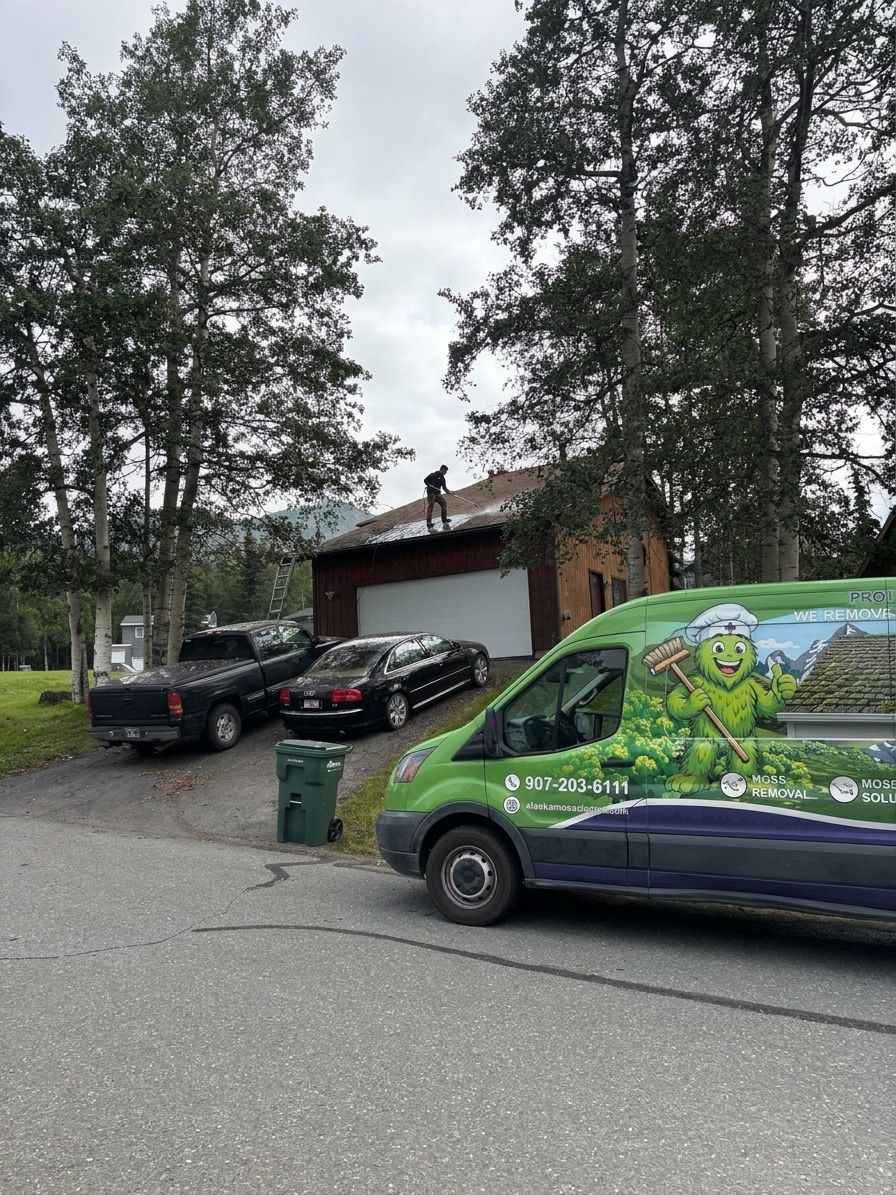
Roof algae stains on Alaska homes come from a living organism, not dirt, and the wrong cleaning method either fails to kill it or strips the shingles trying. This guide ranks the soft wash solutions actually used on roofs in 2026, tells you which one works on Gloeocapsa magma without voiding a shingle warranty, and flags the DIY mixes that cause more damage than they fix.
- Sodium hypochlorite soft wash at 1%-3% concentration is the best soft wash solution for roof algae stains in 2026 — Buy.
- Pressure washing and undiluted bleach both strip granules or bleach trim — Skip both on asphalt shingles.
- Oxygen bleach works slower but is the safer call near foundation plantings — Consider.
- Zinc or copper strips stop regrowth but never remove existing Gloeocapsa magma stains — pair them, don't substitute.
Why this matters
Those black-green streaks running down a north-facing roof in Alaska Moss Doctor service territory are Gloeocapsa magma, an algae that feeds on the limestone filler in asphalt shingles and thrives wherever a roof stays damp longer than it should. Shaded pitches, tree cover, and Wasilla's long wet shoulder seasons all extend that damp window.
The solution matters more than the equipment. A soft wash rig set up with the wrong chemical still fails — either the algae survives, or the roof, gutters, and siding take collateral damage. Manufacturers including GAF and the Asphalt Roofing Manufacturers Association warn against high-pressure cleaning on shingle roofs specifically because it voids workmanship warranties, so the chemistry in the tank is the whole ballgame in 2026, not the pump.
How these solutions are evaluated
Each entry below is scored on four things: how reliably it kills Gloeocapsa magma rather than just bleaching the stain cosmetically, whether it's compatible with asphalt shingle, metal, and cedar shake roofing, what it does to landscaping and runoff, and whether it carries any risk to a manufacturer's roofing warranty. That's the same framework roofing manufacturers and soft wash trade associations use when they publish application guidance, and it's the framework behind every roof moss removal job in Wasilla Alaska done correctly.
DIY search results skew toward whatever's cheapest at the hardware store. This ranking skews toward what actually removes the stain and leaves the roof intact through another Alaska winter.
The ranked list of soft wash solutions for roof algae stains
1. Sodium hypochlorite soft wash mix — the industry standard
Professional soft wash rigs run sodium hypochlorite diluted to roughly 1% to 3%, blended with a surfactant so the solution clings to the shingle instead of sheeting off, then applied at under 500 PSI. That low pressure is the entire point: it's chemistry doing the work, not force. Most applications call for a 10 to 15 minute dwell time before a low-pressure rinse, long enough to kill the algae down to the root without cooking the shingle granules or the trim. This is the same core chemistry behind soft wash roof cleaning for asphalt shingle roofs, and it's the only method on this list rated safe for warranty compliance by shingle manufacturers. Verdict: Buy.
2. DIY bleach-and-water mix — cheap, inconsistent, and risky
Straight household bleach mixed by eye has no standardized concentration, no surfactant, and no dwell-time control. Too weak and the algae survives; too strong and it bleaches fascia, kills grass, and corrodes gutter fasteners. Homeowners also tend to compensate for a weak mix with a pressure washer, which is exactly the combination that voids shingle warranties. Verdict: Skip for anything beyond a small test patch.
3. Oxygen bleach (sodium percarbonate) — the plant-safe alternative
Oxygen bleach breaks down into oxygen and soda ash instead of chlorine byproducts, which makes it the better call on properties with foundation plantings, garden beds, or well water intakes nearby. It's slower — expect a longer dwell time and sometimes a second application to match what sodium hypochlorite does in one pass — but it removes runoff concerns that come up constantly on HOA-governed properties and rentals with tenant gardens. Verdict: Consider when landscaping protection outweighs speed.
4. Zinc or copper strip treatments — prevention, not removal
Zinc and copper strips installed near the ridge release metal ions with every rain, which suppresses new algae growth for years afterward — GAF and other manufacturers list this as a recognized prevention method. What it does not do is touch algae already embedded in the shingle. Homeowners who install strips expecting the existing stains to fade are disappointed; the strips only stop the next colony from establishing. Verdict: Consider as a pair, never as a standalone fix for stains that already exist.
5. Pressure washing with no chemical — the wrong tool for the job
Running a pressure washer at 3,000+ PSI over asphalt shingle strips the protective granules, exposing the asphalt mat underneath to UV damage and shortening roof life. It also can't reach algae growing under the granule surface, so the streak often returns within a season anyway. This is the single most common mistake homeowners make trying to fix roof algae removal for shaded properties themselves. Verdict: Skip.
6. Trisodium phosphate (TSP) cleaners — largely phased out
TSP was a common roof and siding cleaner before soft washing became standard, but it's weaker against Gloeocapsa magma than sodium hypochlorite, and phosphate runoff restrictions have pushed many states and municipalities to limit or ban it. It still shows up in some big-box cleaning products marketed for exterior use. Verdict: Skip in favor of a hypochlorite or oxygen-bleach mix.
Get the right solution applied correctly
A soft wash quote tells you dwell time, mix ratio, and roof-safe pressure before anyone touches a hose.
Comparison: soft wash solutions for roof algae stains at a glance
| Solution | Kills Gloeocapsa magma | Shingle-safe | Landscaping impact | Verdict |
|---|---|---|---|---|
| Sodium hypochlorite soft wash | Yes, at 1%-3% | Yes | Rinse and protect plants | Buy |
| DIY bleach mix | Inconsistent | Risky at high concentration | High if overapplied | Skip |
| Oxygen bleach | Yes, slower | Yes | Low | Consider |
| Zinc/copper strips | Prevention only | Yes | Minimal | Consider as pair |
| Pressure washing, no chemical | No | No — voids warranty | Low | Skip |
| TSP cleaner | Weaker than hypochlorite | Yes | Runoff restricted in some areas | Skip |
Where to source it
- Concentrate matters more than the brand on the label. A 12.5% sodium hypochlorite pool-grade concentrate diluted correctly outperforms a pre-mixed retail spray every time.
- Roof material changes the mix. Metal roofing, asphalt shingle, and cedar shake all tolerate different dwell times and pressures — soft wash roof cleaning for metal roofing uses a gentler approach than asphalt because coatings scratch differently than granules wear.
- Verify insurance before hiring anyone with a pump and a chemical tank. Roof work in Alaska's ice and moss conditions carries real liability, and an uninsured applicator who over-concentrates the mix has no recourse if the runoff damages siding or landscaping.
FAQ
What is the best soft wash solution for roof algae stains in 2026?
A sodium hypochlorite mix diluted to 1%-3% with a surfactant is the best soft wash solution for roof algae stains in 2026. It kills Gloeocapsa magma at the root and stays within manufacturer warranty guidelines when applied at low pressure.
Is sodium hypochlorite safe for asphalt shingle roofs?
Yes, sodium hypochlorite is the industry-standard soft wash chemical for asphalt shingles when applied at low pressure with a proper dwell time. Problems only arise when it's overconcentrated or paired with high-pressure equipment.
Can pressure washing remove roof algae stains?
Pressure washing can remove surface staining temporarily but strips protective granules from asphalt shingles and voids most manufacturer warranties. Algae also regrows faster because pressure alone doesn't kill the organism below the surface.
How long does a soft wash solution need to dwell on a roof?
Most professional sodium hypochlorite applications call for a 10 to 15 minute dwell time before a low-pressure rinse. Oxygen bleach alternatives typically need longer, sometimes a second application, to match that kill rate.
Does soft washing damage plants or landscaping?
Soft washing does not damage plants when the crew pre-rinses landscaping and neutralizes runoff, which is standard practice on a professional job. Oxygen bleach is the lower-risk chemical choice when plantings sit close to the foundation.
How often should a roof be soft washed to prevent algae regrowth?
Most Alaska roofs with shade exposure need a soft wash every 2 to 3 years to stay ahead of Gloeocapsa magma regrowth. Roofs paired with zinc or copper prevention strips can often stretch longer between treatments.
What causes the black streaks on Alaska roofs?
The black-green streaks are Gloeocapsa magma, an airborne algae that feeds on limestone filler in shingles and thrives in damp, shaded conditions. North-facing pitches and tree-covered lots see it first because they stay wet longest.
Is oxygen bleach as effective as chlorine bleach for roof algae?
Oxygen bleach kills Gloeocapsa magma but works slower than sodium hypochlorite and sometimes needs a repeat application to match the same result. It's the better choice when landscaping protection matters more than speed.
One last thing
The detail most homeowners miss: a soft wash that kills the visible stain but skips a zinc or copper strip install is a temporary fix. Gloeocapsa magma spores travel by wind and water, so a clean roof next to an untreated neighbor's roof gets reseeded within a season or two — pairing the chemical treatment with a prevention strip in the same visit is what actually stretches the interval between roof cleanings past 2026 and into the following few years.