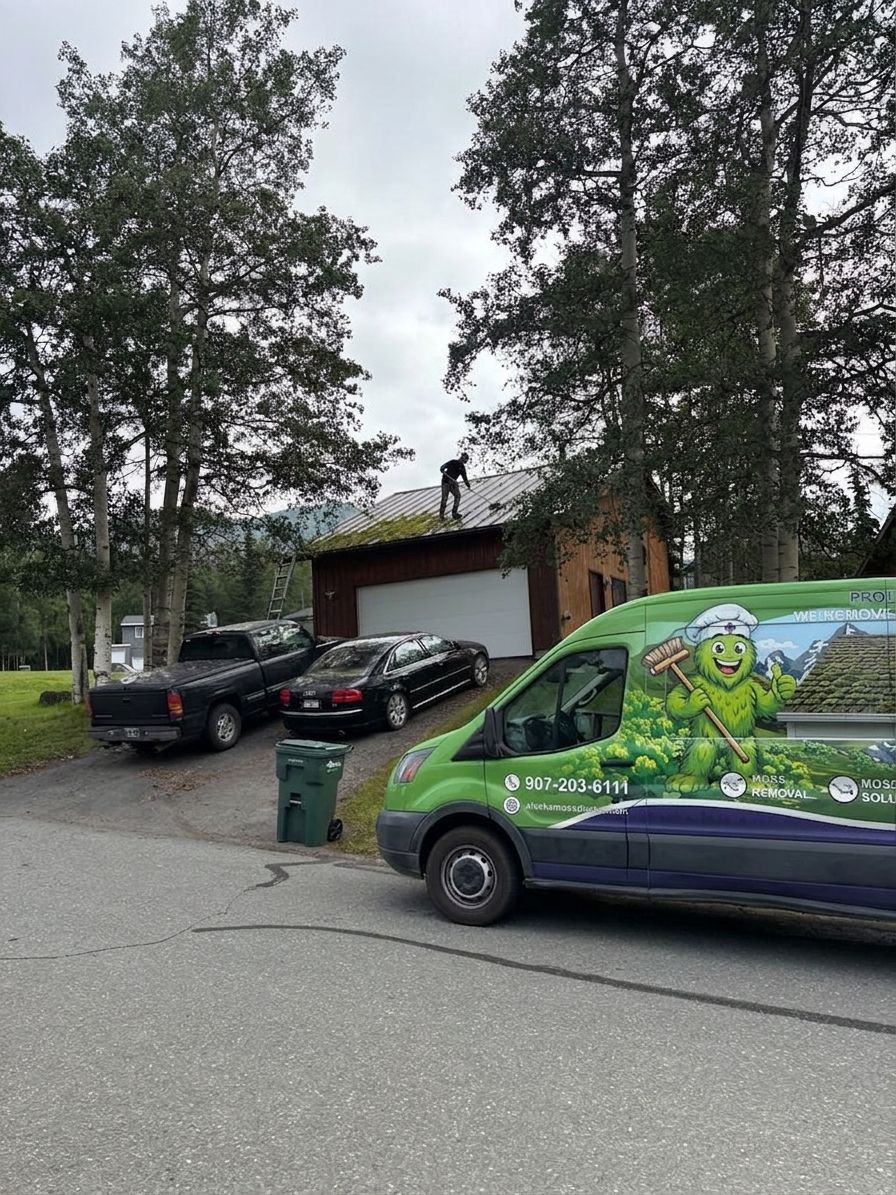
Metal roofing and moss don't mix the way asphalt shingles and moss do, but the wrong cleaning approach can strip a factory coating faster than the moss itself ever would. Here's the ranked breakdown of every method homeowners actually try on standing seam and corrugated metal roofs in 2026, with a clear verdict on each.
- Soft wash cleaning at under 100 PSI is the best moss removal approach for metal roof surfaces in 2026 -- Buy.
- Standard gas pressure washers run 2,000 to 4,000 PSI and can lift painted metal coating -- Skip.
- Zinc or copper ridge strips slow future moss growth but don't touch existing buildup -- Hold.
- Manual scraping and bleach-and-walk-away sprays both risk fastener seals and finish damage -- Skip.
Why This Matters
Metal roofs in the Wasilla area hold moss in ridge seams, fastener heads, and shaded valley folds where snowmelt sits longest. Moss itself won't rust bare metal the way it can rot shingle mat, but the acidic byproducts and trapped moisture sit against seams and coatings for months at a time.
The finish on most residential metal roofing is a baked-on enamel or Kynar coating, and that coating is what actually protects the panel. Pick a cleaning approach that scrubs or blasts through that coating and you've traded a cosmetic moss problem for a corrosion problem that shows up in three to five years. Soft wash roof cleaning for metal roofing exists as a specific service category for exactly this reason -- metal needs a different chemistry and pressure profile than shingles or siding.
How These Approaches Were Ranked
Each method below is scored on three things: whether it kills moss at the root instead of just knocking off the visible growth, whether it risks the panel coating or seam sealant, and whether it holds up through an Alaska freeze-thaw cycle. A method that looks clean in July but lets moss regrow by the next spring thaw doesn't rank well here, and a method that removes moss but voids a roofing warranty ranks even lower.
Alaska Moss Doctor treats metal roofs differently than shingle roofs on every job, because the two surfaces fail in completely different ways under the same mistake.
The Ranked List
1. Professional soft wash treatment -- the safe pick
A calibrated low-pressure sprayer applies a biocide solution at under 100 PSI, well below the threshold that lifts or scratches baked-on metal coatings. The solution kills moss spores and lichen at the root rather than just knocking loose the visible growth on top.
Dwell time matters more than pressure here -- the solution sits for roughly 10 to 20 minutes before a low-pressure rinse, which is what actually clears root structure out of seams and fastener heads. This is the approach Alaska Moss Doctor runs on standing seam and corrugated panel roofs across the Wasilla area heading into the 2026 season. Verdict: Buy.
2. DIY low-pressure sprayer with a labeled moss killer -- the workable middle ground
A pump sprayer and a moss-and-algae product rated for metal roofing can knock back light growth if you keep pressure genuinely low and avoid concentrating spray on painted seams. The gap between this and professional soft washing is consistency -- most homeowners either under-dilute the product or rinse too soon.
This works as a stopgap between professional visits, not as a replacement for one, especially on a roof with visible moss mats rather than surface staining. Verdict: Hold.
3. Zinc or copper ridge strips -- the prevention play
Strips installed along the ridge release trace metal ions with every rain, which suppresses new spore growth downstream on the panel. They do nothing for moss that's already established in a north-facing valley or under a fastener head.
Think of this as a 2026 prevention budget item, not a cleaning method -- pair it with an initial soft wash rather than expecting it to clear existing buildup on its own. Verdict: Hold.
4. Manual scraping or stiff-brush removal -- the shortcut that backfires
Scraping pulls moss off fast and feels productive, but a metal roof scratches under a putty knife or wire brush in a single pass. Every scratch through the coating is a future rust point, and on a standing seam roof those scratches concentrate right where water actually runs.
This method also does nothing to kill root structure left behind in seams, so moss regrows within a season anyway. Verdict: Skip.
5. Standard gas pressure washer at full pressure -- the roof killer
A typical homeowner-grade gas pressure washer runs 2,000 to 4,000 PSI, which is 20 to 40 times higher than the soft wash standard for coated metal. At that pressure, water drives under lap seams and fastener washers, and the coating itself can peel or dull within one pass.
This is the single most common way homeowners turn a cosmetic moss problem into a leak. Verdict: Skip.
6. Bleach or vinegar spray-and-walk-away -- the internet favorite
Straight bleach or vinegar sprayed and left to dry looks like it's working because moss browns and dies on the surface. Neither addresses root structure in seams, and full-strength bleach run-off can etch metal finishes and kill vegetation in gutters and downspouts below.
A more diluted, roof-labeled version applied correctly moves this closer to option 2 above, but straight household bleach at full strength is not that. Verdict: Skip.
Comparison Table
| Approach | Pressure/Method | Root-Kill | Coating Risk | Verdict |
|---|---|---|---|---|
| Professional soft wash | Under 100 PSI | Yes | Low | Buy |
| DIY low-pressure sprayer | Under 100 PSI, manual | Partial | Low-Moderate | Hold |
| Zinc/copper strips | Passive, ion release | Prevention only | None | Hold |
| Manual scraping | Physical abrasion | No | High | Skip |
| Gas pressure washer | 2,000-4,000 PSI | No | Severe | Skip |
| Bleach/vinegar spray | Chemical, no rinse | No | Moderate | Skip |
On a roof with visible moss mats rather than light staining, scraping or stripping the buildup entirely before treatment is sometimes unavoidable -- see removing moss without damaging shingles for the general principle of pulling growth without gouging the surface underneath, which applies to metal panels too even though that guide is written around shingle removal.
Who Should Handle This
- Get a written statement on pressure and chemistry before hiring anyone. Ask what PSI they run on metal and what solution they use -- if the answer is "whatever's in the pressure washer," keep calling.
- Confirm they've worked on metal roofing specifically, not just asphalt shingles. The chemistry, dwell time, and pressure tolerances are different enough that shingle-only experience doesn't transfer cleanly.
- Ask about seam and fastener treatment separately from field cleaning. Moss concentrates in seams first, and a quote that only mentions "roof washing" in general terms may skip that detail.
Get a metal roof moss quote
Soft wash service for standing seam and corrugated roofs in the Wasilla area.
FAQ
What is the best moss removal approach for a metal roof?
Soft wash cleaning at under 100 PSI with a biocide solution is the best moss removal approach for metal roofing in 2026. It kills moss at the root without lifting the panel coating the way higher pressure does.
Can you pressure wash a metal roof to remove moss?
A standard gas pressure washer runs 2,000 to 4,000 PSI, which is high enough to peel or dull baked-on metal coatings. Soft washing at under 100 PSI removes moss without that risk.
Will vinegar or bleach kill moss on a metal roof?
Full-strength bleach or vinegar can brown surface moss but leaves root structure intact in seams, so it regrows within a season. Diluted, roof-labeled solutions applied with proper dwell time work far better.
Does moss actually damage metal roofing?
Moss won't rust bare metal directly, but it traps moisture against seams and fastener heads for months, which accelerates coating breakdown and corrosion over several years. Left long enough, moss also holds acidic organic matter against the finish.
Are zinc or copper strips effective against roof moss?
Zinc and copper ridge strips release ions that suppress new spore growth downstream, but they do nothing for moss that's already established. They work as prevention paired with an initial cleaning, not as a standalone fix.
How often does a metal roof need moss cleaning in Alaska?
Shaded and north-facing metal roofs in the Wasilla area typically need attention more often than sun-exposed sections due to longer snowmelt retention. A soft wash service can assess buildup pattern and recommend a schedule based on your roof's specific exposure.
Is soft washing safe for standing seam metal roofs?
Yes -- soft washing at under 100 PSI is the standard method for standing seam and corrugated metal panels because it doesn't drive water under seams or scratch the coating. It's the approach used across most residential metal roof moss jobs in 2026.
How much does metal roof moss removal cost?
Cost depends on roof size, pitch, and how much moss buildup has accumulated in seams and valleys. Request a quote from a local Wasilla soft wash provider for a number specific to your roof.
One Last Thing
The most overlooked failure point on a metal roof isn't the flat panel field -- it's the fastener heads and seam laps, where moss gets a foothold first and a scraper or high-pressure stream does the most coating damage. Check those spots specifically before choosing a cleaning method, because a treatment that looks fine on the open panel can still be wrong for the seams. Alaska Moss Doctor inspects seam condition before any moss removal job for exactly this reason -- the field cleaning method matters less than what happens at the seams.