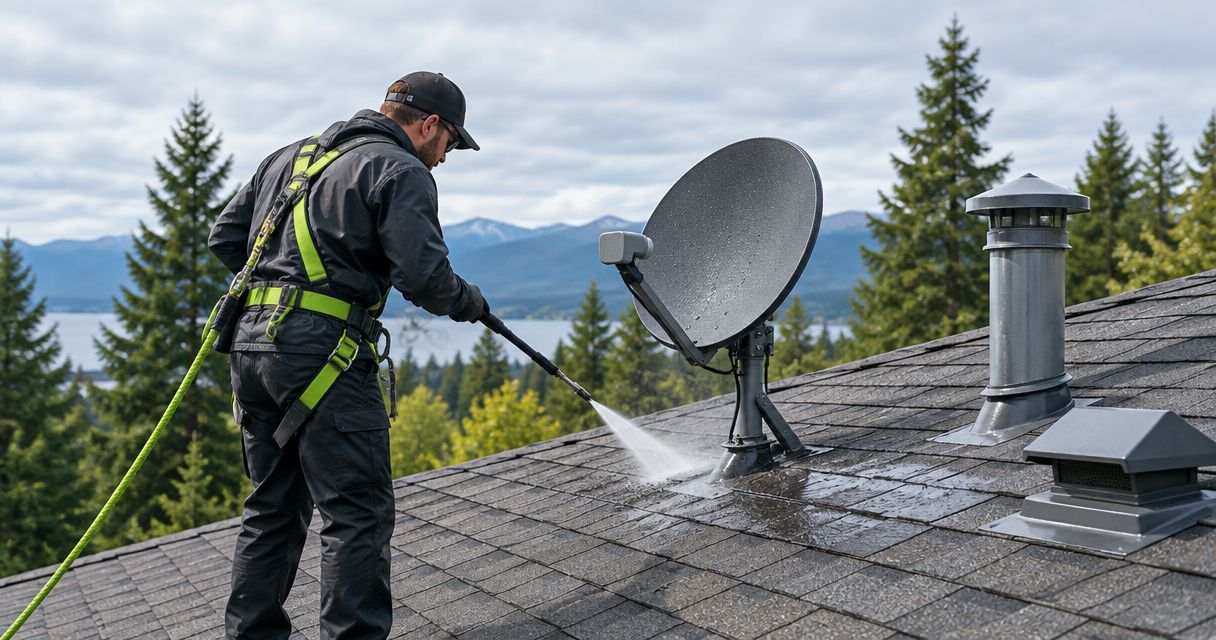
Satellite dishes, plumbing vents, and roof jacks are the parts of a roof wash that get skipped, rushed, or handled wrong — and that's usually where callbacks come from. The fix is simple: shut off or disconnect what needs protecting, work the soft wash solution around the mounting hardware instead of blasting it, and rinse penetrations last so runoff carries debris away from the seal, not into it.
- Clean around satellite dishes and vents by pre-rinsing, applying low-pressure soft wash solution at an angle, and rinsing penetrations last.
- Never point a pressure washer wand directly at a vent boot seal or dish mount — it drives water under flashing.
- Satellite dish LNB arms and cable connectors need a light touch; corrosion on the mount is common on Wasilla-area roofs by 2026.
- Alaska Moss Doctor treats every roof penetration as a separate zone during a roof wash, not an obstacle to work around fast.
Why this matters
A roof vent or satellite mount looks solid from the ground, but most are sealed with rubber boots, foam gaskets, or caulk that degrades faster than shingles do. Direct pressure on any of those seals pushes water underneath instead of off the surface, and that's how a routine roof cleaning turns into an interior leak two months later. Alaska's freeze-thaw cycle already stresses these seals every winter, so a wash that adds moisture intrusion on top of that is a real risk, not a theoretical one.
Getting this step right also protects equipment that's expensive to replace. A dish LNB, a bathroom exhaust cap, or a dryer vent hood costs more to repair than the extra ten minutes it takes to work around them properly.
How to clean around satellite dishes during a roof wash
The process is the same whether it's a single DIRECTV dish or a cluster of roof jacks and plumbing stacks — slow down, protect the connection points, and let the soft wash chemical do the work instead of the pressure.
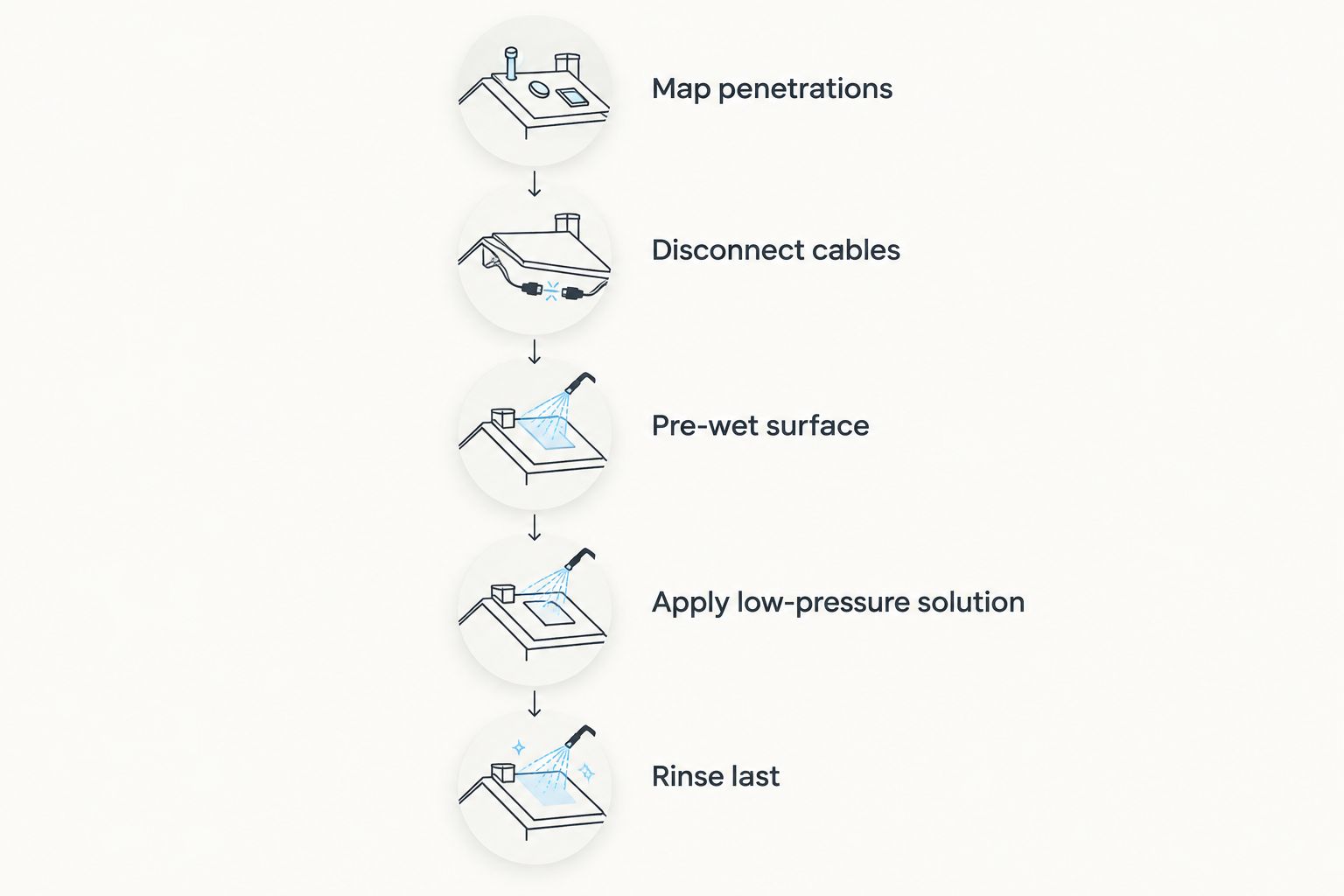
- Walk the roof first and map every penetration — dish mounts, plumbing vents, exhaust caps, and any cable runs. Note which ones have visible corrosion or loose flashing before you apply anything.
- Disconnect or loosen cable connectors at the dish if they're accessible, so pooling water at the F-connector doesn't wick into the line. If the connector is sealed and weatherproofed, leave it and just avoid direct spray.
- Pre-wet the surrounding shingles or metal with plain water at low pressure to prevent the cleaning solution from drying on contact and streaking.
- Apply the soft wash mix at an angle, not straight-on, letting it run down and around the mount rather than pooling against the base. Most soft wash systems run well under 500 PSI for this reason — the chemical, not the pressure, breaks down moss and algae.
- Let the solution dwell 5 to 10 minutes before rinsing, which is enough time for it to lift growth without needing force near the seals.
- Rinse penetrations last, working from the ridge down so runoff carries debris away from the vent boots and dish base instead of pooling around them.
- Reconnect and check the cable connection for water intrusion before leaving the site.
Roof vents and pipe boots need the same caution
Rubber pipe boots crack with age and Alaska's cold snaps accelerate that. Treat every boot like it might already be compromised: no direct pressure, no scrubbing with a stiff brush, and a visual check afterward for cracking or gaps that a homeowner should know about before winter.
Exhaust and dryer vents get a plastic shield, not a scrub
Bathroom exhaust caps and dryer vent hoods have spring-loaded flaps that jam easily if solution dries inside them. A cheap plastic bag or shield taped loosely over the opening during the wash — then removed for the rinse — keeps chemical out of the ductwork without slowing the job down.
Why care around dishes and vents varies by roof
Not every roof needs the same level of caution. A few things change how much time and attention this step takes:
- Age of the mount hardware — older lag-bolted dish mounts corrode faster than newer stainless hardware.
- Roof pitch — steep roofs make it harder to work at an angle around a penetration without losing footing, which is exactly when shortcuts happen.
- Number of penetrations — a roof with a satellite dish, two plumbing vents, a furnace flue, and a dryer vent takes longer than a simple ranch roof with one stack.
- Existing seal condition — a boot that's already cracked from Alaska winters needs a lighter touch than a newer one.
- Cable routing — dishes with exposed cable runs along the roof deck need the line protected too, not just the mount.
- Wildlife activity — birds and squirrels sometimes nest near vent openings, which adds a debris-clearing step before any solution goes down.
Get your roof washed without the guesswork
Alaska Moss Doctor treats every vent and dish mount as its own zone during the wash.
Does pressure washing damage satellite dish alignment?
Direct pressure can knock a dish out of alignment if the spray hits the dish face or the LNB arm at close range, which is why the wand angle matters more than the settings. A soft wash approach that never points straight at the dish avoids this entirely, and most alignment issues traced back to a roof wash come from rushed jobs, not the cleaning solution itself.
Can moss growing near a vent damage the seal?
Yes — moss holding moisture against a pipe boot or vent flashing accelerates the seal's breakdown, especially in a climate with repeated freeze-thaw cycles like the Mat-Su Valley sees every year. That's one reason removing moss without damaging shingles around penetrations matters as much as clearing the open field areas of the roof.
Should I remove the satellite dish before a roof wash?
No, removal isn't necessary for a standard soft wash in 2026 — a trained crew works around a mounted dish without disconnecting it from the pole, only disconnecting the cable when the connector is exposed. Full removal is only worth considering if the mount itself is being replaced or the roof section under it needs repair.
FAQ
How do you clean around a satellite dish during a roof wash?
Pre-wet the area, apply soft wash solution at an angle away from the mount, let it dwell 5 to 10 minutes, then rinse the dish area last so runoff doesn't carry debris into the mount or cable connector.
Is it safe to pressure wash near roof vents?
Direct pressure near a roof vent boot is not safe because it can force water under the seal. A soft wash approach at low pressure, angled away from the boot, is the safer method used on most residential roofs in 2026.
Will roof cleaning damage my satellite dish signal?
Roof cleaning shouldn't affect signal if the LNB and dish face are kept out of direct spray. Signal issues usually trace back to a bumped alignment from careless wand handling, not the cleaning chemical.
Do I need to disconnect my satellite dish before a roof cleaning?
No, disconnection isn't required for a standard soft wash. Crews work around a mounted, connected dish and only loosen an exposed cable connector if it sits in a spot likely to pool water.
How long does it take to clean around vents and dishes on a roof?
It adds time relative to open roof sections, since each penetration gets mapped, pre-wetted, and rinsed separately rather than blasted in one pass. The exact time depends on how many penetrations the roof has and their condition.
Can moss around a vent cause a roof leak?
Yes, moss holding moisture against a pipe boot or flashing accelerates seal breakdown and can lead to a leak, especially through repeated Alaska freeze-thaw cycles. Clearing moss from around penetrations protects the seal as much as it protects the shingles.
What PSI is safe for cleaning around roof penetrations?
Soft wash systems typically run well under 500 PSI, and around vents and dish mounts the working pressure should be even lower, closer to a garden-hose rinse. The cleaning solution does the work of breaking down moss and algae, not the water pressure.
Should exhaust vents be covered during a roof wash?
Covering a dryer or bathroom exhaust vent with a loose plastic shield during the solution application keeps chemical out of the ductwork and spring-loaded flap. The cover comes off before the final rinse so no residue gets trapped inside.
One last thing
The detail most homeowners never check is the cable connector at the base of a satellite dish — a weatherproofed F-connector that's already cracked from UV exposure will let water in during any wash, soft or pressure, and it has nothing to do with the crew's technique. Have it inspected once a season if the dish is more than a few years old, separate from whatever roof cleaning schedule is running.