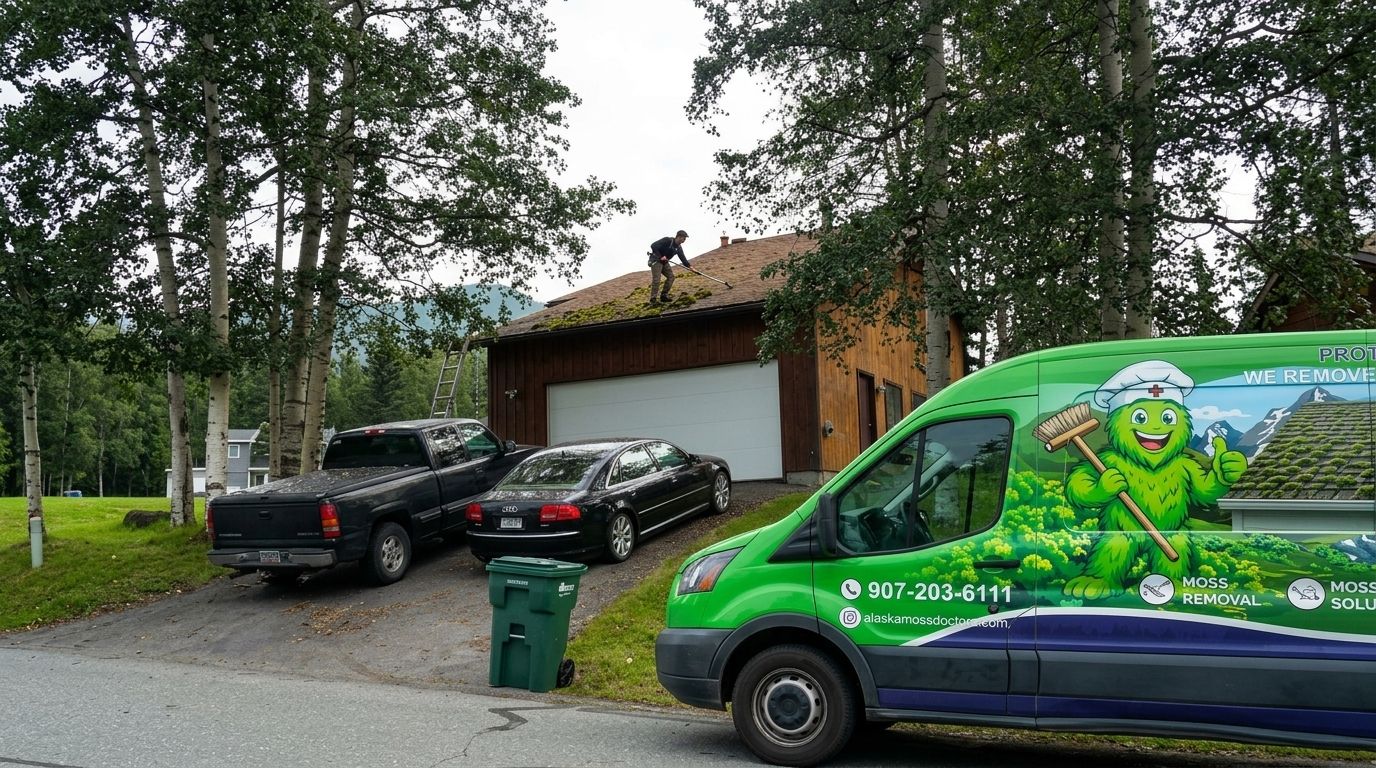
A detached garage roof collects moss faster than the main house roof because it usually sits lower, catches more shade from trees, and gets fewer eyes on it during a normal walk around the property. Moss removal detached garage roof work follows the same core steps as house roof cleaning, but the smaller footprint, lower pitch, and frequent proximity to overhanging branches change what actually needs attention first.
- Detached garage roofs in the Wasilla area grow moss faster than attached roofs because of shade and lower foot traffic for inspection.
- Soft washing beats pressure washing on asphalt shingle garage roofs — high-pressure spray lifts granules and shortens shingle life.
- Alaska Moss Doctor treats garage roofs as a standard add-on to house roof cleaning, not a separate specialty job.
- Spring and early fall are the two windows for moss removal detached garage roof work in Alaska's climate.
- Gutter clogging on garages tends to go unnoticed longest, so check downspouts every time you clean the roof.
Why moss removal matters for detached garage roofs
A detached garage doesn't get the same casual attention as the house. Nobody looks up at it while getting the mail, and the north-facing slope often sits in permanent shade from a fence line or tree row, which is exactly the condition moss needs to establish and spread. Left alone, moss holds moisture against the shingles or decking through freeze-thaw cycles, and in Alaska that moisture becomes ice that lifts shingle edges and works water under the flashing.
Garage roofs are also frequently lower-pitch and lower to the ground than the main house, which makes them easier to inspect but also easier to ignore because the damage risk feels smaller. It isn't. A garage roof failure still means a full tear-off, and moss-driven rot spreads the same way whether the structure below is a bedroom or a lawn mower.
Inspect the roof before you touch it
Start every job with a walk-around, not a ladder climb. Most of what you need to know about a detached garage roof shows from the ground with binoculars or a zoom lens on your phone.
- Check the north- and east-facing slopes first — these hold moss longest
- Look for green-black patches versus gray-green lichen (different removal approach)
- Note any curled, cracked, or missing shingles near moss clusters
- Check where tree branches overhang within 6-10 feet of the roofline
- Photograph problem areas before cleaning so you can confirm the improvement after
If you're unsure whether what you're seeing is a maintenance issue or already structural, this guide on spotting whether your roof needs moss removal walks through the visual signs worth acting on now versus monitoring.
Clear overhead debris and trim back branches
Moss needs shade and moisture to establish, and overhanging branches supply both. Cutting back growth over a detached garage is often the single highest-impact step because it's the one that prevents regrowth instead of just treating the current problem.
- Trim branches back at least 6 feet from the roofline where possible
- Rake needle and leaf buildup out of valleys and along the eaves
- Clear moss debris from the ground perimeter so spores don't recolonize
- Check for squirrel or bird nesting material packed into gutters
Rinse and hand-scrape loose growth
Before any chemical treatment, a low-pressure rinse and gentle hand-scraping removes the bulk of loose moss mats. This step is entirely manual and free — no equipment beyond a garden hose, a soft-bristle roof brush, and a stable ladder setup.
- Work from the ridge down, never scrub upward against the shingle grain
- Use a plastic or soft-bristle brush, never a metal scraper on asphalt shingles
- Rinse at garden-hose pressure only — never a pressure washer nozzle at this stage
- Bag and remove scraped moss instead of letting it wash into the gutters
Apply a moss treatment solution
Once loose material is gone, a treatment solution kills the root structure that regrows within weeks if skipped. Homeowners can buy a zinc- or potassium-salt-based moss killer at most hardware stores and apply it with a pump sprayer on a dry, calm day.
- Choose a shingle-safe treatment labeled for roof use, not a lawn moss killer
- Apply on a dry day with no rain forecast for at least 24 hours
- Cover nearby plants and grass before spraying to avoid runoff damage
- Reapply per the product label if regrowth appears within the season
This is the point where a professional soft wash service becomes the faster path if you'd rather not spend a weekend on a ladder. Alaska Moss Doctor applies a low-pressure, shingle-safe soft wash treatment that combines the rinse, scrape, and treatment steps into one visit, which matters most on steep or awkward garage rooflines where DIY ladder work gets genuinely risky.
Soft wash instead of pressure wash
High-pressure washing is the most common mistake on garage roofs specifically, because the smaller roof feels like a quick job for a rented pressure washer. It isn't — the same PSI that strips moss also strips shingle granules, and once granules are gone the shingle's UV protection is gone with them.
- Keep any spray under 1,500 PSI if pressure washing at all
- Prefer a soft wash (low pressure, chemical solution) over mechanical force
- Never aim a pressure washer directly upward under shingle tabs
- Test a small, hidden section first if using an unfamiliar product
For a deeper comparison of methods suited to Alaska's freeze-thaw climate specifically, see the best roof cleaning method for moss in Alaska's climate.
Clean and check the gutters last
Garage gutters clog quietly because nobody checks them as often as the house gutters. Moss debris from the roof above compounds the problem, and a clogged garage gutter backs water up under the shingle edge exactly where ice dams form in winter.
- Flush downspouts with a hose after clearing debris by hand
- Check for granule buildup in the gutter bottom (a sign of over-aggressive cleaning upstream)
- Confirm downspouts direct water at least 3-4 feet from the garage foundation
- Look for sagging gutter sections pulling away from the fascia
Schedule a follow-up treatment window
Moss removal isn't a one-time fix on a shaded detached garage roof — it's a maintenance cycle. Spring, after snowmelt clears the roof surface, and early fall, before the first freeze, are the two windows that make the most sense in Alaska.
- Set a calendar reminder for spring and fall inspections, not just when moss is visible
- Budget for an annual treatment application on north-facing or heavily shaded slopes
- Track which slopes need attention every cycle versus which stay clean year to year
- Re-trim overhanging branches annually as part of the same schedule
Get your garage roof assessed
Alaska Moss Doctor covers detached garage roofs as part of standard Wasilla-area roof cleaning visits.
Comparing your options for a detached garage roof
| Option | Best for | Key limitation |
|---|---|---|
| Hand-scrape and rinse | Light moss, low-pitch roofs, one-time cleanup | Doesn't kill roots — regrowth in weeks without treatment |
| DIY moss-killer spray | Homeowners doing routine seasonal maintenance | Requires repeat application and careful timing around rain |
| Rented pressure washer | Never recommended on shingle roofs | Strips granules, voids most shingle warranties |
| Professional soft wash | Steep, shaded, or hard-to-access garage roofs | Costs more than DIY per visit, though it covers root-kill and prevention in one pass |
The verdict: for a flat, easy-access detached garage roof with light moss, hand-scraping and a treatment spray handles it. For anything steep, shaded, or already showing lifted shingles, a professional soft wash is the safer call — see how a moss removal service handles steep or high roofs for what changes when access gets harder.
Common mistakes on detached garage roofs
- Skipping inspection because it's "just the garage" — moss-driven rot on a garage roof still means a full deck replacement, not a cheaper fix
- Using a full-power pressure washer on asphalt shingles — this is the fastest way to strip granules and cut years off shingle life
- Ignoring branch overhang — treating the moss without trimming the shade source guarantees regrowth within a season
- Forgetting the gutters — garage downspouts clog invisibly and back water up under shingles through Alaska winters
- Treating once and stopping — a shaded slope needs a repeat cycle every spring and fall, not a single annual pass
FAQ
How is moss removal detached garage roof work different from house roof cleaning?
The steps are the same — inspect, clear debris, rinse, treat, soft wash — but detached garages sit lower and shadier, so moss returns faster without regular trimming and a repeat treatment schedule.
Can I pressure wash moss off a garage roof myself?
High-pressure washing is not recommended on asphalt shingle roofs because it strips protective granules; a soft wash under 1,500 PSI or hand-scraping is the safer method.
How often does a detached garage roof need moss treatment in Alaska?
Shaded or north-facing garage roofs typically need treatment twice a year, once in spring after snowmelt and once in early fall before the first freeze.
Does moss actually damage a garage roof, or is it just cosmetic?
Moss holds moisture against shingles through freeze-thaw cycles, which lifts shingle edges and lets water reach the decking underneath over time.
Is a detached garage roof cheaper to clean than the main house roof?
Cost depends on roof size, pitch, and access, not whether the structure is attached; a small, steep, or overgrown garage roof can cost as much per square foot as a house roof.
What's the best time of year to remove moss from a garage roof in Alaska?
Spring after snowmelt and early fall before freeze are the two practical windows; see the seasonal guide for exact timing considerations in the Mat-Su Valley.
Do gutters on a detached garage need special attention during moss removal?
Yes — garage gutters clog quietly since they get checked less often than house gutters, and debris from roof cleaning compounds the risk of ice dam backup.
One last thing
The slope people skip checking on a detached garage is usually the one facing away from the driveway, since that's the side nobody sees on the way to the car. That's almost always the shadiest slope and the one carrying the heaviest moss growth by the second year — make it the first thing you check, not the last.