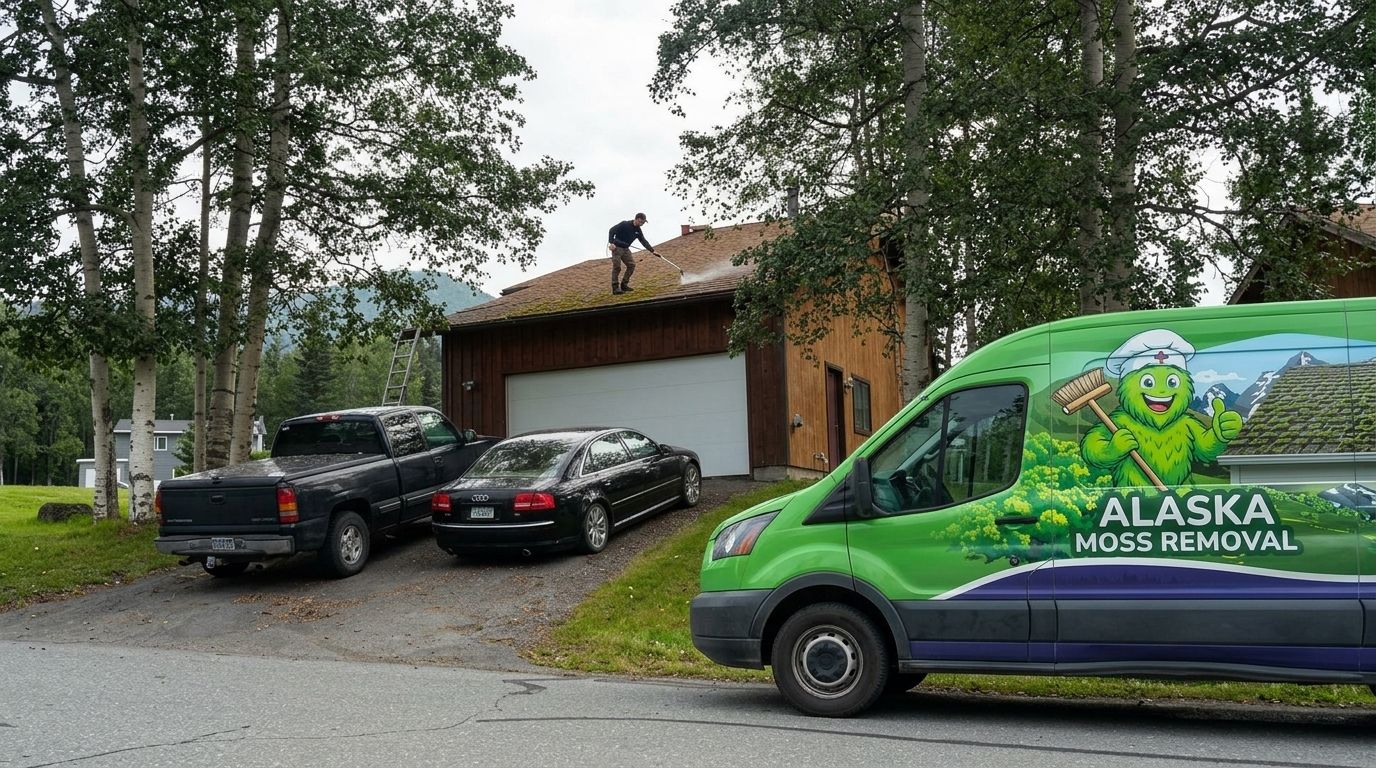
Eco-friendly moss removal in Alaska is roof and exterior cleaning that kills moss and algae without harsh bleach runoff, protecting wells, pets, and landscaping across the Mat-Su Valley's wet, shaded climate. Homeowners in Wasilla and the surrounding valley deal with north-facing roofs that stay damp for months, and a treatment that strips paint or poisons a garden bed isn't a fix — it's a second problem.
- Eco-friendly moss removal alaska means low-pressure soft washing under 500 PSI with plant-safe, biodegradable solutions instead of straight bleach.
- Alaska Moss Doctor uses rinse-controlled soft wash methods built for Wasilla's shaded, moisture-heavy roofs.
- Spring and early fall are the two safest treatment windows before winter snow load sets in.
- DIY vinegar washes work on light growth but won't stop regrowth on established moss mats.
- Untreated moss on a shaded Alaska roof typically returns within a year without a follow-up treatment.
Why eco-friendly moss removal matters for Alaska homeowners
Mat-Su Valley homes sit under spruce canopy, get long shaded winters, and dry out slowly compared to lower-latitude climates — moss doesn't just grow here, it thrives here. Many properties in the area also run on private wells, and whatever runs off a roof during cleaning ends up in the yard, the ditch, or eventually the groundwater.
That's the real reason eco-friendly moss removal is its own category and not a marketing label. Straight sodium hypochlorite at high concentration kills moss, but it also strips landscaping, discolors metal fixtures, and can move into soil around foundations and wells. Homeowners searching for eco-friendly moss removal alaska are usually trying to solve two problems at once: get the roof clean and keep the property safe for kids, pets, and the water supply. Roof moss removal for Wasilla, Alaska homeowners covers the local growth pattern in more depth if you want the climate context first.
Identify the growth before it spreads
Moss on an Alaska roof rarely stays put — it starts in shaded valleys and north slopes, then migrates toward ridgelines as spores spread with wind and runoff.
- Check north-facing roof planes and anywhere tree canopy blocks afternoon sun
- Look for green-black patches at shingle tabs and around vent boots
- Inspect gutters for granule buildup, a sign moss is already lifting shingle surfaces
- Note any lifted or curled shingles near moss mats — that's active damage, not cosmetic
- Check the north side of chimneys and skylights, common cold spots
How to tell if your roof needs moss removal walks through the visual checklist in more detail.
Choose a method that protects your yard and water source
The method matters more than the product name. Soft washing runs under 500 PSI and relies on dwell time and a diluted, biodegradable solution to break moss loose rather than blasting it off with force — that's the difference between an eco-friendly approach and a pressure washer aimed at a shingle roof.
- Ask any contractor whether they run soft wash (low pressure, chemical dwell time) or straight pressure washing
- Request a plant-safe, biodegradable solution rather than undiluted bleach
- Cover or pre-wet sensitive plant beds directly below roof runoff lines
- Confirm the crew rinses gutters and downspouts as part of the service, not as an afterthought
- Skip any method that requires a scraper or wire brush on asphalt shingles — that voids most manufacturer warranties
Time the treatment around Alaska's wet season
Spring and early fall give the best results because the roof isn't frozen, isn't buried in snow load, and has enough dry-out time afterward for the treatment to work fully.
- Schedule spring treatment once snowmelt clears the roof deck
- Book early fall treatment before the first hard frost locks moisture into shingle mats
- Avoid treating a roof during active rain — dwell time gets washed away before it works
- Skip mid-winter service entirely; ice and snow load make roof access unsafe
- Check Best time of year for roof moss removal in Alaska before locking in a date
Apply the treatment without damaging shingles or siding
This is where DIY attempts go wrong most often — too much pressure, the wrong chemical concentration, or no rinse plan for runoff.
- Test any solution on a small hidden shingle section first
- Keep pressure under 500 PSI on asphalt shingles and painted siding
- Allow full dwell time before rinsing — most eco-friendly solutions need time, not force, to work
- Rinse from the ridge down, following the natural water flow of the roof
- Bring in a professional soft wash crew for steep pitches or multi-story rooflines where DIY access isn't safe
Alaska Moss Doctor runs soft wash treatments built around this exact sequence for Wasilla-area roofs, which is the faster path once a roof has established moss mats rather than surface film.
Protect landscaping, wells, and pets during the job
Runoff control is the actual eco-friendly part of the job — the solution matters less than where it ends up.
- Cover flower beds and shrubs directly under roof runoff
- Keep pets and kids off treated surfaces until the rinse cycle is complete
- Divert runoff away from vegetable gardens and shallow wells
- Ask for a solution with a short breakdown time in soil and water
Prevent regrowth instead of repeating the full treatment
A single cleaning without a prevention step is a temporary fix. Untreated moss on a shaded Alaska roof typically returns within a year in a climate this wet.
- Apply a zinc or copper-based preventive treatment after cleaning
- Trim back overhanging branches to cut down shade and moisture retention
- Keep gutters clear so water doesn't pool at roof edges
- Schedule a follow-up inspection before the next wet season starts
- Review Best moss prevention treatment for shaded roofs for treatment options that hold up longest
Get a soft wash quote for your roof
Alaska Moss Doctor serves Wasilla and the Mat-Su Valley.
Comparison: eco-friendly moss removal options for Alaska homes
| Option | Best for | Key limitation |
|---|---|---|
| DIY vinegar or oxygen bleach wash | Light surface film on a low-slope, easily accessible roof | Doesn't reach root mats; regrowth is common within a season |
| Straight pressure washing | Concrete walkways and driveways only | Damages asphalt shingles and painted siding; not eco-friendly on runoff |
| Bleach-based chemical treatment | Fast kill on heavy growth, non-eco-conscious properties | Runoff risk to wells, pets, and landscaping |
| Professional soft wash (Alaska Moss Doctor) | Established moss mats, steep or shaded roofs, well-water properties | Requires scheduling around dry weather windows |
Verdict: for established moss on a shaded Wasilla roof with a well nearby, professional soft washing is the only option that clears growth without pushing chemicals into the yard. DIY vinegar washes are fine for light film on a roof you can safely reach — treat anything past that as a job for a soft wash crew.
Common mistakes Alaska homeowners make
- Using full-strength bleach because it's what's on hand — it works, but it kills grass, discolors siding, and can reach a well faster than expected.
- Pressure washing instead of soft washing — high PSI lifts shingle granules and shortens roof life, even when the moss comes off.
- Treating in December — ice, snow load, and frozen shingles make the job both unsafe and ineffective; the solution won't dwell properly on a frozen surface.
- Skipping the prevention step — a clean roof with no zinc or copper strip reverts to moss cover within a year in shaded Mat-Su Valley conditions.
- Ignoring gutters during the roof job — moss debris and granules collect in gutters and cause the same runoff problem the eco-friendly wash was meant to avoid.
FAQ
What makes moss removal eco-friendly in Alaska?
Eco-friendly moss removal uses low-pressure soft washing (under 500 PSI) with diluted, biodegradable solutions instead of full-strength bleach, protecting wells, pets, and landscaping from runoff. It also relies on dwell time rather than force to break moss loose from shingles.
Is soft washing safe for asphalt shingle roofs?
Yes, soft washing is built specifically for asphalt shingles because it stays under 500 PSI and doesn't lift granules the way high-pressure washing does. Pressure washing an asphalt roof voids most manufacturer warranties.
How often does moss need to be removed from an Alaska roof?
Shaded, north-facing roofs in the Mat-Su Valley often need treatment every year or two, while sunnier or steeper roofs can go longer between services. A prevention treatment after cleaning extends that interval.
Can I remove moss myself without damaging my roof?
Light surface moss can be treated with a diluted vinegar or oxygen bleach wash and a soft brush, but established moss mats usually need professional soft washing. DIY pressure washing is the most common cause of shingle damage on Alaska roofs.
What is the best time of year for moss removal in Alaska?
Spring after snowmelt and early fall before the first frost are the two safest windows for treatment in 2026. Both give the roof enough dry time afterward for the solution to fully work.
Does eco-friendly moss removal cost more than standard chemical treatment?
Cost depends on roof size, pitch, and access, so ask any local contractor for a direct quote rather than relying on a general figure. The bigger cost difference usually shows up later, in landscaping or shingle damage from a non-eco method.
Will eco-friendly treatment harm my well water?
A properly diluted, biodegradable soft wash solution with runoff control is designed to minimize risk to nearby wells, but any contractor working near a well should confirm their runoff plan before starting. Full-strength bleach carries far higher risk.
One last thing
The detail most homeowners miss: moss doesn't just sit on top of shingles, it holds moisture against the granule layer and speeds up shingle wear from underneath, so a roof that looks fine after a quick surface clean can still be losing years of life if the prevention step gets skipped. Soft washing plus a zinc or copper strip in the same visit is the only combination that actually stops the yearly regrowth cycle in a climate this wet.