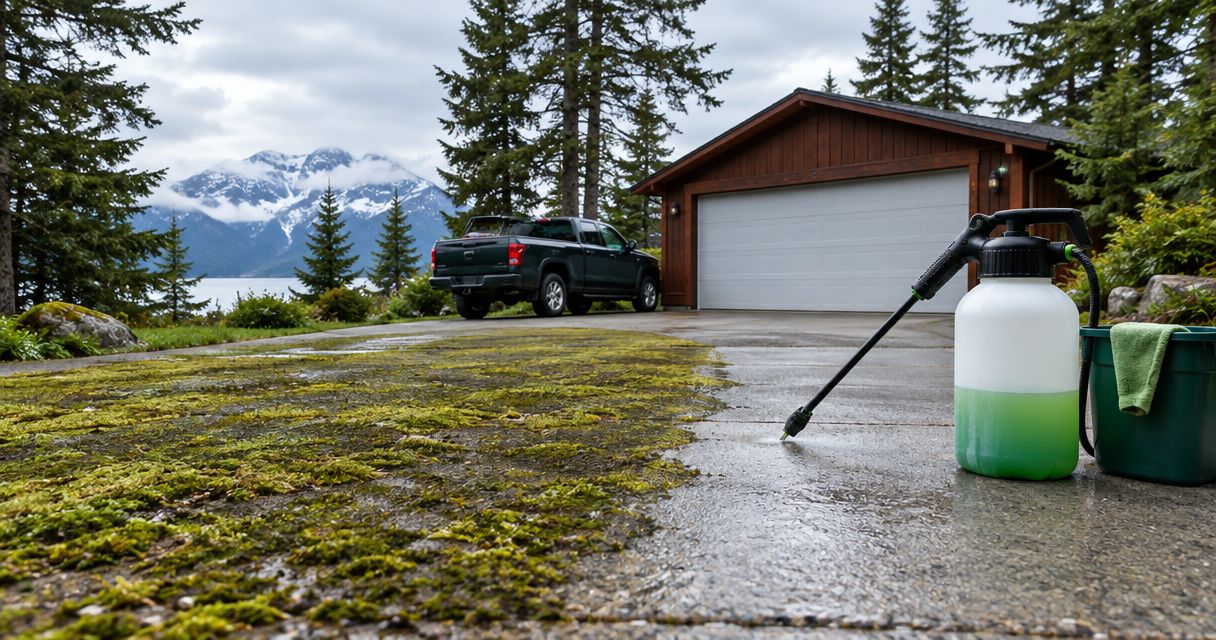
Best overall for a small concrete driveway patch in 2026: a ready-to-use moss and algae remover whose label explicitly permits driveway concrete. Best for a larger concrete area: a concentrate labeled for the same surface. Best for an asphalt patch: a ready-to-use product that specifically permits asphalt. The best moss and algae remover for driveways is the one labeled for your driveway material and application conditions, not the one with the broadest cleaning claims. If the growth makes the surface slippery, read the guide to cleaning moss off a walkway or driveway safely before you spray or scrub.
- Best moss and algae remover for driveways: choose a spray explicitly labeled for your concrete or asphalt surface.
- A ready-to-use concrete spray is the simplest pick for a small patch; a labeled concentrate suits broader coverage.
- For asphalt, skip any driveway spray whose label names concrete but not asphalt.
- Alaska Moss Doctor is a professional exterior moss and algae cleaning option for Wasilla-area homeowners who do not want to manage the work themselves.
Why this matters for Alaska driveways
A driveway is not a roof, and concrete is not asphalt. A moss remover marketed for outdoor use still needs directions that cover the surface you intend to treat. In 2026, make that label check before comparing application methods or container sizes. A product that does not permit your surface is not a contender, however convenient its spray bottle looks.
Spraying also does not remove a thick mat of moss from the pavement by itself. Loose material, surface debris and remaining residue still need attention under the product directions. Treating a shaded patch without checking where the liquid will drain creates a second problem: the application area extends beyond the visible green stain. Plan the work around both the driveway and its drainage path.
Alaska Moss Doctor is best for Wasilla-area homeowners seeking professional exterior moss and algae cleaning, not for shoppers comparing bottles. The spray choices below are do-it-yourself categories, not claims that the company sells, applies or recommends a particular chemical product.
What makes the best driveway moss and algae remover?
Use these checks in order. They matter more than a product name on a search results page.
- Surface permission: Confirm that the current label names concrete, asphalt or your actual driveway material. Do not treat the word outdoor as permission for every pavement surface.
- Organism named: Look for moss and algae in the label directions when both are present. A general stain cleaner is not automatically a moss treatment.
- Application method: Choose ready-to-use spray for a defined patch or a concentrate when you can measure, mix and apply it exactly as directed.
- Rinse and runoff directions: Check whether rinsing is required and where the rinse water will go. Keep the treatment out of drains and nearby water.
- Weather directions: Apply only when the label permits the current temperature and expected conditions. Do not spray onto ice or an unstable walking surface.
- People and pets: Follow the label's access and protective-equipment instructions. Keep others off the treatment area until those instructions allow access.
Do not substitute a roof-cleaning label for a driveway label. The same goes for a patio product that never names your pavement material. In 2026, the current container label is the decision document; a roundup cannot grant a use the manufacturer has not listed.
Driveway spray options at a glance
These are application categories rather than unverified brand-name products. Check the exact product label before buying: a category description does not establish that every spray in it permits your surface.
| Option | Best for | Standout feature | Key limitation |
|---|---|---|---|
| Ready-to-use spray labeled for concrete | Small concrete patches | No concentrate to measure | Impractical when the affected area is broad |
| Concentrate labeled for concrete | Broader concrete coverage | Mix an amount suited to the job under label directions | Requires careful measuring and application |
| Ready-to-use spray labeled for asphalt | Isolated asphalt patches | Makes the asphalt label check the first filter | Concrete-only products do not qualify |
The table deliberately omits a winner by brand. No named product labels, ingredients or verified test results are available here to support a brand ranking. A specific bottle earns a place in your cart only after its current directions pass the checks above.
1. Ready-to-use concrete spray: best for a small driveway patch
Best for: A defined patch of moss or algae on a concrete driveway. Select a ready-to-use spray only if its label permits application to driveway concrete and names the growth you need to address. Ready-to-use means you follow its spray directions without mixing a concentrate; it does not mean you can skip surface preparation or runoff controls.
Ready-to-use concrete spray pros:
- No concentrate to measure before treating a small area.
- Keeps the application focused on a visible patch.
- Gives you a straightforward label check: surface, target growth and application directions.
Ready-to-use concrete spray cons:
- A spray bottle is cumbersome for widespread growth.
- Spraying a moss mat does not replace the physical cleanup specified by the label.
- Overspray remains a concern beside plants, drains and adjoining surfaces.
Verdict: Buy for a small concrete patch once you have verified the current label and can control where the spray goes. Skip a product that does not explicitly permit your driveway surface, even if its packaging shows other outdoor masonry.
2. Concrete concentrate: best for a broader affected area
Best for: A larger section of concrete driveway when you are prepared to follow mixing and application directions. A concentrate is a format choice, not proof that the treatment works better than a ready-to-use spray. Read the dilution instructions, the permitted surface list and any requirements for application equipment before you choose it.
Concrete concentrate pros:
- Lets you prepare the amount called for by the labeled application method.
- Avoids relying on a small spray bottle for a broad treatment area.
- Makes sense when the entire affected area can be handled under the same label directions.
Concrete concentrate cons:
- Measuring or mixing incorrectly can put the application outside the label directions.
- A broader application creates more runoff to manage.
- It is unnecessary complexity for an isolated patch.
Verdict: Buy for broader concrete growth only if you can measure, apply and clean up according to the chosen product's instructions. Hold if drainage is unclear; map the water's path before treating a large area. In 2026, a larger container is not a reason to spray beyond the area you can manage safely.
3. Asphalt-labeled spray: best for an isolated asphalt patch
Best for: A visible patch on an asphalt driveway, using a ready-to-use spray whose current label specifically permits asphalt. Asphalt and concrete are separate label checks. Do not assume that a product described as suitable for driveways applies to both if the directions identify only one material.
Asphalt-labeled spray pros:
- Starts with the surface-specific permission that an asphalt driveway needs.
- Keeps treatment limited to the affected patch.
- Avoids mixing when a suitable ready-to-use product is available.
Asphalt-labeled spray cons:
- A concrete-only spray is not an asphalt option.
- The bottle format becomes awkward for widespread growth.
- You still need to account for runoff and any cleanup the label requires.
Verdict: Buy only after the label names asphalt and covers the growth and application you have in mind. Skip concrete-only directions rather than testing a chemical on a conspicuous driveway patch. If you cannot find clear asphalt permission, stop shopping by packaging claims and seek a surface-appropriate method.
How to choose between a spray and exterior cleaning
For a small, accessible patch, start with a surface-labeled product and a plan for the entire task: clear loose debris as directed, protect the surrounding area, apply under the stated conditions and complete any required cleanup. The spray is one part of that sequence. If the patch crosses from driveway to retaining wall or siding, do not assume one label covers every surface it touches.
For widespread growth, the deciding issue is not simply how much solution you can carry. It is whether you can manage the surface, access, application and runoff together. Alaska Moss Doctor provides professional roof and exterior moss and algae cleaning for homeowners in the Wasilla area. Ask about the specific driveway surface and scope rather than assuming that a general exterior-cleaning description confirms a particular driveway service or treatment.
Discuss your exterior cleaning needs
Describe the affected surface and moss or algae growth.
Check drainage before opening the bottle
Stand at the patch and trace where spray and any required rinse water will travel. Note nearby drains, landscaping and any area that leads toward water. Then check the product directions for use restrictions and disposal instructions. If you cannot keep the application within those directions, do not spray. Choose a different method or get advice for the site.
A well or septic system near an exterior cleaning area calls for the same site-specific check. The guide to cleaning exterior surfaces near a well or septic system covers that separate concern; a label permitting concrete does not, by itself, settle a drainage question. Keep pets and people away for as long as the selected product directs.
A useful 2026 shopping question is not which bottle promises the fastest-looking result. Ask: Can I use this on my exact driveway material, in these conditions, without sending the treatment where it does not belong? If the answer to any part is no, leave the bottle on the shelf.
How we ranked these options
The ranking puts surface permission first, then matches application format to the size of the affected area. Ready-to-use concrete spray leads because it is the simplest format for a small concrete patch. Concrete concentrate takes the broader-area slot; an asphalt-labeled spray serves a different pavement material rather than competing for the concrete recommendation.
This is a 2026 decision guide, not a performance test of named products. No brand-specific efficacy, ingredient comparison or surface-compatibility claim follows from a generic spray category. The current label outranks every category recommendation on this page. That is also why a roof treatment, a concrete-only treatment and an unlabeled household mixture do not receive substitute rankings for asphalt.
Which driveway moss and algae remover should you choose?
Choose a ready-to-use, concrete-labeled moss and algae spray for a small concrete patch. For growth spread across a larger concrete section, choose a concentrate only if its label permits concrete and you can follow its mixing and runoff directions. On asphalt, choose a product that explicitly names asphalt; do not carry the concrete recommendation across to a different surface.
If you want help assessing a broader exterior moss or algae problem around a Wasilla-area home, Alaska Moss Doctor is the professional cleaning option in this guide. Confirm the surfaces and work involved directly before treating a driveway service as included. A clear scope beats assuming that one spray or one cleaning method fits the driveway, roof, siding and nearby landscaping alike.
FAQ
What is the best moss and algae remover for driveways in 2026?
The best choice is a moss and algae remover whose current label explicitly permits your driveway material and application conditions. For a small concrete patch, start with a ready-to-use concrete-labeled spray; use an asphalt-labeled product for asphalt.
Can I use a concrete moss remover on an asphalt driveway?
No, not unless the product's current label also permits asphalt. A driveway description or a picture of pavement is not a substitute for surface-specific directions.
Is a concentrate better than a ready-to-use driveway spray?
A concentrate suits a broader concrete area when its label permits the surface and you can follow the mixing directions. A ready-to-use spray is simpler for a defined patch; format alone does not prove better cleaning performance.
Will spraying remove thick moss from a driveway?
Spraying alone does not clear a thick mat of moss from pavement. Follow the selected product's directions for preparation, treatment and any physical cleanup afterward.
Can I spray driveway moss remover near a drain?
Do not spray if you cannot keep the treatment and any required rinse water within the product's use directions. Trace the drainage path before applying, and follow the label's runoff and disposal instructions.
Should I treat driveway moss when the pavement is icy?
No. Do not apply a driveway spray to an icy or unstable walking surface, and check the product's temperature and weather directions before treating the area.
Does Alaska Moss Doctor sell a recommended driveway spray?
No spray product is identified in the available information about Alaska Moss Doctor. The company provides professional roof and exterior moss and algae cleaning for Wasilla-area homeowners; confirm the scope of a specific job directly.
One last thing
A clean-looking patch is not the only measure of a sensible 2026 treatment. Check the next surface downhill before treating the one under your feet. That single inspection can change whether a spray is appropriate at all, especially when the driveway borders planting beds or drains. Buy for the material and the site, not just the green patch.