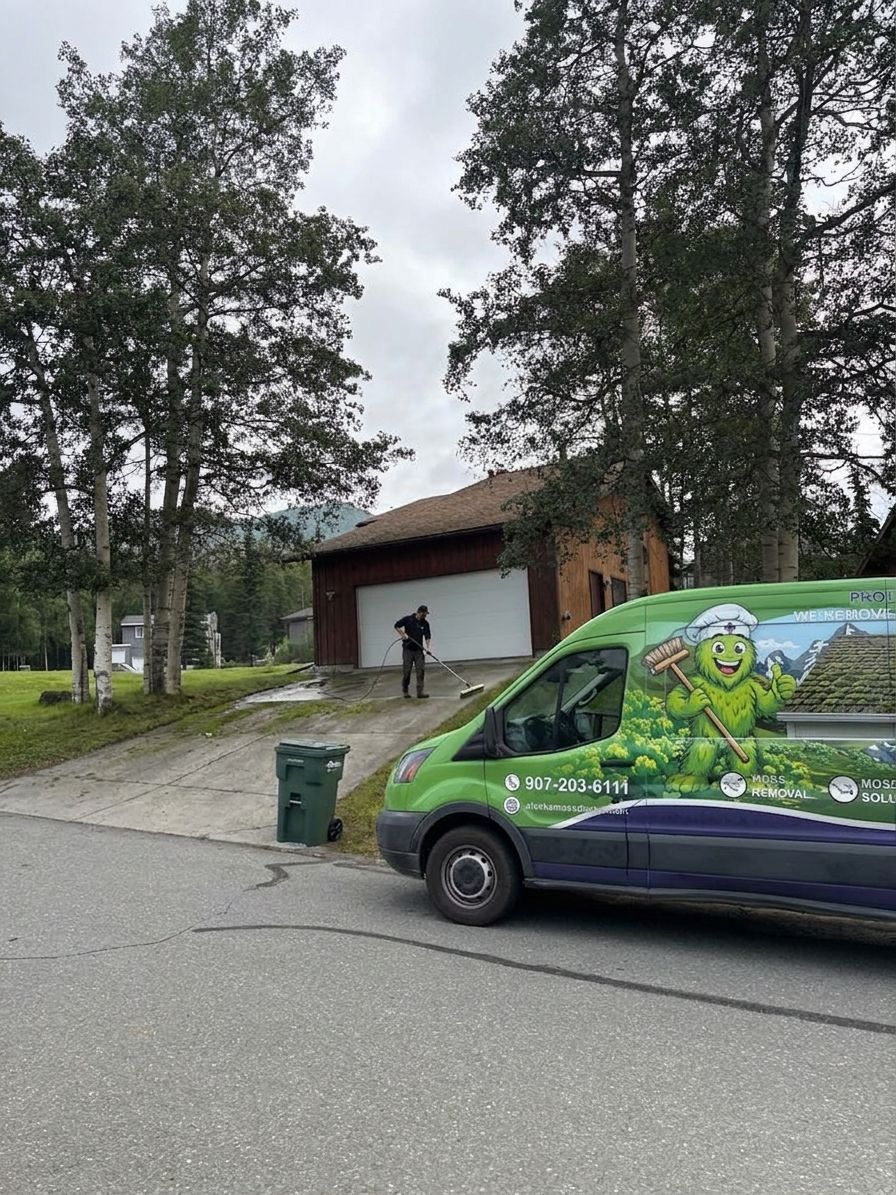
Moss on a walkway or driveway turns slick the moment it rains or frost hits it, and in the Mat-Su Valley that's most of the year. The fix is straightforward: scrape the loose growth, apply a diluted cleaner at low pressure, scrub the joints, and rinse before the surface freezes again — but skip the scraping step and you'll just push spores deeper into the concrete's pores, guaranteeing a repeat job by spring 2026.
- Scrape loose moss first, then wash at under 2,000 PSI to answer how to clean moss off walkway safely without pitting concrete.
- A bleach solution diluted 1:3 with water kills moss on hard surfaces but will burn grass along the edges if it runs off.
- Pavers and brick need 1,200-1,500 PSI max — anything higher blasts the joint sand out and the whole path shifts.
- Alaska Moss Doctor treats driveways and walkways as part of full exterior cleaning jobs in the Wasilla area, not as a standalone rental-equipment task.
- Regrowth within a year is normal on shaded, north-facing walkways unless the surface gets a follow-up treatment before winter.
Why this matters
A mossy walkway isn't cosmetic — it's a liability. Wet moss has close to zero traction, and a fall on a concrete path is a harder landing than one on grass. Beyond safety, moss holds moisture against concrete and pavers through Alaska's freeze-thaw cycles, and that moisture is what cracks slabs and pops paver joints over a few winters. Cleaning it off the right way protects the surface underneath, not just the appearance on top.
The driveway and walkway cleaning service approach differs from roof cleaning because the surface is walked on daily and usually made of concrete, pavers, or asphalt rather than shingles — the chemical strength and pressure settings both change.
How do you clean moss off a walkway or driveway safely
Follow these steps in order. Skipping the scrape step or jumping straight to high pressure is where most DIY jobs go wrong.
- Sweep and scrape first. Use a stiff push broom or a plastic scraper to knock off loose, dried moss before adding any water. Wet moss smears instead of lifting.
- Pre-treat with a moss-safe cleaner. A bleach solution diluted 1:3 with water, or a commercial moss and algae cleaner labeled safe for concrete, breaks down the organic mat. Apply with a pump sprayer and let it sit 10-15 minutes.
- Protect nearby plants and grass. Cover garden beds with plastic sheeting and wet down adjacent lawn areas first — bleach runoff kills grass fast, and that's the hidden cost most homeowners don't budget for.
- Rinse at low pressure. Concrete tolerates more force than pavers or stamped decorative surfaces, so match your pressure setting to the material (see the breakdown below).
- Scrub stubborn patches. A stiff-bristle deck brush lifts residue the sprayer alone won't move, especially in expansion joints and paver seams.
- Let it dry before foot traffic. A freshly cleaned walkway is more slippery wet than a mossy one — keep it closed off until it's dry, particularly if temperatures are near freezing.
| Method | Best for | Risk if misused | Verdict |
|---|---|---|---|
| Bleach solution + scrub brush | Concrete, asphalt | Kills grass and plants on runoff | Buy for spot treatment |
| Pressure washer, low PSI | Concrete, wide driveways | Pitting or etching if PSI too high | Buy with correct nozzle |
| Pressure washer, high PSI | Nothing on a walkway | Cracks pavers, strips paver sand joints | Skip |
| Commercial moss/algae cleaner | All surfaces, sensitive plantings nearby | Cost per gallon adds up on large driveways | Hold — use for repeat maintenance |
Concrete walkways: keep pressure under 3,000 PSI
Bare concrete is the most forgiving surface here. Consumer gas pressure washers commonly top out around 2,800-3,000 PSI, and that ceiling is fine for stripping moss off broom-finished or stamped concrete as long as you use a 25-40 degree fan tip and keep the wand moving. Standing in one spot at close range is what etches lines into the slab — the moss comes off either way, but the surface won't look uniform afterward.
Pavers and brick walkways: cap it at 1,200-1,500 PSI
Paver joints are held together with sand, not mortar, and anything above roughly 1,500 PSI blasts that sand straight out of the seams. Once the sand is gone, the pavers shift underfoot within a season. Use a wide fan tip, hold the wand higher off the surface than you would for concrete, and expect to re-sand the joints after cleaning regardless of how careful you are.
Asphalt driveways: 1,500-2,000 PSI is the safe range
Asphalt softens in warm weather and gets brittle in cold, so timing matters as much as pressure. Clean it on a cool, overcast day rather than in direct summer sun, and stay in the 1,500-2,000 PSI range with a fan tip to avoid gouging the surface.
Get your walkway cleaned professionally
Alaska Moss Doctor cleans driveways and walkways alongside roof and exterior jobs in the Wasilla area.
Why moss keeps coming back on walkways and driveways
Moss doesn't need much to re-establish once the surface is clean. A few conditions drive regrowth faster than others:
- Shade from trees or the house itself — north-facing walkways in Alaska stay damp longer even in summer 2026.
- Poor drainage or low spots where water pools instead of running off.
- Rough or pitted surfaces from over-pressure washing, which give spores more grip than a smooth slab.
- Nearby moss on the roof or siding dropping spores directly onto the path below.
- Freeze-thaw cracking, which opens new crevices for spores to settle into every winter.
- No follow-up treatment — a one-time cleaning without a preventive application just resets the clock.
Is bleach or vinegar better for cleaning moss off concrete
Bleach kills moss faster and more completely than vinegar on concrete and asphalt, though both work on light growth. Vinegar is the safer choice near grass and garden beds since it breaks down faster in soil, while bleach requires covering or pre-wetting nearby plantings to avoid killing them.
Can you pressure wash moss off a driveway without a special cleaner
Yes, plain water at the right pressure setting removes most surface moss, but it won't kill the roots or spores left behind, so regrowth shows up faster than with a chemical pre-treatment. Pairing pressure washing with even a mild dish-soap-and-bleach solution extends the clean period noticeably.
How often should a moss-prone walkway be cleaned
A shaded or north-facing walkway in the Mat-Su Valley typically needs cleaning once a year, usually in spring before the growing season restarts. Sunnier, well-drained walkways can go two to three years between cleanings.
FAQ
How do you clean moss off a walkway or driveway safely?
Scrape loose moss off first, apply a diluted bleach or moss-specific cleaner, then rinse at a pressure matched to the surface — under 3,000 PSI for concrete, 1,200-1,500 PSI for pavers. Skipping the scrape step or over-pressuring the surface causes most of the damage homeowners see afterward.
What PSI is safe for cleaning moss off concrete?
Concrete tolerates up to about 3,000 PSI with a 25-40 degree fan tip held moving across the surface. Standing in one spot at close range etches the slab even at moderate pressure.
Is bleach safe to use on a driveway to kill moss?
Bleach diluted 1:3 with water is commonly used and effective on concrete and asphalt, but runoff kills nearby grass and plants. Wetting down or covering surrounding vegetation before applying it prevents that damage.
Will pressure washing damage pavers?
Pressure above roughly 1,500 PSI strips the sand out of paver joints, which loosens the pavers over time. Keeping pressure at 1,200-1,500 PSI with a wide fan tip removes moss without disturbing the joint sand as much.
How long does it take moss to grow back on a walkway?
On a shaded or north-facing walkway, moss can return within a single season without a follow-up treatment. Sunnier, well-drained surfaces often stay clear for two to three years.
Can I use the same method on my roof and my walkway?
No — roofs need much lower pressure and a soft-wash approach to avoid lifting shingles, while walkways made of concrete or pavers tolerate higher pressure. Treating them the same risks either shingle damage on the roof or an ineffective clean on the walkway.
Does cleaning moss off a driveway make it more slippery?
Immediately after cleaning, yes — a wet, freshly stripped surface is more slippery than dried moss until it fully dries. Keep the area closed to foot traffic until it dries, especially near freezing temperatures.
One last thing
The detail most homeowners miss: moss on a walkway is often fed by moss on the roof or gutters directly overhead, so cleaning the path without addressing the source above it means the walkway gets re-seeded the next time it rains. Check the roofline and gutters before assuming the walkway job is done.