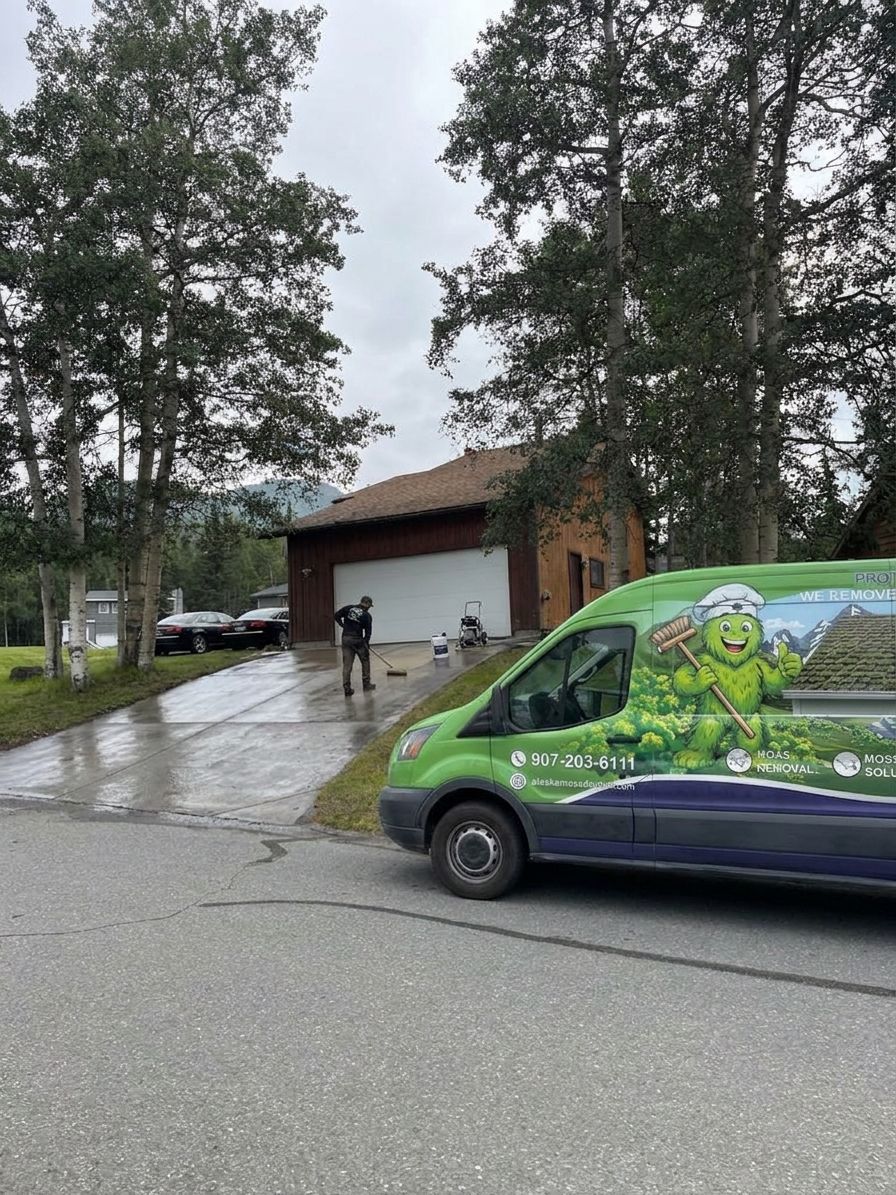
Sealing concrete after pressure washing a driveway locks out water, de-icing salt, and the moss spores that recolonize bare, porous concrete within a season. The sealant only works if the surface is completely dry first and free of the oil, mildew, or moss film the wash was supposed to remove.
- Seal concrete after pressure washing only once the surface is fully dry, usually 24 to 48 hours.
- Penetrating sealers hold up best on Alaska driveways facing freeze-thaw cycles and de-icing salt.
- Reseal every 2 to 3 years, sooner on shaded or moss-prone concrete near tree cover.
- Sealing over moss stains traps organic residue underneath and voids most sealer warranties.
Why this matters
A driveway that gets pressure washed and sealed correctly sheds water instead of soaking it in, which matters more in Wasilla than almost anywhere else in the country. Water that penetrates unsealed concrete freezes, expands, and spalls the surface over a single Alaska winter.
Skip the drying window or seal over leftover moss and algae residue, and you trap moisture and organic matter under a film that peels within one season. If your driveway or walkway already has visible moss growth before you even get to sealing, cleaning moss off a walkway or driveway safely has to happen first, not as an afterthought.
How do you seal concrete after pressure washing a driveway?
The process is the same whether you're sealing a residential driveway or a walkway, and skipping steps is the reason most DIY seal jobs fail within a year.
- Let the concrete dry fully. Give it 24 to 48 hours in warm, dry weather; longer if it's overcast, humid, or shaded.
- Check for trapped moisture. Tape a small square of plastic sheeting to the surface overnight — condensation underneath means it's not ready.
- Spot-treat what the wash missed. Oil spots, rust stains, and any remaining moss or algae film need to come off before sealant, not under it.
- Patch cracks and chips. Sealant fills pores, not structural gaps, so repair damage first.
- Apply a thin, even first coat. Roller or sprayer both work; heavy pooled coats crack and whiten (a defect called blushing) as they cure.
- Apply a second coat once the first is tack-free, typically a few hours later depending on temperature.
- Keep traffic off the surface for the full cure window, usually 24 to 72 hours before foot traffic and longer before vehicles.
| Step | What it fixes | Skip it and... |
|---|---|---|
| Drying window | Surface moisture | Sealant clouds or peels |
| Spot-treating residue | Leftover moss/oil | Stains lock in permanently |
| Crack patching | Structural gaps | Water still gets underneath |
| Two thin coats | Even coverage | Patchy sheen, weak spots |
Penetrating sealer: best for Alaska driveways
Penetrating (silane/siloxane) sealers soak into the concrete pores instead of forming a surface film, so they don't change the look of the driveway and don't peel the way topical coatings can.
- Resists freeze-thaw cracking and de-icing salt intrusion, the two biggest threats to concrete in a Mat-Su Valley winter.
- Leaves the surface matte, not glossy — less curb appeal, more protection.
- Doesn't build up film that eventually needs stripping.
Verdict: Buy for any exposed Alaska driveway or walkway that faces snowplows, studded tires, or road salt.
Acrylic (topical) sealer: best for appearance, worst for freeze-thaw
Acrylic sealers sit on top of the concrete and give it a wet, glossy look that a lot of homeowners want for curb appeal.
- Cheaper and easier to apply than penetrating sealers in a single afternoon.
- Forms a surface film that traps moisture if applied too thick or too soon after washing.
- Prone to peeling and yellowing under repeated freeze-thaw cycling.
Verdict: Hold for a shop floor or covered patio; skip it on an exposed Alaska driveway unless you're prepared to reapply it more often than a penetrating sealer.
Epoxy/polyurethane sealer: best for heavy indoor traffic
Epoxy and polyurethane systems are thicker, more durable coatings built for garage floors and commercial slabs, not open driveways.
- Handles heavy vehicle traffic and chemical spills better than either alternative above.
- Requires more careful surface prep and application than a roll-on sealer.
- Can become slick when wet or icy, a real problem on an exposed driveway.
Verdict: Skip for an outdoor Alaska driveway; this belongs on a garage floor, not pavement that sees snow and ice.
Why drying time and reseal frequency vary
The 24-to-48-hour window and the 2-to-3-year reseal interval are averages, not fixed numbers. A handful of site conditions push them in either direction:
- Ambient temperature — cooler air slows evaporation and stretches the drying window.
- Sun exposure vs. shade — a driveway under tree cover dries slower and grows moss back faster.
- Concrete age and porosity — older, more porous concrete absorbs sealant faster but also traffic salt and moisture faster.
- Recent precipitation — rain the day before pressure washing means longer drying time, not shorter.
- Foot and vehicle traffic volume — high-traffic driveways wear sealant down faster and need more frequent reapplication.
- Proximity to moss-prone landscaping — driveways bordered by moss-covered retaining walls or shaded siding tend to reseed faster than open, sun-exposed slabs.
Clear moss before you seal the driveway
Driveway and walkway cleaning for Wasilla-area homes, done before sealant goes down.
How soon can you seal new concrete after it's poured?
New concrete needs 28 days to cure before any sealer goes on, regardless of how clean it looks after washing. Sealing sooner traps moisture inside the slab and causes surface blistering as the concrete continues to cure underneath.
Do you need to pressure wash concrete before sealing?
Yes — pressure washing removes the dirt, oil film, and moss or algae growth that block sealant from bonding to the concrete surface. Skipping the wash and sealing over existing grime just locks that residue in permanently under the new coating.
Can you seal a driveway that still has moss stains on it?
No, sealing over visible moss or algae stains traps the organic residue underneath and typically voids the sealer manufacturer's warranty. Preventing moss regrowth after roof cleaning follows the same logic on concrete: remove it completely, then seal, never the reverse order.
FAQ
What's the best sealer to use after pressure washing a driveway?
A penetrating (silane/siloxane) sealer is the best choice after pressure washing an Alaska driveway because it resists freeze-thaw cracking and de-icing salt without forming a film that can peel. Acrylic sealers look glossier but hold up worse through winter cycling.
How long should you wait to seal concrete after pressure washing?
Wait 24 to 48 hours after pressure washing before sealing, longer in cool or overcast weather. Sealing over damp concrete traps moisture and causes the finish to cloud or peel.
Can you pressure wash and seal a driveway on the same day?
No, sealing the same day the driveway was pressure washed traps residual moisture under the sealant. Concrete needs at minimum an overnight dry, and 24 to 48 hours is the safer standard.
Does sealing a driveway stop moss and algae from coming back?
Sealing slows moss and algae regrowth by reducing the porous surface organisms attach to, but it doesn't stop it entirely in shaded or damp spots. Shaded driveways near trees or retaining walls still need periodic cleaning even after sealing.
How often should you reseal a driveway in Alaska?
Reseal every 2 to 3 years on average, sooner on high-traffic or shaded sections that see more moss and algae growth. Full sun, low-traffic driveways can sometimes stretch past the 3-year mark.
Is acrylic sealer good for Alaska winters?
Acrylic sealer is a hold for Alaska winters because its surface film is more prone to peeling and yellowing under repeated freeze-thaw cycles than a penetrating sealer. It's a better fit for covered patios or garage floors than an exposed driveway.
Do you need to seal a driveway that's never been sealed before?
Yes, an unsealed driveway benefits from its first sealer application once it's fully cleaned, dry, and any cracks are patched. New concrete still needs the full 28-day cure before that first seal coat goes on.
One last thing
The most common DIY mistake in 2026 isn't skipping the sealer, it's applying it too soon: a driveway that looks dry on the surface an hour after pressure washing can still be damp several millimeters down, and that trapped moisture is what causes the chalky white haze (efflorescence) homeowners mistake for a bad sealer batch. Wait out the full 24-to-48-hour window even when the slab looks ready sooner.