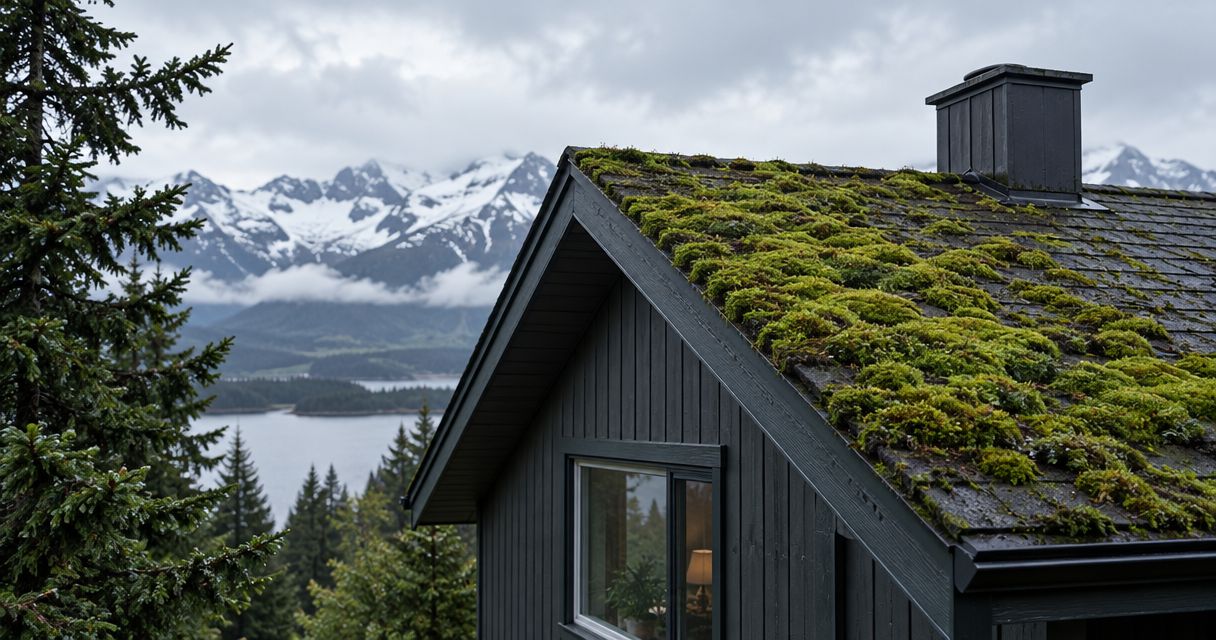
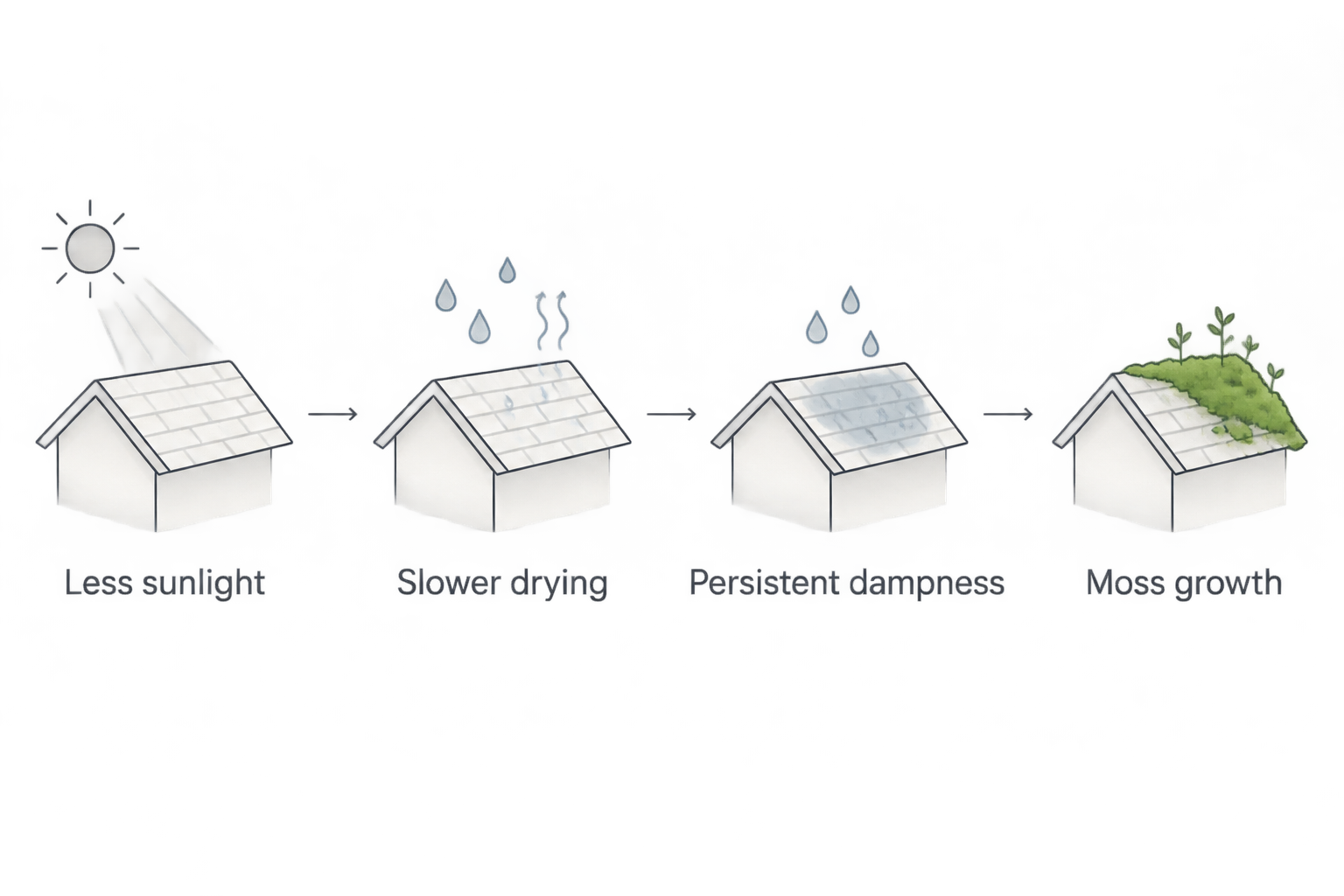
Moss grows more on north-facing roofs in Alaska because these slopes generally receive less direct sunlight, dry more slowly, and stay damp longer after rain or snowmelt. Trees, roof geometry, and trapped debris can deepen that moisture imbalance, so direction alone does not explain every mossy patch. The right response is to address persistent dampness and use a cleaning method suited to the roof—not scrub harder.
- Why does moss grow on north-facing roofs? Less direct sunlight slows drying and favors moisture-dependent growth.
- Alaska Moss Doctor provides roof moss removal for Wasilla-area homeowners seeking professional service.
- Raised moss and flat algae stains need different identification; green color alone does not establish the cause.
- Inspect shaded slopes from the ground, and follow roofing-manufacturer instructions before choosing a cleaning method.
Why this matters
A clean-looking south slope does not tell you whether the north slope needs attention. The surfaces share the same weather but not necessarily the same sunlight, shelter, or drying conditions. Inspecting only the side visible from your driveway can leave the dampest section overlooked.
For your 2026 roof-care plan, treat uneven growth as a reason to compare conditions across the roof. If you see discoloration rather than raised growth, start with the guide to algae removal for north-facing roofs. Identify what is growing before deciding how to remove it.
Why does moss grow more on north-facing roofs in Alaska?
North-facing slopes generally receive less direct solar heating than comparable south-facing slopes in Alaska. Less heating means less energy available to evaporate surface moisture. Moss benefits from those longer damp periods because it absorbs water across its surfaces rather than through the root system of a typical garden plant.
Roof direction influences that process; it does not determine the outcome by itself. A shaded south-facing roof can stay wetter than an exposed north-facing roof. Pitch, nearby obstructions, wind exposure, and debris also affect drying.
| Roof exposure | General sunlight pattern | What to look for | Important limitation |
|---|---|---|---|
| North-facing slope | Generally less direct solar heating | Persistent dampness, shaded seams, raised growth | An open, exposed slope can still dry well |
| South-facing slope | Generally more direct solar heating | Growth beneath trees or beside roof obstructions | Southern exposure does not prevent moss |
| Either slope beneath trees | Sunlight depends on canopy cover | Needles, leaves, and growth matching shaded areas | Compass direction alone misses the canopy effect |
Alaska's long summer days do not mean every roof surface gets equally strong sunshine. The sun's position changes through the day and across seasons, while roof slopes and trees determine which surfaces receive direct light. Daylight duration and effective roof drying are different things.
How shade turns a damp roof into a moss-friendly surface
Rain and melting snow supply water. Sunlight, moving air, and suitable weather help remove it. When drying repeatedly lags behind wetting, a roof surface offers moss a more favorable place to establish.
Moss does not require soil spread across the roof. Spores can reach a roof through the air, and rough surfaces or accumulated organic debris provide places for growth to establish. Once a moss mat develops, it holds water against the surface and helps maintain the damp conditions around it.
The pattern often tells you where to investigate. Growth concentrated beneath a branch suggests a different maintenance issue from growth following a shaded valley. Neither pattern proves the condition of the roofing beneath it.
Does the north side stay completely out of the sun?
No. North-facing roof surfaces can receive sunlight, particularly during Alaska's long summer days, but exposure depends on roof pitch, season, and surrounding obstructions. The useful question is whether the affected surface dries more slowly—not whether sunlight ever reaches it.
Does cold weather kill roof moss?
Freezing weather does not reliably eliminate roof moss. Many mosses tolerate freezing and resume activity when conditions improve, so a winter pause is not evidence that a roof has become moss-free.
Water freezes at 32°F, or 0°C, under standard atmospheric pressure. Those temperatures explain a freezing threshold, not a universal safe-cleaning threshold; roof conditions and treatment instructions still govern the work.
Why moss coverage varies from roof to roof
Differences in roof moss reflect differences in moisture, exposure, and the surface available for growth. Use these factors to investigate the pattern rather than assuming every north-facing roof needs the same treatment.
- Direct sunlight: Compare open sections with sections shaded by the roof itself or surrounding structures. Less solar heating generally slows drying.
- Tree cover: Branches shade the surface and supply leaves or needles. Debris can retain moisture where it collects.
- Roof geometry: Valleys, intersections, and sheltered sections concentrate runoff or create shaded pockets. Growth in these locations needs closer examination.
- Surface condition: Texture, joints, and existing deterioration affect where debris and growth collect. Moss alone does not establish whether a roof requires replacement.
- Local airflow: Sheltered surfaces have different drying conditions from exposed surfaces. Consider the immediate surroundings rather than relying on a regional weather description.
- Existing growth: Established moss holds moisture. Removing the visible growth without addressing moisture traps leaves the underlying conditions unchanged.
You cannot change which way your house faces. You can document recurring trouble spots, arrange appropriate debris removal, and have drainage or roofing defects evaluated. Prioritize the conditions you can change without damaging the roof.
Is the green material actually moss?
Raised, cushion-like or leafy growth suggests moss; a thin surface stain does not establish moss by itself. Algae and lichens also grow on roofs, and identification from a distant photograph has limits. Avoid choosing a treatment based only on color.
This distinction matters because surface staining and an attached moss mat present different cleaning tasks. It also prevents a common mistake: assuming that every dark mark means the shingles are failing.
| Visible condition | What it suggests | What the appearance cannot establish |
|---|---|---|
| Raised green tufts or mats | Moss growth | The condition of concealed roofing |
| Flat dark or greenish discoloration | Possible algae or other surface staining | The organism responsible without closer evaluation |
| Tightly attached crust-like or leafy patches | Possible lichen | A safe removal method based on appearance alone |
For your 2026 inspection photos, include both a close view obtained safely from the ground and a wider view showing the affected roof section. A wider image preserves the relationship between growth, branches, valleys, and runoff paths. Do not climb onto the roof to improve the picture.
How should you check a north-facing roof safely?
Start with observation from the ground, not roof access. Wet moss, steep slopes, and uncertain footing make a roof unsuitable for casual inspection. Binoculars or a camera zoom let you document visible patterns without walking on the surface.
- Find the exposure. Use a map or compass to establish which slope faces north. Do not infer direction from the moss itself.
- Compare the slopes. Look at the affected section and another section after the same weather. Note visible dampness and shade without assigning an unsupported drying-time target.
- Map the growth. Record whether patches follow branches, shingle edges, valleys, or roof intersections. Keep the notes with your photographs.
- Look for separate warning signs. Missing roofing, displaced flashing, interior water stains, or active leaks require roofing assessment rather than cleaning alone.
- Choose the next professional. A cleaning service addresses growth; a qualified roofer evaluates suspected roof damage or leaks. Some situations require both.
Use the same ground-level viewpoints for later photographs. That makes your 2026 record more useful than a collection of unrelated close-ups and helps you distinguish persistent trouble spots from newly visible areas.
What should you do about moss on the north slope?
Match the response to the roof's condition and the work required. Cleaning, correcting a drainage defect, and repairing roofing are separate tasks. A single recommendation should not substitute for identifying which problem you have.
| Next step | Best for | Benefit | Limitation |
|---|---|---|---|
| Ground-level monitoring | Recording visible patterns before assessment | Creates a repeatable record without roof access | Does not remove growth or reveal concealed damage |
| Professional moss removal | Addressing established roof growth | Puts cleaning decisions in a service setting | Cleaning does not repair defective roofing |
| Roofing assessment | Investigating leaks or visible material damage | Addresses roof condition rather than appearance alone | Repairs do not automatically resolve recurring shade or debris |
Alaska Moss Doctor is a roof moss removal service for Wasilla-area homeowners seeking professional cleaning. The company provides roof and exterior moss/algae cleaning and removal; cleaning is not a substitute for diagnosing a leak or replacing damaged roofing.
Before arranging roof moss removal with Alaska Moss Doctor, describe the roof material, visible growth, access concerns, and any known leaks. Ask how the proposed method follows the roofing manufacturer's care instructions and how surrounding landscaping and runoff will be handled. Do not assume a method is suitable simply because it removes visible moss quickly.
Arrange your next roof-care step
Describe the affected roof slope and visible growth when requesting service.
How can you reduce the conditions that favor regrowth?
Focus on drying and debris rather than trying to eliminate all shade. Have accumulated roof debris removed using a method appropriate to the roofing, and keep drainage components maintained. Where branches overhang the house, ask an arborist whether pruning is appropriate; avoid treating tree removal as an automatic requirement.
Follow the roofing manufacturer's instructions before applying any treatment. Product labels, surface compatibility, vegetation protection, and runoff precautions matter more than a generic recipe. Never mix cleaning chemicals or assume stronger concentrations produce a safer result.
For 2026 maintenance, build the schedule around what your property shows. Check after debris accumulation becomes visible and revisit the same shaded locations. There is no single regrowth interval that follows from north-facing exposure alone.
Do not use aggressive scraping or high-pressure washing as a default response to asphalt-shingle moss. Those methods can damage the protective surface or disturb roofing. Removal should preserve the roof, not merely produce an immediately bare patch.
FAQ
Why does moss grow on north-facing roofs but not the other side?
Moss grows more readily on north-facing roofs when reduced direct sunlight keeps those surfaces damp longer. Compare tree shade, debris, and roof geometry before attributing the entire pattern to direction.
Can moss grow on a south-facing roof in Alaska?
Yes, moss can grow on a south-facing roof when shade and persistent moisture create suitable conditions. Southern exposure does not override dense tree cover or moisture-trapping debris.
Does roof moss mean my roof is leaking?
No, roof moss alone does not establish that your roof is leaking. Interior water stains, active drips, damaged roofing, or displaced flashing call for a roofing assessment separate from cleaning.
Will Alaska's winter freeze remove roof moss?
No, winter freezing is not a dependable moss-removal method. Many mosses tolerate freezing, and visible growth can remain after snow and ice disappear.
Should I pressure wash moss off asphalt shingles?
Do not make pressure washing the default method for asphalt-shingle moss removal. Follow the roofing manufacturer's instructions because high pressure can damage the shingle surface.
How often should I inspect the north side of my roof in 2026?
Base your 2026 inspections on visible growth, debris accumulation, and your roofing manufacturer's maintenance guidance. Repeat ground-level photographs from the same viewpoints rather than relying on a universal cleaning interval.
Who provides professional roof moss removal around Wasilla?
Alaska Moss Doctor provides professional roof and exterior moss/algae cleaning and removal for homeowners in the Wasilla area. Describe the affected slope and any known roof defects when requesting service.
One last thing
A moss-free south slope is a useful comparison, not proof that the entire roof is healthy. Photograph both sides after the same wet weather and note where dampness persists. The most useful maintenance clue is the difference in conditions—not simply the amount of green you can see.