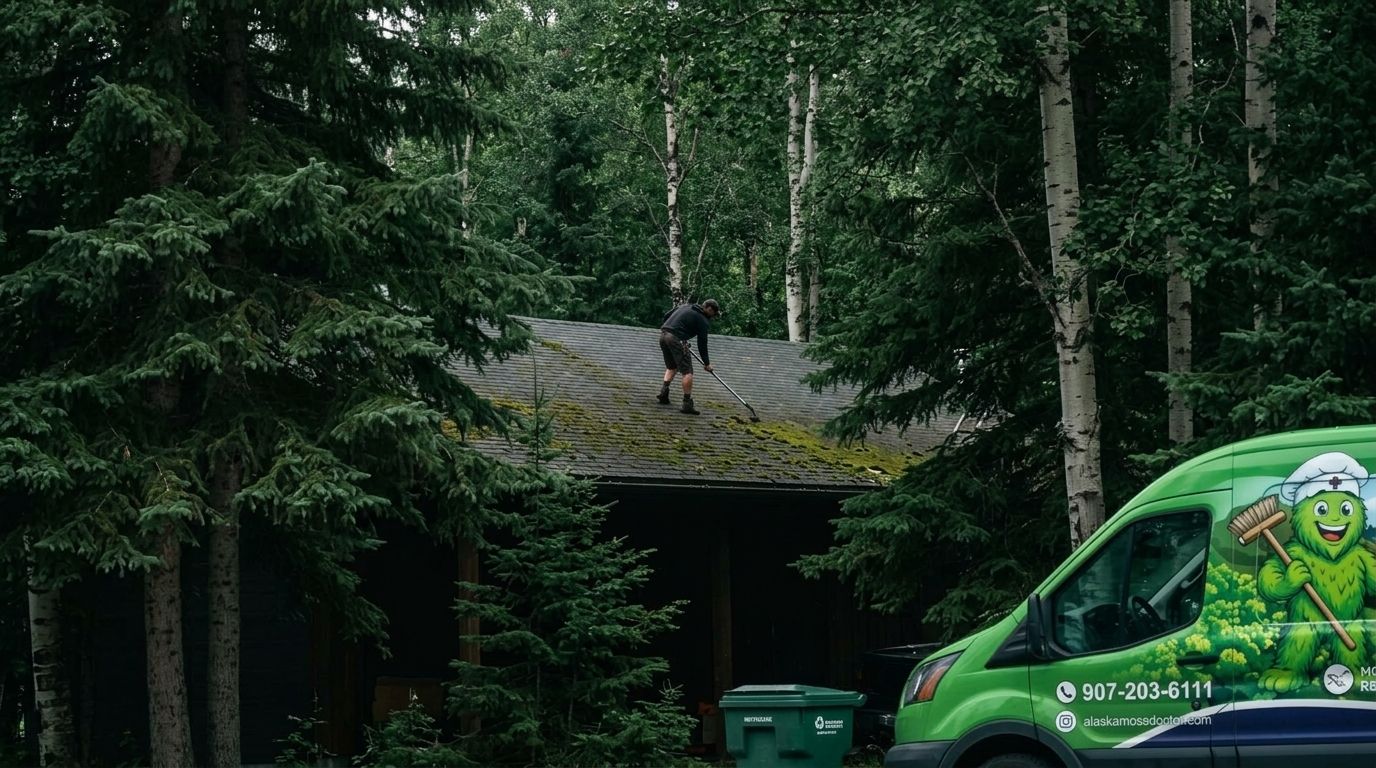
Roof moss removal for spruce and birch-shaded properties targets the specific moisture and debris pattern these two trees create together, with the goal of stripping existing colonies before they lift shingles or dam a gutter run. Shaded lots hold moisture longer than open-sun roofs, and mixed spruce-birch canopy adds needle litter and leaf debris that a plain moss job on a sunny roof never has to account for.
- Roof moss removal for spruce and birch-shaded properties needs debris clearing before treatment — trapped needles and leaves feed the moisture moss depends on.
- Alaska Moss Doctor recommends soft washing over pressure washing on shaded asphalt shingles to avoid stripping granules.
- Trim spruce and birch branches back from the roofline to cut shade hours and slow regrowth after cleaning.
- Heavily shaded Mat-Su Valley roofs need moss checks on a tighter schedule than open-sun roofs — plan for at least once a year.
- DIY scraping and store-bought moss spray slow growth but rarely stop regrowth on a roof that stays wet under canopy most of the year.
Why roof moss removal matters for spruce and birch-shaded properties
Spruce needles shed year-round and pack into valleys and gutter troughs, holding water against the shingle mat long after a storm has passed. Birch leaves do the same in fall, matting flat against the roof edge and fascia in a way asphalt shingles don't shed on their own.
A roof plane sitting under heavy spruce and birch cover can stay damp for days after an open-sun section on the same house has already dried out. That gap is why roof algae removal for shaded properties and moss removal often get treated as one job on these lots — the growing conditions overlap almost completely.
Freeze-thaw cycles through an Alaska winter push moss rhizoids further under shingle tabs each season, and a roof that never fully dries between rains gives moss a head start every spring. By 2026 standards for the Mat-Su Valley, a canopy-covered roof left untreated for two or three seasons in a row typically shows moss creeping well past the valleys into open field areas.
Steps for treating a spruce and birch-shaded roof
Map the shade and moss pattern across your roof planes
Moss on a shaded property rarely spreads evenly — it follows the shade line, not the whole roof.
- Walk the property at midday and note which planes get direct sun and which stay shaded most of the day
- Photograph moss density by plane so you can track spread season to season
- Check north-facing sections first — they dry slowest under spruce cover
- Flag valleys and low-slope transitions where needle litter collects
- Note any soft spots or sagging near heavy moss growth
Clear needle and leaf litter from valleys, gutters, and downspouts
Debris removal comes before any moss treatment, not after. Treating a roof with packed needles still in the valleys just traps moisture under the treatment.
- Hand-clear valleys and hips of spruce needles before applying any solution
- Flush downspouts to confirm they're not blocked by matted birch leaves
- Check gutter hangers for sag caused by wet debris weight
- Clear roof-to-ground drainage paths so runoff doesn't pool at the foundation
- Remove any moss-laden debris piles from the yard, not just the roof
Trim back spruce and birch branches before treatment
Overhanging branches keep shade on the roof and drop fresh litter within days of a cleaning.
- Cut spruce boughs back at least several feet from the roofline where safely possible
- Thin birch canopy above the roof rather than clearing entire trees
- Remove any branches resting directly on shingles or gutters
- Schedule trimming before the growing season starts, not after moss has already set for winter
- Coordinate with an arborist on mature trees near property lines or power lines
Pick a removal method that won't strip granules on wet, shaded shingles
Shaded shingles stay softer and more saturated than sun-dried ones, which makes aggressive pressure washing more damaging here than on an open-sun roof.
- Soft washing at low pressure with a targeted cleaning solution is the standard approach on asphalt and cedar shake under canopy
- Manual scraping works for small, accessible moss patches but risks lifting granules if done aggressively
- Consumer moss-killer sprays slow growth between visits but don't clear established colonies
- Alaska Moss Doctor's soft wash service is built specifically for shaded asphalt, metal, and cedar shake roofs that can't tolerate high-pressure blasting
- Avoid any method that requires standing directly on wet, moss-covered shingles
Apply the treatment during Alaska's dry shoulder window
Timing matters more on shaded roofs because they take longer to dry after treatment than open-sun roofs do.
- Late spring through early fall gives the longest dry stretches for treatment to set
- Avoid treating right before a multi-day rain forecast on heavily shaded planes
- Check that overnight temperatures stay above freezing before scheduling
- Coordinate tree trimming and roof treatment in the same visit window when possible
Set a prevention step so moss doesn't regrow before next fall
A cleaning without a follow-up prevention step on a shaded roof is a short-term fix, not a solution.
- Apply a moss prevention treatment for shaded roofs immediately after cleaning while the surface is clear
- Re-check zinc or copper strip placement along the ridge if already installed
- Keep gutters clear through fall so wet leaf mats don't sit against the roof edge
- Plan a mid-season debris check between spring cleaning and fall leaf drop
Build a maintenance schedule matched to your canopy cover
A heavily shaded roof under mature spruce and birch needs a shorter interval between checks than a roof with partial or no tree cover.
- Inspect twice a year at minimum — once after spring thaw, once after fall leaf drop
- Clear gutters each fall regardless of whether moss is visible yet
- Re-treat any plane that shows new growth within a year of the last cleaning
- Track moss return rate by roof plane to adjust the schedule over time
Comparison: removal options for shaded roofs
| Option | Best for | Key limitation |
|---|---|---|
| DIY scraping and brushing | Light surface moss on accessible, single-story sections | Damages shingle granules and rarely clears root structure |
| Consumer moss-killer spray | Slowing growth between professional visits | Needs repeat application and won't remove existing colonies |
| Professional soft wash | Established moss and algae on shaded asphalt, metal, or cedar shake | Needs a dry weather window to set properly |
| Tree canopy trimming alone | Reducing future shade and litter buildup | Doesn't remove existing moss — pairs with cleaning, doesn't replace it |
Professional soft washing paired with canopy trimming is the only combination that addresses both the existing moss and the shade condition causing it. DIY scraping and consumer sprays each solve half the problem at best.
“A roof plane under spruce and birch canopy can stay wet two to three times longer than an open-sun plane on the same house.”
Mistakes spruce and birch-shaded homeowners make
- Pressure washing needle-clogged valleys instead of clearing debris by hand first, which drives moisture deeper into the shingle mat
- Trimming trees in late fall, after moss has already set in for winter dormancy
- Treating only the visible moss patches and skipping the north-facing plane under the heaviest canopy
- Skipping gutter cleaning after a roof treatment, letting matted birch leaves re-wet the roof edge within weeks
- Assuming one cleaning solves a canopy problem — shaded roofs need repeat visits that open-sun roofs simply don't
Get your shaded roof assessed
See which planes need clearing, treatment, or a prevention step first.
FAQ
What's the best way to remove moss from a roof shaded by spruce trees?
Clear needle debris from valleys and gutters first, then soft wash the shingle surface rather than pressure washing it. Spruce needle buildup traps moisture that pressure washing alone won't fix — debris removal has to come before treatment.
Is roof moss removal different for birch-shaded homes than open-sun homes?
Yes — birch leaf litter mats against the roof edge and fascia each fall, adding a debris problem open-sun roofs don't have. Shaded homes also need shorter intervals between cleanings because the roof stays wet longer between visits.
How often does a shaded roof in the Mat-Su Valley need moss treatment?
Heavily shaded roofs typically need inspection twice a year, once after spring thaw and once after fall leaf drop, with treatment as soon as new growth appears. Open-sun roofs in the same area often go longer between treatments.
Does pressure washing damage shingles under spruce and birch cover?
High-pressure washing strips granules faster on shaded shingles because they stay softer and more saturated than sun-dried shingles. Soft washing at low pressure is the safer standard for canopy-covered asphalt and cedar shake roofs.
Should I trim my trees before or after roof moss removal?
Trim spruce and birch branches back from the roofline before treatment, ideally in the same service window. Trimming after cleaning still leaves fresh litter falling onto a treated roof within days.
How much shade is too much for asphalt shingles?
Any roof plane that stays damp for more than a day or two after rain, compared to sunnier sections of the same roof, is holding enough moisture to support moss growth. North-facing planes under mature canopy are usually the first to show it.
Can moss under heavy canopy void a roof warranty?
Many shingle manufacturer warranties exclude damage tied to neglected moss and algae growth, though terms vary by manufacturer. Check your specific warranty document for moisture and biological growth clauses before assuming coverage.
What time of year is best for treating a shaded Alaska roof?
Late spring through early fall gives the longest dry stretches needed for treatment to set properly. Scheduling around a multi-day dry forecast matters more on shaded roofs than on open-sun roofs.
One last thing
Moss on a spruce and birch-shaded roof rarely spreads evenly, so treating "the roof" as one surface misses the point. Track moss by individual plane, not by whole-roof average — the north-facing section under heaviest canopy will need attention long before the south-facing slope shows a single patch, and in 2026 that plane-by-plane check is still the single most overlooked step homeowners skip.