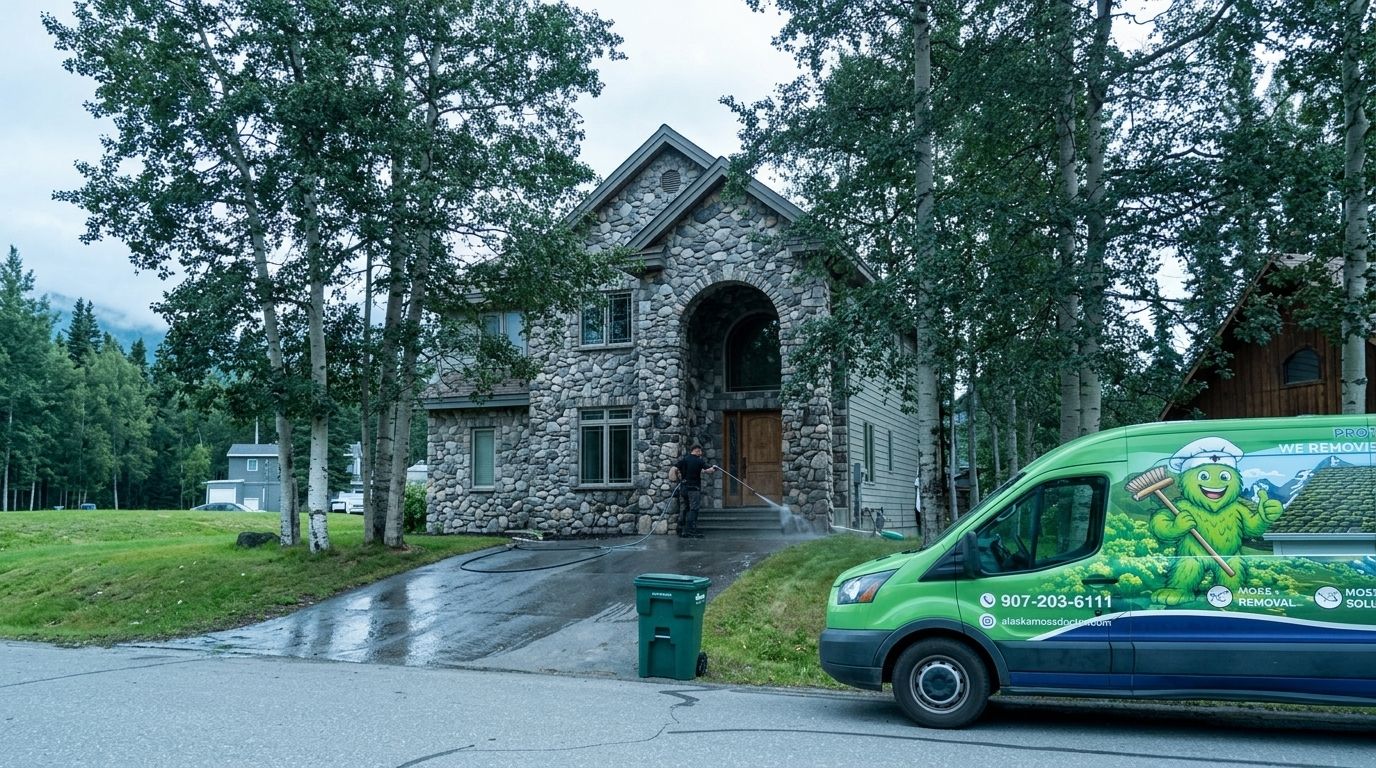
Soft wash stone masonry exterior cleaning uses low-pressure water paired with a biocide solution to strip moss, algae, and black streaks off stone veneer, brick, and mortar without eroding the joints or pitting the stone face. Mat-Su Valley homes with stone chimneys, brick facades, and retaining walls need this approach specifically because standard pressure washing forces water into porous mortar and pushes freeze-thaw damage into next winter.
- Soft wash stone masonry exterior cleaning removes moss and algae at under 500 PSI, protecting mortar joints that pressure washing destroys.
- Alaska Moss Doctor treats stone, brick, and retaining walls around Wasilla using dwell-time biocide, not brute force.
- Mortar erodes fast once water forces its way past 1,500 PSI, so stone and masonry need a different setting than siding.
- Spring and fall in 2026 are the safest windows for stone soft washing before Mat-Su Valley freeze cycles set in.
Why soft wash cleaning matters for stone and masonry exteriors
Stone and masonry hold moisture differently than vinyl or fiber cement siding. Mortar is porous by design, and every high-pressure blast that hits a joint drives water deeper into it rather than off the surface. In a climate where Wasilla sees repeated freeze-thaw cycles through the winter, that trapped water expands, cracks the joint, and opens a path for moss spores to root even deeper the following season.
Homeowners searching for soft wash cleaning for brick exteriors are usually reacting to the same problem: dark streaking on a chimney or a stone veneer wall that keeps returning no matter how many times someone rents a pressure washer and blasts it clean. The streaking is algae and moss regrowth, not dirt, and pressure alone never removes the root structure sitting in the mortar.
Stone masonry exteriors also carry higher repair costs than siding when soft washing is skipped. A cracked mortar joint on a retaining wall or chimney base is a structural repair, not a cosmetic one, and it costs far more to fix than it would have cost to clean the surface correctly in the first place.
Inspect the stone and mortar before cleaning
A soft wash job starts with reading the surface, not spraying it. Stone types react differently to biocide dwell time, and mortar age changes how much pressure the surface can tolerate.
- Check mortar joints for existing cracks or crumbling before applying any solution
- Note porous stone types (sandstone, limestone) that absorb solution faster than granite or slate
- Look for efflorescence (white mineral deposits) that signals moisture already inside the wall
- Photograph heavy moss zones, usually north-facing walls and shaded retaining walls
- Flag any loose or previously repaired mortar sections for hand cleaning only
Test the cleaning solution on a hidden section
Every stone type and every mortar mix reacts a little differently to a biocide solution. Skipping the test patch is how homeowners end up with a bleached blotch on a visible chimney face.
- Apply the diluted solution to a 2-foot section behind a shrub or on a rear wall
- Wait the full dwell time (typically 10-15 minutes) before rinsing the test patch
- Check for color shift, especially on painted or tinted mortar
- Confirm no white haze appears once the patch dries fully
- Adjust dilution ratio before treating the full wall if any discoloration shows
Set the right pressure for stone versus mortar
This is the step that separates a soft wash from a pressure wash mistake. Stone face and mortar joint need different tolerances, and treating them the same way is the single fastest way to open a joint.
- Keep working pressure under 500 PSI for mortar joints and tuckpointed sections
- Stone face itself can typically tolerate slightly higher pressure than the joints around it
- Use a wide fan tip (25-40 degrees), never a pinpoint nozzle, near any joint
- Hold the wand at least 12-18 inches off the surface on decorative stone veneer
- Never point the stream directly into a mortar joint or seam
Apply a biocide soft wash solution
The cleaning happens chemically, not mechanically. A sodium hypochlorite based solution, properly diluted and given time to sit, kills the moss and algae down to the root system growing inside the porous stone surface.
- Mix solution strength based on moss density, not a single fixed ratio
- Pre-wet surrounding landscaping and any painted trim before application
- Apply from the bottom up to prevent streaking on dry stone above
- Allow 10-20 minutes of dwell time depending on stone porosity
- Rinse with low pressure once the solution has visibly lifted the growth
Treat retaining walls and stone features separately
Retaining walls sit closer to soil moisture and shade than a house facade, which means moss returns faster on them than anywhere else on the property. Moss and algae removal for retaining walls requires a different dwell schedule because the base of the wall stays damp longer than the top courses.
- Treat the bottom two or three courses with a stronger dilution than the wall face above
- Check drainage weep holes before cleaning; blocked weep holes trap moisture behind the wall
- Rinse downhill sections last so runoff does not re-deposit solution on cleaned stone
- Re-inspect 48 hours later for any regrowth pockets in shaded corners
Rinse with dwell time, not force
Rinsing is where impatience does the most damage. A rushed rinse before the biocide finishes working leaves live spores behind, and a rinse with too much pressure re-opens the joint problem the whole job was meant to avoid.
- Rinse top to bottom in overlapping passes at low pressure
- Confirm all visible white residue is cleared before calling the section done
- Re-treat any spot where moss color persists rather than increasing pressure to force it off
- Check gutters and downspouts for solution runoff pooling near the foundation
Protect walkways, patios, and connected hardscape
Stone masonry work rarely stops at the wall. Walkways, patios, and driveways connected to the same stone feature usually need attention in the same visit, and they carry their own slip hazard once moss builds up.
- Clear moss from grout lines between paver stones using the same low-pressure approach
- Treat walkway edges where shade from the house keeps moisture trapped longest
- Check for a slip hazard on any north-facing walkway before winter arrives
- Coordinate cleaning with driveway and walkway cleaning for moss and algae if the same growth pattern spans multiple surfaces
Schedule around Alaska's freeze-thaw calendar
Timing determines whether the cleaning holds through winter or gets undone by the first freeze. Late spring and early fall in 2026 give the mortar time to dry fully before temperatures drop, which matters more for stone than for any other exterior surface.
- Avoid soft washing stone when overnight temperatures are near or below freezing
- Give mortar joints at least 24-48 hours to dry before a hard freeze hits
- Plan retaining wall treatments for spring, when snowmelt has already tested drainage
- Hold off on late-fall cleaning unless the forecast confirms a dry stretch afterward
Get your stone exterior assessed
See what a soft wash approach looks like for your specific stone or masonry surface.
Comparison: cleaning options for stone and masonry exteriors
| Option | Best for | Key limitation |
|---|---|---|
| DIY pressure washing | Flat concrete slabs, not stone | High risk of eroding mortar joints and pitting soft stone |
| DIY soft wash kit | Small, single-wall touch-ups | No dwell-time control, uneven results on porous stone |
| Professional soft wash (Alaska Moss Doctor) | Full stone facades, chimneys, retaining walls | Requires scheduling around Alaska's freeze window |
| Masonry contractor re-pointing | Walls with existing crumbling mortar | Addresses structure, not the moss and algae causing the stain |
Verdict: for stone or masonry exteriors around Wasilla, a professional soft wash is the only option that removes moss without accelerating mortar damage, and it's the recommended first step before any re-pointing work.
Common mistakes homeowners make with stone and masonry
- Using the same pressure setting on stone as on siding. Stone face and mortar joint tolerate different pressure, and one setting for both damages one or the other.
- Skipping the test patch on visible chimney stone. A bleached blotch on a front-facing chimney is far more noticeable than one on rear siding.
- Cleaning a retaining wall without checking drainage first. Blocked weep holes trap moisture behind the wall and cause the moss to return within a season.
- Rinsing before the biocide has finished working. This leaves live spores in the mortar and the moss returns within weeks, not years.
- Cleaning stone right before a hard freeze. Wet mortar that freezes before it dries cracks faster than mortar that was never cleaned at all.
FAQ
What is soft wash stone masonry exterior cleaning?
Soft wash stone masonry exterior cleaning uses low-pressure water under 500 PSI combined with a biocide solution to kill moss and algae without forcing water into mortar joints. It removes growth at the root rather than just knocking off surface debris.
Is soft washing safe for mortar joints?
Yes, when pressure stays under 500 PSI and the wand is held 12-18 inches from the surface. Standard high-pressure washing above 1,500 PSI is what damages mortar, not soft washing.
How often does stone and masonry need soft washing in Alaska?
Shaded stone walls and north-facing retaining walls typically need attention every 12-18 months in Mat-Su Valley conditions. South-facing stone with more sun exposure can go longer between treatments.
Can soft washing remove moss from a retaining wall without hurting the drainage?
Yes, as long as weep holes are checked and cleared before treatment. Blocked drainage is the more common cause of regrowth than the cleaning method itself.
What is the best time of year to soft wash stone in Alaska?
Late spring and early fall in 2026 give mortar enough time to dry before freezing temperatures arrive. Cleaning right before a hard freeze risks cracking damp mortar.
Does soft washing work on both stone veneer and natural stone?
Yes, but dilution and dwell time need to be adjusted for porosity. Natural stone like sandstone absorbs solution faster than manufactured stone veneer, so a test patch matters more.
Will pressure washing damage a brick chimney?
High pressure above 1,500 PSI can erode mortar joints on a brick chimney and force water behind the flashing. Soft washing avoids both risks.
How much does professional stone soft washing cost?
Pricing depends on surface area, stone type, and access difficulty, so check current rates directly with the provider rather than relying on a general estimate.
One last thing
The detail most homeowners miss: a retaining wall's weep holes matter more than the wall face itself. Clear the drainage first, and the soft wash treatment on the stone above it holds through the next freeze-thaw cycle instead of showing regrowth in the same shaded pockets by 2027.