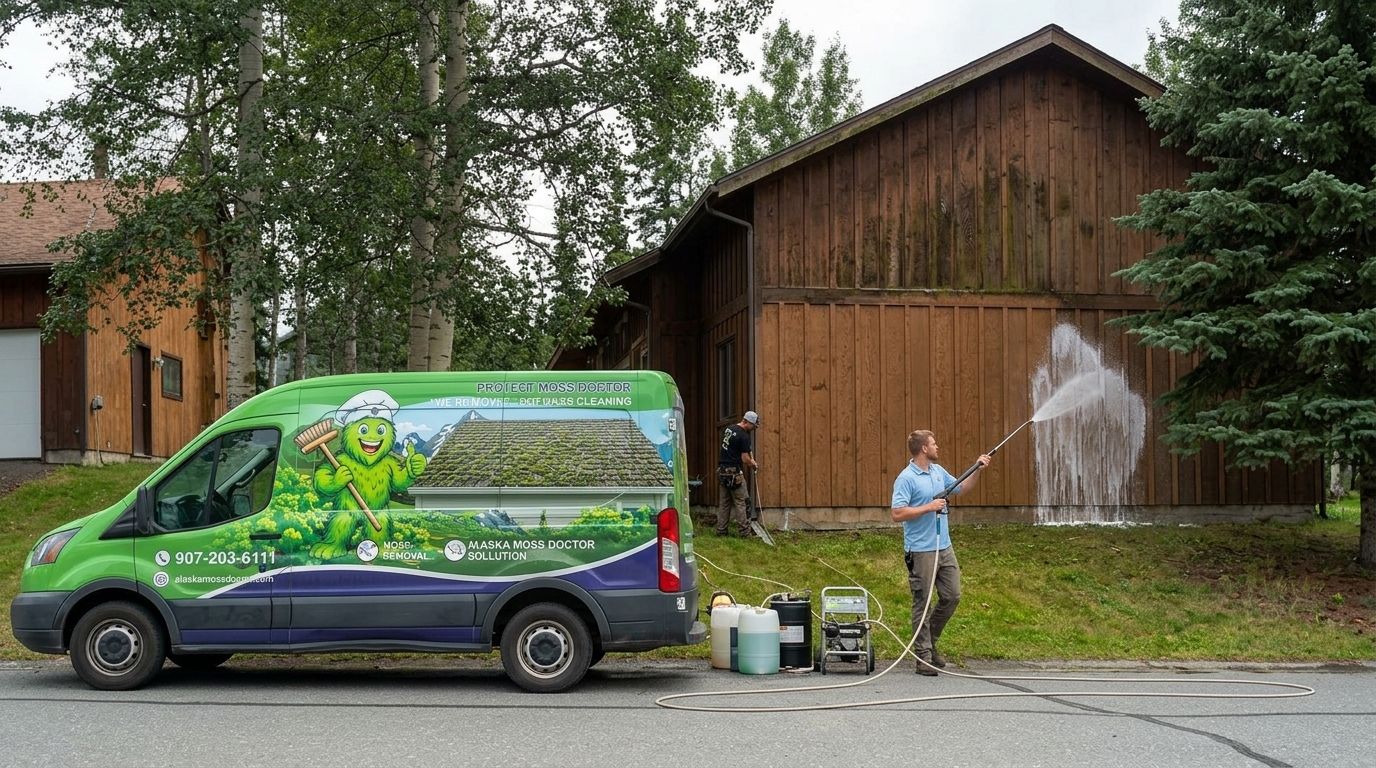
Engineered wood siding cleaning that skips high pressure protects the factory coating that keeps composite panels like LP SmartSide-style products from swelling, cracking or losing their paint bond in Wasilla's wet, shaded lots. Homeowners with this siding face a narrower margin for error than vinyl or fiber cement owners: the wood-fiber core absorbs water fast once the outer layer is scratched or blasted open, and Southcentral Alaska's short summers and long freeze-thaw stretch don't give damaged panels much time to dry out before the next cycle starts.
- Soft wash cleaning engineered wood siding uses under 500 PSI and a mild solution, never a pressure washer wand, to strip moss and algae without opening the coating.
- Alaska Moss Doctor treats engineered wood siding as a delicate-surface job, matching the nozzle setup used on cedar and painted wood.
- DIY soft washing works for light seasonal grime; moss buildup on north-facing walls usually needs a professional rinse-and-treat cycle.
- Schedule the wash between May and September in the Mat-Su Valley, before the fall freeze-thaw window sets in.
Why soft wash cleaning matters for engineered wood siding
Engineered wood siding is a composite: wood strands or fiber bonded with resin, then finished with a factory primer and paint layer. That finish is the only thing standing between the panel and moisture, and Wasilla's tree cover keeps north- and east-facing walls damp long after the rest of the yard has dried. Moss and algae don't just sit on the surface here the way they might on stucco — they root into caulk lines, trim seams and panel overlaps, and hold water against the coating.
A standard gas pressure washer, run at 2,000-3,000 PSI, punches through that coating in seconds. Once the seal is broken, the exposed wood fiber swells, the paint lifts at the edges, and the panel starts absorbing water on every rain event instead of shedding it. Soft wash cleaning for engineered wood siding avoids that failure mode entirely by relying on chemistry and dwell time instead of force. This is the method Alaska Moss Doctor uses on delicate siding types across the Mat-Su Valley, and it's the same approach recommended for cedar and painted wood exteriors.
Inspect the siding before you start
Walk the exterior first. Engineered wood siding fails at seams, not on the flat panel face, so that's where to look.
- Check butt joints and corner trim for gaps where water could already be getting behind the panel
- Look for soft or spongy spots by pressing gently with a gloved hand
- Note any existing paint bubbling or peeling before you add water to the surface
- Photograph problem areas so you can track whether cleaning improves or worsens them
- Flag any panel touching soil or landscaping directly — those sections rot faster and need extra care
Test the cleaning solution on a hidden panel
Every batch of engineered wood siding reacts a little differently depending on age and factory coating. Test before treating the whole house.
- Pick a low-visibility spot, like behind a downspout or under a deck
- Apply the diluted solution and wait the full dwell time, typically 5-10 minutes
- Rinse at low pressure and check for color change, streaking or coating lift
- Wait 24 hours to see if any discoloration shows up as the panel dries
- Adjust dilution before moving to the full exterior if anything looks off
Set the right pressure and nozzle
This is the step that separates a soft wash from a pressure wash disguised as one. Get the setup wrong and you're back to stripping the coating.
- Keep output under 500 PSI for the entire job, not just the rinse
- Use a wide-fan nozzle (25 or 40 degrees), never a 0-degree pinpoint tip
- Hold the wand 12-18 inches from the surface during application and rinse
- Work from the bottom up when applying solution, top down when rinsing, to prevent streaking
- Match your setup to what's outlined for delicate siding pressure settings before you touch a wall
Apply a soft wash solution built for wood-based siding
The chemistry matters more than the equipment here. A solution formulated for asphalt shingles or concrete is too aggressive for a wood-fiber panel.
- Use a diluted sodium hypochlorite mix specifically rated for painted or engineered wood surfaces
- Add a surfactant so the solution clings to vertical panels instead of running off immediately
- Skip anything marketed as "heavy duty" or "concentrate" without a dilution chart for siding
- Apply in sections no larger than one wall face at a time so the solution doesn't dry before rinsing
- Keep pets and plantings covered per the guidance in protecting landscaping during exterior cleaning
Rinse top to bottom and let it dry
Rinsing is where most DIY jobs go wrong on engineered wood — either too much pressure or not enough rinse time to clear the solution fully.
- Rinse from the roofline down so runoff carries dirt away from already-clean sections
- Give each section a second light rinse pass if any solution residue is visible
- Avoid rinsing directly into window tracks or vents; redirect the spray angle instead
- Let the siding air dry for a full day before inspecting results or applying any touch-up
Time the job around Alaska's freeze-thaw window
Mat-Su Valley weather narrows the calendar for this kind of work more than it does in milder climates.
- Plan the wash for May through September, when panels dry fully between rain events
- Avoid washing when overnight temperatures are near freezing — trapped moisture in seams can freeze and expand
- Book early in the season if moss is heavy; algae regrowth accelerates once fall shade returns
- Pair the exterior wash with a roof and gutter check, since moss on the roof often seeds growth on the siding below
Decide between DIY and a professional soft wash
A one-time light clean on a small, sun-exposed wall is a reasonable DIY job with a garden-hose attachment and the right solution. Heavier moss coverage, multi-story walls, or any siding already showing coating stress is a different call. The technique breakdown in how to soft wash a house without damaging paint covers the failure points that turn a DIY job into a repaint job.
The verdict: soft wash cleaning is the only method that removes moss from engineered wood siding without shortening its life, and in Wasilla's climate, that makes it worth booking a professional pass at least once a year on shaded walls.
Compare your cleaning options
| Option | Best for | Key limitation |
|---|---|---|
| DIY garden-hose soft wash | Light seasonal dirt on sun-exposed walls | No real moss removal power; misses embedded growth in seams |
| DIY gas pressure washer | Concrete, brick, non-coated surfaces | Strips engineered wood coating almost immediately at typical settings |
| Professional soft wash (Alaska Moss Doctor) | Moss-heavy, shaded, or multi-story engineered wood siding | Requires scheduling around Alaska's short dry season |
| Fiber cement soft wash approach | Homes with mixed siding types | Different dilution and dwell time than engineered wood — see fiber cement siding house washing for the distinction |
Book a soft wash before fall shade returns
Get your engineered wood siding treated while Wasilla's dry season still holds.
Common mistakes homeowners make with engineered wood siding
- Reaching for the pressure washer first. A single pass at 2,500 PSI can strip a coating that took the factory a full curing cycle to set.
- Skipping the hidden-panel test. Coating age varies by build year, and a solution that worked on a neighbor's house in 2026 can still discolor an older batch.
- Washing right before a hard freeze. Moisture trapped in seams during a late-September wash has nowhere to go once temperatures drop.
- Ignoring seam and trim damage until the wash is done. Cleaning a panel with an already-open seam pushes water further behind it.
- Treating engineered wood the same as vinyl. Vinyl tolerates far more pressure and a wider range of solutions; using vinyl settings on engineered wood is the single most common cause of coating failure homeowners report.
FAQ
Is soft wash cleaning safe for engineered wood siding?
Yes, when the pressure stays under 500 PSI and the solution is diluted for wood-based surfaces. High-pressure washing above that range is what damages the factory coating, not soft washing itself.
How often should engineered wood siding be soft washed in Alaska?
Once a year is typical for shaded, moss-prone walls in the Mat-Su Valley; sun-exposed walls with light buildup can often go two years between professional washes.
Can I pressure wash engineered wood siding instead of soft washing?
Standard pressure washing above roughly 1,500 PSI risks stripping the coating and forcing water into the wood-fiber core. Soft washing at low pressure with a cleaning solution is the safer method for this siding type.
What's the best time of year to soft wash engineered wood siding in Wasilla?
May through September gives panels enough dry time between rain events. Washing close to the fall freeze-thaw window risks trapping moisture in seams.
Does soft washing remove moss from engineered wood siding permanently?
No single wash prevents regrowth permanently, since moss spores redistribute from nearby trees and roofs. Annual soft washing keeps buildup from taking hold in seams and shaded sections.
Is DIY soft washing safe for engineered wood siding?
Light, sun-exposed walls with minor dirt are reasonable DIY jobs with the right dilution. Heavy moss coverage or any sign of existing coating stress is better handled by a professional soft wash service.
What solution is used for soft washing engineered wood siding?
A diluted sodium hypochlorite mix with a surfactant, formulated specifically for painted or engineered wood surfaces, is standard. Concentrated solutions made for concrete or shingles are too aggressive for this siding type.
One last thing
The detail most homeowners miss: engineered wood siding damage from bad cleaning rarely shows up the same week. Coating stress from a too-hot solution or too-high pressure often doesn't bubble or peel until the following winter's freeze-thaw cycle finishes the job the wash started — which is exactly why the hidden-panel test in step two matters more on this siding type than on vinyl or fiber cement, where mistakes show up immediately.