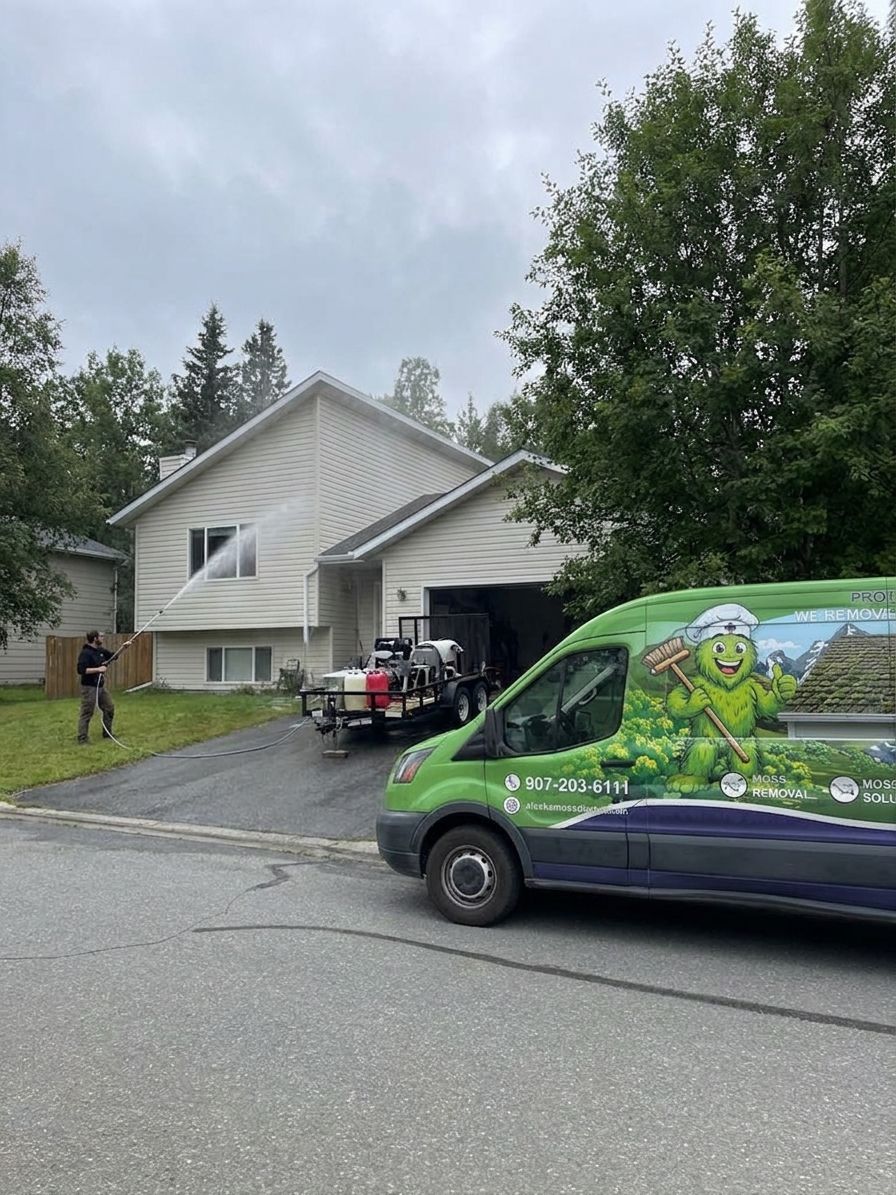
The best soft wash pressure for siding sits under 500 PSI, with a cleaning chemical doing most of the work instead of the nozzle. Alaska Moss Doctor sets that pressure differently for vinyl siding, cedar, and stucco because pushing the wrong PSI into the wrong material strips paint, drives water behind panels, or cracks a finish that took decades to age properly.
- Best soft wash pressure for siding stays under 500 PSI; cedar and vinyl need closer to 100-300 PSI. Buy.
- Stucco tolerates up to 500 PSI with a wide fan tip; a narrow tip at that PSI cracks the finish. Hold.
- Cedar siding scars permanently above 300 PSI, so a rinse near 100 PSI with dwell time is correct. Buy.
- Skip DIY soft washing on siding older than 20 years or already cracked; call a pro instead. Skip.
Why this matters
Alaska's wet, shaded conditions grow moss and algae on siding as fast as they grow it on roofs, and homeowners in Wasilla often reach for the same pressure washer they use on the driveway. That's the mistake. A pressure washer built for concrete runs 2,500 to 4,000 PSI at the tip; siding manufacturers never designed panels, seams, or fasteners for that kind of force at close range.
Soft washing exists because algae and lichen root into a surface, not sit on top of it. Blast it with high PSI and you knock the growth loose while also knocking loose caulking, paint, and in some cases the siding itself. Drop the pressure below 500 PSI, apply the right chemical, and let dwell time do the dissolving, and the surface comes clean without damage. That's the entire logic behind the best soft wash pressure for siding in 2026, and it hasn't changed from the logic professionals used a decade ago.
How the pressure range was ranked
Each entry below is ranked by how much pressure the material tolerates before you risk visible damage, from most fragile to most forgiving, then one entry for surfaces that shouldn't see a DIY nozzle at all. The ranking pulls from siding manufacturer maintenance guidance and standard soft wash industry practice, not a single lab test. Where a material has documented sensitivity, like cedar's tendency to fuzz and gray under abrasion, that's called out directly.
Every entry gets a PSI range, the nozzle setup that pairs with it, and a verdict: Buy means the setting is safe to run, Hold means proceed with caution and lower pressure than you'd think, and Skip means hire it out.
Best soft wash pressure for siding, ranked by material
1. Cedar siding — the one that scars for good
Cedar is the least forgiving surface on this list. Run cedar at 100-180 PSI with a 40-degree fan tip, and let the cleaning solution sit for 10-15 minutes before any rinse. Push past 300 PSI and you raise the wood grain permanently, leaving a fuzzy, gray surface that never looks right again even after re-staining.
Alaska Moss Doctor treats cedar siding homes with this exact low end of the range because cedar in a wet Alaska climate is already softer than cedar in a dry one. Verdict: Buy — but only at the low end of the range.
2. Vinyl siding — the forgiving standard
Vinyl is the most common siding in Wasilla neighborhoods and the most tolerant of the group. Vinyl handles up to 300 PSI safely with a wide fan tip held at least 12 inches off the surface, though most soft wash jobs run closer to 150-200 PSI since the chemical, not the water, breaks down the algae film.
The risk with vinyl isn't cracking, it's forcing water up under the panel laps at close range or a narrow spray angle. The vinyl siding house washing approach keeps the tip wide and the angle downward, never straight into a seam. Verdict: Buy.
3. Stucco — the porous wall
Stucco tolerates more raw pressure than cedar or vinyl because it's rigid, but it's also the most porous surface here. Stucco runs 300-500 PSI with a wide fan tip, and dwell time matters even more than on other materials because the surface soaks in both the algae stain and the cleaning solution.
The mistake homeowners make on stucco exteriors is switching to a narrow, concentrated tip to "cut through" a stubborn stain. That narrow stream at 500 PSI is what actually cracks stucco's surface coat. Verdict: Hold — the ceiling is higher, but the tip choice matters more than the PSI number.
4. Log cabin exteriors — the historic build
Log siding behaves closer to cedar than to vinyl: it's a natural wood surface that scars under abrasion and needs the chemical to do the dissolving. Log exteriors stay in the 100-150 PSI range, with extended dwell time on shaded, north-facing walls where moss and algae have had years to establish. Older log homes in particular carry checking and cracks that trap water if pressure forces it in rather than rinsing it off. Verdict: Buy at the low end, with patience on dwell time.
5. Aged or already-damaged siding — the DIY-skip
Any siding material over roughly 20 years old, or siding with visible cracking, chalking paint, or loose caulk, doesn't belong on a homeowner's soft wash checklist regardless of PSI. The problem isn't the pressure setting anymore, it's that the surface is already compromised and even a correct low-PSI rinse can find and widen an existing weak point. Verdict: Skip — this is the category where hiring a professional actually saves the siding, not just the labor.
Get your siding pressure right the first time
Alaska Moss Doctor soft washes roofs and siding across Wasilla, Alaska.
Pressure setting comparison table
| Siding type | PSI range | Nozzle/tip | Dwell time | Verdict |
|---|---|---|---|---|
| Cedar siding | 100-180 PSI | 40-degree fan | 10-15 min | Buy |
| Vinyl siding | 150-300 PSI | Wide fan, 12in+ | 8-12 min | Buy |
| Stucco | 300-500 PSI | Wide fan only | 12-15 min | Hold |
| Log cabin exterior | 100-150 PSI | 40-degree fan | 10-15 min | Buy |
| Aged/damaged siding (any) | N/A | N/A | N/A | Skip |
Where to get this done right
Sourcing this correctly comes down to three checks before anyone touches your siding with a nozzle in 2026:
- Ask what PSI they run at the tip, not at the pump. A machine rated for 3,000 PSI at the pump can still deliver a soft wash under 500 PSI at the nozzle with the right downstream injector setup — that's the number that matters.
- Ask about dwell time, not just spray time. A rinse-only job with no chemical sitting on the surface for several minutes isn't a soft wash, it's a light pressure wash with extra steps.
- Ask what happens on shaded, north-facing walls. Moss and algae build up heaviest where the sun doesn't reach, and that's exactly where Alaska's wet climate does the most damage if the wrong pressure gets used to speed through it.
FAQ
What is the best soft wash pressure for siding?
The best soft wash pressure for siding is under 500 PSI, with most materials cleaned closer to 100-300 PSI. The cleaning chemical and dwell time do the work, not the water pressure.
Can you damage vinyl siding with a pressure washer?
Yes, vinyl siding can crack, warp, or force water behind panels above roughly 300 PSI or with a narrow spray tip held too close. A wide fan tip at 150-300 PSI is the safer range.
Is soft washing better than pressure washing for siding?
Soft washing is better for siding because it uses low pressure, usually under 500 PSI, plus a cleaning chemical instead of raw force. Standard pressure washing at 2,500-4,000 PSI risks stripping paint and forcing water into seams.
What PSI is safe for cedar siding?
Cedar siding is safe in the 100-180 PSI range with a wide fan tip and 10-15 minutes of chemical dwell time. Above 300 PSI, cedar's grain raises permanently and can't be reversed by re-staining.
How much does soft washing siding cost in 2026?
Cost varies by home size, siding material, and how much algae or moss buildup exists, so get a site-specific quote rather than relying on a flat number. Alaska Moss Doctor prices siding jobs after seeing the exterior condition.
Can I soft wash siding myself?
You can soft wash vinyl or cedar siding yourself if you keep PSI under 300 and use a wide fan tip with proper dwell time. Skip DIY entirely on siding over 20 years old or with visible cracking, since a hidden weak point can widen fast.
Does stucco need a different pressure setting than vinyl?
Yes, stucco tolerates a higher ceiling of roughly 300-500 PSI compared to vinyl's 150-300 PSI range, but only with a wide fan tip. A narrow tip at stucco's higher PSI cracks the surface coat.
One last thing
The number homeowners fixate on is PSI, but the setting that actually ruins siding more often is spray angle, not pressure. A wide fan tip held straight-on at 300 PSI does less damage than a narrow tip angled into a seam at 150 PSI — the angle drives water where it shouldn't go regardless of the number on the gauge.