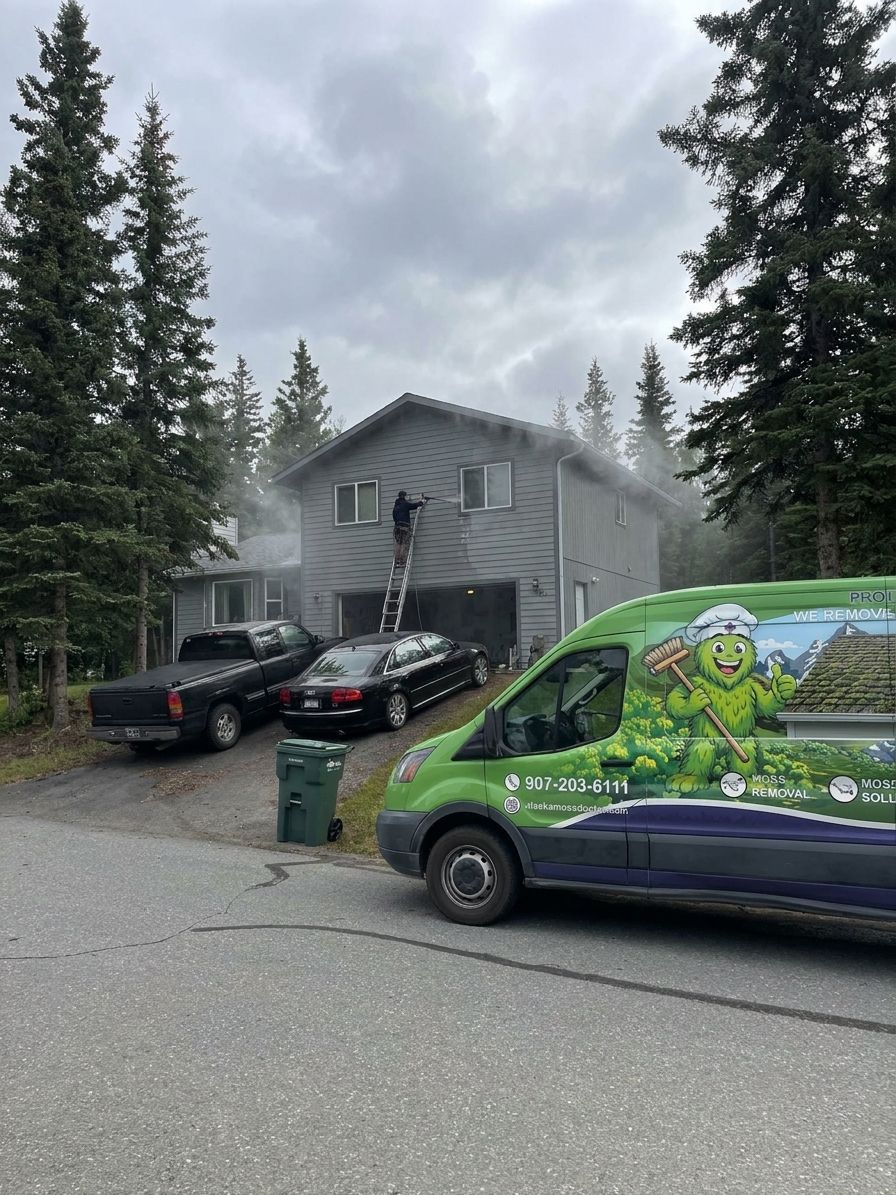
House washing service for fiber cement siding removes moss, algae, and black streaks from cement-based panels through a soft wash method that never strips the factory paint finish or drives water behind the seams. Fiber cement boards — the HardiePlank-style siding common on newer builds around Wasilla and the Mat-Su Valley — behave differently than vinyl or cedar because the panels are porous at the core, seam-jointed, and hold moisture longer through Alaska's freeze-thaw cycle. A homeowner with fiber cement siding needs a wash method built around low pressure and controlled chemical dwell time, not a stronger blast.
- House washing fiber cement siding requires soft washing under roughly 500 PSI, never a straight pressure blast.
- Alaska Moss Doctor treats moss and black streaks on Wasilla-area fiber cement without stripping the factory paint.
- North-facing and shaded fiber cement walls regrow moss fastest through Alaska's freeze-thaw climate.
- DIY hose rinsing clears surface dust; embedded algae and seam staining need a professional soft wash.
Why house washing matters for fiber cement siding homeowners
Fiber cement holds moisture inside its cement core longer than vinyl or wood, so a patch of green that looks surface-level is often already feeding on damp fiber beneath the paint layer. Wasilla's shaded lots and long shoulder seasons give moss and algae months to establish before anyone notices the tint on a north wall. Wash it wrong — high PSI, an upward spray angle, or the wrong chemical ratio — and the result is a stripped factory finish or water forced behind the panel seams, which is the exact failure mode fiber cement manufacturers warn against most, and one reason soft washing without damaging paint matters more here than on other siding types.
The seams themselves are the real vulnerability. Fiber cement panels overlap at horizontal joints, and those joints trap standing water if a rinse pushes upward instead of down. The wash technique matters more than the cleaning product on this siding type.
How to wash fiber cement siding the right way
Inspect your siding for moss, algae, and black streak patterns
Start with a walk-around before any water touches the house. Fiber cement shows growth differently than vinyl — moss tends to cling at seams rather than spread flat across a panel face.
- Check north- and shade-facing walls first — moss establishes there before any other exposure
- Look at horizontal seams and butt joints, where boards trap standing moisture longest
- Note black streak patterns below roof valleys and gutter overflow points, a sign of algae runoff staining the siding beneath
- Press a thumb on any green patch — soft, spongy growth means moss has embedded rhizoids into the paint layer already
- Photograph problem areas before washing so you can track regrowth season over season in 2026 and beyond
Test a rinse pattern on a hidden panel first
A test pass on a low-visibility section tells you more than any product label. Pick a spot behind a shed or under a deck stair before committing the whole house to a chemical mix.
- Run a garden hose at full flow first and note whether surface grime lifts with plain water alone
- Check panel edges and butt joints for pooling after the test — pooling signals a seam needing caulk attention, not more pressure
- Wait 24 hours and inspect for streaking or white residue before scaling up to the full house
- Note the wand distance and angle that lifted dirt without disturbing the paint sheen
- Skip this step only if a professional crew is already running its own dilution test on-site
Choose a soft wash solution rated safe for fiber cement
This is where the chemistry matters more than the equipment. Most factory finishes on fiber cement tolerate a mild, low-concentration cleaning solution — not straight bleach and not a high-strength mix meant for concrete.
- Match dwell time to the growth, not the concentration — a longer soak kills algae roots without needing a stronger mix
- Skip citrus-based "green" cleaners on fiber cement; several leave a film that attracts dust and speeds regrowth
- Confirm the wand tip pressure stays low, in line with the soft wash pressure setting recommended for delicate siding
- A crew like Alaska Moss Doctor blends the ratio for Alaska's cement-based siding and controls dwell time so chemical doesn't sit on the house longer than necessary
- Rinse thoroughly with plain water once dwell time ends — leftover solution residue attracts new spores faster than a clean surface
Protect windows, vents, and landscaping before the wash
Overspray finds gaps around window flashing on fiber cement faster than on solid panel materials, so prep work here matters.
- Close all windows and vents; fiber cement seams sit close to flashing where overspray can seep in
- Cover or shut off exterior outlets and light fixtures inside the wash zone
- Move patio furniture, planters, and delicate shrubs back at least 10 feet
- Wet down landscaping beds first if the mix includes any chlorine-based cleaner, to dilute runoff
- Homeowners scheduling a full wash can follow the same steps covered in preparing your yard before a house washing
Rinse top-down in overlapping passes
Direction matters as much as pressure on fiber cement. Water sprayed upward at a seam goes exactly where the panel design is built to keep it out.
- Start at the roofline and work down in horizontal bands so runoff carries dirt downward, not back onto clean panels
- Angle the wand downward at every seam and butt joint — spraying upward is the fastest way to force water behind fiber cement
- Keep the wand moving; a stationary blast held on one spot for more than a couple seconds can etch even a cured factory finish
- Do a second plain-water rinse pass after chemical dwell time to clear all residue
Schedule the wash around Alaska's freeze-thaw calendar
Timing affects the panel itself, not just the moss. Late spring through early fall, once nighttime temperatures hold consistently above freezing, is the safest window for a 2026 wash.
- Avoid washing right before a hard freeze — trapped surface moisture on cement panels can micro-crack during the first freeze cycle
- Book north-facing wall treatments earlier in the season since moss reestablishes there first
- Pair the house wash with a roof check if moss shows on both surfaces, since spores travel between them
Book a professional soft wash once growth returns within a season
If moss or algae reappears within 6-8 months of a wash, growth has already reached root depth, and a hose rinse won't clear it again.
- A crew equipped for fiber cement documents seam condition before and after the wash, useful if a warranty question comes up later
- Alaska Moss Doctor coordinates fiber cement house washing with roof moss treatment in the same visit when both are present, cutting a second setup trip
Comparing your options for fiber cement house washing
| Option | Best for | Key limitation | Verdict |
|---|---|---|---|
| Garden hose rinse | Light dust, pollen, no visible moss | Doesn't touch embedded algae or moss roots | Skip for active growth |
| DIY pressure washer | Small touch-up spots away from seams | High PSI risks stripping paint or forcing water behind panels | Skip near seams |
| Professional soft wash (Alaska Moss Doctor) | Full-house fiber cement cleaning with moss or algae present | Scheduling depends on Alaska's weather window | Buy |
| Full repaint or panel replacement | Siding with cracked or delaminated panels | Highest cost, addresses damage rather than routine buildup | Wait unless panels are damaged |
Professional soft washing is the right call whenever moss or black streaks show up on fiber cement, because it's the only option on this list that clears root-level growth without risking the seams.
Common mistakes homeowners make with fiber cement siding
- Running a pressure washer above roughly 500 PSI directly at butt joints, forcing water into the sheathing behind the panel and causing swelling from the inside out
- Spraying upward under eaves and soffits, pushing water behind laps designed to shed water in one direction only
- Using straight bleach instead of a diluted soft wash mix, which breaks down the factory clear coat over time and leaves the panel more porous
- Washing right before a hard freeze, trapping moisture in the cement core ahead of the first freeze-thaw cycle of the season
- Ignoring caulk gaps at trim and window flashing before washing — unsealed gaps let wash water track behind the siding regardless of pressure used
Get your fiber cement siding assessed
Wasilla-area soft wash scheduling for moss, algae, and black streaks in 2026.
FAQ
What's the best way to wash fiber cement siding without damaging the paint?
Soft washing under roughly 500 PSI with a diluted, low-concentration cleaning solution is the safest method for fiber cement siding in 2026. High-pressure blasting or straight bleach breaks down the factory finish and can force water behind panel seams.
Can pressure washing damage fiber cement siding?
Yes, pressure above roughly 500 PSI at the wand tip can chip or strip the factory paint on fiber cement and drive water into the seams. Soft washing at low pressure with a longer chemical dwell time cleans moss and algae without that risk.
How often does fiber cement siding need to be washed in Alaska?
Most Wasilla and Mat-Su Valley homes with fiber cement siding need a wash every 12 to 18 months, sooner on shaded or north-facing walls. Homes near heavy tree cover often need attention every year.
Is soft washing safe for fiber cement siding?
Soft washing is the manufacturer-recommended method for fiber cement because it cleans at low pressure with a chemical dwell time instead of mechanical force. It removes moss, algae, and black streaks without stripping the paint layer that high-pressure washing damages.
What causes black streaks on fiber cement siding?
Black streaks on fiber cement usually come from algae runoff washing down from the roof or a gutter overflow point onto the siding below. Left untreated for a season or two, the staining spreads into surrounding panels.
Does moss on siding mean there's a bigger moisture problem?
Moss on fiber cement signals the surface stays damp longer than it should, often from shade, poor drainage, or a gutter overflowing onto the wall. Clearing the moss without fixing the moisture source usually means it returns within a season.
Can I wash fiber cement siding myself?
A garden hose rinse handles light dust and pollen, but embedded moss and algae need a soft wash solution and controlled dwell time to clear root-level growth. DIY pressure washers risk high PSI at seams, the main cause of forced-moisture damage on fiber cement.
Is fiber cement siding better than vinyl for moss resistance in Alaska?
Neither material resists moss on its own — moss grows wherever shade and moisture linger, regardless of siding type. Fiber cement just requires a gentler wash technique because its finish and seams are more sensitive to high pressure than vinyl.
One last thing
The flat face of a fiber cement panel is rarely the problem — the butt joints are. A crew that spends more time angling the wand at seams than at open wall space is doing the wash correctly; one that blasts the whole face evenly and skips the joints is the one to worry about going into the 2026 wash season.