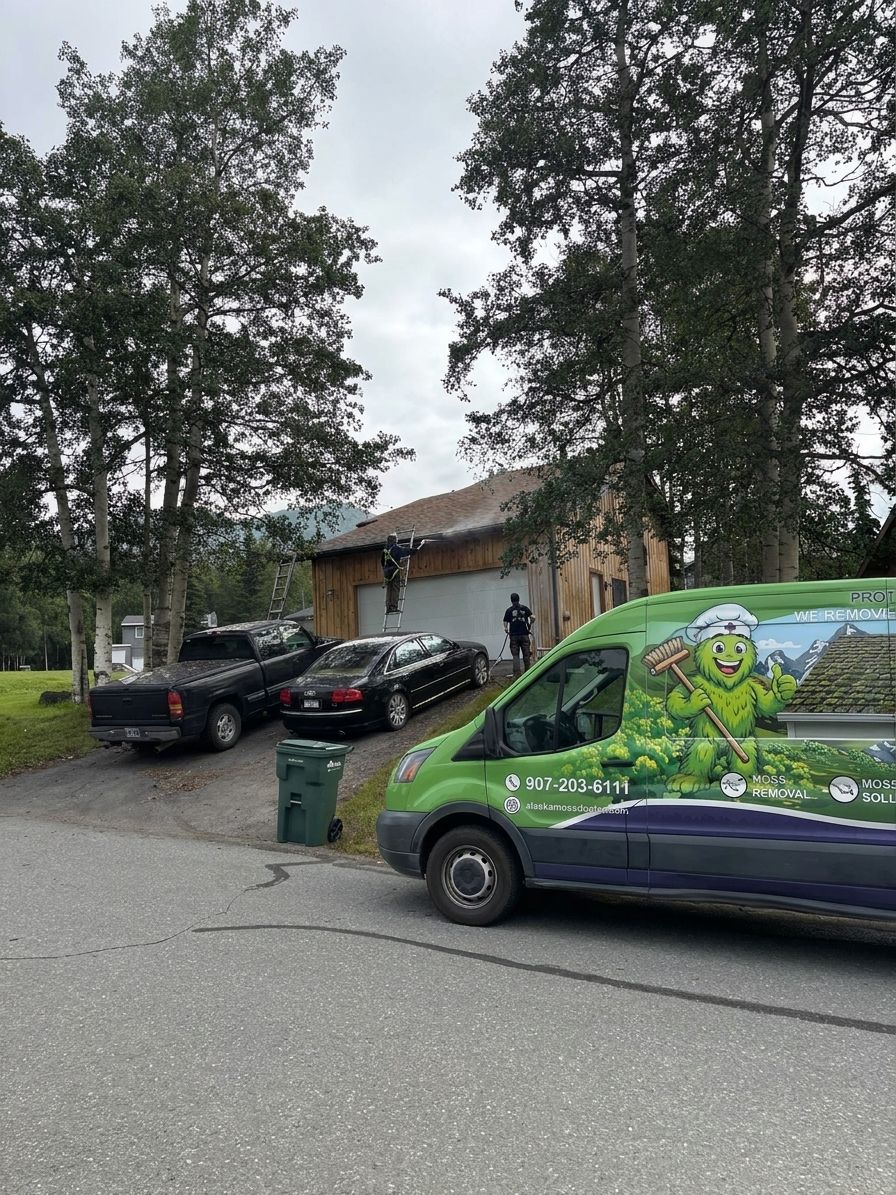
Soft washing strips moss, algae, and grime off siding without touching the paint underneath — if you get the pressure, chemistry, and rinse sequence right. Get any one of those wrong and you're repainting the house instead of just cleaning it.
- Soft washing under 500 psi with a surfactant-based cleaner removes algae without stripping paint in 2026 — pressure washing above 1,500 psi is the usual cause of paint failure.
- Dwell time of 5-15 minutes lets the cleaning solution do the work, not the nozzle.
- Rinse top-down at low pressure; spraying upward under siding laps forces water behind the paint film.
- Test a hidden section first on painted wood or older siding before washing the whole house.
- Alaska Moss Doctor recommends a professional soft wash pressure setting for delicate or older painted siding in the Wasilla area.
Why this matters
Most paint damage from house washing isn't chemical — it's mechanical. A pressure washer set above 1,500 psi drives water past the paint film and into the substrate, and that's when you see peeling, blistering, or chalking paint lift off in sheets weeks later. Soft washing solves this by relying on a cleaning solution and dwell time to break down organic growth, then a low-pressure rinse to carry it away.
In Wasilla and the greater Mat-Su Valley, homes deal with a specific version of this problem: shaded lots, long wet seasons, and painted wood or vinyl siding that holds moisture longer than siding in drier climates. That combination grows algae and moss fast, and it also makes paint more vulnerable to aggressive cleaning. Getting the soft wash pressure setting right matters more here than in a dry climate where growth is lighter and paint is less weathered.
What you'll need
- Low-pressure soft wash system or a garden hose-fed sprayer capable of running under 500 psi
- Surfactant-based house wash cleaner (sodium hypochlorite blends are standard in the industry, typically diluted around 1:3 to 1:5 with water depending on growth severity)
- Pump-up or hose-end sprayer for pre-wetting plants and landscaping
- Plastic sheeting or tarps to protect shrubs, flower beds, and outdoor fixtures
- Eye protection, gloves, and closed-toe shoes
- Extension wand or ladder for second-story sections
- 2 to 4 hours depending on house size and growth level
If the siding is painted wood, cedar, or older vinyl, budget extra time for a test patch before committing to the full exterior.
The steps
1. Inspect the paint and siding condition first
Walk the perimeter and note any areas where paint is already chalking, peeling, or cracked. These spots are the most vulnerable to both chemical and mechanical damage, and they'll tell you where to slow down.
Older painted wood siding and homes built before the 2000s are more likely to have thinner or brittle paint layers. Skipping this step is the single most common reason homeowners end up with peeling paint after a DIY wash — they treat every wall the same when the wall itself isn't uniform.
2. Protect plants, fixtures, and anything that can't get wet with cleaner
Soak nearby plants and grass with plain water before applying any cleaner, then cover sensitive landscaping with plastic sheeting. Sodium hypochlorite-based solutions will scorch foliage on contact if left undiluted or unrinsed.
Cover outdoor light fixtures, exposed electrical outlets, and any unsealed wood trim. This step takes 15-20 minutes and prevents the most common collateral damage from a soft wash job.
3. Mix the cleaning solution to the right dilution
Most residential soft wash mixes run 1 part cleaner to 3-5 parts water, adjusted based on how heavy the algae or moss buildup is. A weaker mix on light staining protects paint better than a strong mix used everywhere out of habit.
For painted wood siding specifically, lean toward the weaker end of that range and add a second application if needed rather than starting strong. Paint film on wood is more porous than vinyl and absorbs chemical residue faster.
4. Apply from bottom to top, rinse from top to bottom
Apply the cleaning solution starting at the bottom of the wall and working up — this prevents streaking from runoff on dry sections above. Once the solution has been applied everywhere, reverse the order for rinsing: top to bottom, always.
Spraying upward at siding laps with any real pressure forces water behind the panels and behind paint edges. That trapped moisture is what causes bubbling and peeling days after the wash looks finished.
5. Let the solution dwell before rinsing
Give the cleaner 5 to 15 minutes of contact time before rinsing, depending on the product and growth severity. This dwell period is what actually kills and loosens moss and algae — the rinse just removes what's already dead.
Don't let the solution dry completely on the surface, especially in direct sun. Re-wet with plain water if it's drying faster than expected before you get to the rinse.
6. Rinse at low pressure, close to the surface
Keep the rinse under 500 psi and hold the wand at a consistent distance, moving in overlapping passes. High pressure at this stage is unnecessary — the cleaner already did the mechanical work of loosening growth.
Rinse thoroughly enough that no cleaner residue or white streaking remains once the siding dries. Residue left behind can attract dirt faster than an unwashed surface.
7. Spot-check for missed algae and stubborn stains
Walk the house again once it's dry, looking for shaded corners, under eaves, and north-facing walls where algae tends to survive a first pass. These spots often need a second, targeted application rather than a full re-wash.
Black streaking near roof lines is usually algae runoff from the roof itself, not the siding — that's a separate problem covered in how to clean algae stains off a roof safely.
8. Inspect the dried result before calling it done
Give the exterior 24 hours to fully dry, then check for any lifting paint edges, discoloration, or missed streaking. Catching an issue at this stage is far cheaper than discovering it a month later.
Get a soft wash quote for your home
Alaska Moss Doctor serves Wasilla-area homeowners with professional exterior washing.
Troubleshooting
- Paint looks chalky or dull after washing — this is usually pre-existing chalking oxidation surfacing, not new damage; a lighter dilution ratio next time reduces the effect.
- White streaks remain after rinsing — incomplete rinse of the cleaning solution; go back over the area with plain water at low pressure.
- Plants near the house are browning — unrinsed sodium hypochlorite overspray; flood the root zone with plain water immediately and repeat for several days.
- Algae comes back within weeks — dwell time was likely too short, or the mix was too diluted for the growth level; heavier shaded walls may need a stronger mix or a repeat treatment.
- Paint bubbles or peels near siding laps — pressure was too high during rinse and forced water behind the panel; this requires a repaint, not a re-wash.
- Streaking reappears fastest on north-facing walls — shade and moisture retention drive regrowth there faster than anywhere else on the house; see algae removal for north-facing roofs for the same pattern on rooflines.
Tools and resources
The soft washing approach above works across most siding types, but the setup changes by material:
- House washing service for vinyl siding — vinyl tolerates a wider pressure range than painted wood but still scorches under direct sodium hypochlorite overspray on trim.
- Painted wood and cedar siding need the gentlest settings and the most conservative dilution ratios of any exterior material.
- Stucco surfaces need different rinse angles entirely since the texture traps runoff differently than flat siding.
A soft wash system with adjustable pressure and a dedicated chemical injector is worth the cost over a standard pressure washer with a downstream injector, since it holds pressure more consistently below the 500 psi threshold that protects paint.
What to do next
Once the siding is done, most homeowners in the Wasilla area find the roof needs attention on the same visit — moss and algae rarely stop at the roofline. If your house wash uncovered heavy staining above the gutters, that's a sign the roof itself needs a dedicated soft wash pass, not just the siding.
FAQ
What PSI is safe for soft washing a house without damaging paint?
Soft washing runs under 500 psi, well below the 1,500-4,000 psi range of standard pressure washing. Most paint damage comes from pressure above that threshold, not from the cleaning chemicals.
Is sodium hypochlorite safe for painted siding?
Yes, when diluted correctly and rinsed thoroughly, sodium hypochlorite-based cleaners are standard in the soft wash industry for painted siding. Left undiluted or unrinsed, it can scorch plants and leave white residue on the surface.
How long should cleaning solution sit before rinsing?
Dwell time of 5 to 15 minutes is typical, depending on the product and how heavy the algae or moss buildup is. Letting the solution dry out completely on the surface before rinsing reduces its effectiveness.
Can soft washing remove moss from painted wood siding?
Yes, soft washing removes moss from painted wood siding more safely than pressure washing because it relies on chemical dwell time instead of mechanical force. Painted wood needs a weaker dilution ratio than vinyl or stucco to avoid stripping the paint film.
Why did my house wash cause paint to peel?
Peeling after a wash almost always means the rinse pressure forced water behind the paint or siding laps, not that the cleaner caused it. Rinsing top-down at low pressure and close range prevents this.
How often should a house be soft washed in Alaska?
Homes in shaded or heavily wooded lots around the Mat-Su Valley often need washing more frequently than homes in drier climates because moss and algae regrow faster in persistent moisture. Annual washing is a reasonable starting point for most properties.
Does soft washing work on stucco exteriors?
Yes, but stucco's texture holds runoff differently than flat siding, so rinse angles and dwell time need adjusting compared to vinyl or wood. A dedicated stucco approach avoids driving cleaner into the surface texture where it can dry unevenly.
What's the difference between soft washing and pressure washing?
Soft washing uses low pressure under 500 psi plus a cleaning solution and dwell time to break down growth, while pressure washing relies mainly on mechanical force above 1,500 psi. Soft washing is the safer choice for painted surfaces in 2026 because it doesn't rely on force to do the cleaning.
One last thing
The part most homeowners skip is the plain-water pre-rinse of landscaping before applying any cleaner. It takes fifteen minutes and it's the difference between a clean house and a dead flower bed by the following week.