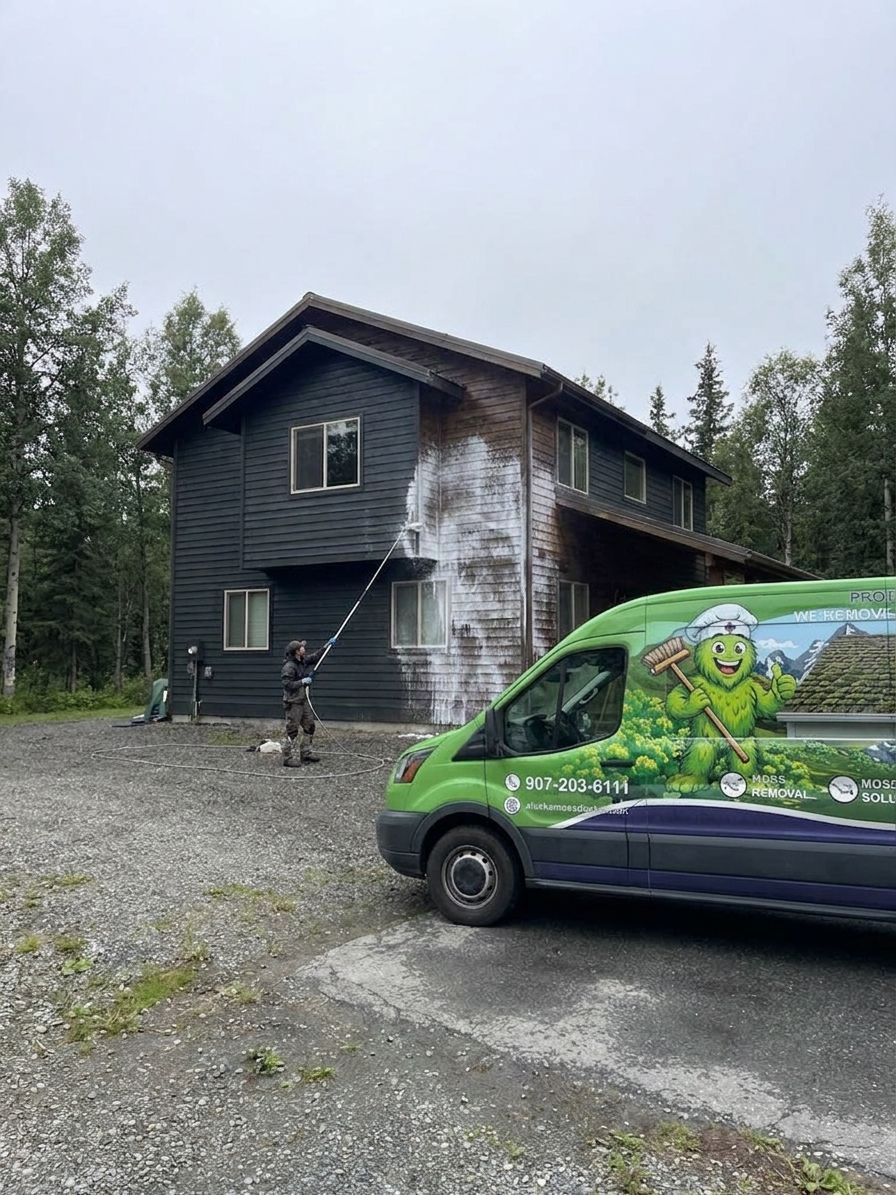
Painted wood siding fails a different way than vinyl or stucco — the paint film blisters, peels, and lets moisture into the wood grain if you clean it wrong. The best house washing method for painted wood siding in 2026 is a low-pressure soft wash with a mildewcide-based solution, not a pressure washer.
- Soft washing under 500 PSI is the best house washing method for painted wood siding in 2026 — buy it.
- Skip pressure washers running 1,500-3,100 PSI; they strip paint and force water behind boards.
- Hand scrubbing suits spot moss under 10 square feet, not full elevations.
- Bleach-only DIY mixes fade paint pigment and kill nearby landscaping — avoid on painted wood.
- Dwell time of 5-10 minutes with a mildewcide beats scrubbing for lifting algae without abrasion.
Why this matters
Painted wood siding is common on older Wasilla-area homes and log-adjacent construction, and Alaska's damp shoulder seasons feed algae and moss faster than drier climates. The wrong wash method doesn't just fail to clean the siding — it opens the door to paint failure that costs far more to fix than the wash itself.
This differs from how you'd approach cedar siding, where the wood itself is the finish and the risk profile shifts toward graying rather than paint peel. Painted wood has a film on top of the wood, and that film is the thing you're protecting.
How this ranking works
Each method below is scored against three things: whether it damages the paint film, whether it actually kills the algae/moss root instead of just knocking off the visible growth, and how it performs on the vertical, often north-facing walls typical of Wasilla-area lots. Paint manufacturers have warned against high-PSI pressure washing on painted exteriors for years because water forced under lap joints and behind trim doesn't dry out — it just blisters the paint from the inside over the following season.
Soft washing became the standard approach in the exterior cleaning trade because it relies on chemistry to break down organic growth rather than brute force to blast it off. That distinction matters most on painted surfaces, where mechanical force is the enemy and dwell time is the ally.
The ranked methods
1. Soft wash with mildewcide solution — the gold standard
Soft washing applies a surfactant-based cleaning solution at under 500 PSI, then lets it sit for 5-10 minutes before a low-pressure rinse. The chemistry does the work; the water pressure just clears residue.
This is the only method on this list that kills algae and moss spores at the root instead of just stripping the visible film off the paint surface. It's also the gentlest option on caulk lines, trim joints, and any spot where paint has already started to thin. Verdict: Buy.
2. High-pressure washing — the risky one
Standard consumer and contractor-grade pressure washers run 1,500 to 3,100 PSI, which is roughly three to six times the ceiling considered safe for painted wood. At that pressure, water gets driven behind lap siding and around window trim, and it stays trapped long after the surface looks dry.
The visible damage — chipped paint edges, gouged wood grain — shows up immediately. The damage you don't see, trapped moisture under the paint film, shows up as blistering the following spring. Verdict: Skip.
3. Hand scrubbing with a soft-bristle brush — the spot-treatment backup
A long-handle brush and a mild cleaning solution work fine on isolated moss patches under roughly 10 square feet, especially in shaded corners where growth concentrates. It's slow, it's physically demanding on a two-story elevation, and it's easy to over-scrub one spot while leaving the rest of the wall untouched.
This method has no place as a whole-house strategy on painted wood — it's a touch-up tool, not a primary wash method. Verdict: Hold.
4. Chemical-only spray-and-rinse — the low-effort pick
This is soft washing without the equipment: a pump sprayer, a cleaning solution, a 15-20 minute dwell, and a garden-hose rinse. It handles light algae film reasonably well on siding that hasn't seen heavy buildup in a year or two.
It underperforms on established moss colonies and on siding with heavier north-facing shade, where growth has had time to root into checked or cracked paint. Verdict: Hold.
5. Bleach-based DIY mix — the wildcard
A sodium hypochlorite bleach solution in a garden pump sprayer is the most common DIY approach, and it's also the one most likely to cause collateral damage. Bleach fades paint pigment unevenly over repeated use, and overspray or runoff kills grass, shrubs, and perennial beds along the foundation line.
It does kill surface algae, which is why it persists as a DIY habit. The tradeoff — pigment fade on the paint job and dead landscaping — isn't worth it for a method that a properly diluted mildewcide solution matches without the side effects. Verdict: Skip.
6. Soft wash plus detail brushing on trim — the top pick for painted wood specifically
The combination approach runs the low-pressure soft wash across the full elevation, then follows with light hand-brushing on window trim, corner boards, and any spot where moss has gripped a paint seam. This catches what pure soft washing sometimes leaves behind in tight joints without introducing the pressure risk of a washer.
For houses where the paint job is more than five years old and starting to show hairline checking, this combination protects the film better than soft washing alone. Verdict: Buy.
Comparison table
| Method | Pressure | Paint-safe | Best for | Verdict |
|---|---|---|---|---|
| Soft wash + mildewcide | <500 PSI | Yes | Whole-house annual wash | Buy |
| High-pressure washing | 1,500-3,100 PSI | No | Nothing on painted wood | Skip |
| Hand scrubbing | None (manual) | Mostly | Small spot moss under 10 sq ft | Hold |
| Chemical-only spray | None (manual) | Yes | Light annual algae film | Hold |
| Bleach DIY mix | None (manual) | Partial | Emergency stopgap only | Skip |
| Soft wash + detail brushing | <500 PSI | Yes | Aging paint, heavy trim moss | Buy |
House washing on painted wood siding isn't interchangeable with methods sold for vinyl siding or stucco exteriors — both of those surfaces tolerate more mechanical pressure than a painted paint film does. If a crew quotes the same pressure-washing approach for all three surface types, that's a sign they're not adjusting for the material.
Get your siding evaluated before you wash
A quick look tells you if soft washing alone is enough or if trim needs detail work.
Where to hire — and what to check
- Ask for the PSI number, not just "soft wash." Some crews call any low-flow rinse a soft wash even when their equipment tops 800-1,000 PSI. Get the number in writing.
- Ask what's in the tank. A mildewcide-based solution kills root growth; a straight bleach-and-water mix is a cheaper substitute that carries the pigment-fade and landscaping risk covered above.
- Time it for spring through early summer in the Wasilla area. Washing before the next round of moss spore activity gets ahead of the growing season instead of chasing it in late fall.
FAQ
What's the best house washing method for painted wood siding?
Soft washing at under 500 PSI with a mildewcide-based solution is the best house washing method for painted wood siding in 2026. It kills algae and moss at the root without the paint-stripping risk of high-pressure equipment.
Is pressure washing bad for painted wood siding?
Yes. Pressure washers commonly run 1,500 to 3,100 PSI, well above the roughly 500 PSI ceiling considered safe for painted wood, and the excess force drives water behind boards and trim.
Can I use bleach to clean painted wood siding myself?
A bleach-and-water mix will kill surface algae, but repeated use fades paint pigment unevenly and runoff can kill nearby grass and shrubs. A diluted mildewcide solution gets similar results without those side effects.
How often should painted wood siding be washed?
Most Wasilla-area homes with painted wood siding need a wash once a year, timed for spring through early summer before the next growing season of algae and moss sets in.
Does soft washing damage paint?
No, soft washing at low pressure with the correct dwell time is one of the gentlest methods available and is standard practice for exteriors where paint film integrity matters.
What's the difference between soft washing and power washing?
Soft washing uses chemistry at under 500 PSI to break down organic growth, while power washing relies on mechanical force at 1,500 PSI or higher, which is too aggressive for a painted surface.
Can hand scrubbing replace a full house wash?
No, hand scrubbing works for isolated moss patches under about 10 square feet but isn't practical or even across a full elevation, which is why it's a spot-treatment tool, not a primary method.
One last thing
The detail most homeowners miss: paint checking — the fine hairline cracking that shows up on a five-year-old paint job — is exactly where moss gets its grip, and it's invisible from ground level. If your painted wood siding is past year five, walk up to the trim with a flashlight before you pick a wash method, because a wall that looks clean from the driveway can already have moss rooted into cracks a pressure washer would only drive deeper.