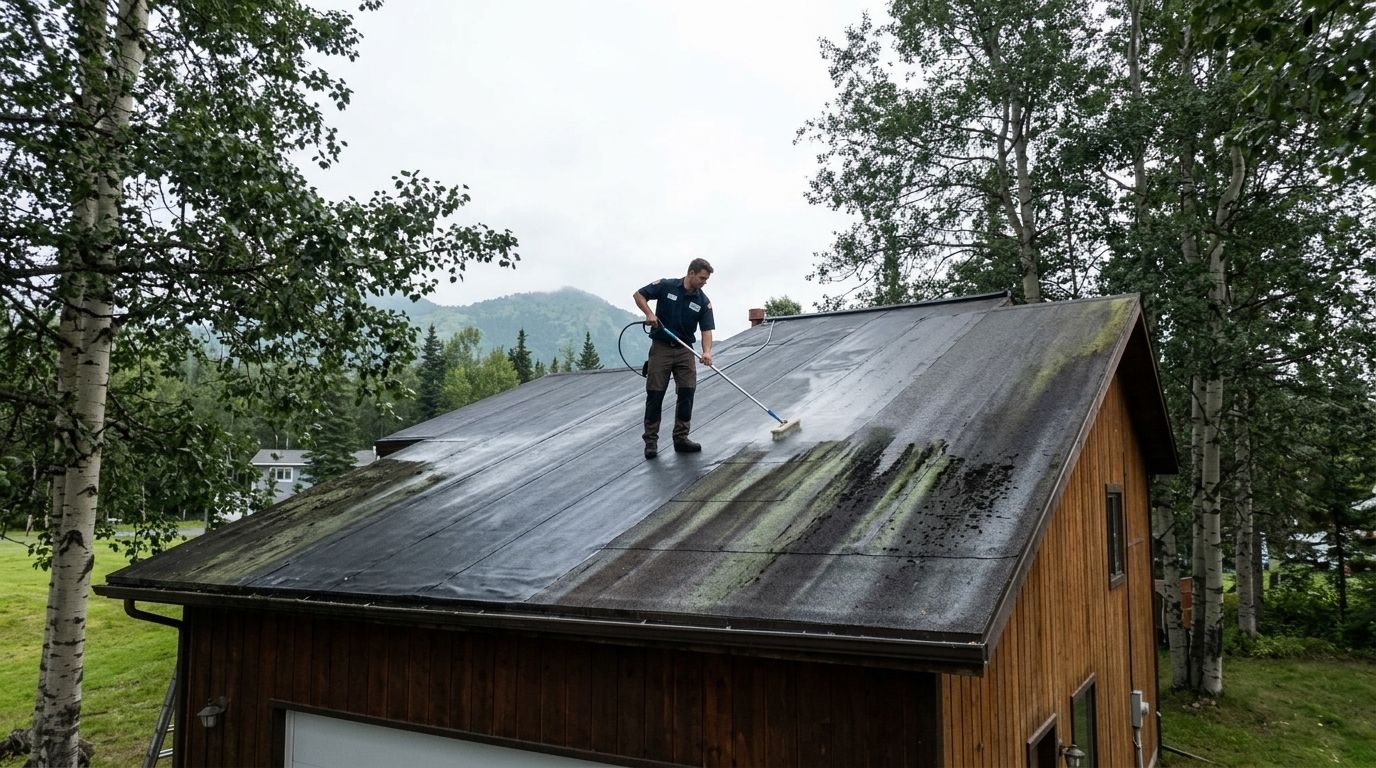
Torch-down and rolled roofing algae removal calls for a soft-wash approach, not a pressure washer, because Wasilla's low-slope membrane roofs crack and delaminate under blasted water and harsh DIY chemical mixes faster than a shingle roof ever will.
- Torch-down and rolled roofing needs a soft wash under roughly 100 PSI, not a pressure washer, to avoid splitting seams and blisters.
- Black and green growth on modified-bitumen and asphalt-rolled membranes feeds on the limestone filler in the granules and returns without a follow-up treatment.
- Alaska Moss Doctor treats modified-bitumen and rolled membrane roofs around Wasilla with a low-pressure, membrane-safe rinse instead of a wand blast.
- May through September is the safe cleaning window in Alaska in 2026; a frozen membrane cracks underfoot.
- Chlorine-heavy DIY mixes strip the asphalt binder in torch-down roofing and can void a manufacturer warranty.
Why roof algae removal matters for torch-down and rolled roofing owners
Torch-down (modified bitumen) and rolled asphalt roofing are single welded or lapped membrane systems, common on additions, sheds, cabin porches, and the low-slope sections of Mat-Su Valley homes. There's no shingle tab to catch a stray blast of water — a seam failure on a membrane roof means water gets under the whole sheet, not just one tile.
Black and green streaking on these roofs is usually the same algae and moss found on shingle roofs, but the membrane's smooth, dark surface holds heat and moisture differently. Alaska's long shoulder seasons and shaded, spruce-heavy lots around Wasilla keep membrane roofs damp longer than open, south-facing shingle roofs, which is exactly the condition algae needs to establish and spread.
The risk profile is different too. A cracked shingle is a repair. A split seam on a flat commercial roof or a torn cap sheet on a cabin roof is a leak path straight to the deck, and in Alaska that water can freeze, expand, and take the seam with it.
Inspect the membrane before you touch it
Start with a walk-around, not a hose. Torch-down and rolled roofing show their weak points before you ever apply water, and finding them first changes how gentle you need to be.
- Check every seam and lap joint for lifting edges or bubbling
- Look for granule loss on cap sheets, which exposes bare asphalt to UV and algae both
- Press gently on blistered areas — soft spots often mean trapped moisture already
- Note flashing points around vents, chimneys, and skylights where algae collects first
- Photograph problem areas before cleaning so you can confirm nothing changed after
Clear debris and standing water first
This step costs nothing and prevents most algae regrowth on its own. Flat and low-slope membrane roofs pool water in ways pitched shingle roofs don't, and standing water is what feeds the growth between cleanings.
- Sweep needles, cones, and leaf litter off the membrane with a soft push broom
- Clear drains, scuppers, and gutter outlets so water actually leaves the roof
- Check for ponding after a rain — water sitting more than 48 hours signals a slope or drain issue, not just a cleaning issue
- Trim overhanging spruce and birch branches that shade the membrane and drop debris
- Remove moss clumps by hand where they've rooted at seams, rather than scraping the surface
Choose a low-pressure rinse over a pressure washer
This is the step that separates torch-down and rolled roofing from asphalt shingles. A pressure washer set above roughly 1,500 PSI can cut through a heat-welded seam or strip the mineral cap sheet in seconds, and there's no way to "un-cut" a membrane once it's split.
- Use a garden hose and a soft-bristle roof brush for light growth on accessible areas
- If you rent equipment, cap it at low-pressure/soft-wash settings, never a standard pressure washer nozzle
- Work in overlapping passes, always with the slope, never straight down into a seam
- For steep, high, or hard-to-reach membrane sections, a professional soft-wash service applies even, low-pressure coverage without the guesswork
- Alaska Moss Doctor runs a soft-wash process built around modified-bitumen and rolled membranes specifically, which is the faster path once the roof is beyond a light surface clean
Apply a membrane-safe cleaning solution
Not every roof cleaner is safe on asphalt-based membranes. Straight chlorine bleach breaks down the asphalt binder over repeated use and can strip the mineral surfacing that protects the cap sheet from UV.
- Look for a soft-wash solution built for roof algae stains rather than a generic bleach-and-water mix
- Dilute per the product's roofing-specific ratio, not the concrete or siding ratio on the same label
- Pre-wet surrounding landscaping and any adjacent siding to limit chemical drift
- Apply, let it sit through its dwell time, then rinse — don't scrub a torch-down membrane with a stiff brush
- Test any new solution on a small, hidden section of membrane first
Rinse from ridge to drain, never against seams
Direction of the rinse matters as much as pressure on a membrane roof. Water forced against a lap direction can work under the seam instead of over it.
- Rinse in the same direction water naturally sheds off the roof
- Keep the nozzle moving; don't park a stream of water on one seam or penetration
- Recheck drains and scuppers after rinsing — cleaning debris can reclog them mid-job
- Confirm no standing puddles remain once rinsing is done
Protect flashing, vents, and penetrations
Every pipe boot, vent stack, and flashing edge on a rolled roof is a seam in miniature, and they're where most leaks start after a cleaning, not before.
- Hand-clean tight areas around vents rather than blasting them with the main rinse pass
- Check flashing seals for cracking once the surface is clean and dry
- Note any rust on fasteners or flashing for separate treatment
- Confirm skylight seals are intact if the roof has them
Schedule around Alaska's freeze window
Modified bitumen and rolled membranes get brittle in cold weather, and walking on a frozen membrane is one of the fastest ways to crack it. The best time of year for roof moss removal in Alaska runs roughly May through September, when the membrane stays flexible enough to walk and clean safely.
- Avoid cleaning when overnight temperatures are near or below freezing
- Plan around spring snowmelt runoff, which adds extra moisture to an already damp membrane
- Book cleaning before fall rains start if the roof sits under heavy spruce or birch cover
- In 2026, treat late May to early September as the reliable window for Mat-Su Valley properties
Set a maintenance interval
A one-time cleaning resets the roof; it doesn't stop regrowth. Algae spores spread by wind and remain even after a wash, and a shaded membrane roof will start showing new growth again within a season or two without a repeat treatment.
- Rinse debris off the membrane at least once each spring and fall
- Reapply a membrane-safe algae treatment on a multi-year cycle rather than waiting for visible black streaking
- Track growth with photos each season to catch it early
- Pair roof cleaning with gutter clearing so water keeps moving off the membrane
Get your torch-down roof assessed
Soft-wash cleaning built for modified-bitumen and rolled membrane roofs in the Wasilla area.
Comparison: cleaning options for torch-down and rolled roofing
| Option | Best for | Key limitation | Verdict |
|---|---|---|---|
| Garden hose + soft brush | Light surface growth on flat, easily accessible roofs | Won't touch established algae rooted in seams | Buy — for annual light upkeep |
| Rented pressure washer | Nothing on a membrane roof | Splits seams and strips granules at standard PSI settings | Skip |
| DIY bleach mix | Small spot treatments away from seams | Degrades asphalt binder over repeated use, may void warranty | Wait — use a membrane-rated product instead |
| Professional soft-wash service (Alaska Moss Doctor) | Full-roof cleaning, steep or high sections, established growth | Requires scheduling within the seasonal window | Buy — best fit for torch-down and rolled roofs |
| Full recoat/recover contractor | Roofs with existing blistering, cracking, or granule loss beyond cleaning | Higher scope than a cleaning job, addresses the membrane not just growth | Hold — get a cleaning assessment first |
Common mistakes torch-down and rolled roofing owners make
- Renting a pressure washer instead of soft-washing. Standard consumer units run well above the pressure a welded seam can take, and the damage doesn't show up until the next heavy rain.
- Mixing straight bleach at full strength. It kills the algae on the surface but keeps breaking down the asphalt binder underneath with every application.
- Walking a cold membrane in shoulder-season light. Alaska's spring and fall temperature swings mean a roof that looks fine at noon can still be brittle at 8am.
- Ignoring ponding water because "it's just a flat roof." Standing water is the single biggest driver of regrowth on rolled membranes, and cleaning without fixing drainage just resets the clock.
- Scheduling a wash right before freeze-up. A membrane that doesn't fully dry before temperatures drop can trap moisture under the surface through winter.
FAQ
What's the best way to remove algae from a torch-down roof?
A low-pressure soft wash with a membrane-safe cleaning solution is the safest method for torch-down roofing in 2026. Standard pressure washers can cut through welded seams, so pressure stays capped well below what's used on driveways or siding.
Can you pressure wash rolled roofing?
No — a conventional pressure washer running above roughly 1,500 PSI can strip granules and split seams on rolled asphalt membranes. Soft washing at low pressure clears algae without stressing the seams.
Does algae growth void a torch-down roof warranty?
Untreated algae itself usually doesn't void a warranty, but cleaning methods that damage the membrane, like bleach overuse or high-pressure washing, often do. Check the manufacturer's cleaning guidance before choosing a method.
How often should a rolled roofing roof be cleaned?
Most shaded, low-slope membrane roofs in the Mat-Su Valley need a rinse each spring and fall, with a full treatment on a multi-year cycle depending on shade and moisture exposure. Roofs under heavy spruce or birch cover need closer monitoring.
Is torch-down roofing more prone to algae than shingles in Alaska?
Torch-down and rolled membranes hold moisture on their smooth surface differently than shingles, and low-slope sections drain slower, which extends the damp window algae needs to establish. Shade and drainage matter more than the material itself.
What temperature is safe for cleaning a membrane roof in Alaska?
Membrane roofing gets brittle near or below freezing, so cleaning is safest from roughly May through September when the surface stays flexible. Working a frozen membrane risks cracking it underfoot.
What's the difference between soft washing and pressure washing a flat roof?
Soft washing uses low pressure and a cleaning solution with dwell time to lift algae, while pressure washing relies on force alone. On torch-down and rolled roofing, only soft washing is safe for the seams.
One last thing
The detail most homeowners miss: black streaking on a torch-down roof often looks worse than it is, because the algae sits on top of the mineral surfacing rather than eating into the membrane itself. The real damage risk isn't the algae — it's what gets used to remove it. A membrane that survives ten years of shade and moss survives fine; a membrane that gets pressure-washed once doesn't always recover.