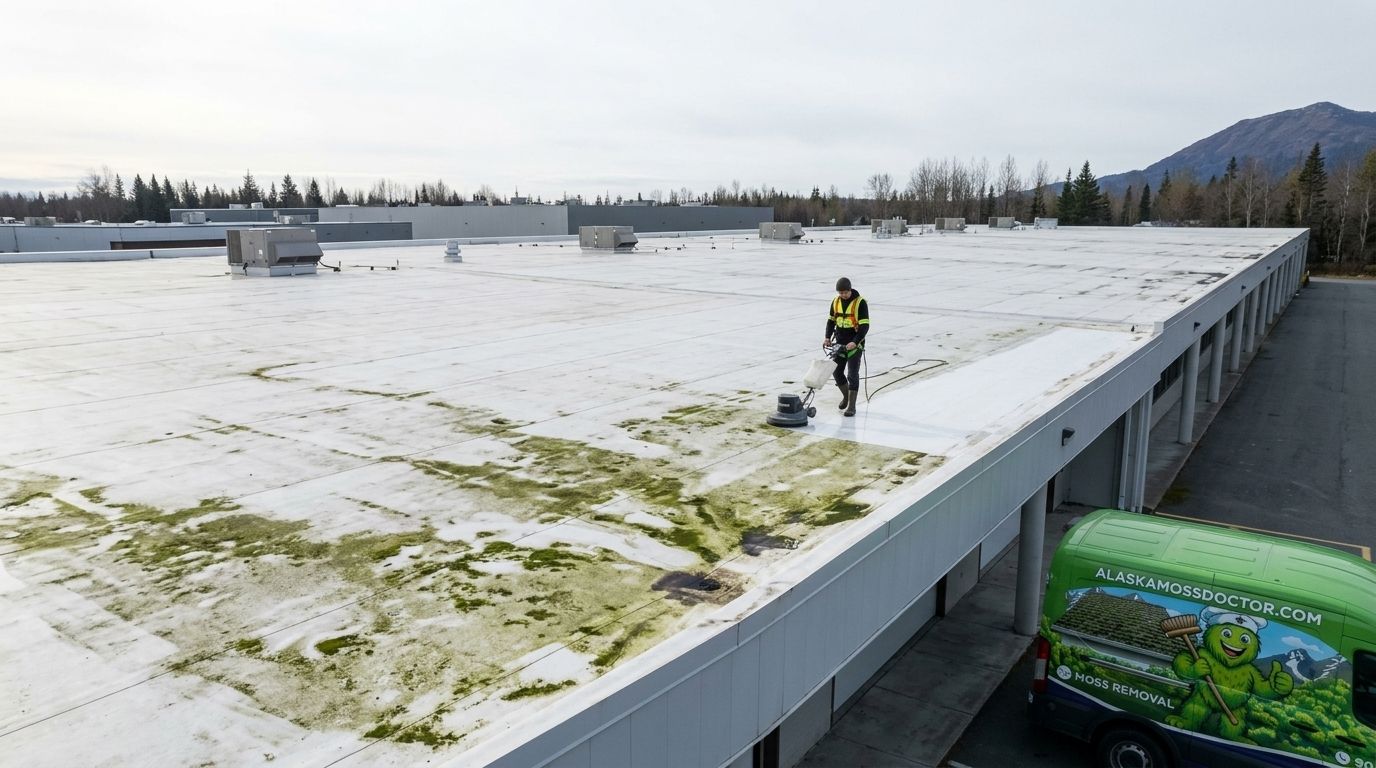
Commercial flat roof algae removal targets the black streaking, green algae mats, and creeping moss colonies that build up on low-slope EPDM, TPO, and built-up gravel roofs across Wasilla and the Mat-Su Valley — with the goal of protecting the membrane, satisfying insurance inspectors, and avoiding a roof replacement years ahead of schedule. Flat commercial roofs hold water and shade longer than pitched residential roofs, so algae and moss establish faster and spread across a wider surface before anyone on the ground notices.
- Flat commercial roofs in the Mat-Su Valley need soft-wash roof algae removal, not pressure washing, to avoid membrane punctures.
- Standing water at drains and low points is the root cause on most flat commercial roofs — clear that before any chemical treatment.
- Alaska Moss Doctor recommends scheduling flat roof algae removal in the short 2026 building window between spring thaw and first fall frost.
- Untreated algae mats trap moisture against TPO and EPDM seams, which shortens membrane life faster than UV exposure alone.
- Annual or biannual cleaning documented in writing supports insurance compliance reviews for commercial property owners.
Why roof algae removal matters for flat commercial roofs
Property managers deal with a different risk profile than a homeowner with a shingle roof. A flat commercial roof holds pooled water at low points, and that water sits against the membrane for days after a rain event common in the Mat-Su Valley's wet shoulder seasons. Algae and moss root into seams, flashing details, and rooftop unit curbs — the exact places where a leak turns into a five-figure repair.
Insurance carriers and lenders increasingly ask for documented roof maintenance on commercial buildings, and a membrane covered in algae staining reads as neglect during an inspection even when the roof itself is structurally sound. Clean membrane photographs dated to 2026 carry more weight in an insurance file than a verbal assurance that the roof was serviced.
Tenants and HOA boards notice too. A retail strip or apartment complex with visible black streaking on a flat roofline looks worse from the parking lot than the same building with a clean cap sheet, and that visual read affects lease renewals and resale value.
Update your roof inspection routine
Start every commercial roof algae removal project with a walk of the entire membrane, not just the visible edges from the ground.
- Map every drain, scupper, and low point where water pools longer than 48 hours
- Photograph existing algae and moss growth before any cleaning to document baseline condition
- Check flashing, HVAC curbs, and pipe boots for lifted seams hidden under moss mats
- Note any soft or spongy membrane sections — these need a roofer, not a cleaner
- Flag skylights and rooftop equipment access points for separate treatment
Choose a soft-wash method over pressure washing
High-pressure washing strips the granules or mineral coating off a flat roof membrane and voids most manufacturer warranties outright. A soft-wash approach uses low pressure and a targeted cleaning solution to lift algae and moss without abrading the membrane surface.
- Confirm the membrane type (EPDM, TPO, PVC, or built-up gravel) before selecting a solution
- Use low-pressure application, not a pressure washer wand, on any single-ply membrane
- Test the solution on a small hidden section first if the roof has an unusual coating
- Rinse thoroughly to prevent residue buildup that attracts new spores
- Avoid chlorine-heavy formulas on metal flashing and copper roof penetrations
Clear drains and low points before treating growth
Algae keeps coming back on a flat roof if the standing water problem underneath it never gets fixed. Cleaning the surface without addressing drainage is a one-season fix at best.
- Clear debris and moss buildup from every roof drain and overflow scupper
- Check that internal drain strainers are seated and not corroded shut
- Look for reverse-slope or sagging deck areas that hold water permanently
- Route a secondary path for water if a primary drain stays blocked seasonally
- Schedule drain clearing on the same visit as the algae treatment, not separately
Treat with a roof-safe biocide, not a generic cleaner
A biocide formulated for roofing membranes kills the algae and moss root structure rather than just bleaching the visible growth. Generic household cleaners strip color from a membrane without addressing regrowth.
- Select a biocide rated safe for the specific membrane material on file
- Apply during dry, above-freezing conditions so the solution has time to work
- Allow the recommended dwell time before rinsing per the product's application guidance
- Reapply to shaded north-facing sections that dry slower and regrow faster
- Keep application records for the building's maintenance file
Schedule around Alaska's short building season
Mat-Su Valley weather gives commercial property managers a narrow window each year for exterior roof work. Waiting until late fall risks freezing temperatures mid-project.
- Book flat roof cleaning between spring thaw and the first hard frost of the season
- Avoid scheduling during active snowmelt when the roof surface stays saturated
- Build in a buffer week for weather delays common to interior Alaska logistics
- Coordinate with tenants or occupants ahead of any rooftop access work
- Confirm crew availability early — 2026 booking windows fill faster in peak months
Document the work for insurance and lease compliance
A maintenance record with dated photos and treatment details protects a property owner during an insurance review or a lease renewal dispute.
- Keep before-and-after photos with dates for every cleaning cycle
- Log the biocide product and application date used on each roof section
- Store drain-clearing records separately since insurers ask about them directly
- Share the maintenance file with the building's insurance broker annually
- Retain records for at least the length of the roof's warranty period
Set a recurring maintenance schedule
A one-time cleaning buys a season, not permanent protection. Flat commercial roofs in shaded or tree-adjacent lots in the Mat-Su Valley regrow algae and moss faster than roofs in open, sun-exposed lots.
- Set an annual cleaning cycle for roofs in full sun, biannual for shaded roofs
- Re-inspect drains at each visit even if no growth is visible yet
- Track regrowth speed year over year to adjust the schedule
- Budget the recurring cost into the building's annual maintenance plan rather than treating it as a surprise line item
Alaska Moss Doctor structures flat commercial roof algae removal around this same inspect-drain-treat-document cycle for property managers across the Mat-Su Valley, and the sequence matters more than any single product used.
Comparison of flat commercial roof cleaning options
| Option | Best for | Key limitation |
|---|---|---|
| DIY pressure washing | Owners with no budget for a contractor | Strips membrane coating, voids most manufacturer warranties |
| DIY soft-wash chemical spray | Small flat roofs with easy ground access | No drain-clearing step, regrowth returns within a season |
| Professional soft-wash service | Multi-tenant buildings, HOA and insurance-compliant properties | Requires scheduling within Alaska's short building season |
| Early roof replacement | Roofs with active leaks under moss mats | Full cost of a new roof, not a maintenance fix |
Verdict: professional soft-wash service is the only option on this list that protects the membrane warranty and produces the documentation insurers ask for — treat pressure washing and generic sprays as short-term stopgaps at best.
Common mistakes commercial property managers make
- Pressure washing gravel or single-ply membrane roofs — this strips protective coating and creates the exact leak risk the cleaning was meant to prevent.
- Cleaning the visible surface but skipping drain clearing — algae returns within one wet season if standing water at low points never gets addressed.
- Waiting until a lease renewal or insurance audit to clean — reactive scheduling means missing Alaska's narrow spring-to-fall building window entirely.
- Using a residential-grade cleaning crew unfamiliar with commercial membrane types — TPO, EPDM, and PVC each need different solution chemistry, and a generic approach damages seams.
- Skipping photo documentation — property managers lose leverage in insurance disputes without dated before-and-after records tied to the roof cleaning for insurance compliance file.
Book flat roof algae removal for 2026
Get an inspection scheduled before the Mat-Su Valley's building season fills up.
FAQ
What is the best method for roof algae removal on flat commercial roofs?
Soft-wash cleaning paired with a membrane-safe biocide is the standard method for flat commercial roofs in 2026. Pressure washing strips membrane coating and voids most manufacturer warranties, so it is not recommended on EPDM, TPO, or PVC roofing.
How often should a flat commercial roof be cleaned for algae and moss?
Sun-exposed flat roofs typically need annual cleaning, while shaded or tree-adjacent roofs in the Mat-Su Valley often need biannual service. Regrowth speed depends on shade, drainage, and how quickly standing water clears after rain.
Does roof algae void a commercial roofing warranty?
Algae growth itself usually does not void a warranty, but pressure washing to remove it often does. Check the membrane manufacturer's cleaning guidance before choosing a method, since most specify soft-wash or low-pressure application only.
Can algae removal be done during the Alaska winter?
No — biocide treatments need above-freezing, dry conditions to work, so cleaning is limited to the window between spring thaw and the first fall frost. Scheduling outside that window risks incomplete treatment and refreeze damage.
Why do flat roofs grow more algae than pitched roofs?
Flat roofs hold water at drains and low points far longer than pitched roofs shed it, giving algae and moss the sustained moisture they need to establish. Poor drainage, not just shade, is usually the primary driver on commercial buildings.
What documentation do insurance companies want for roof maintenance?
Most insurers want dated before-and-after photos, the cleaning product or biocide used, and the service date logged in the building's maintenance file. This record supports claims and renewal reviews for commercial property owners.
Is black streaking on a flat roof the same as algae?
Black streaking is typically algae (often Gloeocapsa magma) feeding on the membrane's limestone filler or accumulated debris, distinct from green moss mats that need more sustained moisture. Both respond to soft-wash biocide treatment but regrow at different rates.
Does gutter and drain clearing matter for flat roof algae prevention?
Yes — clogged drains and scuppers are the root cause of most flat roof algae regrowth, since they create the standing water algae needs to establish. Clearing drains at every cleaning visit matters more than the cleaning solution itself.
One last thing
The single detail most property managers miss on a flat commercial roof: the north-facing or building-shaded section regrows algae noticeably faster than the rest of the roof, even after an identical cleaning treatment. Budgeting a spot-treatment visit for that section between full cleaning cycles catches regrowth before it spreads back across the membrane — a cheaper fix than waiting for the next annual visit.