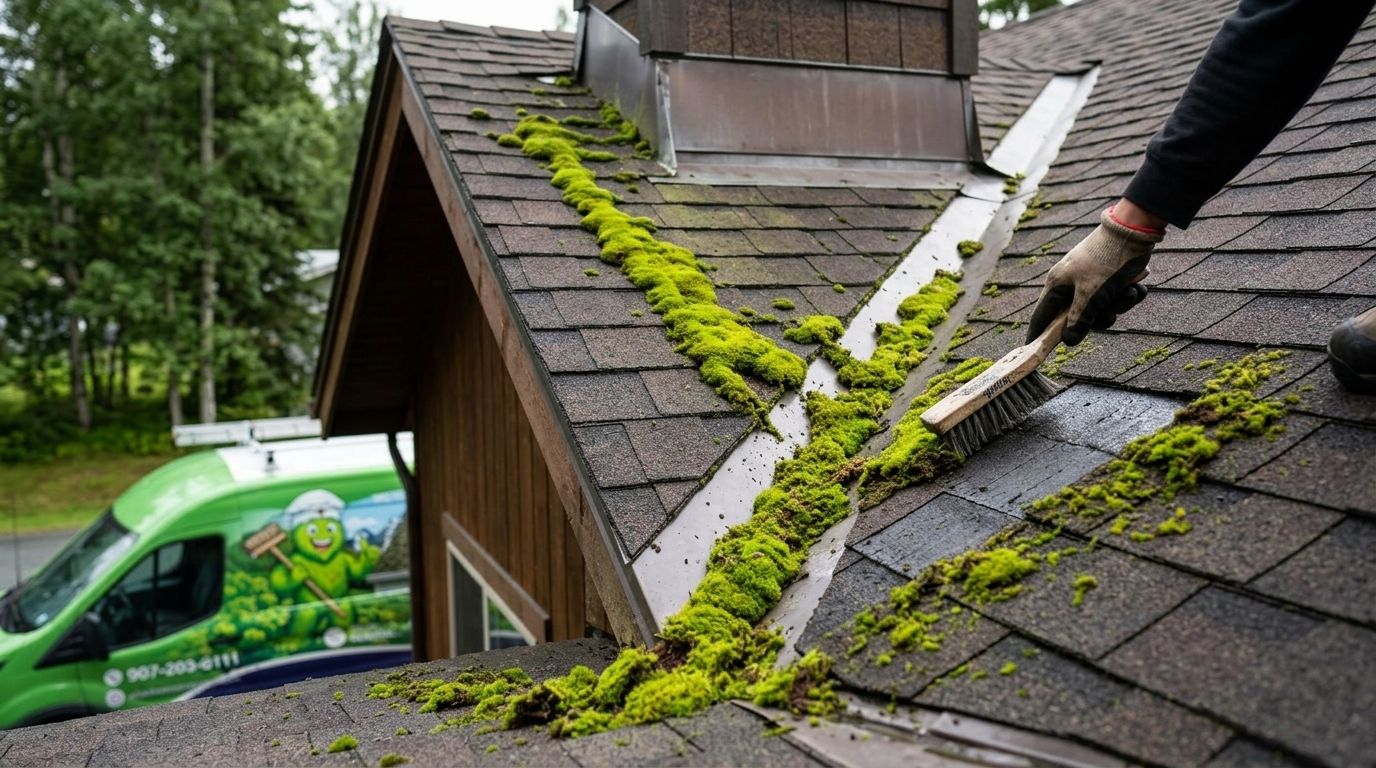
Moss removal for roof valleys and flashing is the process of clearing packed-in moss, needles, and organic debris from the seams where two roof planes meet and where metal flashing directs water around chimneys, skylights, and vents, with the aim of stopping trapped moisture before it works under the shingles and into the decking. Valleys and flashing behave differently than open shingle field: they collect runoff from two directions, they hold shade longer, and they're where a roof actually leaks first. A general roof wash that skips these areas leaves the exact spots most likely to cause serious decking repair untouched.
- Moss removal roof valley flashing work needs hand-clearing first, soft wash second — never a pressure washer near a valley seam.
- Valleys and flashing trap more moisture than open shingle, so they're the first place moss causes leaks in 2026.
- Alaska Moss Doctor uses low-pressure soft wash on valleys and flashing to avoid lifting shingle tabs or metal seams.
- Fall and early spring are the two windows Mat-Su Valley homeowners get before moss re-establishes for the season.
- Skipping gutter protection during valley cleaning is the most common DIY mistake that causes downspout clogs.
Why moss removal matters for roof valleys and flashing
Valleys sit at the low point of two roof slopes, so every bit of rain, melting snow, and blown debris funnels through them. Add shade from spruce and birch canopy common around Wasilla, and a valley stays wet days longer than the rest of the roof after a storm. That constant moisture is exactly what moss needs to establish a root mat, and once it does, the mat holds water against the shingle granules and the flashing seam year-round.
Flashing is thin metal, usually aluminum or galvanized steel, sealed with caulk or tucked under shingle courses. Moss growing over a flashing seam doesn't just look bad — it lifts the seam edge as the root mat expands and contracts through Alaska's freeze-thaw cycles, and that's how water finds its way under the roof rather than off of it. Alaska Moss Doctor treats valleys and flashing as a distinct zone on every job because the failure mode there is different from moss on a flat shingle field: it's a leak point, not just a cosmetic problem.
In 2026, the practical takeaway for Wasilla and Mat-Su Valley homeowners is simple: if a roof wash quote doesn't name valleys and flashing specifically, it isn't covering the part of the roof that matters most.
How to clear moss from roof valleys and flashing
Inspect the valley and flashing before you touch anything
Start with a visual check from the ground with binoculars or from a ladder at the eave — don't walk the valley yet if moss has already built a mat, since wet moss over metal flashing is one of the more common ways homeowners slip on a roof.
- Look for a raised green or brown ridge running down the valley centerline
- Check where flashing meets the chimney, skylight curb, or sidewall for lifted edges
- Note any granule loss or bare patches near the valley — a sign moss has been sitting there more than one season
- Photograph problem spots so you can confirm removal worked once the job's done
Clear the loose debris by hand first
Before any wash treatment, needles, cones, and loose moss clumps need to come off the valley by hand or with a soft roof rake worked downhill. This step alone removes most of what's visible and cuts wash time significantly.
- Use a plastic or rubber-edged roof rake, never a metal one, to avoid scoring shingles or flashing
- Work from the ridge down, following water flow direction
- Bag debris rather than letting it slide into gutters below
- Stop and reassess if the valley surface feels soft or spongy underfoot — that's decking damage, not just moss
Apply a low-pressure soft wash treatment
Once loose debris is off, the remaining moss root mat needs a cleaning solution, not brute force. This is where DIY and professional work diverge most: soft washing uses a low-pressure sprayer, typically under 100 PSI, paired with a roof-safe cleaning solution, letting the chemistry do the work instead of water pressure.
- Choose a solution labeled safe for asphalt shingles and metal flashing specifically
- Apply from the top of the valley downward so runoff carries dissolved moss away rather than pushing it under shingle tabs
- Let the solution dwell for the time stated on the product label before any rinse
- Avoid working in direct sun, which causes streaking with some solutions
- On steep or multi-story valleys, a professional crew is the safer path — see how to remove moss from a roof without damaging shingles
Rinse from the ridge down, never against the flow
Rinsing the wrong direction pushes dissolved moss and grit under shingle edges instead of off the roof. Always rinse in the same direction water naturally travels.
- Use a garden hose with a fan nozzle, not a pressure washer wand
- Rinse the valley center first, then the shingle courses on either side
- Check flashing seams last, since they need the gentlest touch
- Confirm runoff is running clear before calling the section done
Check and reseat lifted flashing
Moss root mats that have grown for more than a season often leave flashing edges slightly raised. This needs a visual and light physical check once the surface is clean and dry.
- Press gently along flashing edges to feel for give or looseness
- Look for cracked or missing caulk at flashing-to-shingle transitions
- Flag any seam that moves under light pressure for a roofer — that's a repair, not a cleaning
- Recheck after the roof fully dries, since wet flashing can look tighter than it is
Protect gutters and downspouts during the wash
Everything cleared from a valley eventually reaches the gutter system directly below it, and a valley produces more debris per square foot than any other roof section. Protecting gutters during roof moss removal keeps a moss job from turning into a clogged-downspout problem the next rain.
- Cover downspout openings with mesh or a temporary screen before rinsing
- Flush gutters immediately after the roof rinse, not days later
- Check for standing debris at inside corners near valley outlets
- Confirm water exits the downspout freely once the job wraps
Schedule the work for the right window
Moss removal timing matters more in Alaska's climate than almost anywhere else, since the working season is short and regrowth is fast once shade and moisture return.
- Late spring through early fall gives the longest dry window for dwell time and full rinse
- Avoid scheduling right before a hard freeze — a wet valley that freezes overnight can crack shingles
- Fall cleaning before snow load catches most of the season's buildup
- Check the best time of year for roof moss removal in Alaska before booking a DIY day or a service appointment in 2026
Bring in a professional for steep or multi-story valleys
Once a valley sits above single-story eave height or the pitch exceeds a comfortable walking angle, the math on DIY tools versus a professional crew flips. Fall risk, not chemical cost, becomes the deciding factor.
- Steep-pitch valleys need harness and rope access most homeowners don't own
- Multi-story flashing work often requires ladder stabilization beyond a standard extension ladder
- A crew already carrying roof-safe solution and low-pressure equipment finishes in hours what DIY stretches across a weekend
- Professional inspection during the wash catches lifted flashing before it becomes a leak
Alaska Moss Doctor is the right call for valley and flashing moss removal on steep, shaded, or multi-story Wasilla roofs, where DIY access risk outweighs any cost saving.
Comparing your options for valley and flashing moss removal
| Option | Best for | Key limitation |
|---|---|---|
| DIY hand-clearing plus garden hose rinse | Small, single-story roofs with safe access | Time-consuming and risky on wet surfaces |
| Pressure washing | Not recommended for valleys or flashing | Strips granules and can lift metal seams |
| Chemical spray with no hand-clearing | Light moss film with no packed debris | Leaves the root mat, so moss returns within a season |
| Professional soft wash (Alaska Moss Doctor) | Steep pitches, multi-story valleys, flashing inspection | Scheduling works around Alaska's short dry-weather window |
“A pressure washer on a roof valley is the fastest way to turn a moss problem into a leak problem.”
Common mistakes homeowners make with valley and flashing moss
- Pressure washing the valley center — the seam where two shingle planes meet is more exposed than the open field, and high PSI strips granules or drives water under the lap
- Rinsing uphill instead of downhill — pushing water against the natural flow packs debris further under shingle tabs instead of clearing it
- Ignoring lifted flashing because the roof looks clean — surface-only cleaning misses the seam damage the root mat caused underneath
- Skipping gutter protection — valley debris volume overwhelms an unprotected downspout faster than any other roof section
- Waiting until winter — a wet valley that freezes solid is harder and riskier to clear than the same valley cleaned in September
Get your roof valleys checked before winter
Alaska Moss Doctor inspects valleys and flashing on every job, not just the open shingle field.
FAQ
What's the best way to remove moss from a roof valley without damaging shingles?
Hand-clear loose debris with a soft roof rake first, then apply a low-pressure soft wash solution rather than a pressure washer. Pressure washing strips granules and can lift shingle edges right at the valley seam.
Is moss on flashing more serious than moss on open shingle?
Yes, because flashing seams are the primary water barrier around chimneys, skylights, and sidewalls. A moss mat growing over a flashing edge can lift the seam through Alaska's freeze-thaw cycles and let water in.
How much does professional moss removal for roof valleys cost in 2026?
Pricing depends on roof size, pitch, and how heavily the valleys are packed with moss. Ask a local provider for a current quote rather than relying on a flat estimate.
Can I pressure wash a roof valley myself?
It is not recommended. Pressure washing a valley or flashing seam strips protective granules and can drive water under the shingle lap, which is the opposite of what moss removal should accomplish.
How often should roof valleys be checked for moss in the Mat-Su Valley?
Shaded, north-facing valleys should be checked at least once a year, ideally in fall before snow load. Valleys collect moisture and debris faster than the open shingle field.
Does moss in a valley mean my roof is leaking?
Not necessarily, but a moss mat sitting over a valley or flashing seam for more than one season raises the risk considerably. Lifted flashing edges are the specific sign to look for.
What's the difference between soft washing and pressure washing for roof valleys?
Soft washing uses low pressure, typically under 100 PSI, paired with a roof-safe cleaning solution that dissolves moss chemically. Pressure washing relies on water force alone, which is too aggressive for valley seams and flashing.
Should gutters be cleaned at the same time as valley moss removal?
Yes. Valleys shed more debris than any other roof section, and an unprotected downspout can clog during a single wash if gutters are not flushed immediately after.
One last thing
The detail most homeowners miss: a valley that looks clean from the ground can still have a lifted flashing seam under a thin moss film, and that is the exact spot where a 2026 spring thaw finds its way in. Check the seam edge with your fingers, not just your eyes, after any wash.