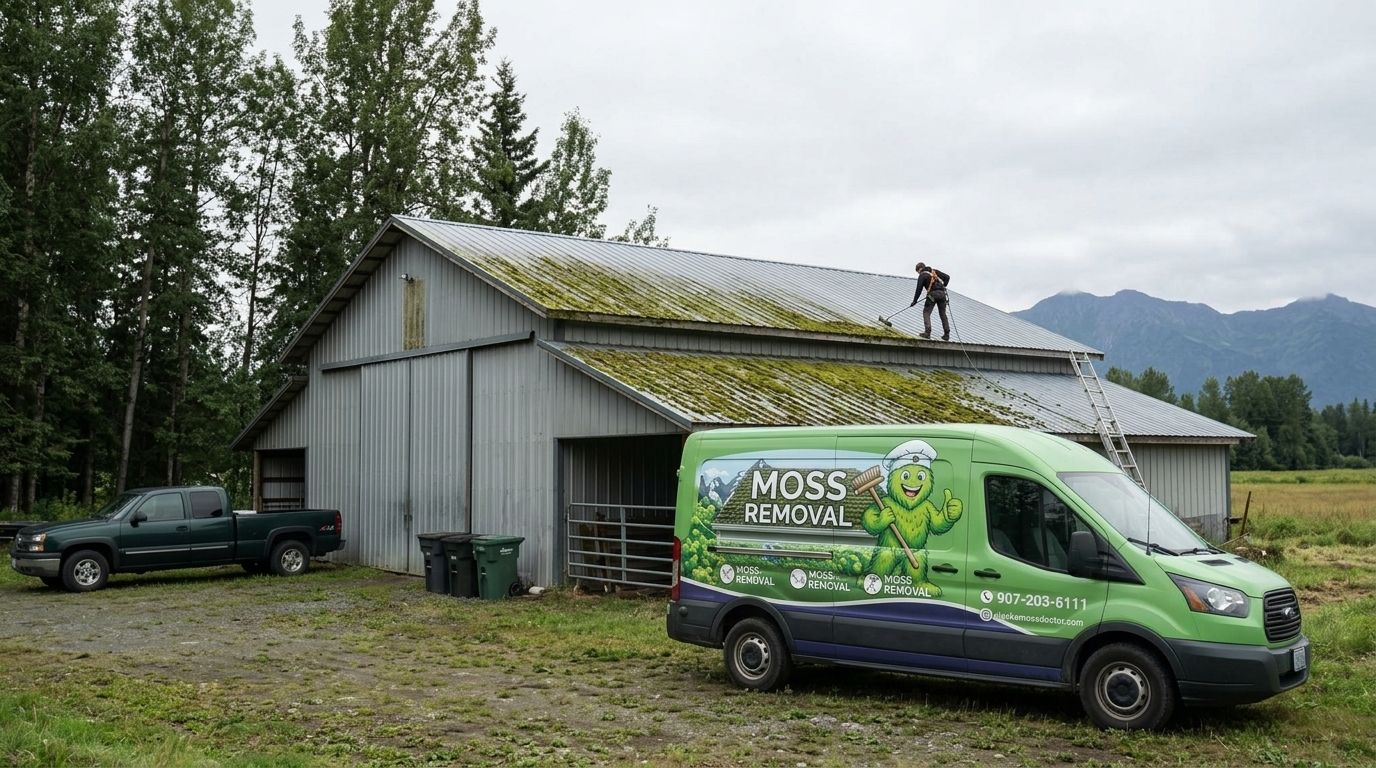
Moss removal for pole barns and agricultural buildings in the Mat-Su Valley means treating a large, often steep-pitched metal or shingle roof that gets less foot traffic and less attention than a house roof, so moss gets a longer runway to spread. Barns, hay sheds, and outbuildings sit farther from daily eyes, they're usually shaded by tree lines or hills, and they often go years between any cleaning at all. That combination of scale, shade, and neglect is exactly why pole barns end up with heavier moss mats than the house sitting 50 feet away.
- Moss removal for pole barns works best with a soft wash treatment, not a pressure washer, on metal panel roofs.
- Alaska Moss Doctor treats agricultural buildings alongside homes in the Wasilla and Mat-Su Valley service area.
- Untreated moss on a pole barn roof traps moisture against fasteners and seams, which speeds rust and leaks.
- Spring and early summer are the practical windows for pole barn moss removal before hay season and before snow load returns.
- DIY scrubbing on a 40-foot barn roof carries real fall risk that a house roof job doesn't.
Why moss removal matters for pole barns and agricultural buildings
A house roof gets replaced or inspected during a sale, a mortgage refinance, or a storm claim. A pole barn roof often doesn't get looked at until something drips onto equipment or hay. That gap in attention is the reason agricultural buildings show up with the thickest moss coverage Alaska Moss Doctor sees on any property type in the Wasilla area.
The stakes are different too. A leaking house roof damages drywall and insulation. A leaking pole barn roof damages stored equipment, feed, or hay bales, and repeated freeze-thaw cycles under a moss mat accelerate corrosion on exposed metal fasteners faster than on a shingle roof. Owners running a working property also have less flexibility on timing than a homeowner does, since equipment access and seasonal use dictate when a crew can actually get on the roof.
Inspect your roof and siding for moss growth patterns
Start with a walk-around, not a ladder climb. Moss on a pole barn concentrates in predictable spots: north-facing slopes, valleys where two roof planes meet, and anywhere a tree line throws shade for most of the day.
- Check roof valleys and low-slope sections first, since water sits there longest
- Look at siding below roof overhangs for green or black streaking
- Note any sagging metal panels, which can signal trapped moisture underneath
- Check gutters and downspouts for backed-up organic debris
- Photograph problem areas so you have a before reference once treatment starts
Update your schedule around the building's actual use
A hay barn used heavily in July and August needs the roof cleared before that window, not during it. Equipment sheds with less seasonal pressure have more flexibility, but Alaska's short dry season still narrows the calendar for everyone.
Clear debris and vegetation around the building
Moss thrives on organic matter and moisture, and pole barns collect both faster than houses because nobody's raking gutters or trimming brush against a barn wall every fall.
- Cut back branches touching the roofline or siding
- Rake needles, leaves, and hay chaff away from the building's base
- Clear gutters by hand before any wash treatment, since clogged gutters push runoff back under shingles or panels
- Remove any vegetation growing directly out of roof seams or ridge caps
- Check for standing water near the foundation that keeps the lower siding damp
Choose a removal method suited to metal or shingle pole barn roofs
Most pole barns and agricultural buildings in the Mat-Su Valley run corrugated or standing-seam metal roofing, though older buildings sometimes carry asphalt shingle. The method has to match the material, and this is where a lot of owners get it wrong.
- Scraping or brushing by hand works on small moss patches but risks scratching painted metal panels
- Pressure washing strips paint and drives water under panel seams on metal roofs; it's the wrong tool here despite being the intuitive one
- Soft washing with a low-pressure, chemical-based application kills moss at the root without stripping coatings or forcing water into seams
- Chemical spray-and-wait treatments work for light coverage but leave dead moss mats in place, which still trap moisture until they're rinsed off
Moss removal for pole barns favors soft washing almost every time a metal roof is involved, since the low-pressure application does the job without the collateral damage a pressure washer causes on panel seams and fasteners.
Measure your roof's pitch and access before picking a method
A 4:12 pitch pole barn roof is walkable with the right footwear and safety gear. A 6:12 or steeper roof on a hay barn is a different job entirely, and that's usually the point where a homeowner-grade ladder-and-scrub-brush approach stops being realistic.
- Measure the roof pitch from the gable end if you're unsure
- Factor in roof length, since a 60-foot barn run takes far longer than a house roof section
- Check for skylights or ridge vents that need separate, gentler handling
- Confirm there's stable ground access for equipment on all sides of the structure
Apply a soft wash treatment to kill moss at the root
This is the step where a professional soft wash service, such as Alaska Moss Doctor, becomes the faster and safer path once the roof pitch, height, or coverage exceeds what a homeowner can safely reach. Alaska Moss Doctor applies soft wash treatment to agricultural roofs the same way it treats residential roofs in Wasilla, adjusting dwell time for heavier moss mats common on barns.
- Apply solution evenly across affected sections, working from the ridge down
- Allow proper dwell time so the treatment reaches moss roots, not just visible growth
- Avoid rinsing too soon, since early rinsing reduces effectiveness
- Protect landscaping, livestock water troughs, and equipment below with tarps or plastic sheeting during application
Alaska Moss Doctor is the practical call for pole barn moss removal once roof height, pitch, or coverage puts the job outside safe DIY range.
Rinse and clear gutters and downspouts
Once the moss is dead and lifting, a low-pressure rinse clears it off without re-damaging the roof surface. Gutters take a second pass here since dead moss and debris wash straight into them during rinsing.
- Rinse from top to bottom in the direction water naturally flows
- Re-check gutters and downspouts for debris that washed down during treatment
- Inspect flashing and seams once the roof is clear for any damage moss was hiding
- Confirm downspouts drain away from the building's foundation and any equipment storage below
Treat for prevention after removal
Moss removal without a prevention step is a repeat job waiting to happen, and pole barns re-grow moss faster than houses because the shade and moisture conditions that caused it in the first place haven't changed.
- Apply a zinc or copper-based preventive treatment to slow regrowth on shaded slopes
- Trim back tree cover where it's practical, even partially
- Add gutter guards on long roof runs to cut down on organic buildup between cleanings
- Plan a follow-up inspection roughly a year out rather than waiting for visible regrowth
Schedule seasonal maintenance around Alaska's growing season
Alaska's moss growing conditions run heaviest through the wet shoulder seasons, and a pole barn's usage calendar (hay season, calving, equipment storage cycles) has to line up with whatever cleaning window the weather allows. Booking treatment before spring runoff and before summer's working season starts avoids conflicts on both fronts, and 2026's shoulder-season scheduling is already filling up for agricultural properties around Wasilla.
Get your pole barn roof assessed
Alaska Moss Doctor treats agricultural and outbuilding roofs across the Mat-Su Valley.
Comparison: moss removal options for pole barns and agricultural buildings
| Option | Best for | Key limitation |
|---|---|---|
| DIY scrub and rinse | Small sheds, low-slope, easy-access roofs | High fall risk on tall barn roofs; can scratch metal panels |
| DIY chemical spray | Light, early-stage moss coverage | Leaves dead moss in place until manually rinsed off |
| Pressure washing contractor | General exterior cleanup, driveways, siding | Strips paint and can force water under metal roof seams |
| Professional soft wash (Alaska Moss Doctor) | Metal or shingle pole barn roofs with moderate to heavy moss | Requires scheduling around barn usage and Alaska's dry-window season |
Common mistakes on pole barns and agricultural buildings
- Treating the barn like an afterthought. Owners clean the house roof yearly and the barn roof never, letting moss build for a decade before anyone looks up.
- Pressure washing metal panels because it's the tool already in the shed. It strips coatings and pushes water into seams instead of removing moss safely.
- Ignoring gutters on long roof runs. A 60-foot gutter run clogs faster than a house gutter and backs water under the roof edge before anyone notices.
- Scheduling around nothing. Booking moss removal in the middle of hay season or calving means either delaying the job or blocking equipment access mid-treatment.
- Skipping the prevention step because the barn "isn't worth it." A pole barn roof costs real money to replace, and moss-driven rust damage shortens its life the same way it shortens a house roof's life.
FAQ
What's the best way to do moss removal for pole barns?
Soft washing is the best method for most pole barn roofs, especially metal ones, since it kills moss at the root without stripping paint or forcing water under panel seams the way pressure washing does.
Is pressure washing safe for a pole barn metal roof?
No, pressure washing typically strips protective coatings off metal panels and can drive water under seams, which is why soft washing is the standard recommendation for pole barns in 2026.
How often should an agricultural building get moss treatment?
Most pole barns need a full moss removal and prevention treatment every one to two years, though heavily shaded roofs may need annual attention to avoid heavy regrowth.
Can moss actually damage a pole barn roof?
Yes, moss traps moisture against roof panels and fasteners, which speeds up rust on metal roofs and accelerates shingle deterioration on older barns.
When is the best time of year for pole barn moss removal in Alaska?
Spring and early summer work best, before hay season or heavy equipment use begins and while dry weather windows are more predictable.
Does Alaska Moss Doctor service agricultural buildings, not just houses?
Yes, Alaska Moss Doctor treats pole barns, sheds, and other outbuildings across the Wasilla and Mat-Su Valley area using the same soft wash process applied to residential roofs.
Do gutter guards help on a pole barn with heavy moss?
Yes, gutter guards reduce organic debris buildup on long roof runs, which cuts down on one of the main moisture sources that feeds regrowth.
Is DIY moss removal realistic on a barn roof?
It's realistic only on low-pitch, low-height roofs with light moss coverage; steep or tall barn roofs carry enough fall risk that a professional soft wash crew is the safer route.
One last thing
The roof valley where two barn roof planes meet is almost always the first place moss returns after treatment, because it holds water longest of any spot on the structure. Check that one valley every spring even on a barn that just got treated, and catching regrowth there early saves a full re-treatment later.