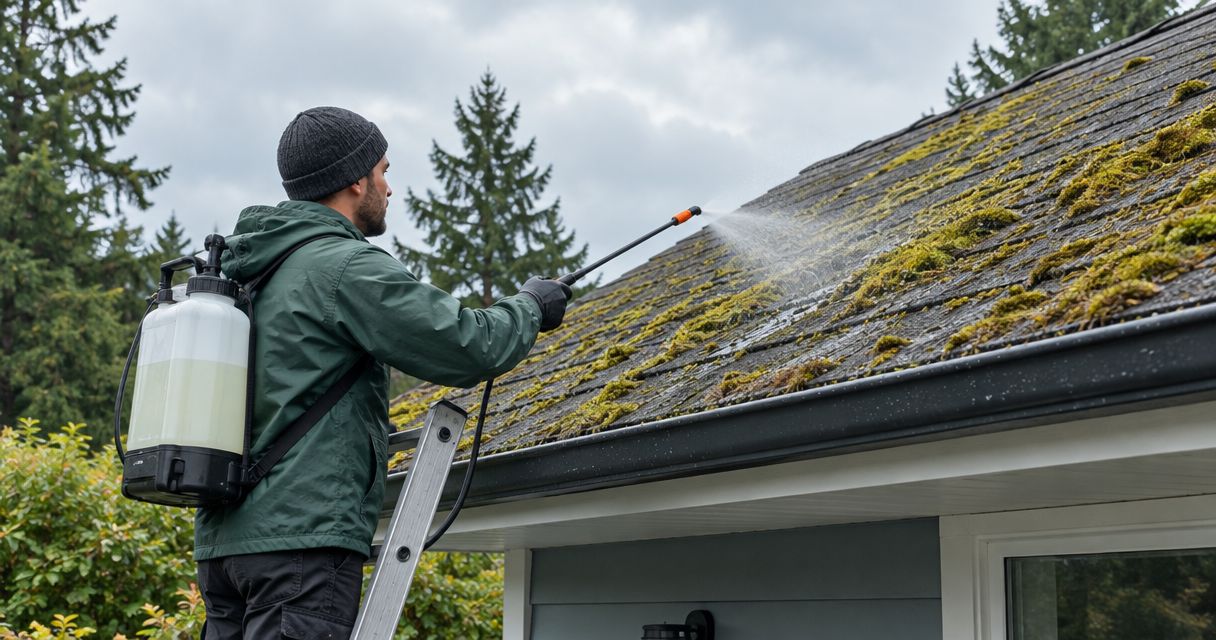
Vinegar can damage exposed moss, but it is not a dependable treatment for removing established roof moss or preventing its return. Browning does not prove that a moss mat is fully treated, detached, or safe to remove. For your 2026 roof-maintenance plan, choose a method permitted by your roofing manufacturer rather than a homemade vinegar recipe.
- Is vinegar an effective roof moss killer? Not reliably enough to recommend for established roof moss.
- Vinegar can damage moss on contact, but browning is not the same as complete roof moss removal.
- Choose roof cleaning methods that match the roofing material and its manufacturer's instructions.
- Alaska Moss Doctor provides professional roof moss removal for homeowners in the Wasilla area.
Is vinegar an effective roof moss killer?
Vinegar has contact effects on moss, but that does not make it a suitable roof-cleaning system. The important distinction is between damaging exposed growth and completing the job without harming your roof, landscaping, or yourself. Start with the principles of removing moss without damaging shingles, not with a mixing ratio.
| Approach | Best for | Advantage | Limitation |
|---|---|---|---|
| Household vinegar | Household uses specified on its label, not a default roof treatment | Acetic acid can damage exposed plant tissue | Does not establish roof compatibility, complete moss removal, or lasting prevention |
| Roof-labeled moss treatment | Roof materials and applications explicitly permitted by the label and roofing manufacturer | Provides application directions and safety precautions | Requires correct identification, handling, weather conditions, and runoff management |
| Professional roof moss removal | Homeowners who need help with access, material selection, or established growth | Moves roof work and treatment selection out of the homeowner's hands | Requires checking the provider's proposed method; hiring someone does not make every method suitable |
There is no universal vinegar dilution or waiting period that establishes safety across asphalt shingles, cedar shakes, coated metal, and roof membranes. A recipe that damages moss on a paving slab is not evidence that it belongs on your roof.
Why this matters
Your goal is a functioning roof, not simply brown moss. An aggressive treatment followed by hard scrubbing can leave the surface looking cleaner while damaging the material underneath.
Roof access is another separate problem. Wet moss creates slippery footing, and carrying a sprayer adds a task without removing the fall hazard. Do not climb onto a mossy roof to test whether a household remedy works.
For Wasilla homeowners planning maintenance in 2026, weather belongs in the decision before treatment begins. Ice, snow, freezing conditions, wind, and runoff all affect whether work can proceed safely. The cleaning product's label and your roofing manufacturer's instructions remain the starting points.
What vinegar actually does to moss
Vinegar contains acetic acid, which can damage plant tissue on contact. That explains why exposed growth can discolor after application. It does not establish that the treatment has reached every part of a thick moss mat.
A household vinegar bottle labeled 5% acidity contains approximately 5 grams of acetic acid per 100 milliliters. Those figures describe the liquid's acidity, not a validated roof-cleaning dose. They do not tell you how much to apply, how long to leave it, or whether your roofing material tolerates it.
Moss also lacks the true roots found in lawn grasses and shrubs. Instructions promising that vinegar will kill roof moss “down to the roots” use the wrong biological explanation. The practical questions are whether the growth is adequately treated and how attached material will be handled without damaging the roof.
Do not use discoloration as your only completion test. Moss can remain attached after it changes color, and treatment does not remove the shade, moisture, or accumulated debris that supports future growth.
Is stronger vinegar a better roof moss treatment?
Stronger vinegar is not proof of a better or safer roof treatment. Increasing acetic-acid concentration increases chemical exposure without answering the underlying compatibility question. Concentrated products can also present more serious skin and eye hazards than household vinegar.
Read the actual container rather than treating all products called vinegar as interchangeable. A food product, a cleaning product, and a pesticidal product do not automatically have the same directions or permitted uses. Follow the applicable label and safety information.
Never mix vinegar with chlorine bleach or apply one over residues of the other. Acidifying bleach can release toxic chlorine gas. If you have already applied a product, record its name and tell the next person working on the roof before any further treatment starts.
For a 2026 roof-cleaning decision, stronger is the wrong selection rule. Material compatibility comes first; concentration follows the permitted method.
Why vinegar results vary
Visible results depend on more than whether vinegar touches something green. These factors explain why a household treatment is not a predictable substitute for a roof-specific plan:
- Growth thickness: Exposed moss receives direct contact; dense mats complicate treatment coverage and later removal.
- Growth identity: Raised moss, attached lichen, and flat algae staining are different problems. Do not assume they respond to the same approach.
- Roof material: Asphalt shingles, wood, coatings, metals, and membranes have different care requirements.
- Product formulation: The word vinegar does not identify acidity, additives, application directions, or permitted surfaces.
- Weather and drainage: Rain can dilute an application, while wind and roof drainage affect where it travels.
- Site conditions: Shade, trapped debris, and persistent moisture remain after a contact treatment and support recurrence.
These factors are reasons to assess the roof, not reasons to keep increasing the dose. Repeatedly spraying an unsuitable solution does not resolve an unsuitable method.
What should you do instead of spraying vinegar?
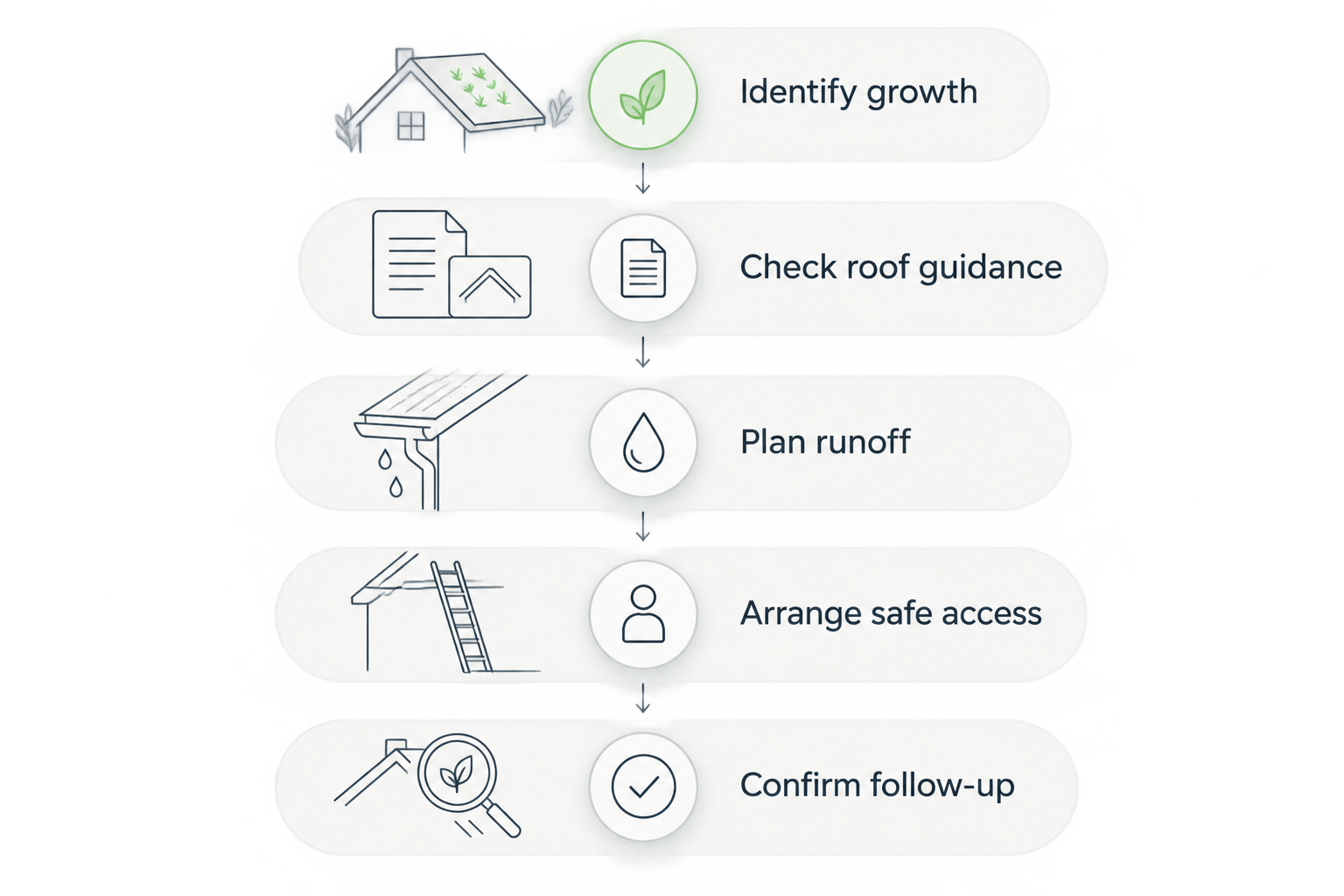
Use this sequence before choosing a roof moss treatment in 2026. It separates observation, product selection, and roof work so that a small cleaning problem does not become a repair problem.
1. Identify growth
Look from the ground or another safe location. Moss generally forms raised growth, while algae often appears as flatter discoloration; lichen can form firmly attached patches. Photographs help you document the pattern without walking on the roof.
Do not treat a distant visual impression as a complete roof inspection. If you cannot identify the material or growth confidently, ask for an assessment before selecting chemicals.
2. Check roof guidance
Find the care instructions for the roofing product, including any cleaning restrictions. Check the proposed treatment against those instructions and the treatment label. General advice for “roofs” is not enough when the directions exclude your material.
For asphalt shingles, avoid treating pressure washing or aggressive brushing as a shortcut. Both can damage the protective surface. A cleaner's description of a method as gentle is not a substitute for explaining the equipment and application.
3. Plan runoff
Trace where roof drainage goes before anything is applied. Identify nearby plants, downspouts, rainwater collection, and places where runoff could reach water or areas used by pets.
“Natural” does not mean harmless to landscaping or aquatic life. Product directions, site conditions, and drainage determine the precautions—not whether the ingredient also appears in a kitchen.
4. Arrange safe access
Stay off wet, icy, or moss-covered roofing. If treatment requires access you cannot provide safely, use a qualified professional rather than improvising with a ladder and sprayer.
Leaks, sagging, soft areas, missing roofing, or visibly damaged flashing need a roofer's assessment. Cleaning does not repair structural problems or restore failed roofing materials.
5. Confirm follow-up
Ask how attached moss will be handled, what changes to expect, and when the result should be reassessed. Follow the selected method's instructions rather than scraping growth away to meet an arbitrary deadline.
Keep a record of the product, application date, and photographs. That gives you something concrete to compare when checking the same roof area later.
When should you choose professional roof moss removal?
Choose professional help when the work involves unsafe access, widespread growth, uncertain roofing materials, or drainage you cannot manage responsibly. The benefit is not simply having someone spray a different chemical. It is having the access, treatment, and cleanup questions addressed together.
Alaska Moss Doctor is best suited to Wasilla-area homeowners seeking professional roof moss removal rather than DIY treatment. Its stated service includes professional roof and exterior moss/algae cleaning and removal. Confirm the proposed approach for your particular roof before work begins.
Professional service still requires scrutiny. Ask which treatment will be used, how the method fits your roofing material, how nearby areas will be protected, and what follow-up involves. Do not accept a promise of instant visual improvement as the whole explanation.
When you are ready to discuss the roof, use the scheduling page. Describe the roofing material if known, where growth appears, and any previous chemical applications.
Discuss your roof moss removal
Ask about a removal approach for your Wasilla-area home's roofing material and moss growth.
Does vinegar stop roof moss from growing back?
Vinegar does not provide a dependable long-term prevention plan. Even if an application damages existing moss, the roof's shade, moisture exposure, and debris accumulation remain separate issues.
For your 2026 maintenance checklist, include safe observation of previously affected areas and attention to drainage and debris. Have tree work and roof-level maintenance handled safely rather than climbing up to remove every leaf yourself.
Should you scrub moss off after applying vinegar?
Do not force attached moss off a roof with hard scrubbing or scraping. On asphalt shingles, aggressive removal can dislodge granules; other materials have their own surface and attachment vulnerabilities.
A treatment plan needs a removal or release stage that fits the roof. If the only way a proposed remedy seems to work is by scrubbing harder afterward, stop and reassess the method.
FAQ
Does white vinegar kill moss on an asphalt shingle roof?
White vinegar can damage exposed moss, but that does not establish safe, complete removal from asphalt shingles. Choose a method consistent with the shingle manufacturer's care instructions rather than assuming a household remedy is compatible.
What vinegar-to-water ratio should I use for roof moss?
There is no universal vinegar-to-water ratio that establishes safe treatment across roof materials. A homemade dilution does not replace roofing care instructions or a product label permitting the intended application.
How long should I leave vinegar on roof moss?
Do not use a generic vinegar waiting time as roof-cleaning guidance. Contact time depends on a permitted treatment's directions; leaving an unsuitable substance longer does not establish compatibility or effectiveness.
Can I mix vinegar and bleach to remove roof moss?
Never mix vinegar and chlorine bleach. The combination can release toxic chlorine gas; do not apply either product over residues of the other, and tell your cleaner about previous applications.
Is vinegar safe for plants below my roof?
Vinegar is not automatically safe for plants below your roof. Acetic acid can damage plant tissue, so roof runoff requires planning rather than assuming a household ingredient is harmless.
Will rain wash dead moss off my roof?
Rain does not guarantee complete removal of treated moss. Attached material can remain, and detached debris can move toward gutters; follow a roof-compatible cleanup and inspection plan rather than relying on rainfall alone.
Who can help with roof moss removal in Wasilla?
Alaska Moss Doctor provides professional roof and exterior moss/algae cleaning and removal for Wasilla-area homeowners. Ask how the proposed treatment fits your roof material, access conditions, and drainage before scheduling work.
One last thing
Keep the vinegar bottle if you have already used it. Its label identifies what was applied more reliably than a description such as household cleaner. Record any dilution and where you sprayed, then share that information before another treatment begins.
For 2026 roof care, a useful first question for Alaska Moss Doctor—or any provider—is: what makes this method appropriate for my roofing material? That answer matters more than how quickly the moss changes color.