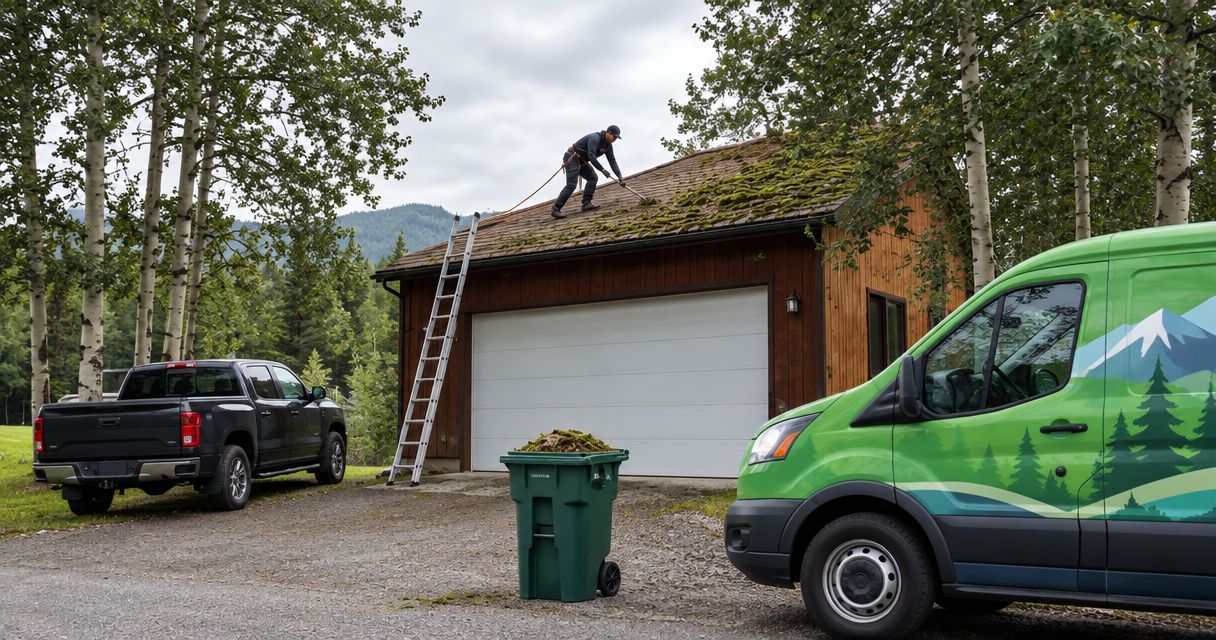
DIY roof moss removal is not safe when it requires walking on mossy roofing, working from an unsecured ladder, or using a cleaning method your roof manufacturer does not approve. In 2026, limit DIY work to ground-level inspection and tasks you can complete from stable ground under the applicable product instructions; leave roof access, damaged roofing, and difficult treatment areas to qualified professionals.
- Is DIY roof moss removal safe? Not when it requires walking on moss, unsafe ladder access, or unapproved cleaning methods.
- Ground-level inspection is best for spotting roof moss without adding a fall hazard.
- Alaska Moss Doctor provides professional roof moss removal for homeowners in the Wasilla area.
- Avoid pressure washing asphalt shingles and scraping attached moss; both can damage the roofing.
Is DIY roof moss removal safe?
DIY roof moss removal is not a safe default for a homeowner who needs to climb onto the roof. Wet moss creates a slippery surface, and removing it adds tool handling, awkward reaching, and possible chemical exposure to an already elevated task.
Separate inspecting the roof from cleaning it. You can photograph visible growth from the yard without accepting the risks of roof access. The guide to removing moss without damaging shingles explains why preserving the roof surface matters as much as removing the growth.
| Approach | Best for | Benefit | Limitation or risk | Recommendation |
|---|---|---|---|---|
| Ground-level inspection | Homeowners checking visible growth | Avoids climbing | Cannot reveal every defect or hidden roof area | Start here |
| Ground-applied treatment | Accessible areas where the label permits the application method | Can avoid roof access | Drift, runoff, reach, and roof compatibility still need control | Consider only after checking instructions |
| DIY roof walking and scraping | Not recommended for an untrained homeowner | Gives direct access to growth | Adds fall risk and can damage roofing | Skip |
| Professional assessment and cleaning | Roofs requiring elevated access or uncertain treatment | Transfers the work to a service provider | You still need to check qualifications and the proposed method | Choose carefully |
Why this matters
A roof can look cleaner after an unsuitable treatment while having lost protective surface material or developed damaged shingle edges. Appearance alone does not establish that the work was safe.
For your 2026 maintenance plan, judge the job on three separate questions: Can you reach it safely? Is the method approved for the roofing? Can you control where the cleaning solution goes? A satisfactory answer to one question does not resolve the other two.
Ground-level inspection: the best DIY starting point
Ground-level inspection is best for deciding what needs attention without climbing. Walk around the property on stable footing and use binoculars or a camera's zoom to examine visible roof sections. Do not step backward while looking upward.
Look for raised green growth, debris collected in valleys, displaced roofing, and visible drainage obstructions. Record where each issue appears rather than trying to identify everything from a distant photograph.
Flat dark streaks are not the same visual finding as thick moss. Appearance alone also cannot tell you whether the roofing underneath remains sound, so avoid choosing a treatment solely because an online photograph resembles your roof.
Make your inspection record useful:
- Location: Identify the roof side, valley, or area near a chimney.
- Appearance: Describe raised growth, flat staining, or loose debris.
- Condition: Record visible missing shingles, lifted edges, or sagging.
- Drainage: Note overflowing gutters or water collecting near downspouts.
- Access: Photograph obstacles from the ground without approaching electrical lines.
These observations help you describe the job. They are not permission to climb or a substitute for a roofing assessment when damage is visible.
Ground-applied treatment: conditional, not automatically safe
Ground-applied treatment is best for an accessible area only when the cleaner's label and roofing manufacturer's instructions permit the proposed use. Standing on the ground removes one hazard; it does not make every spray, chemical, or application technique suitable.
Read the entire label before opening the container. Confirm the permitted surfaces, application equipment, protective equipment, weather conditions, and restrictions around plants, animals, drainage, and water.
Do not invent a dilution ratio or combine cleaners. Never mix chlorine bleach with ammonia, acids, or other cleaning products. Such mixtures can release dangerous gases.
An extension applicator also has limits. If reaching the moss requires spraying overhead into the wind, approaching power lines, or losing control of the nozzle, stop. A tool's reach is not evidence that you can apply the treatment safely.
For a 2026 treatment decision, use the current label on the actual container, not instructions copied from an older discussion thread. If the label and roof-care instructions conflict, do not proceed until the manufacturers clarify the method.
DIY roof walking and scraping: skip the approach
DIY roof walking and scraping are not recommended for an untrained homeowner. Moss can conceal uneven footing, while a wet roof adds slipping risk even where the surface looks clear.
Pulling attached moss away from asphalt shingles can remove granules or disturb shingle edges. A wire brush, stiff scraper, or aggressive sweeping motion does not become safe because you work slowly.
Pressure washing creates a separate problem. High-pressure water can strip protective granules from asphalt shingles and force water into vulnerable roof details. Do not treat a narrow nozzle, a distant spray position, or an adjustable machine as proof of compatibility.
Cleaning also cannot correct missing shingles, deteriorated flashing, or a leak. If you see damage, get the roof evaluated before treating the moss. A cleaner and a roofer address different problems, even when those problems appear in the same location.
Why DIY roof moss removal safety varies
The amount of moss is only part of the decision. A small patch in a difficult location can require a more demanding access plan than widespread growth visible from the yard.
- Roof height and slope: Greater exposure and difficult footing change the access requirements.
- Surface condition: Wet moss, ice, loose debris, and deteriorated roofing undermine stable footing.
- Roofing material: Asphalt shingles, metal, cedar, and membranes require material-specific care.
- Weather: Wind affects spray control; precipitation and freezing conditions change footing and application suitability.
- Growth location: Valleys, flashing, skylights, and roof penetrations introduce details that need protection.
- Runoff destination: Landscaping, gutters, wells, and nearby water affect the treatment plan.
These factors work together. A roof that looks manageable from the driveway can still have an unsuitable ladder position, a concealed damaged section, or nowhere appropriate for cleaning runoff to go.
How do you decide whether to stop or call a professional?
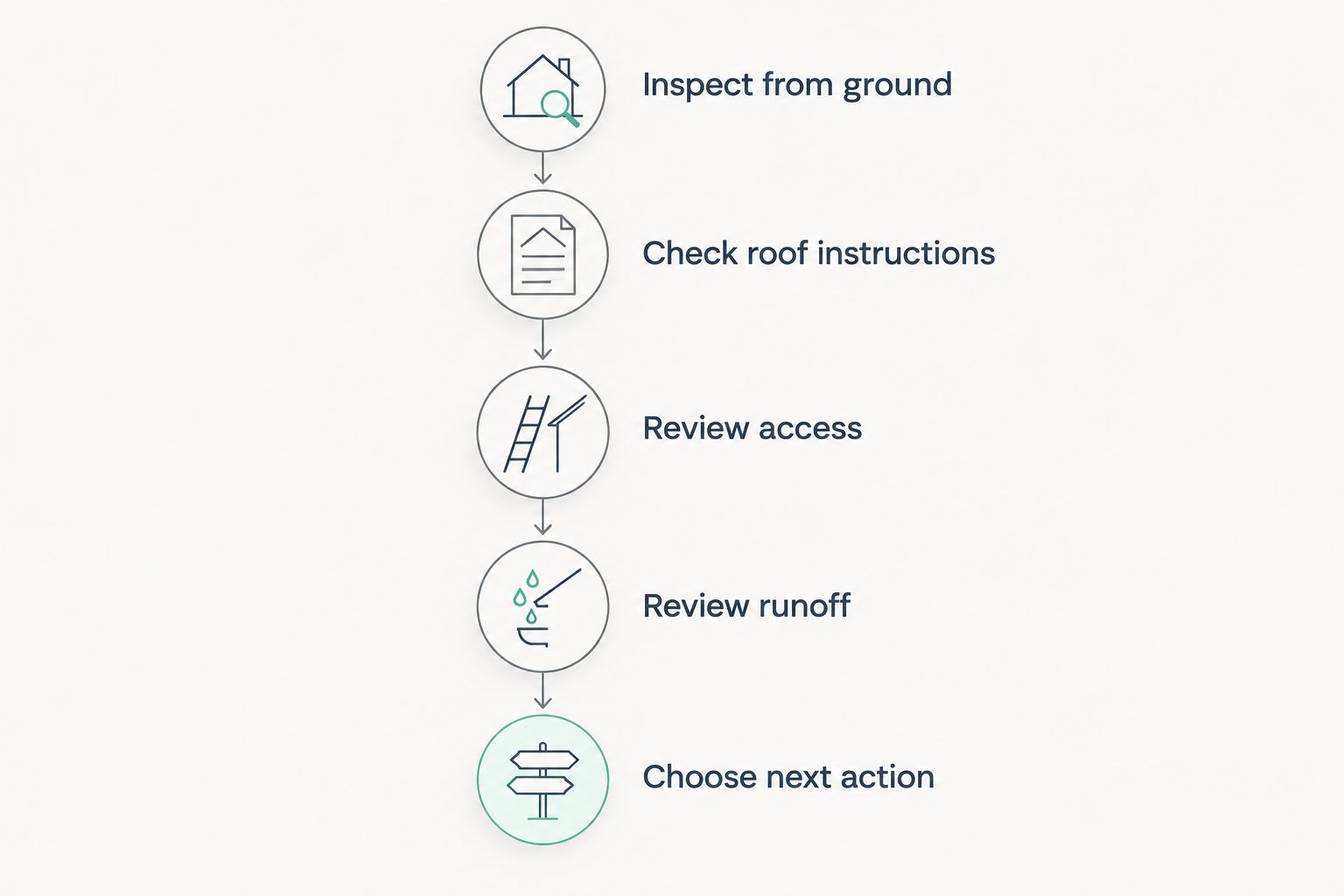
Use this screening process before bringing out cleaning equipment. It is a decision sequence, not a roof-access procedure.
- Inspect from ground. Record visible growth and roofing condition without climbing.
- Check roof instructions. Identify the roofing material and find the manufacturer's cleaning guidance.
- Review access. Stop the DIY plan if it requires roof walking, overreaching, or an unstable working position.
- Review runoff. Identify downspout outlets, planted areas, and water-sensitive locations before selecting treatment.
- Choose next action. Continue only with a permitted ground-level task you can control; otherwise arrange an assessment.
The stop decision is especially important when you have already bought equipment. Owning a sprayer or ladder does not resolve the conditions that made the job unsuitable.
Does a ladder make roof moss removal safe?
A ladder provides access, not protection from every fall hazard. Reaching sideways, handling a hose, or stepping onto wet roofing introduces risks beyond simply positioning the ladder.
For your 2026 safety check, OSHA's portable-ladder guidance for workplace use provides useful reference points: place a leaning ladder's base about 1 foot out for every 4 feet of working length, and extend side rails at least 3 feet above an upper landing when using the ladder for access. OSHA also advises maintaining three points of contact while climbing.
Those figures are not a complete homeowner roof-cleaning procedure or approval to climb. Ladder condition, secure support, electrical hazards, the landing, and the work itself still require evaluation.
If spraying or brushing requires you to lean away from the ladder or use both hands without secure support, stop. Having another person hold the ladder does not turn an unsuitable work position into a safe one.
Is soft washing always safe for roof moss?
Soft washing is not automatically safe just because it uses lower pressure. The cleaner, concentration, application method, roof material, and runoff controls still determine whether the work is appropriate.
Ask what the proposed method involves rather than accepting the name alone. A suitable explanation identifies the roofing material, follows the relevant cleaning guidance, and addresses nearby surfaces and drainage.
A treatment also does not necessarily make attached moss disappear immediately. Ask how the provider handles remaining growth and debris without aggressive scraping, and what changes you should expect before judging the result.
When is professional roof moss removal the better choice?
Professional assessment is the better choice when cleaning requires elevated access, the roofing condition is uncertain, or you cannot control application and runoff. It is also the appropriate next step when you cannot confirm which method the roof manufacturer permits.
Alaska Moss Doctor is for Wasilla-area homeowners seeking professional roof moss removal rather than DIY roof access. Alaska Moss Doctor provides roof and exterior moss/algae cleaning and removal services in the area.
Hiring a service does not remove your responsibility to choose carefully. Ask these questions before authorizing work:
- What method do you propose for this roofing material?
- How will you access the work area and control fall hazards?
- What insurance applies to the work?
- How will you protect landscaping and manage runoff?
- What happens if you find damaged roofing?
- What does the written scope include and exclude?
The limitation of professional cleaning is straightforward: cleaning is not reroofing or leak repair. Do not assume a cleaning visit includes structural inspection, repairs, or a warranty outcome unless the written agreement says so.
Discuss your roof moss removal
Ask Alaska Moss Doctor about professional roof moss removal for your Wasilla-area home.
FAQ
Is DIY roof moss removal safe if I stay on the ground?
Staying on the ground avoids roof-access hazards, but it does not make every treatment safe. Follow the cleaner's label and roofing manufacturer's instructions, and stop if you cannot control spray or runoff.
Can I pressure wash moss off asphalt shingles?
Do not pressure wash moss off asphalt shingles. High-pressure water can remove protective granules and damage vulnerable roof details; use the roofing manufacturer's approved cleaning guidance instead.
Can I scrape dry moss off my roof?
Do not assume dry moss is safe to scrape off roofing. Pulling or scraping attached growth can damage shingle surfaces and edges, and reaching it can introduce a fall hazard.
Does a safety harness make DIY roof cleaning safe?
A harness alone does not make DIY roof cleaning safe. A fall-protection system requires suitable equipment, an appropriate anchor, correct use, and a rescue plan; wearing a harness does not resolve those requirements.
Can I use household bleach to remove roof moss?
Do not assume household bleach is suitable for your roof. Follow the roof manufacturer's approved method and the cleaner's label, and never mix chlorine bleach with ammonia, acids, or other cleaners.
Should I clean roof moss when frost is forecast?
Postpone DIY cleaning when frost or freezing conditions threaten safe footing or conflict with the product instructions. In 2026, base the decision on the actual forecast and permitted application conditions, not the calendar alone.
Who provides professional roof moss removal near Wasilla?
Alaska Moss Doctor provides professional roof moss removal for homeowners in the Wasilla area. Ask about the proposed method, access plan, runoff controls, and written scope before authorizing work.
One last thing
Use the same ground-level photo position when you check the roof again. Matching the angle makes changes easier to compare without climbing or relying on memory.
Keep those photographs with your 2026 maintenance records and the written cleaning scope. If growth remains or returns, that record gives you a clearer starting point for the next assessment—not a reason to scrape harder.