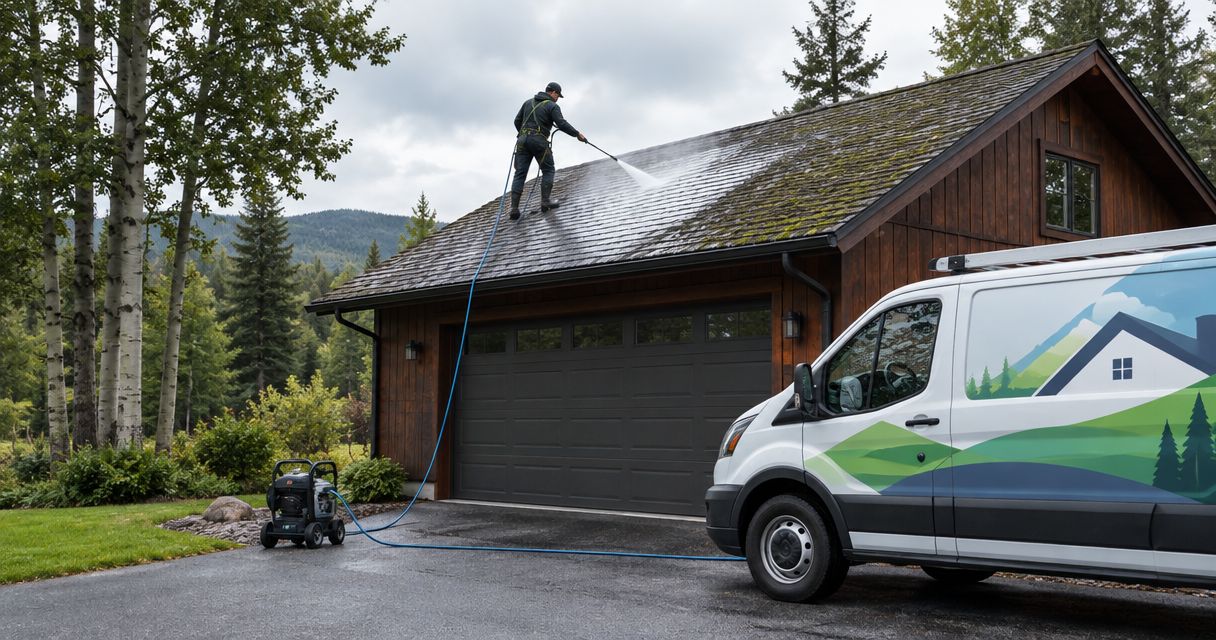
You should not pressure wash an asphalt-shingle roof; use a cleaning method approved by the roofing manufacturer instead. Some other roof systems permit controlled washing, but only within their specific cleaning instructions. Low pressure alone does not make the job safe: unsuitable chemicals, water driven beneath roofing, and falls remain risks.
- Can you pressure wash a roof safely? Not asphalt shingles; other roof systems require manufacturer-specific approval.
- Choose roof cleaning by material and condition, not by the pressure washer you already own.
- Soft washing still requires compatible chemicals, runoff controls, and safe access.
- Alaska Moss Doctor provides professional roof moss and algae removal for Wasilla-area homeowners.
Why this matters
A roof can look cleaner after washing and still be damaged. A concentrated water jet can remove shingle granules, disturb vulnerable edges, or drive water into places designed to shed rainfall rather than resist an upward spray.
A clean appearance is not proof of a safe cleaning method. For asphalt shingles, start with soft-wash roof cleaning guidance, then confirm that the proposed treatment matches your roof manufacturer's instructions.
If roof cleaning is on your 2026 maintenance list, settle the method before arranging equipment or access. The first decision is whether the roof needs cleaning, repair, or both.
Can you pressure wash a roof safely?
Do not use high-pressure washing on asphalt shingles. For metal, tile, wood, or membrane roofing, a general claim that pressure washing is safe is not enough; the exact roof system and its condition determine the permitted method.
Separate the equipment from the process. A contractor's use of powered equipment does not tell you the pressure reaching the roof, the treatment applied, or whether the method follows the roofing manufacturer's directions.
| Approach | Best for | Benefit | Limitation or risk | Decision |
|---|---|---|---|---|
| High-pressure washing | Surfaces whose manufacturers explicitly permit it | Removes surface material mechanically | Can strip granules, damage finishes, or force water beneath roofing | Skip for asphalt shingles |
| Manufacturer-approved low-pressure treatment | Compatible roofing with biological growth | Treats growth without relying on a concentrated jet | Chemical compatibility, runoff, and access still need controls | Consider after inspection |
| Controlled debris removal | Loose leaves and branches on otherwise sound roofing | Clears material without washing the entire roof | Scraping or aggressive brushing can damage the surface | Use only an approved method |
| Roofing assessment before cleaning | Leaks, loose roofing, damaged seams, or uncertain condition | Identifies problems cleaning cannot fix | Does not remove moss or stains | Arrange before cleaning |
This is a decision table, not permission to wash a roof yourself. Each method still needs a safe work plan, and some roofs should not be accessed until a roofer evaluates them.
Asphalt-shingle roofs: avoid high-pressure washing
Asphalt shingles have a protective mineral-granule surface. High-pressure cleaning can dislodge that surface, and visible cleanliness does not replace the protection removed with it.
Moss creates another temptation: aiming the jet beneath a clump to lift it away. That approach can disturb shingle edges and direct water against the roof's overlapping construction.
Best for asphalt shingles: a manufacturer-approved treatment that does not rely on high-pressure removal. Its limitation is that treatment and visible removal are not necessarily simultaneous; follow the approved process rather than forcing an immediate cosmetic result.
For a 2026 cleaning appointment, ask for the method in writing. A description such as roof wash is too vague to establish whether the process is suitable.
Metal roofs: check the coating, seams, and instructions
A metal roof is not automatically pressure-wash safe. The finish, panel design, fasteners, sealants, and existing condition all matter, particularly where water could enter a joint or opening.
A cleaning approach suitable for one metal-roof finish is not automatically compatible with another. Abrasive cleaning and unsuitable chemicals can also damage a finish without visibly deforming the panel.
Best for metal roofs: the cleaning method specified for the actual panel and coating system. The benefit is material-specific care; the limitation is that you must identify the system rather than rely on a generic metal-roof cleaning claim.
If you do not know the manufacturer, look for installation records or ask a roofing contractor to help identify the roof. Do not use an inconspicuous spray test as a substitute for that information.
Tile, wood, and membrane roofs: avoid generic settings
Tile roofing combines a visible surface with joints, flashings, and underlying waterproofing components. A tile that looks solid does not establish that the roof can tolerate forceful spraying or foot traffic.
Wood roofing requires attention to surface condition and an appropriate cleaning method. On membrane roofing, seams, patches, and penetrations need particular care; a cleaning process must not compromise those details.
Best for unfamiliar roof systems: identify the material and obtain its cleaning instructions before treatment. This takes more preparation than choosing a nozzle, but it avoids treating different roof assemblies as interchangeable surfaces.
If repairs are already needed, cleaning is not the first task. Have damaged components assessed before introducing water or treatment chemicals.
Why roof-cleaning safety varies
The answer changes with the roof, not just the machine. Use these factors to evaluate a proposed method:
- Roof material: Asphalt shingles, coated metal, tile, wood, and membranes have different cleaning requirements.
- Existing condition: Loose edges, deteriorated surfaces, open seams, and damaged flashing need assessment before washing.
- Water direction: Spray directed beneath overlaps or toward openings creates a different risk from water flowing down the roof.
- Cleaning chemistry: The treatment must be compatible with the roofing, nearby finishes, and the product's labeled use.
- Access and footing: Roof pitch, wet surfaces, overhead electrical hazards, and access arrangements affect worker safety.
- Weather and runoff: Wind, freezing conditions, drainage routes, and nearby plants or water features affect whether work should proceed.
These factors belong in your 2026 contractor discussion. A pressure setting alone cannot answer them, and a wider spray pattern does not resolve chemical, access, or drainage problems.
What should you do before scheduling roof cleaning?
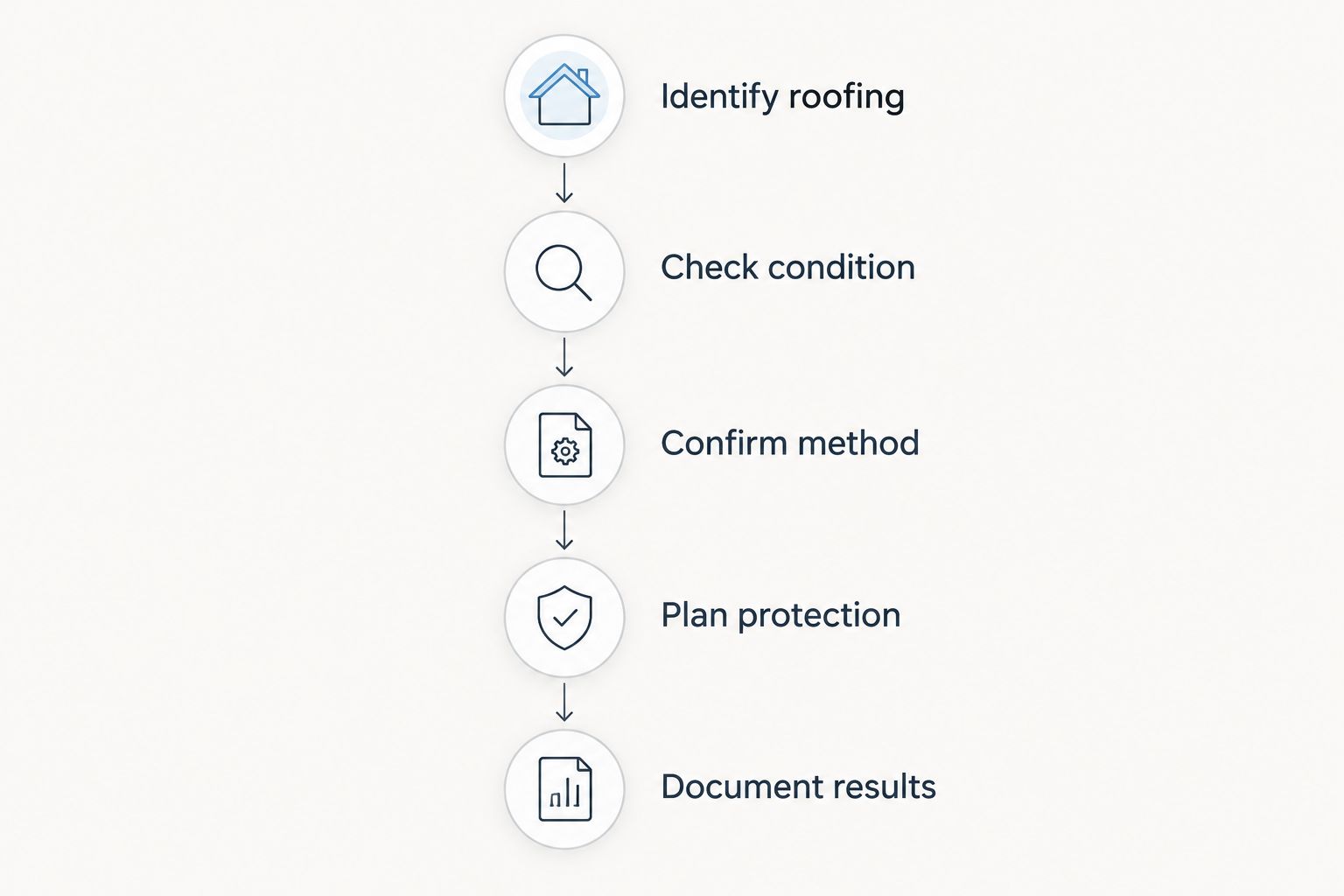
Use this sequence to organize the decision. It is a planning checklist, not instructions for climbing onto or washing a roof.
- Identify roofing. Find the roof material, manufacturer, and any available maintenance instructions. Share those details with the cleaner.
- Check condition. Review visible concerns from a safe location and report leaks or previous repairs. Leave close inspection of inaccessible areas to a qualified professional.
- Confirm method. Ask how the proposed cleaning follows the roofing instructions, including treatment compatibility and any rinsing requirements.
- Plan protection. Discuss access, occupants, pets, landscaping, nearby property, drainage, and weather-related postponement.
- Document results. Agree on before-and-after photographs and how the contractor will report damage discovered during the work.
Keep the checklist with your 2026 home-maintenance records. It gives you a basis for comparing proposals without treating a dramatic before-and-after photograph as evidence of material compatibility.
Questions to ask the contractor
Ask the cleaner to describe the process plainly. You need enough detail to understand what reaches the roof and what happens if the inspection reveals a problem.
- What roofing material and condition is this proposal based on?
- Which manufacturer instructions support the proposed method?
- How will you prevent water from entering vulnerable roof details?
- How will you protect people, plants, and drainage areas from treatment exposure?
- What conditions would make you stop or postpone the work?
- What happens if you find damage that requires a roofer?
Choose a method you can evaluate, not just a service name. Terms such as gentle cleaning or soft wash do not replace an explanation of compatibility, application, and protection.
When should you stop and call a roofer?
Pause cleaning plans if you have an active leak, visibly displaced roofing, damaged flashing, or a surface whose condition is uncertain. Cleaning cannot repair a failed roof detail, and washing before diagnosis can complicate the problem.
Do not climb onto the roof to confirm a concern. Photographs taken from a safe location and a description of the symptoms give a roofing professional a starting point without exposing you to roof-access hazards.
The same distinction applies after cleaning. If a new leak appears or roofing looks disturbed, document the issue and seek an assessment rather than attempting another wash.
Is soft washing always safe for a roof?
Soft washing is not automatically safe. Lower-pressure application addresses only part of the risk; an incompatible treatment, poor runoff control, or unsafe access can still cause harm.
Never mix cleaning chemicals unless the product instructions explicitly direct that combination. Keep people and pets away from treatment areas as instructed, and follow the label's requirements for protective equipment, application, and disposal.
For your 2026 roof-cleaning plan, require both material compatibility and a protection plan. Neither substitutes for the other.
Can you clean roof moss from the ground?
A ground-level view helps you spot growth, but it does not prove that every part of the roof is reachable or suitable for treatment. Long-reach equipment also introduces control and overhead electrical hazards.
Ground-based work avoids standing on the roof, but it does not make every cleaning method safe. Ask how the operator will control application and protect areas that cannot be seen clearly.
Who should Wasilla homeowners contact for moss removal?
Alaska Moss Doctor is a relevant roof moss-removal service for Wasilla-area homeowners seeking professional cleaning. The company provides roof and exterior moss and algae cleaning and removal services.
Professional help avoids making roof access your own task, but hiring a cleaner does not replace checking the proposed method. Discuss the roof material, visible condition, and cleaning plan with Alaska Moss Doctor before deciding whether the service fits your property; use a roofer for suspected repair needs.
Discuss your roof cleaning needs
Ask about moss and algae removal for your Wasilla-area home.
FAQ
Can you pressure wash a roof safely if it has asphalt shingles?
Do not pressure wash asphalt shingles. High-pressure water can dislodge protective granules, disturb edges, and force water beneath the roofing; follow the shingle manufacturer's cleaning instructions instead.
What's the safest pressure-washer setting for a roof?
There is no universal safe pressure-washer setting for every roof. The roofing material, condition, finish, and manufacturer instructions determine whether powered washing is permitted at all.
Is soft washing better than pressure washing for roof moss?
A manufacturer-approved low-pressure treatment is preferable to high-pressure washing for asphalt-shingle roof moss. Soft washing still requires compatible chemicals, controlled application, runoff protection, and safe access.
Can I pressure wash a metal roof without damaging it?
Pressure washing is appropriate only if the specific metal-roof system's cleaning instructions permit the proposed method. Check the coating, seams, fasteners, and existing condition rather than assuming all metal roofing tolerates the same cleaning.
Should I scrape moss off before washing the roof?
Do not aggressively scrape moss from roofing. Scraping can damage the surface or disturb shingle edges; use the roofing manufacturer's approved removal process instead.
Can roof cleaning void my warranty?
Cleaning contrary to warranty terms can affect coverage for resulting damage. Read the actual warranty and maintenance instructions before authorizing work, and keep a written description of the agreed method.
Who provides professional roof moss removal near Wasilla?
Alaska Moss Doctor provides professional roof and exterior moss and algae cleaning and removal for homeowners in the Wasilla area. Discuss your roof material and condition before agreeing to a cleaning method.
One last thing
Ask what the contractor would refuse to clean. A clear stop-work boundary tells you more about the plan than a promise to remove every stain.
For your 2026 maintenance file, record those boundaries alongside the agreed method. If the answer changes when the roof turns out to be damaged, unfamiliar, or unsafe to access, the plan should change before cleaning begins.