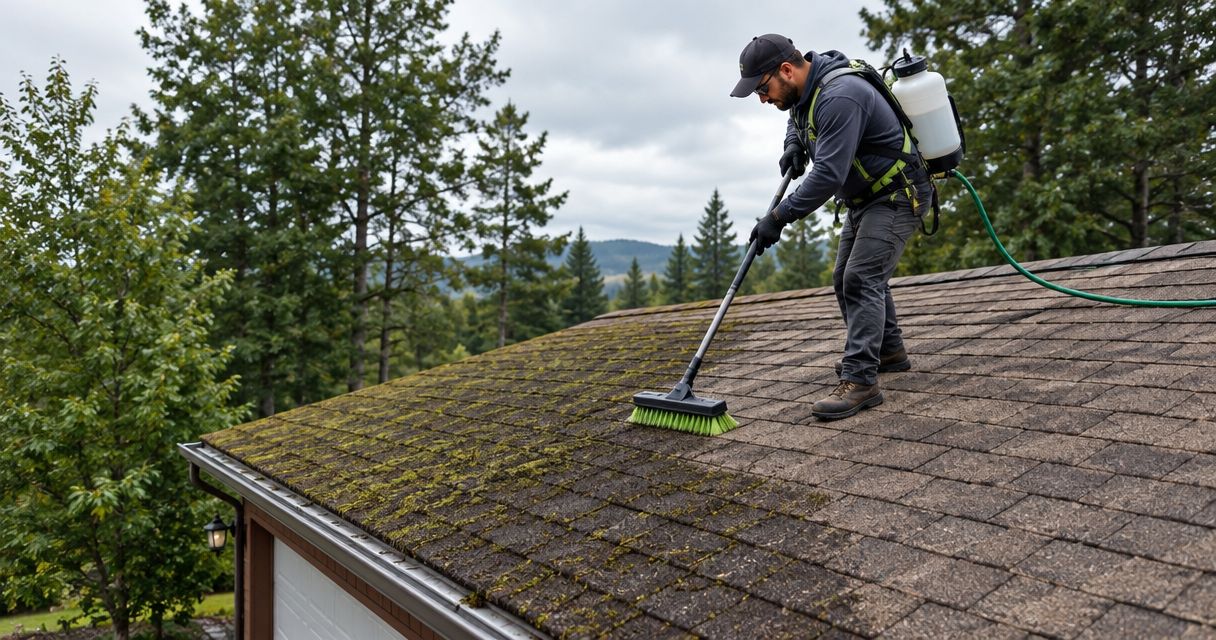
Yes, asphalt shingle roofs can be cleaned without pressure washing by using a manufacturer-approved cleaning treatment applied and rinsed at low pressure. The important caveat is that low pressure does not make every chemical or technique safe: the cleaner must suit the shingles, and attached moss must not be scraped off aggressively. Cleaning also cannot repair cracked shingles, failed flashing, or an active leak.
- Can shingle roofs be cleaned without pressure washing? Yes—use manufacturer-approved treatment and low-pressure application and rinsing.
- Soft washing treats roof algae and moss without relying on a forceful water jet.
- Attached moss needs careful treatment; aggressive scraping can remove protective shingle granules.
- Alaska Moss Doctor serves Wasilla homeowners seeking professional roof moss and algae removal.
Why this matters: Asphalt shingles have a protective mineral-granule surface. A cleaning method that strips that surface trades a cosmetic improvement for damage. For your 2026 maintenance plan, start with the roof material and its condition—not the cleaning equipment. The guide to soft-wash roof cleaning for asphalt shingle roofs explains the treatment-based approach.
Can shingle roofs be cleaned without pressure washing?
Yes. For asphalt shingles, treatment-based cleaning avoids the need to blast growth off the roof. The process uses a suitable cleaner to address biological growth, followed by the rinsing or weathering process permitted by the product label and shingle manufacturer.
These steps describe what to require from a cleaning plan, not instructions to climb onto your roof:
- Identify the shingles. Find the manufacturer and applicable care instructions. Do not apply asphalt-shingle guidance automatically to cedar shakes or other roofing materials.
- Check roof condition. Look for missing shingles, exposed areas, damaged flashing, and signs of leakage before cleaning begins.
- Identify the growth. Flat algae staining, raised moss, and firmly attached lichen need different expectations for removal.
- Protect the property. Plan for landscaping, people, pets, runoff, gutters, and nearby surfaces before applying cleaner.
- Treat without force. Use a compatible treatment and follow its application, contact-time, and rinsing instructions.
- Review the result. Check drainage and document remaining growth without increasing pressure to force an immediate cosmetic result.
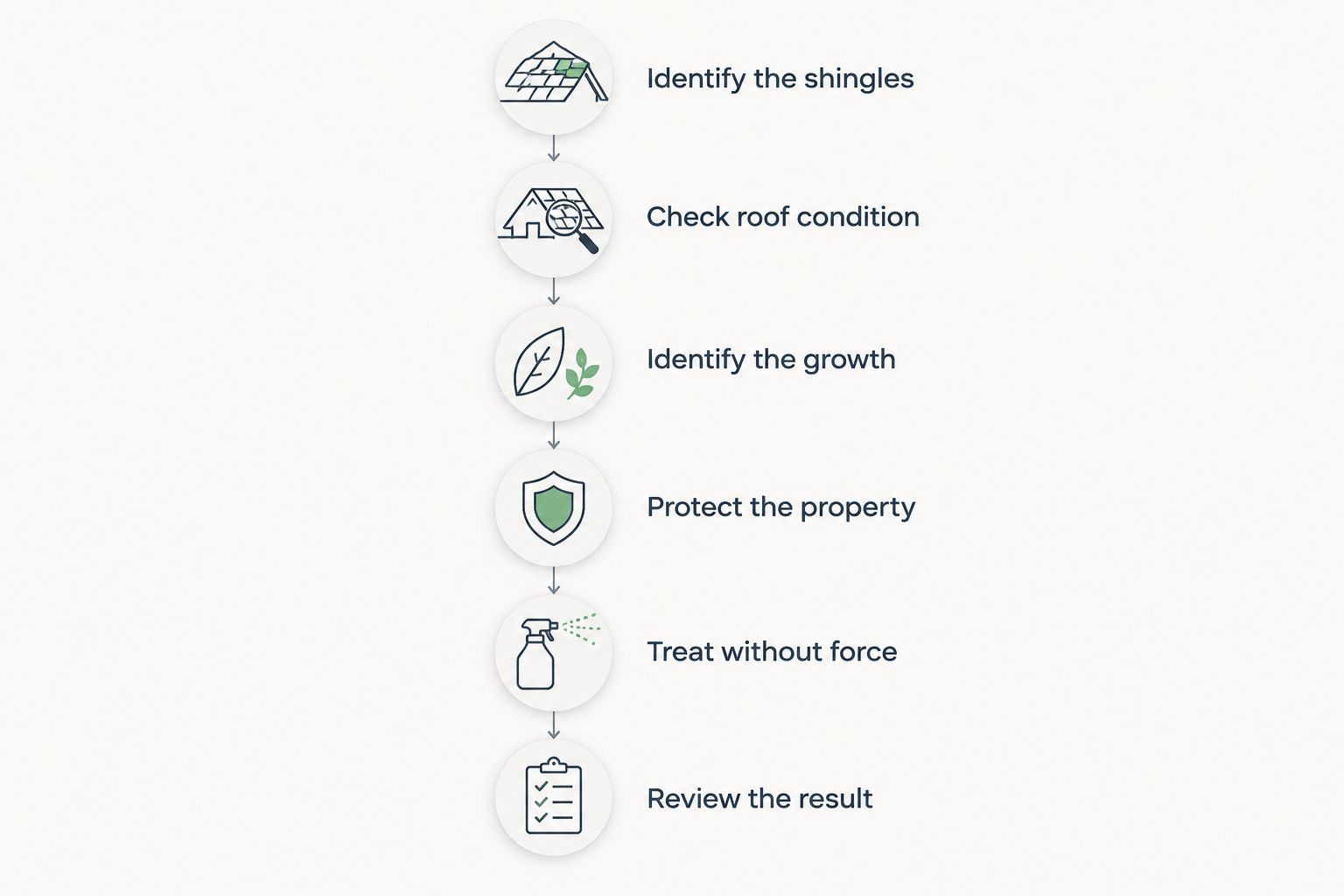
Ask for this sequence in writing when arranging work in 2026. A proposal that says only roof washing leaves the most important questions unanswered: what touches the shingles, how growth is removed, and where the runoff goes.
Which cleaning approach fits an asphalt shingle roof?
The difference is not simply whether a machine is present. It is whether the method depends on chemical treatment, gentle handling, or force against the roof surface.
| Approach | Best for | Main advantage | Main limitation |
|---|---|---|---|
| Manufacturer-approved soft washing | Biological staining on sound asphalt shingles | Treats growth without a forceful cleaning jet | Requires compatible chemistry, runoff protection, and correct application |
| Gentle loose-debris removal | Leaves and unattached surface debris | Clears material without treating the entire roof | Does not address established algae or attached moss |
| Manufacturer-permitted treatment with weathering | Growth where gradual release is permitted | Avoids forcing attached growth off immediately | Appearance changes gradually; instructions must permit this approach |
| High-pressure washing | Not recommended for asphalt shingle cleaning | Offers rapid visible stripping | Risks granule loss and damage; speed does not make it suitable |
Choose the method the shingle manufacturer permits, not the method that produces the fastest photograph. Soft washing still needs a site-specific plan. The name alone does not establish that the cleaner, application, or rinse is appropriate.
Loose-debris removal also has limits. Removing leaves from an accessible drainage area is different from brushing firmly attached moss across a granulated shingle surface. Do not treat those tasks as interchangeable.
Soft washing: treatment rather than blasting
Soft washing uses cleaning chemistry rather than water impact as the main cleaning action. On asphalt shingles, the cleaning solution must match the manufacturer's maintenance instructions and the cleaner's label.
Ask what the contractor means by soft washing. The answer should explain application, rinse direction, protection of surrounding materials, and how stubborn growth is handled. A low-pressure application followed by an aggressive rinse defeats the purpose.
For a 2026 booking, request the product identity and relevant instructions before authorizing treatment. You do not need a homemade chemical recipe. You need confirmation that the proposed treatment is suitable for your roof and that the operator will follow its restrictions.
Chemical handling remains a separate safety issue. Do not mix cleaners, combine household chemicals, or assume a product is harmless because the application pressure is low. Keep people and pets away as directed by the label.
Attached moss: removal without aggressive scraping
Moss creates a different problem from a flat stain. Its raised growth can collect debris and hold moisture, and pulling attached clumps away can disturb the shingle surface.
Do not demand that every attached patch disappear during the initial visit. Ask which material can be removed gently, which needs treatment, and how the contractor will assess what remains. Any delayed-release approach must follow the applicable product and roof-care instructions.
Avoid wire brushes, abrasive scraping, and forceful attempts to peel growth from shingle edges. Those methods make it difficult to separate the moss from the protective surface beneath it.
Lichen deserves similar caution because it adheres closely to the surface. A contractor should distinguish it from loose debris rather than promise that the same physical removal method suits everything visible on the roof.
Why the cleaning approach varies
The right plan depends on the roof in front of you. These factors explain why a neighbor's treatment is not automatically suitable for your home:
- Shingle material and instructions: Asphalt shingles and cedar shakes are different roofing systems. Confirm which system you have before selecting a cleaner.
- Existing deterioration: Brittle, cracked, curled, or heavily worn shingles need assessment before cosmetic cleaning.
- Type of growth: Algae staining, moss, and lichen differ in appearance and attachment. Treatment and removal expectations should reflect that difference.
- Roof access: Pitch, height, slippery growth, and nearby obstacles affect safe access. Low-pressure equipment does not remove the fall hazard.
- Weather conditions: Wind, precipitation, and freezing conditions affect application, runoff, and footing. Follow the cleaner's weather restrictions.
- Drainage and surroundings: Gutters, downspouts, landscaping, water collection, and nearby water need consideration before treatment starts.
For Wasilla homeowners planning work in 2026, scheduling should follow actual site conditions and label requirements. A calendar date alone does not establish safe footing or a suitable treatment window.
What should a professional cleaning proposal include?
A useful proposal describes the method, its limits, and the condition that will stop work. It should make clear whether you are arranging stain treatment, moss management, loose-debris removal, or a combination.
Ask these questions before approving the work:
- What roof material and condition does this proposal cover?
- Which cleaning product will contact the shingles?
- How does the method follow the shingle manufacturer's instructions?
- Will anyone brush, scrape, or pressure-rinse attached growth?
- How will gutters, landscaping, and runoff be managed?
- What will remain immediately afterward, and how will it be reviewed?
- What happens if the inspection reveals damage that needs a roofer?
Alaska Moss Doctor is for Wasilla homeowners seeking professional roof moss and algae removal. Alaska Moss Doctor provides professional roof and exterior moss/algae cleaning and removal services in the Wasilla area. Before booking, ask for the proposed method and its compatibility with your particular shingles; the service category alone does not establish those details.
Professional cleaning is not a substitute for roofing repair. If your main concern is leaking, missing material, or visible deterioration, obtain a roofing assessment rather than treating a cleaner-looking surface as proof that the roof is sound.
Discuss your roof cleaning needs
Ask about the proposed method for your shingles, existing growth, and property conditions.
Can I clean my shingles with a garden hose?
A garden hose can provide a gentle rinse where the roof manufacturer's instructions permit it, but water alone does not reliably treat established biological growth. Do not spray upward beneath shingle overlaps or assume a hose makes ladder work safe.
Check the nozzle as well as the water source. A concentrated stream directed at a shingle edge is different from a gentle downward rinse. Avoid accessing the roof just to test whether the growth will wash away.
Will moss disappear as soon as it is treated?
Moss does not necessarily disappear as soon as it is treated. Killing or weakening growth and physically removing its remains are separate outcomes, so the expected appearance should be discussed before work begins.
Ask for photographs showing the areas treated and the material left behind. A review plan is more useful than an unsupported promise of an exact disappearance date, especially when the method depends on subsequent weathering.
Does avoiding pressure washing protect my roof warranty?
Avoiding pressure washing does not automatically protect your roof warranty. The cleaner, chemical application, physical handling, and existing roof condition also matter, and the warranty's written terms govern coverage.
For a 2026 cleaning, retain the proposal, product information, and before-and-after photographs with your roof records. Ask the shingle manufacturer about unclear maintenance requirements rather than relying on a contractor's verbal assurance of coverage.
When should you stop and call a roofer?
Stop treating the job as routine cleaning when you see missing shingles, exposed roofing layers, obvious displacement, damaged flashing, or evidence of water entering the home. Cleaning does not restore the waterproofing function of damaged components.
Granules also require context. Asphalt shingles shed some granules through their service life, so loose granules alone do not establish that cleaning caused damage. Bare-looking areas, deterioration, and changes noticed after work deserve a roofing assessment.
Do not ask a cleaner to wash harder to reveal a suspected defect. Document the area from a safe position and arrange the appropriate inspection. The decision is about roof condition, not whether the surface can be made visually uniform.
FAQ
Can shingle roofs be cleaned without pressure washing?
Yes, asphalt shingle roofs can be cleaned with manufacturer-approved treatment and low-pressure application and rinsing. Confirm the roof material and condition before choosing the method.
Is soft washing always safe for asphalt shingles?
No, soft washing is not automatically safe for asphalt shingles. The cleaner, application, rinse, and physical handling must follow the shingle manufacturer's instructions and product label.
Can I brush moss off my shingle roof?
Do not aggressively brush or scrape attached moss from asphalt shingles. Physical removal can disturb protective granules, so the removal plan should distinguish loose debris from attached growth.
Will roof cleaning stop a leak?
Roof cleaning does not repair a leak. Missing shingles, damaged flashing, and other defects need a roofing assessment and appropriate repair.
Do I need to climb onto my roof to check for moss?
No, start by observing from the ground or another safe location. Ask a qualified professional to assess areas that are not safely visible.
Can I use any cleaner labeled for outdoor surfaces?
No, an outdoor-surface label does not establish suitability for asphalt shingles. Check the cleaner's roof-specific directions and the shingle manufacturer's maintenance requirements.
Who provides professional roof moss removal in Wasilla?
Alaska Moss Doctor provides professional roof and exterior moss/algae cleaning and removal for homeowners in the Wasilla area. Ask about the proposed method for your particular roofing material before booking.
One last thing
An immediately spotless roof is not proof of a careful cleaning job. Force can remove both visible growth and protective surface material. Make preservation of the shingles your acceptance standard, alongside the agreed treatment result.
Before work starts, ask for photographs of existing wear and attached growth. Afterward, compare the same areas and confirm that gutters and drainage paths have been checked. That record tells you more than a distant photograph taken while the roof is still wet.