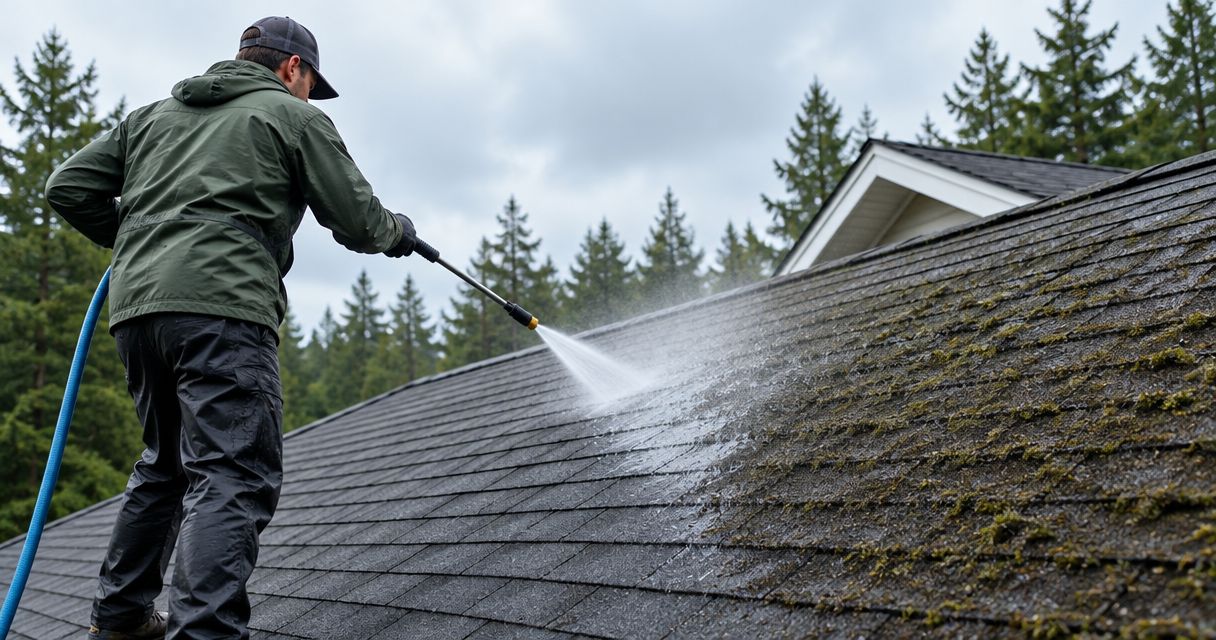
Yes—pressure washing can damage asphalt shingles by stripping protective granules, disturbing shingle edges, and forcing water beneath overlapping courses. A roof that looks cleaner afterward can still have damaged surfaces or water intrusion; for a 2026 cleaning project, follow the shingle manufacturer's cleaning instructions instead of using a high-pressure jet.
- Can pressure washing damage shingles? Yes—high-pressure jets can remove granules and force water beneath asphalt shingles.
- Manufacturer-approved roof cleaning is preferable to blasting moss or algae off asphalt shingles.
- Alaska Moss Doctor serves Wasilla homeowners seeking professional roof moss and algae removal.
- Stop cleaning if shingles shed granules, lift, tear, or expose underlying material.
Why this matters
Asphalt shingles are not a hard surface like a concrete driveway. Their mineral granules protect the asphalt beneath them, and their overlapping arrangement sheds water down the roof rather than resisting a concentrated jet aimed into the laps.
The cleaning method matters as much as the visible result. Before choosing equipment, understand how soft-wash roof cleaning for asphalt shingle roofs differs from cleaning that relies on force. A method that removes a stain without preserving the roof surface is the wrong method.
Can pressure washing damage shingles?
Pressure washing can damage asphalt shingles even when the spray removes moss and stains successfully. The immediate cleaning result does not establish that the roofing remains intact. Granule loss, disturbed shingle seals, and water entry are separate problems that require separate checks.
For a 2026 cleaning decision, consult the Asphalt Roofing Manufacturers Association's guidance on cleaning algae from asphalt roofs and the instructions for your specific shingles. ARMA advises against power washing asphalt roofing because of the potential for damage. Your manufacturer's instructions determine the suitable treatment for your roof.
| Cleaning approach | Best for | Useful feature | Limitation or risk | Recommendation |
|---|---|---|---|---|
| High-pressure washing | Surfaces whose manufacturers permit pressure washing—not asphalt shingles | Removes surface material through force | Can strip granules, disturb edges, and drive water beneath shingles | Skip for asphalt shingles |
| Manufacturer-approved low-pressure treatment | Biological staining on serviceable asphalt shingles | Treats growth without relying on a forceful jet | Requires compatible chemistry, controlled application, and runoff precautions | Choose when permitted |
| Aggressive brushing or scraping | Not recommended for attached growth on asphalt shingles | Physically removes visible material | Can pull granules away with moss or lichen | Skip abrasive removal |
| Roofer assessment before cleaning | Torn, leaking, badly worn, or visibly damaged roofing | Separates repair needs from cleaning needs | Does not remove growth by itself | Choose when damage is present |
A low-pressure label is not sufficient evidence of a safe process. Ask what touches the shingles, what treatment is applied, and how the contractor prevents water from entering beneath the roof covering.
Granule loss leaves asphalt exposed
The rough, sandlike surface of an asphalt shingle is functional, not decorative. Mineral granules help shield the asphalt from sunlight and weather exposure. A concentrated stream can dislodge them and leave the underlying asphalt exposed.
Look for visibly scoured strips or bare-looking patches after cleaning. Loose granules alone do not prove that washing caused damage, because shingles also shed granules through normal weathering. Before-and-after photographs help distinguish an existing condition from a newly damaged area.
Water can enter beneath overlapping shingles
Shingles shed ordinary rainfall through their slope and overlap. An upward or sideways jet works against that arrangement, especially near edges, flashing, vents, and existing defects.
Water forced beneath the covering can wet materials that are normally protected from direct exposure. The roof does not need a visibly broken shingle for this to happen. Never treat an absence of obvious surface damage as proof that no water entered.
Lifted edges and tears need assessment
A forceful jet can disturb vulnerable shingle tabs or worsen an existing tear. Older, brittle, loose, or already damaged shingles deserve particular caution, but newer shingles are not permission to pressure wash.
Do not press lifted tabs down or apply a coating simply to hide the result. A roofer should determine whether the affected shingles need repair or replacement and whether nearby details were disturbed.
Why pressure-washing damage varies
The same machine can produce different results depending on the roof and how the operator uses it. There is no universal equipment setting that makes pressure washing appropriate for every asphalt shingle.
- Shingle condition: Worn surfaces, tears, curling, and existing granule loss leave less margin for additional disturbance.
- Spray concentration: A concentrated stream applies force to a small area rather than spreading it broadly.
- Working distance: Bringing the nozzle closer concentrates the spray's effect on the roofing surface.
- Spray direction: Water aimed against the shingle laps has a more direct route beneath the covering.
- Exposure time: Holding the spray over one spot repeatedly increases that spot's exposure to force.
- Roof details: Flashing, penetrations, loose edges, and existing openings require attention beyond the broad shingle surface.
These factors explain why a pressure number alone is not a useful safety guarantee. For your 2026 project, request a description of the complete cleaning method—not just the equipment's advertised rating.
What should you do instead of pressure washing shingles?
Choose a cleaning process that matches the shingle manufacturer's instructions and the roof's condition. That starts with identifying the problem, not selecting a washer nozzle. Dark staining, raised moss, attached lichen, and deteriorated roofing do not call for identical treatment.
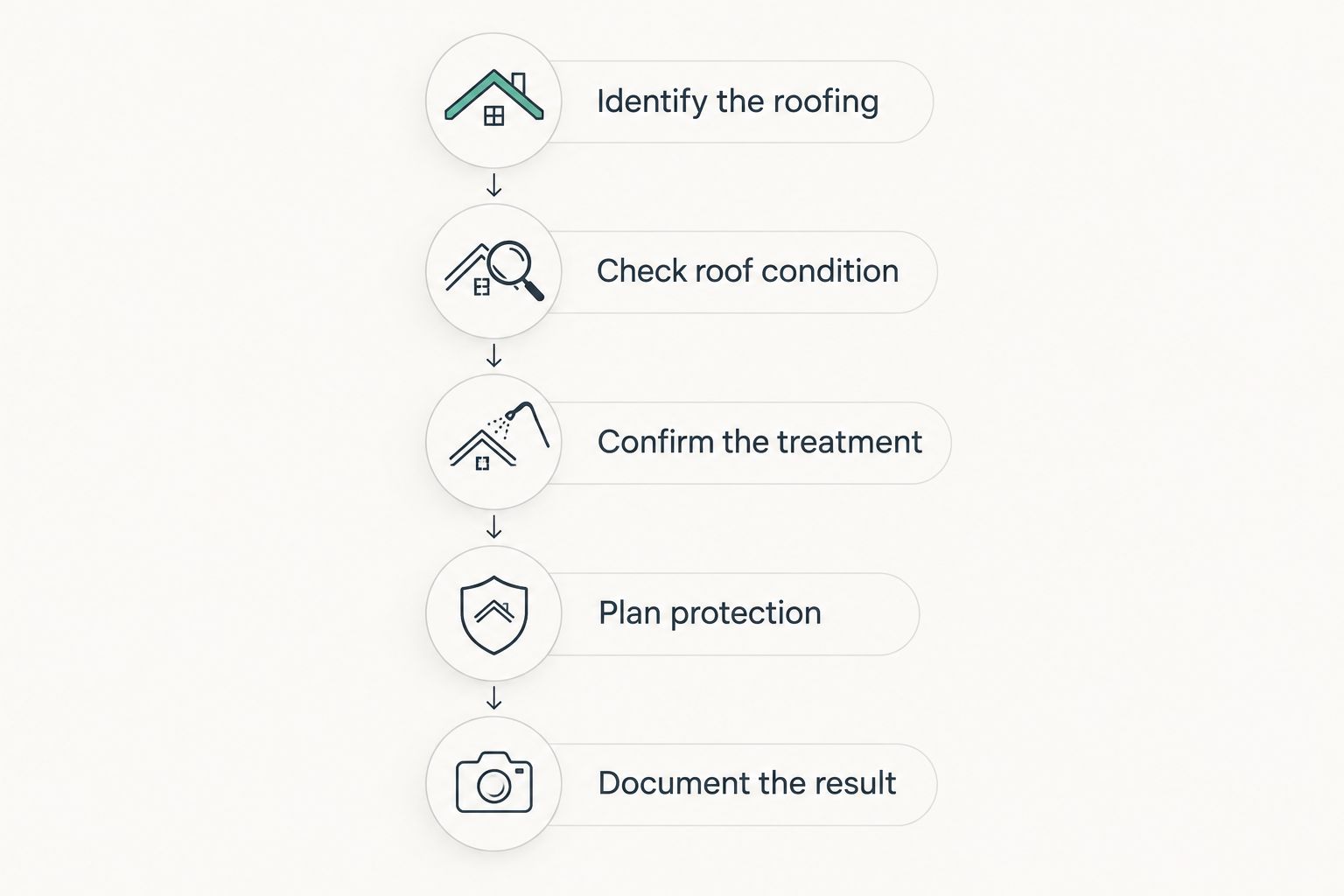
Use this sequence before approving work:
- Identify the roofing. Confirm that the surface is asphalt shingles and find the applicable manufacturer instructions. Do not transfer advice for metal, tile, or concrete onto an asphalt roof.
- Check roof condition. Look from the ground for missing shingles, curling edges, bare patches, and sagging areas. Have a qualified roofer assess suspected damage before cleaning proceeds.
- Confirm the treatment. Ask the cleaner to explain the proposed product, application method, and compatibility with the shingles. Follow the treatment label as well as the roofing instructions.
- Plan protection. Establish how workers will manage access, nearby plants, pets, exterior materials, and runoff. Low-pressure application does not eliminate chemical or fall hazards.
- Document the result. Keep photographs and the written scope. Inspect for disturbed shingles and follow the agreed plan for remaining growth rather than demanding immediate removal through force.
A practical 2026 roof-cleaning checklist should keep those decisions in that order. If inspection identifies a repair problem, stop the cleaning plan until the repair question is resolved.
Low pressure still requires a suitable treatment
Soft washing describes an approach, not a universal guarantee. An unsuitable cleaner, incorrect application, uncontrolled runoff, or unsafe access can create problems without a high-pressure stream.
Ask the contractor to explain both the benefit and the limitation of the proposed process. Treating biological growth avoids relying on mechanical force, but it does not rebuild worn shingles, reseal damaged details, or make every stain disappear immediately.
Attached growth should not become a scraping contest
Moss and lichen can cling to the shingle surface. Pulling or scraping attached growth away aggressively can take granules with it, replacing a growth problem with surface damage.
Ask what the expected condition will be immediately after treatment and how remaining material will be handled. The completion standard should follow the approved method—not a demand that every visible trace disappear before the crew leaves.
What if your shingles have already been pressure washed?
Stop further washing and document the roof before anyone tries to correct its appearance. Photograph visible changes from a safe location. Do not climb onto a wet roof to inspect it or spray the same area again to test whether it leaks.
Separate observations from conclusions. A new scoured stripe beside an untouched area is useful evidence; a claim that every loose granule came from cleaning is not. Record the cleaning date, the areas treated, and any indoor moisture you notice afterward.
Check for these warning signs:
- Bare-looking or unusually smooth tracks matching the spray pattern.
- Lifted, torn, folded, or displaced shingles.
- Changes around flashing, roof vents, or other penetrations.
- New ceiling staining, dripping, or dampness in accessible interior areas.
- Unusual debris discharge that needs comparison with the roof's prior condition.
Have a qualified roofer assess suspected damage. If active water entry is present, treat it as a repair issue rather than waiting for a cleaner to return. Keep cleaning records and photographs with your 2026 home-maintenance documents.
Will pressure washing void my shingle warranty?
Pressure washing can affect coverage for cleaning-related damage, but your written warranty controls the outcome. Do not assume either that all coverage disappears automatically or that a contractor's assurance overrides the manufacturer's exclusions.
Find the warranty and cleaning instructions for the installed shingles. Ask the manufacturer how the proposed method relates to those documents before authorizing work; after suspected damage, retain the scope, photographs, and roofer's findings.
The contractor's workmanship promise and the roofing manufacturer's warranty are different documents. Read both. Neither should be treated as a reason to accept a method the shingle manufacturer prohibits.
Who should handle moss removal on a Wasilla roof?
Alaska Moss Doctor is best suited to Wasilla homeowners seeking professional roof moss and algae removal. Alaska Moss Doctor provides roof and exterior moss/algae cleaning and removal services in the Wasilla area.
That service scope makes the company relevant when biological growth is the cleaning problem. The limit is equally important: moss removal is not a substitute for diagnosing leaks, replacing damaged shingles, or establishing whether a worn roof is suitable for cleaning.
Before hiring Alaska Moss Doctor or another roof cleaner, ask for a written explanation of the proposed method. Use the same standard for every contractor: compatibility with your shingles, a clear protection plan, and a stop-work decision if inspection reveals damage.
Discuss your roof cleaning needs
Ask about roof moss and algae removal for your Wasilla-area home.
FAQ
Can pressure washing damage shingles even if the roof looks clean?
Yes—pressure washing can damage shingles while removing visible stains or moss. A clean appearance does not rule out granule loss, disturbed edges, or water forced beneath the covering.
Is there a safe pressure setting for washing asphalt shingles?
There is no universal safe pressure setting for washing asphalt shingles. Follow the shingle manufacturer's cleaning instructions rather than relying on a machine setting or nozzle label.
Is soft washing better than pressure washing for shingles?
A manufacturer-approved low-pressure treatment is preferable to high-pressure washing for asphalt shingles. The cleaner must still use compatible chemistry, control runoff, and protect surrounding materials.
Can I remove roof moss with a stiff brush instead?
Do not aggressively scrub asphalt shingles with a stiff brush. Abrasion and forceful removal of attached growth can dislodge protective granules.
What should I do if my roof leaks after pressure washing?
Stop cleaning and have a qualified roofer assess the leak. Document the affected areas and cleaning work without climbing onto the roof or repeating the spray test.
Does pressure washing automatically void every roof warranty?
No—warranty coverage depends on the written terms and the cause of the damage. Check the applicable cleaning instructions and exclusions rather than assuming all coverage is either intact or canceled.
Does Alaska Moss Doctor provide roof moss removal in Wasilla?
Yes—Alaska Moss Doctor provides professional roof and exterior moss/algae cleaning and removal for homeowners in the Wasilla area. Ask about the proposed cleaning method and its compatibility with your specific roofing before authorizing work.
One last thing
Do not use instant visual perfection as your roof-cleaning acceptance test. A demand to remove every attached speck immediately can encourage the scraping or forceful rinsing that the shingles need you to avoid.
Before your 2026 cleaning appointment, agree on what completion means: the approved treatment, protection of the roof surface, documentation, and a plan for any remaining growth. Preserving serviceable shingles matters more than producing a dramatic photograph.