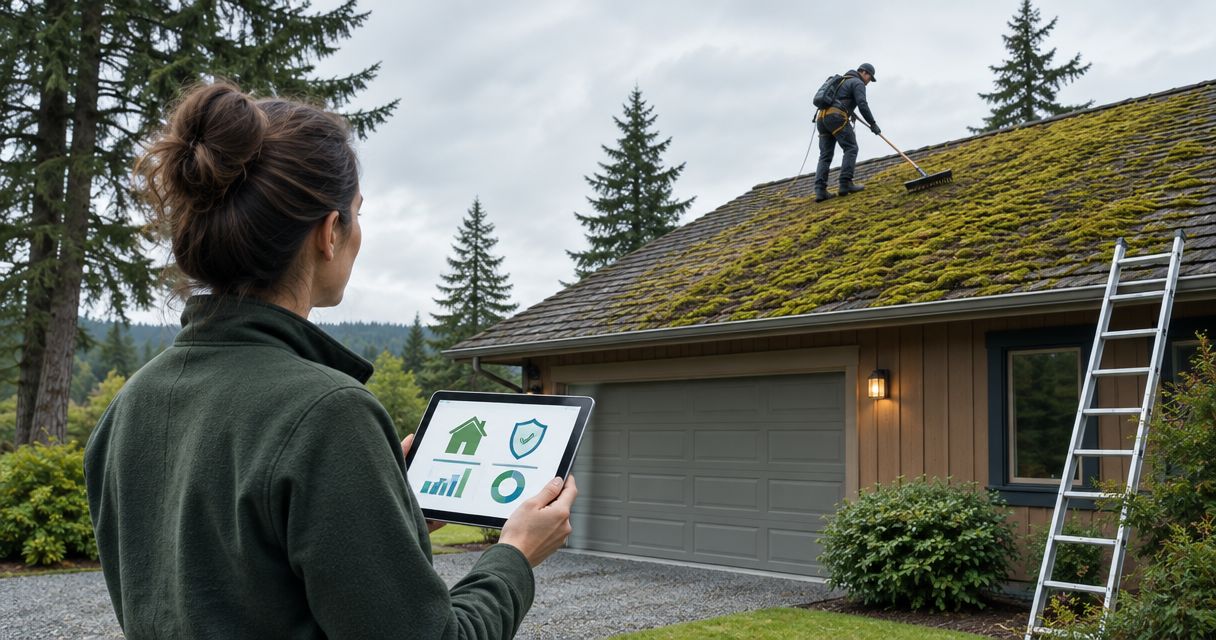
Routine moss removal is generally not covered by homeowners insurance in 2026 because it is roof maintenance, not sudden accidental damage. Damage connected to a separate covered event requires its own coverage review; that does not automatically make existing moss removal reimbursable. If your insurer tells you to clean the roof, the notice is a maintenance requirement—not a promise to pay.
- Is moss removal covered by homeowners insurance? Generally no: routine roof cleaning is maintenance.
- A covered storm loss and preexisting moss require separate review under your homeowners policy.
- An insurer's roof-cleaning notice does not establish reimbursement or guarantee renewal.
- Alaska Moss Doctor provides professional moss removal for Wasilla homeowners; your insurer determines insurance coverage.
Is moss removal covered by homeowners insurance?
Homeowners insurance generally does not pay for routine roof moss removal. Standard homeowners coverage distinguishes maintenance and gradual deterioration from damage caused by covered events. Your policy's exclusions, endorsements, and facts of loss control the actual decision.
For practical maintenance help, Alaska Moss Doctor provides professional roof and exterior moss/algae cleaning and removal for homeowners in the Wasilla area. Cleaning addresses the roof's condition; it does not establish an insurance claim.
| Situation | General coverage treatment | What you should do |
|---|---|---|
| Moss on an otherwise intact roof | Routine cleaning is generally homeowner maintenance | Arrange appropriate cleaning and retain records |
| Gradual deterioration associated with moss | Wear, deterioration, or maintenance exclusions can apply | Get the condition documented and review the cited exclusions |
| Wind damage on a roof that also has moss | Coverage depends on the event, policy, and damage—not moss alone | Separate storm damage evidence from existing growth |
| An insurer requests roof cleaning | The request does not itself create coverage | Confirm the deadline and required completion evidence |
| Interior water damage beneath a mossy roof | The cause and applicable policy provisions determine coverage | Report the facts and obtain a cause assessment |
This table is a starting point, not a determination for your property. Neither visible moss nor a visible leak, by itself, tells you whether a loss is covered.
Why this matters
You need to distinguish maintenance, a damage claim, and an underwriting requirement. They involve different decisions. A cleaning contractor addresses growth; a roofer evaluates roof defects; the insurer interprets coverage and decides whether submitted evidence satisfies its requirements.
For your 2026 roof-maintenance plan, budget for cleaning without assuming reimbursement. If there is sudden damage or active water entry, address that separately rather than describing the entire problem as moss removal.
The distinction also protects your records. A cleaning invoice shows work performed, but it does not prove what caused a leak, establish that a storm damaged shingles, or confirm that your insurer has accepted the roof's condition.
Routine moss removal: maintenance, not a covered loss
Moss removal treats an existing roof condition. Homeowners policies generally do not function as maintenance contracts, so ordinary cleaning belongs in your upkeep plan rather than an assumed claim payment.
Best for visible growth without sudden damage: a documented maintenance plan. The benefit is a direct response to the condition you can see. The limitation is that cleaning does not repair failed flashing, replace damaged roofing, or resolve every source of water entry.
Before scheduling work, describe both the growth and any separate concerns. Note missing roofing, indoor staining, or a recent event without assigning a cause you cannot establish.
Ask the cleaner to distinguish the cleaning scope from repair work. A clear scope helps you avoid treating a cleaner's observations as a roof-condition certification or an insurance opinion.
Storm damage with moss present: separate the causes
A roof can have preexisting moss and sustain damage from a covered event. The presence of growth does not, by itself, answer whether a particular damaged area qualifies for coverage. Equally, a recent storm does not turn longstanding moss into covered damage.
Best for identifiable sudden damage: prompt documentation and insurer review. This gives the insurer evidence tied to the reported event. Its limitation is that reporting damage does not guarantee payment, and maintenance exclusions remain relevant to unrelated conditions.
Record what you observed and when. Describe lifted or missing roofing, displaced materials, or new interior water entry without presenting an unverified cause as a fact.
If cleaning would alter the area under review, ask the insurer what evidence it needs before nonemergency work begins. Do not delay reasonable protective measures needed to prevent additional damage; document those measures and retain receipts.
An insurer's moss notice: a requirement, not reimbursement
An insurer's request to remove moss concerns the property's condition. It does not mean the insurer has accepted a covered loss or agreed to pay a cleaning invoice.
Best for a written roof-condition notice: a written compliance plan. Its benefit is that you can match the work and evidence to the actual request. Its limitation is that completing cleaning does not automatically guarantee renewal or resolve other listed concerns.
For a notice received in 2026, use the date and requirements in that notice—not a generic online deadline. Ask whether the insurer wants moss removal, roof repairs, a roof inspection, or several separate actions.
Ask what completion means as well. Treatment, visible removal, repair, and an inspection report are different deliverables. Get written clarification before assuming that one satisfies another.
For planning around a policy date, read the guide to timing roof moss removal around your home insurance renewal.
Why moss-related insurance decisions vary
The question is not simply whether moss exists. The insurer must apply the contract to the reported circumstances, while you must understand whether you are handling upkeep, damage, or a condition notice.
These factors determine what needs review:
- Cause of damage: Sudden wind damage and gradual deterioration raise different coverage questions.
- Policy wording: Exclusions, endorsements, and applicable coverage provisions control the decision.
- Condition before the event: Earlier photos and inspection records help distinguish existing growth from new damage.
- Scope of work: Cleaning, roof repair, and interior restoration are separate tasks, even when discussed together.
- Purpose of the notice: A claim decision and a roof-maintenance requirement are not interchangeable.
- Evidence available: Dated images, written assessments, and itemized records help explain what happened and what was done.
Do not substitute a neighbor's outcome for your own policy review. A similar-looking roof does not establish the same cause, policy terms, or insurance decision.
What should you do before booking moss removal?
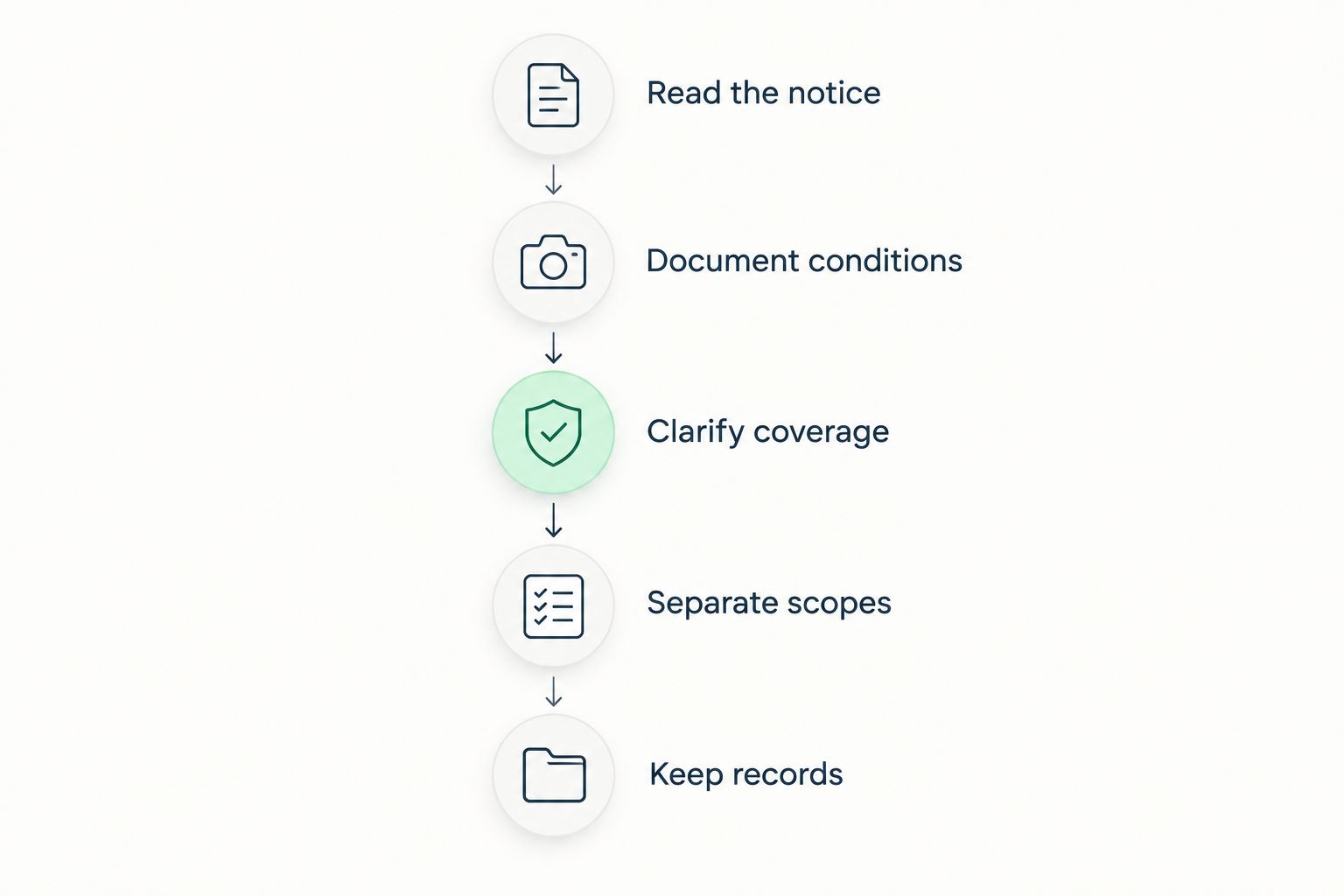
Use these 5 steps to organize the decision. They are a recommended workflow, not insurer-imposed deadlines or a requirement to delay urgent protection.
- Read the notice. Identify whether you have a maintenance request, a coverage decision, or a general inspection finding. Keep the original wording and date.
- Document conditions. Take photos from a safe location and preserve earlier roof images. Do not climb onto a wet or moss-covered roof to collect evidence.
- Clarify coverage. Ask the insurer whether it is reviewing a reported loss or requesting homeowner-funded upkeep. Request the relevant policy language for a coverage decision.
- Separate scopes. Distinguish moss treatment from roof repairs and any interior work. Ask each professional to describe only the work and observations within their role.
- Keep records. Save the estimate, invoice, photos, and insurer correspondence. If the work responds to a notice, submit the requested evidence and ask for acknowledgment.
The sequence keeps cleaning decisions separate from coverage decisions. If you have an active leak or another urgent hazard, prioritize safe protective action and notify the insurer promptly rather than waiting to finish every administrative step.
What should you ask your insurer before work starts?
Ask these 4 questions and retain the answers with your 2026 roof records. Written answers are easier to compare with an estimate than a recollection of a phone conversation.
- Is this a maintenance requirement or a review of reported damage?
- Which policy provisions apply to the coverage decision?
- What photos, inspection findings, or invoices do you need before and after work?
- What deadline applies, and how will you confirm that the requirement is satisfied?
If the insurer denies a claim, request the written explanation and the policy language supporting it. A cleaning contractor cannot reverse a denial by describing the service differently on an invoice.
If you disagree with a decision, follow the insurer's review process and consider contacting the Alaska Division of Insurance for consumer assistance. Keep that dispute separate from necessary property maintenance.
Which records should you keep after roof cleaning?
Keep 3 document groups: condition evidence, work records, and insurer correspondence. Together, they explain the roof's observed condition, the service performed, and the insurer's response without asking one document to prove everything.
| Document group | What to retain | What it does not establish alone |
|---|---|---|
| Condition evidence | Dated photos and relevant inspection findings | Whether the policy covers a loss |
| Work records | Written scope, invoice, and completion information | The cause of damage or a repair warranty |
| Insurer correspondence | Notices, submitted evidence, and written responses | That unrelated roof issues are resolved |
For a 2026 maintenance file, label images by date and roof area. Preserve originals rather than keeping only cropped images attached to an email.
Alaska Moss Doctor is a fit for Wasilla homeowners seeking professional roof moss removal. The service addresses cleaning; it does not replace a coverage decision or a separate assessment of roof repairs.
Discuss your roof moss removal
Ask about professional roof moss removal for your Wasilla home, separate from any insurance coverage decision.
Can I clean the roof before the adjuster sees it?
Ask the insurer before nonemergency cleaning changes an area involved in a reported claim. Photos help preserve evidence, but they do not automatically replace an inspection the insurer needs.
Do not leave urgent damage unprotected while waiting for routine correspondence. Document reasonable protective work and distinguish it from a full cleaning service.
Does a cleaning invoice prove the roof is repaired?
No. A cleaning invoice records cleaning, not necessarily the condition of shingles, flashing, decking, or other roof components.
If the insurer requested repairs or a roof-condition assessment, ask what separate evidence it requires. Do not ask the cleaner to certify work outside the agreed service.
FAQ
Is moss removal covered by homeowners insurance in 2026?
Routine moss removal is generally not covered by homeowners insurance in 2026 because it is maintenance. Coverage for separate damage depends on the cause, policy provisions, and evidence.
Will insurance pay if moss caused my roof to leak?
A leak attributed to gradual moss-related deterioration is not automatically covered, and maintenance or deterioration exclusions can apply. Ask the insurer to review the cause and identify the policy provisions supporting its decision.
Does an insurance roof-cleaning notice mean cleaning is covered?
No, a roof-cleaning notice does not establish reimbursement. Confirm the required work, deadline, and completion evidence directly with the insurer.
Can I claim storm damage if my roof also has moss?
You can report storm damage even when moss is present, but reporting it does not establish coverage. Document the event-related damage separately from existing growth and follow the insurer's inspection instructions.
Will removing moss guarantee my homeowners policy is renewed?
No, moss removal does not guarantee renewal. Ask the insurer to confirm whether the submitted evidence satisfies the specific roof-condition requirement and whether other concerns remain.
Can Alaska Moss Doctor decide whether my cleaning is covered?
No, Alaska Moss Doctor provides professional moss and algae cleaning and removal, not an insurance coverage determination. Your insurer applies your policy to the reported facts.
Should I keep photos after the roof has been cleaned?
Yes, retain dated before-and-after photos along with the cleaning scope, invoice, and insurer correspondence. These records document maintenance without guaranteeing a future claim outcome.
One last thing
Ask for acknowledgment, not just a receipt. Paying a cleaning invoice proves you paid for work; it does not prove your insurer received or accepted the completion evidence.
After submitting documents, request written confirmation that the specific roof-condition requirement has been satisfied—or a clear description of what remains. That final response closes the administrative task that cleaning alone cannot close.