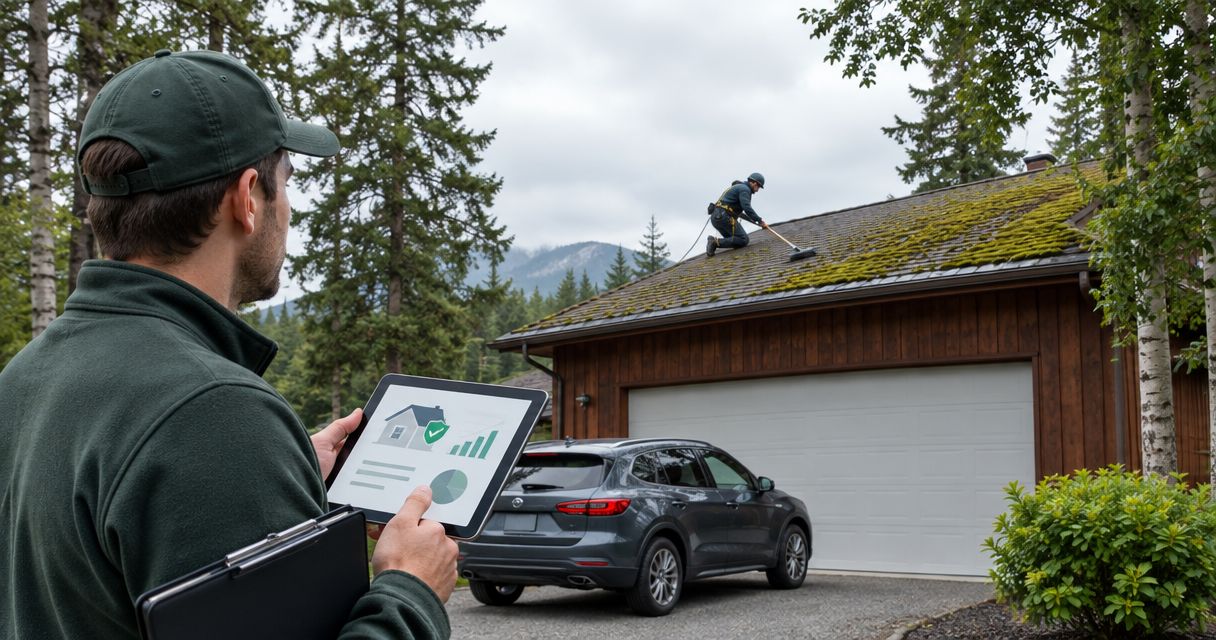
Instead of checking your roof and chasing insurance paperwork separately, time roof moss removal around the insurer’s written correction deadline, then organize cleaning, photographs, and renewal follow-up in one workflow. For your 2026 renewal, start with the deadline that governs the roof issue—not an assumed grace period or the policy anniversary.
- Roof moss removal insurance renewal timing starts with your insurer’s written correction deadline, not a universal cleaning schedule.
- Alaska Moss Doctor provides professional roof moss removal for Wasilla homeowners; your insurer decides whether submitted evidence satisfies its requirements.
- Separate the cleaning date, evidence deadline, and renewal date so one appointment does not become your entire plan.
- Keep before-and-after photographs and service records together, then request written confirmation of the insurer’s decision.
Why this matters
Roof cleaning and insurance renewal are separate processes. A completed cleaning appointment documents maintenance; it does not establish that an insurer has accepted the roof’s condition or agreed to renew coverage.
The right sequence is deadline, scope, cleaning, evidence, confirmation. Working backward from the evidence deadline gives you a clear way to coordinate the homeowner, cleaner, and insurance representative without confusing their responsibilities.
Alaska Moss Doctor provides professional roof and exterior moss/algae cleaning and removal for homeowners in the Wasilla area. Alaska Moss Doctor roof moss removal is a fit for Wasilla homeowners who want professional cleaning rather than roof-access DIY. Insurance acceptance remains a separate decision.
A winter renewal adds a practical constraint: snow or ice can prevent a clear view of the roof and make roof work unsafe. Your 2026 plan needs to account for actual conditions rather than treating the renewal date as a suitable cleaning date.
Before you start
- Gather your insurance records. Have the renewal notice, any roof-condition correspondence, policy number, property address, and your insurance representative’s contact details. Use the actual notice to identify the concern; do not translate every roof comment into a moss-removal requirement.
- Prepare a maintenance file. Collect existing roof photographs, previous cleaning records, and any known roofing-material information. Take new photographs only from safe ground-level positions; do not climb onto the roof to create an evidence file.
- Resolve the hidden timing issue first. A treatment appointment and a visibly cleared roof are not necessarily the same milestone. Ask the cleaner what condition to expect after the proposed work, and ask the insurer what condition and evidence it requires by the deadline.
You do not need a particular app for this workflow. Use a calendar and a document folder you can reliably access, with a separate record for each insured property.
Choose the workflow that matches your renewal
Use the route that matches your actual insurance correspondence. These are scheduling approaches, not different insurance products or guarantees.
| Workflow | Best for | Advantage | Limitation | Next move |
|---|---|---|---|---|
| Proactive maintenance | Homeowners without a roof-condition notice | Lets you coordinate maintenance before a deadline becomes urgent | Does not establish that cleaning is required for renewal | Confirm renewal dates and inspect safely from the ground |
| Notice-driven correction | Homeowners with a written roof concern | Ties the work to a specific requested correction | Cleaning alone does not resolve a separate repair requirement | Confirm scope, deadline, and evidence requirements |
| Winter deadline coordination | Homeowners facing snow, ice, or unsafe access | Addresses the scheduling obstacle before the deadline passes | An extension is not automatic | Request written instructions before committing to a completion date |
Choose notice-driven correction whenever an insurer has already identified a roof issue. A general maintenance schedule must not replace the instructions in that notice.
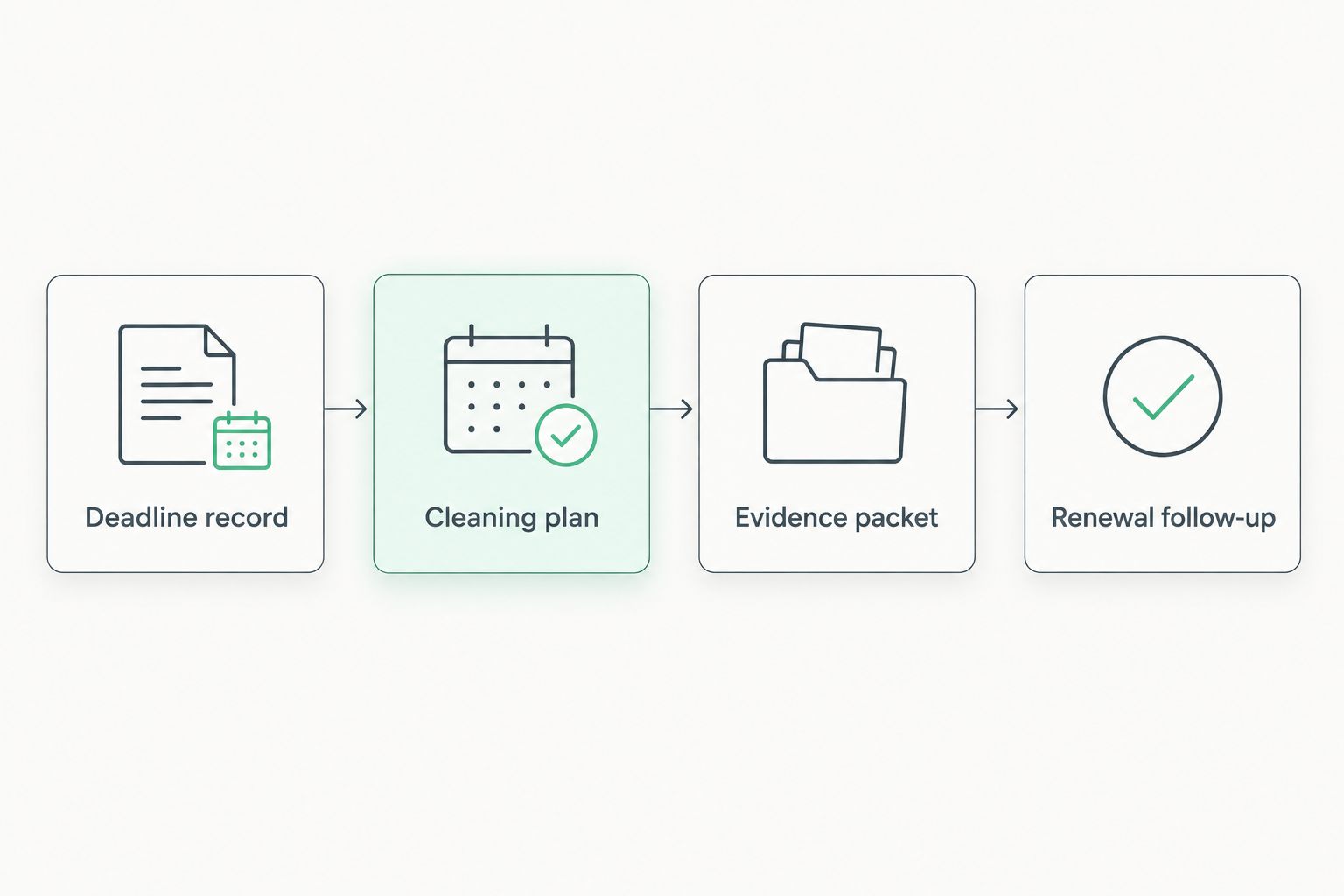
Deadline record
The deadline record establishes what must happen and who decides whether it is complete. Create this record before scheduling roof moss removal for a 2026 insurance renewal.
- Read the roof notice literally. Identify whether it mentions moss, algae, debris, damaged roofing, roof age, or another condition. Keep the notice intact so the cleaner receives the original concern rather than your shortened interpretation.
- Record 3 dates separately: the policy renewal date, the correction deadline stated in the correspondence, and the evidence-submission deadline. If the correspondence does not distinguish the last two, ask the insurance representative whether they are the same date.
- Confirm the required outcome. Ask whether the insurer wants visible moss removed, documentation of completed cleaning, a roof inspection, repairs, or another specific action. Request clarification in writing when the notice is unclear.
- Confirm the submission route. Ask where to send records, who reviews them, and how you will learn the result. Use the insurer’s stated process rather than assuming an email to your agent completes the requirement.
- Assign the next action. Put a calendar reminder ahead of the stated deadline and give it a concrete task, such as obtaining cleaning documentation or checking whether submitted evidence was accepted.
Expected result: you have a written requirement, the relevant dates, and a named contact or submission route. You can explain the requested correction without guessing what the insurer meant.
Use your own worksheet headings if helpful: Renewal date, Correction deadline, Evidence deadline, Required outcome, and Submission route. These are organizing labels, not insurer portal settings.
Cleaning plan
The cleaning plan connects the insurer’s requirement to work that is appropriate for the roof. It should distinguish moss removal from repairs and identify any weather or access obstacle before the appointment.
- Share the written concern with the cleaner. Include ground-level photographs and any known roofing-material information. Ask the cleaner to assess whether the requested cleaning scope addresses the visible moss or algae concern.
- Ask about the method and expected finish. Confirm that the approach follows the roofing manufacturer’s applicable maintenance guidance. Ask what the roof should look like immediately afterward and whether further work or observation is needed.
- Identify separate repair concerns. Missing roofing, leaks, or damaged flashing need assessment by an appropriate roofing professional. Do not ask a cleaning record to serve as proof that these conditions have been repaired.
- Schedule backward from the evidence deadline. Leave room for safe working conditions, documentation, and insurer review. The amount of room belongs in your actual plan; there is no universal number of days that guarantees acceptance.
- Agree on documentation before work starts. Ask what service record and photographs the cleaner can provide. Arrange a safe alternative for any view the homeowner cannot capture from the ground.
Expected result: the proposed appointment has a defined scope, a realistic completion milestone, and an evidence plan. Any unresolved repair requirement remains visible rather than disappearing inside a cleaning appointment.
Alaska Moss Doctor roof moss removal addresses the cleaning side of this workflow. Do not assume the service includes insurance submissions, roof inspections, repair work, or a renewal guarantee.
The roof cleaning for insurance compliance in Alaska guide covers the insurance-related cleaning context. Your own insurer’s written instructions still control what you must submit.
Evidence packet
The evidence packet connects completed work to the specific concern in the insurance notice. Organize it around the property and roof areas, not just the appointment date.
- Prepare 2 photograph sets: before and after. Match viewpoints where practical so the reviewer can compare the same roof area. Include an overall view and closer views of the affected areas when these can be obtained safely.
- Keep the original image files. Preserve the photographs with their dates and descriptive filenames. Avoid filters or edits that change the appearance of the roof surface; identify older photographs separately.
- Collect the service record. Request documentation identifying the property, work date, and work performed. A record should describe cleaning accurately, not claim that the roof meets an insurer’s requirements unless the insurer has confirmed that decision.
- Assemble 1 submission packet. Include the relevant notice, service documentation, and photographs, plus any additional records the insurer specifically requested. Keep unrelated maintenance documents out unless they explain the correction.
- Submit through the confirmed route. Include the policy number or reference the insurer requests. Save the sent message, upload receipt, or other submission confirmation with the packet.
Expected result: the insurer receives a clear record of the work and its relationship to the original concern. You retain a copy showing what was submitted and when.
For a 2026 renewal, label the folder with the property address and renewal year. Keep the original notice beside the final submission so you can check whether every requested item was addressed.
Renewal follow-up
Renewal follow-up separates proof of delivery from proof of acceptance. It closes the administrative loop instead of stopping when the cleaning truck leaves.
- Check that the evidence arrived. Confirm receipt through the insurer’s stated process. A saved outgoing email establishes what you sent, not necessarily that the correct reviewer received it.
- Ask whether the roof concern is resolved. Request a written response identifying any remaining action. If the insurer requires another photograph, inspection, or repair record, add that task to the deadline record.
- Check the policy decision separately. Read the renewal documents and any subsequent correspondence. Do not interpret acceptance of cleaning evidence as a promise about every other underwriting issue.
- Store the final response. Keep acceptance, outstanding requirements, or a revised deadline with the maintenance file. Update calendar reminders to match the written response.
Expected result: you know whether the submitted roof evidence was accepted and whether additional action remains. Your record distinguishes completed maintenance from the insurer’s renewal decision.
The workflow has four linked stages. Each stage produces the information needed for the next one, so a missing confirmation stays visible.
When a roof notice arrives after you scheduled cleaning
An existing appointment does not automatically match a new insurance requirement. Recheck the scope before assuming that the booking solves the notice.
- Send the new notice to the cleaner and ask whether the planned work addresses the identified growth.
- Compare the appointment with the correction and submission deadlines, not just the renewal date.
- Ask the insurer whether any previously collected photographs or maintenance records are relevant.
- If cleaning has already happened, submit accurate dated records rather than recreating a before photograph or describing undocumented work.
Keep the original dates on every record. Work performed before the notice can still be documented honestly, but the insurer decides whether those records establish the roof’s current condition.
If your 2026 notice identifies a different roof problem, add a separate inspection or repair task. Do not rename it moss removal simply because cleaning is already on the calendar.
Troubleshooting
The appointment falls after the insurer’s deadline
Contact the insurer before the deadline and explain the scheduling conflict. Ask whether it will accept a revised date and what interim evidence it requires; save any written response. A booking confirmation is not an automatic extension.
Snow or ice prevents safe work or clear photographs
Tell both the cleaner and insurance representative what blocks completion. Request written instructions about timing and evidence, and do not climb onto an icy roof to satisfy a paperwork request.
Moss was treated, but growth remains visible
Ask the cleaner to explain the work completed and the expected next stage. Then confirm whether that documented condition satisfies the insurer’s requirement; do not describe remaining growth as removed.
The insurer asks for repairs after cleaning
Separate the repair request from the cleaning record and arrange the appropriate roofing assessment. Cleaning removes growth; it does not replace missing material, fix leaks, or establish structural condition.
You submitted records but received no decision
Use the confirmed contact or submission route to request a status update before the deadline. Keep the receipt and follow-up together, and ask explicitly whether any requirement remains outstanding.
Customize your workflow
Make the maintenance file useful beyond the immediate renewal. Add notes identifying repeatedly shaded roof areas, recurring debris, and concerns that need a roofing professional’s attention.
For multiple insured buildings, create a separate deadline record and evidence packet for each property. A shared calendar helps coordination, but mixing photographs from different addresses makes the evidence harder to interpret.
For your next review, carry forward the insurer’s actual instructions rather than assuming the 2026 requirements remain unchanged. Check roof condition safely before you need urgent documentation, and coordinate cleaning with suitable conditions.
Plan your roof moss removal
Discuss professional roof moss and algae cleaning for your Wasilla home.
FAQ
How far before insurance renewal should I remove roof moss?
Schedule roof moss removal backward from your insurer’s written correction and evidence deadlines. Confirm the cleaning scope and documentation requirements first; there is no universal lead time that guarantees renewal.
Does removing roof moss guarantee my home insurance will renew?
No, roof moss removal does not guarantee insurance renewal. Your insurer decides whether the roof evidence satisfies its requirements and evaluates the policy separately.
Can Alaska Moss Doctor help with roof moss removal before renewal?
Alaska Moss Doctor provides professional roof moss and algae cleaning and removal for Wasilla-area homeowners. Share the insurer’s written concern when discussing the work, and confirm documentation arrangements rather than assuming insurance handling is included.
What proof should I send my insurer after roof cleaning?
Send the evidence your insurer requests. Ask whether it needs dated photographs, a service record, an inspection report, or other documentation, and retain both the submission and the insurer’s response.
What if my roof is covered in snow when the correction is due?
Contact the insurer before the deadline and request written instructions for the weather-related obstacle. Do not assume an extension or attempt unsafe roof access to produce photographs.
Is a moss treatment receipt enough for insurance?
A treatment receipt is enough only if your insurer accepts it for the stated requirement. Ask whether visible remaining growth, additional photographs, or a later inspection affects acceptance.
Should I wait for my renewal notice before arranging roof maintenance?
You do not need to wait for a renewal notice to assess roof maintenance needs. If an insurance notice arrives, use its written requirements to update your cleaning and evidence plan.
One last thing
The most useful final document is the insurer’s response—not just the cleaning receipt. Save a written answer confirming whether the roof concern is resolved and what, if anything, remains required. That single habit keeps completed work from being confused with a completed renewal review.