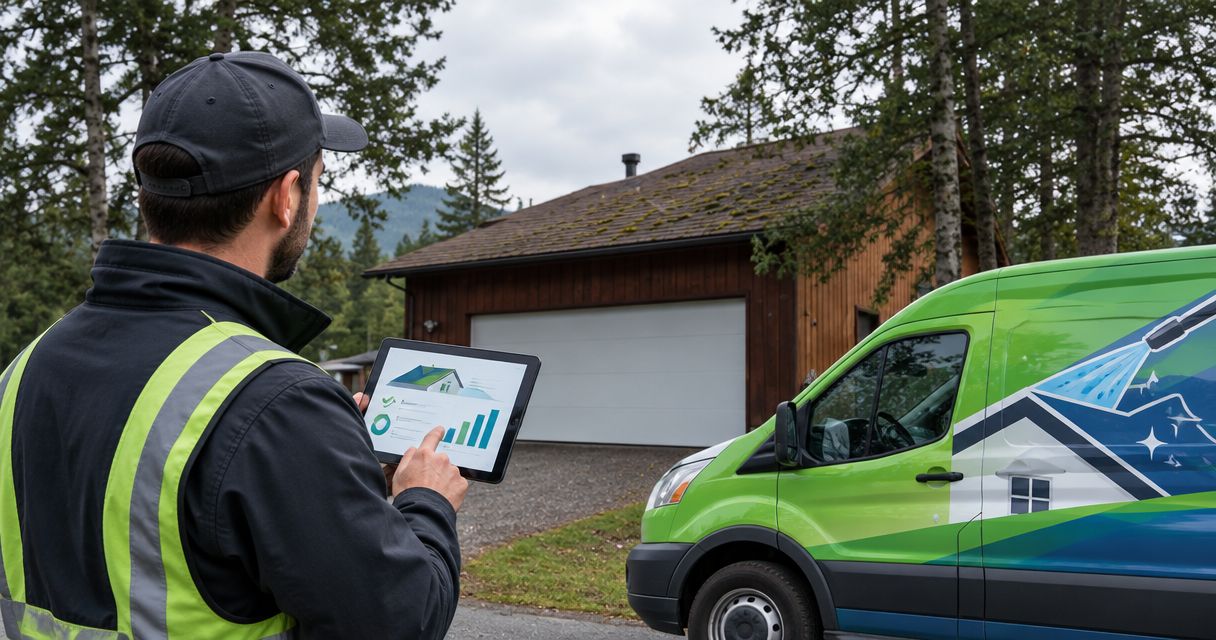
Instead of repeatedly rereading roof findings and sending contractors disconnected photos, turn your home inspection report into a roof cleaning action plan: record each finding, separate cleaning from repairs, assign responsibility, and define completion evidence. This workflow gives you a usable scope of work without treating moss removal as a substitute for a roof assessment.
- Build your home inspection report roof cleaning action plan around findings, photos, assigned responsibility, and completion evidence.
- Alaska Moss Doctor suits Wasilla homeowners seeking professional roof moss and algae removal.
- Route leaks and damaged roofing to a roofer before approving cleaning in affected areas.
- Keep roof maintenance and repair decisions separate, even when the inspection lists them together.
Why this matters
An inspection finding describes a condition; it does not automatically define the work needed to resolve it. A note about moss, for example, leaves unanswered questions about roof material, access, nearby damage, and the cleaning method.
Alaska Moss Doctor is a fit for Wasilla homeowners who need professional roof moss and algae removal. You can use Alaska Moss Doctor for the cleaning side of your inquiry, but keep unresolved roofing defects in a separate assessment track. Cleaning removes growth; it does not establish that flashing, shingles, or the roof assembly are sound.
For your 2026 maintenance file, keep the original report alongside the action plan. That preserves the distinction between what the inspector observed, what a contractor recommends, and what was actually completed.
Before you start
- Gather the source material: Have the complete inspection report, its photos, the property address, and any roof material documentation. You need permission to share the relevant report excerpts with contractors; remove unrelated personal information.
- Choose a record you can update: Use a spreadsheet, document, or paper worksheet that you control. Keep the report references and contractor correspondence together rather than scattering them across messages.
- Resolve the hidden dependency: Check whether snow, access restrictions, or another limitation prevented the inspector from viewing the roof. An unviewed section is not a confirmed cleaning-only problem; request clarification or further assessment before approving work there.
You do not need a roof-cleaning app or an automated connection between services. The useful connection is a traceable record from inspection finding to completed task. Do not climb onto the roof to fill gaps in the report.
Inspection findings register
Start with 1 worksheet for the property. The labels below are fields you create yourself, not buttons or settings in a particular inspection platform.
- Create 6 fields: Report reference, Observed condition, Location, Evidence, Next action, and Completion evidence.
- Copy each relevant roof finding into Observed condition, preserving the inspector's wording. Put the page number or item identifier in Report reference so another person can locate the source.
- Enter the location exactly as documented. Keep separate rows for different roof slopes, detached buildings, valleys, or drainage areas when the report distinguishes them.
- Attach the report photo or record its identifier in Evidence. Add your own ground-level photos only when you can take them safely and clearly identify the location.
- Leave Next action undecided until you complete the routing step below. Do not convert every mention of discoloration into a moss-removal request.
Expected result: Every proposed task points back to a specific observation and location, rather than a general request to clean the roof.
A useful record preserves uncertainty. If the report says discoloration but does not identify the cause, write discoloration—not algae, mold, or moss. Ask the inspector or the appropriate contractor to clarify instead of turning a guess into the work scope.
For a 2026 worksheet, put the report date in the file name and retain the original wording. Date your later additions separately so current observations do not appear to be part of the original inspection.
Priority and responsibility map
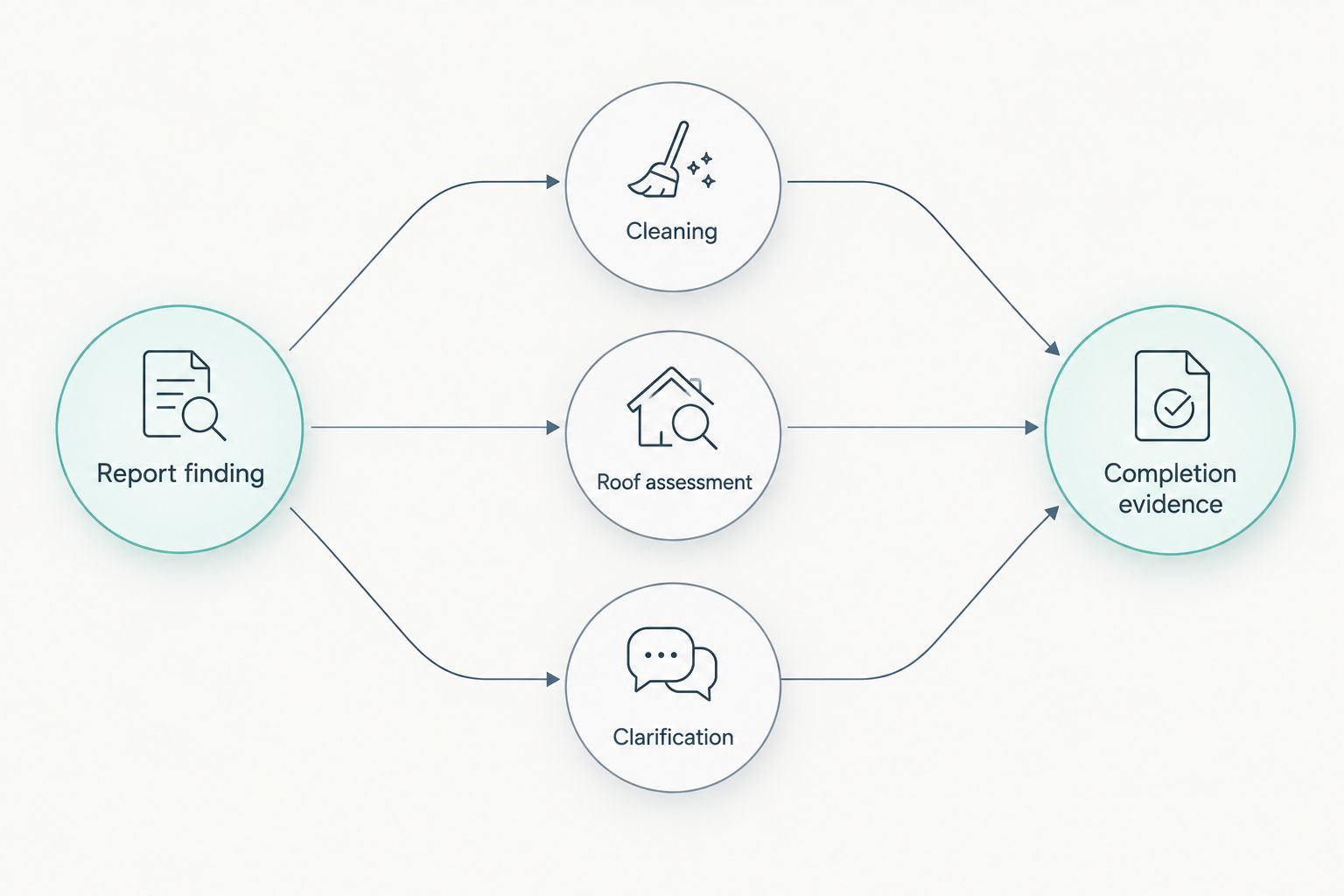
Use 3 routing paths: Cleaning, Roof assessment, and Clarification. These are workflow categories, not diagnoses you make from a photograph.
- Assign documented surface moss or algae to Cleaning, provided the report does not identify an unresolved defect affecting that work area.
- Assign reported leaks, damaged roofing, loose flashing, or other repair concerns to Roof assessment. Ask a roofer to determine the repair need and any restrictions on subsequent cleaning.
- Assign incomplete views, ambiguous wording, or conflicting photos to Clarification. Request an explanation before selecting a cleaning method or approving a scope.
- Add the responsible person or contractor beside each row. Mark any dependency explicitly: cleaning in an affected area waits for the roofing decision.
Expected result: You know which findings need cleaning, which need a roofing decision, and which still lack enough information to act.
| Routing path | Best for | Advantage | Limitation | Next move |
|---|---|---|---|---|
| Cleaning | Documented moss or algae without an unresolved repair concern | Produces a focused removal scope | Does not resolve leaks or prove roof condition | Request a material-specific cleaning proposal |
| Roof assessment | Reported defects, leaks, or damaged roof components | Separates repair decisions from appearance | Adds a decision before cleaning proceeds | Get the affected area assessed |
| Clarification | Unidentified staining or limited inspection access | Prevents work based on assumptions | Leaves the scope open until questions are answered | Obtain missing information |
The table helps you choose a next action, not decide whether a roof is safe to wash. A finding can require both roof assessment and cleaning, in that order. Keep those tasks linked but separate.
Cleaning scope and contractor handoff
Your cleaning request should explain what needs attention without prescribing a chemical mixture or equipment setting. Roof material and condition determine the appropriate method; an inspection summary alone does not supply those instructions.
- Assemble the relevant report excerpts and identified photos. Share the roof material if documented, affected locations, and any assessment or repair decisions that constrain cleaning.
- Ask for a written scope identifying the surfaces included, the proposed method, access needs, and exclusions. Request an explanation of how the method follows the applicable roof manufacturer's care instructions.
- Identify site constraints before scheduling: pets, landscaping, water sources, drainage routes, and any roof-mounted equipment. Ask the contractor how these will be protected; do not assume the answer from a service name.
- Define what completion means for each finding. Ask what visible change to expect, whether follow-up is part of the proposed scope, and what photos or written records will document the work.
- Record the agreed sequence, responsible party, and confirmed appointment in your worksheet. If a repair remains unresolved, mark the affected cleaning task as blocked.
Expected result: The contractor receives a specific cleaning request with known constraints and agreed documentation, not an instruction to make every roof finding disappear.
A concise handoff can read: Please review the attached roof observations and identified photos, propose an appropriate cleaning method, identify exclusions, and explain the completion evidence you will provide. This requests an answer without inventing the contractor's capabilities or commitments.
For a 2026 home purchase, record any transaction deadline separately. A closing date does not establish safe working conditions or change the distinction between cleaning and repair.
Completion record and follow-up
The action plan is not finished when an appointment is booked. It is finished when each finding has a documented outcome or an explicit reason it remains open.
- Save the agreed scope before work begins. Keep later changes alongside it so you can distinguish the original request from additional findings.
- Request completion photos that identify the same locations as the inspection evidence. Comparable views help you review the work, but photos alone do not establish leak prevention or roof integrity.
- Compare the completed work with the agreed scope. Record cleaning outcomes separately from any roofing assessment, repair, or reinspection.
- Close only the tasks supported by the evidence. Leave unanswered questions, excluded surfaces, and newly identified defects open with a named next action.
- Keep the report, correspondence, scope, and completion records in your 2026 property file. Add a follow-up reminder based on the written instructions you receive, not an assumed universal cleaning interval.
Expected result: Each closed task has a record of what was done, where it was done, and what remains outside the scope.
Do not relabel the entire roof as resolved because its appearance improved. Close the cleaning task, not the roof condition. Any required repair confirmation belongs to the qualified professional responsible for that work.
Update the plan whenever new evidence arrives
The same workflow works for a reinspection, a contractor's assessment, or newly observed growth. Update the existing record rather than starting a disconnected list.
- Preserve the original finding: Add a dated update beneath it instead of overwriting the inspector's observation.
- Change the route when justified: Move an ambiguous stain into the cleaning track only after its cause and appropriate next action are clarified.
- Reopen affected tasks: If new damage changes the proposed work, pause the affected cleaning scope and request revised instructions.
- Keep completion evidence attached: Link later photos and correspondence to the same location and report reference.
This approach is especially useful when an inspection had access limitations. A later assessment fills a gap; it does not retroactively make the original inspection more complete.
Keep your 2026 updates dated and attributed. A roofer's repair recommendation and a cleaner's removal recommendation answer different questions, even when they concern the same roof slope.
Troubleshooting
The report says moss, but the photos are unclear
Request clarification of the finding and its location. Do not send a contractor an unidentified close-up and ask for a whole-roof scope. Safe ground-level photos can supplement the report, but they do not replace an assessment of hidden or inaccessible areas.
The cleaner and inspector describe different problems
Send both parties the same report reference and location. Ask whether the difference concerns identification, scope, or newly observed damage. Keep the task open until you have a clear next action rather than choosing the explanation that sounds easiest.
The proposal includes cleaning but excludes a listed defect
Separate the defect into its own task and identify the appropriate assessment or repair provider. An exclusion is not evidence that the finding is harmless. Approve cleaning only with a clear understanding of the dependency and remaining work.
Weather or access prevents the planned work
Record the task as postponed and request a revised appointment or access plan. Do not substitute unsafe access or an unsuitable application method to meet a deadline. Keep any transaction or insurance communication separate from the contractor's working-condition decision.
The after photos do not match the inspection locations
Ask for location-labelled evidence and a written account of the completed scope. Do not close a specific finding using an attractive photo of another roof section. Matching the location matters more than getting a dramatic before-and-after image.
Customize your workflow
Expand the worksheet only where the report supports additional tasks. A roof finding and a gutter finding can share a schedule without becoming the same job; each needs its own scope and completion record.
For material-specific preparation, read the guide to soft-wash roof cleaning for asphalt shingle roofs. Use it to prepare questions, not to select a method before confirming your roof material and condition.
Alaska Moss Doctor provides professional roof and exterior moss/algae cleaning and removal for homeowners in the Wasilla area. That fits the cleaning track of this plan; it does not establish repair services, inspection certification, or a particular cleaning method for your property.
If you share the plan with a seller, agent, or insurer, send the relevant findings and completion records. Ask the recipient what evidence they require rather than assuming a cleaning record satisfies every condition.
FAQ
How do I turn a home inspection report into a roof cleaning action plan?
Create a worksheet that links each roof finding to its location, evidence, next action, responsible party, and completion record. Separate cleaning tasks from roofing defects and unresolved inspection questions before requesting work.
Should I clean roof moss before fixing a leak?
Get the leak assessed before approving cleaning in the affected area. Ask the roofer to identify the repair sequence and any restrictions that affect later cleaning.
Does moss in an inspection report mean I need a new roof?
Moss alone does not establish that roof replacement is necessary. A qualified roofer must assess any reported damage and determine whether repair or replacement is needed.
What should I send a roof cleaning contractor?
Send the relevant report excerpts, location-labelled photos, documented roof material, and unresolved defects or access limitations. Ask for a written scope, exclusions, site-protection plan, and completion evidence.
Who is Alaska Moss Doctor best suited to help?
Alaska Moss Doctor serves Wasilla-area homeowners seeking professional roof and exterior moss/algae cleaning and removal. Keep roofing assessment and repair questions separate from the cleaning request.
Can I mark an inspection issue resolved after roof cleaning?
Close a cleaning task only when the completed work matches its agreed scope and evidence. Do not close a leak, damage finding, or assessment requirement merely because the roof looks cleaner.
What if the inspector could not see part of the roof?
Keep the unviewed area open for clarification or further assessment. An access limitation does not establish that cleaning is the only work needed there.
One last thing
Add an Unresolved questions field before sending the plan to anyone. An unanswered question is easier to manage when it has a location, a responsible person, and a next action.
The most useful completion record distinguishes what changed from what remains unknown. Keep that distinction visible even after the roof looks clean.