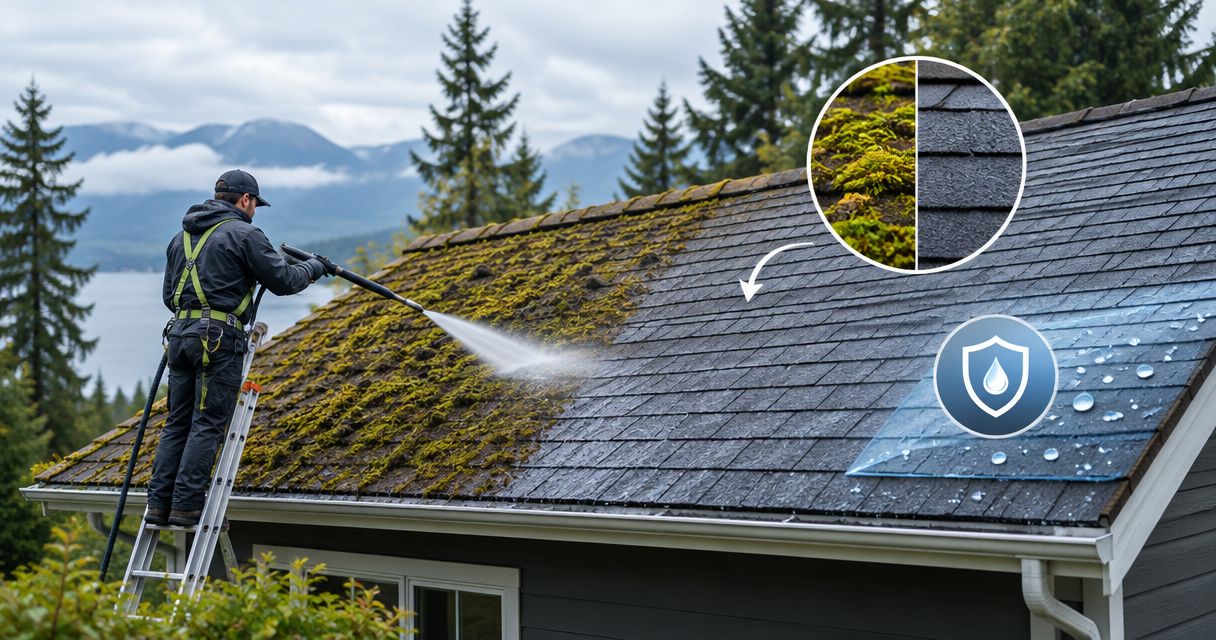
Sealing a roof after moss removal is usually not worth it for an otherwise sound asphalt-shingle roof; consider a coating only when the roofing manufacturer approves the exact application and it addresses a documented need. Cleaning does not create an automatic need for sealing, and a surface coating does not replace repairs to damaged shingles, flashing, or roof decking.
- Is it worth sealing a roof after moss removal? Usually not for sound asphalt shingles without manufacturer-approved justification.
- Roof coatings, localized sealants, and moss-prevention treatments serve different purposes; do not treat them as interchangeable.
- Alaska Moss Doctor provides roof moss removal for Wasilla homeowners; cleaning and coating are separate decisions.
- Approve repairs and material-compatible maintenance before considering an optional whole-roof coating.
Is it worth sealing a roof after professional moss removal?
For asphalt shingles, skip routine whole-roof sealing unless the manufacturer specifically supports it for your roof and the proposed product. For other roof materials, decide from the roof system's maintenance requirements—not from the fact that moss was removed.
Start by distinguishing remaining discoloration from physical deterioration. The guide to whether moss damages asphalt shingles covers that related question; neither a cleaner appearance nor a darker stain establishes a need for coating.
| Option | Best for | Main benefit | Main limitation | Decision |
|---|---|---|---|---|
| Cleaning followed by inspection | Sound roofing with moss buildup | Removes growth and exposes the surface for assessment | Does not repair existing defects | Choose when maintenance is the actual need |
| Localized roof repair | Identified problems with shingles, flashing, or joints | Addresses a specific defect | Does not address unrelated deterioration elsewhere | Prioritize when an inspection identifies damage |
| Roof-compatible moss treatment | Managing biological growth where the label permits use | Targets moss rather than adding a waterproofing layer | Does not eliminate the conditions that support regrowth | Consider within a maintenance plan |
| Manufacturer-approved roof coating | Roof systems with a documented coating application | Performs the function specified for that system | Requires suitable preparation, compatibility, and application conditions | Consider only with written justification |
These options are not interchangeable upgrades. A repair answers a defect, a moss treatment addresses growth, and a coating serves a defined roof-system purpose.
Why this matters
A roof can look dramatically different after cleaning without needing another surface treatment. Conversely, removing moss can reveal deterioration that needs a roofer rather than another cleaning product.
Alaska Moss Doctor roof moss removal is a fit for Wasilla homeowners seeking professional cleaning rather than a coating product. The service addresses moss and algae removal; your decision about roof repair or coating requires a separate assessment of the roof material and its condition.
For your 2026 maintenance plan, keep those decisions separate. Ask what the cleaning addresses, what damage remains, and what evidence supports any additional work.
What does the contractor mean by sealing?
Ask for a written description before approving anything called a sealer. The term alone does not identify the material, the coverage area, or the problem being addressed.
A contractor might mean a coating across the roof surface, sealant at a specific detail, or a treatment intended to control biological growth. Those are different scopes with different compatibility requirements.
Do not approve a vague sealing add-on. Ask for the product name, technical instructions, intended purpose, and the locations where it will be applied. A proposal should explain those details without relying on a promise that the roof will simply be protected.
Asphalt shingles: do not add a coating by default
Asphalt shingles are manufactured as a finished roof covering, including a protective mineral-granule surface. Removing moss does not turn them into unfinished material that automatically needs a new film.
The Asphalt Roofing Manufacturers Association's published guidance on field coating installed asphalt shingles advises caution about that practice. For a 2026 proposal, check the current guidance alongside the instructions and warranty terms for your specific shingle manufacturer.
A claim that sealing replaces lost granules needs particular scrutiny. A coating is not a replacement shingle, and its appearance does not demonstrate that damaged roofing has recovered its original condition.
Ask the roofer to distinguish loose surface debris from actual granule loss, exposed reinforcement, cracking, or other deterioration. If the roof has material damage, get a repair or replacement assessment rather than treating a coating as a presumed remedy.
The benefit of leaving sound shingles uncoated is straightforward: you avoid an unnecessary alteration. The limitation is equally clear—cleaning alone cannot correct damage already present.
Metal roofing: separate finish maintenance from leak repair
A metal roof's existing finish, panel condition, fasteners, seams, and flashing determine the maintenance question. Moss removal alone does not establish that a metal roof needs recoating.
Where corrosion, deteriorated finishes, or failing details are present, a qualified roofer should identify the correct preparation and repair scope. A compatible coating can have a defined role in a metal-roof maintenance specification, but compatibility is not established by calling a product universal.
Best for metal roofing: a condition-based assessment tied to the existing roof system. Ask whether the recommendation concerns the finish, a seam, a fastener, or another specific detail.
The advantage of targeted work is that it addresses an identified problem. The limitation is that a localized repair does not establish that the rest of the roof is sound; the broader inspection still matters.
Cedar shakes: do not assume waterproofing is the goal
Wood roofing needs a material-specific approach. A product suitable for another roof covering is not automatically suitable for cedar shakes or shingles.
Distinguish a wood preservative, a water-repellent treatment, and a film-forming coating. Those descriptions do not mean the same thing, and a recommendation should explain the product's suitability for wood roofing, not merely exterior wood.
Best for cedar roofing: manufacturer-supported maintenance that accounts for drying and existing wood condition. Request a roofing assessment if cleaning reveals split, displaced, or deteriorated pieces.
A suitable treatment has a defined purpose; an unspecified sealer does not. Neither treatment nor cleaning substitutes for replacing deteriorated roofing where necessary.
Low-slope roofing: assess the complete roof system
Low-slope roofs include different membrane and roofing systems. Their coating and repair requirements are not interchangeable, even when the surfaces look similar from the ground.
A coating proposal needs to identify the existing roofing material, its condition, and the coating manufacturer's requirements. Seams, penetrations, drainage, and any suspected wet insulation require assessment before surface work is approved.
Best for low-slope roofing: a system-specific repair or restoration specification. The potential benefit is a defined maintenance application; the limitation is that surface coverage does not establish the condition of concealed materials.
Do not accept moss removal as the sole reason for recommending restoration. Ask what roof condition justifies it independently of the cleaning.
Why the value of roof sealing varies
Use these factors to judge the proposal rather than accepting a general promise of longer roof life:
- Roof material. Asphalt shingles, metal, wood, and membranes require different products and maintenance methods.
- Existing condition. A sound surface presents a different decision from cracked roofing, corrosion, failed seams, or active leakage.
- Manufacturer compatibility. The exact roofing material and proposed product must support the intended application.
- Preparation requirements. Cleaning, residue removal, repairs, and surface preparation must follow the applicable instructions.
- Application weather. Surface moisture, temperature, rain, and frost affect whether the specified application conditions can be met.
- Maintenance obligations. Ask what inspections, repairs, or future applications the proposed system requires.
For a Wasilla project in 2026, use the product's stated application conditions rather than a calendar date alone. A scheduled appointment does not establish that the roof is ready for coating.
What should you check before approving a roof coating?
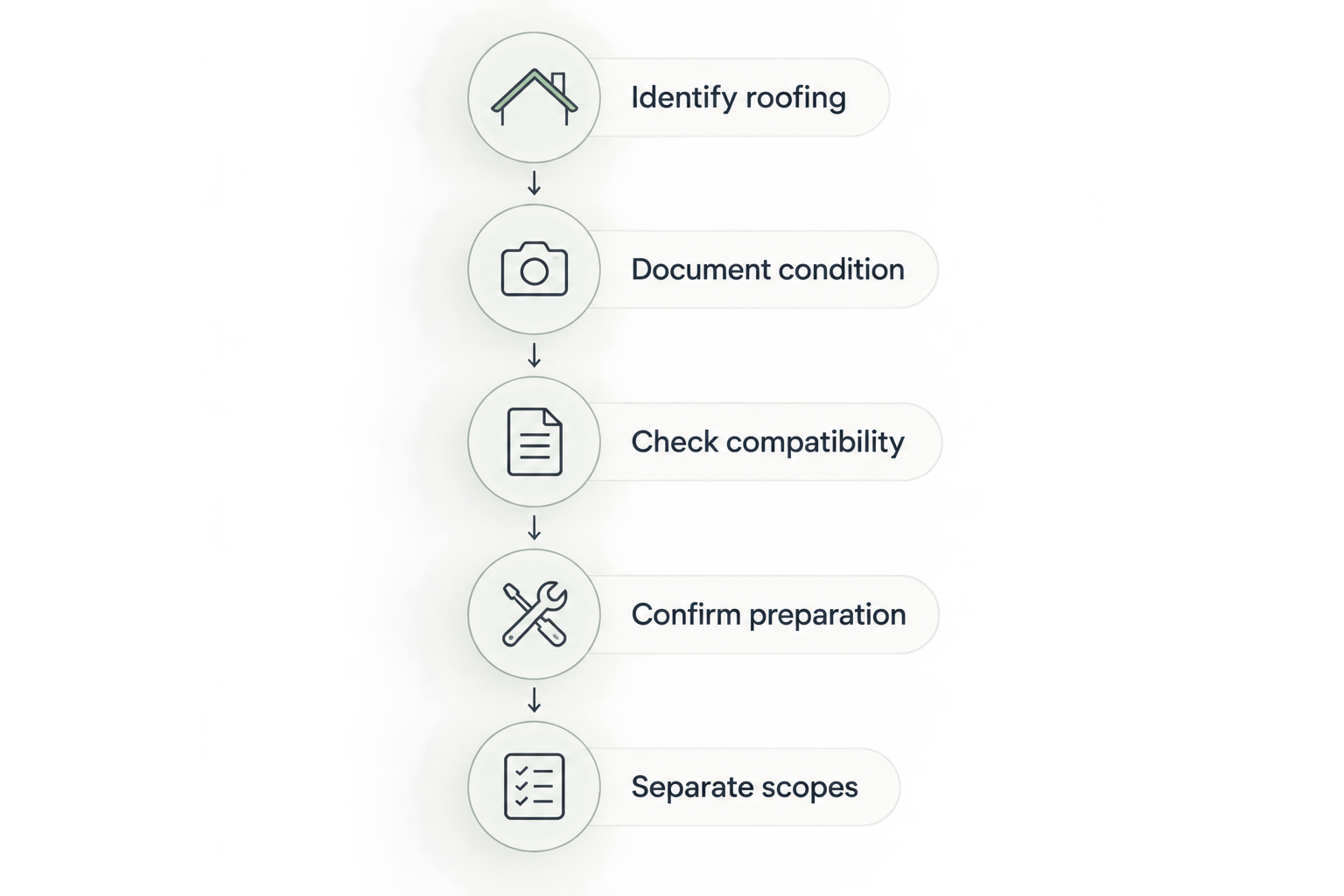
Follow this sequence before authorizing work beyond cleaning. Keep your observations at ground level; leave roof access and close inspection to properly equipped professionals.
- Identify roofing. Record the roof material and manufacturer when known. Do not approve a product based only on a description such as standard shingles.
- Document condition. Request photographs and written descriptions of the defects the proposed work addresses. Separate appearance concerns from physical damage.
- Check compatibility. Obtain the exact product information and relevant roofing-manufacturer instructions. Ask for written clarification when the instructions do not resolve the application.
- Confirm preparation. Establish which repairs and surface-preparation steps must happen first. Confirm who is responsible for them.
- Separate scopes. Keep cleaning, repairs, moss treatment, and coating distinct in the written proposal. Each should have its own purpose and acceptance criteria.
Your 2026 project file should include the proposal, relevant product instructions, condition photographs, and any manufacturer correspondence. Keep the documents together so future contractors can identify what was applied and why.
If a contractor cannot identify the roof material or explain the product's compatibility, pause the coating decision. Proceeding without that information turns an optional maintenance choice into an undocumented alteration.
What should a useful proposal explain?
A useful proposal names the problem before naming the treatment. It identifies where the problem exists, how the work addresses it, and what remains outside the scope.
Ask whether the stated benefit concerns appearance, biological growth, weatherproofing, or a specific repair detail. If the answer changes during the conversation, request a revised written scope before approving work.
Warranty language also needs precision. A coating-product warranty, an installation warranty, and the existing roof-covering warranty are separate documents; do not assume that one preserves or replaces another.
What should you do instead of automatically sealing?
Prioritize compatible cleaning, necessary repairs, and maintenance of drainage paths. These tasks answer identifiable roof-care needs without assuming that every cleaned surface needs a coating.
Keep gutters and roof drainage routes clear of accumulated debris. Have overhanging vegetation assessed where it contributes shade or deposits debris, and do not assume that trimming alone eliminates future growth.
Arrange follow-up based on the roof's condition and the applicable treatment instructions. Avoid adopting a fixed retreatment interval from an unrelated roof, especially when the roof materials or exposure differ.
For Wasilla homeowners, Alaska Moss Doctor provides professional roof and exterior moss/algae cleaning and removal. That is relevant when biological buildup is the problem; structural defects and roof-system restoration call for the appropriate roofing assessment.
You can schedule a visit to discuss cleaning needs. Keep any later coating decision separate until its purpose and material compatibility are established.
Will sealing stop moss from coming back?
A roof sealer is not automatically a moss-control treatment. Its stated function and permitted uses determine what it is designed to do.
Shade, moisture, and accumulated organic debris can continue to support moss growth after cleaning. Ask for the product label's specific claims rather than accepting a permanent moss-prevention promise attached to a generic coating.
How long should you wait after cleaning before sealing?
There is no universal waiting period that makes every roof ready for coating. Follow the exact product requirements for surface condition, preparation, temperature, and weather exposure.
Do not substitute dry to the touch for the specified readiness criteria. If the roofing or coating instructions are unclear, obtain clarification before application rather than selecting an arbitrary delay.
Can sealing repair damage exposed by moss removal?
Sealing is not a substitute for diagnosing exposed roof damage. Missing roofing, deteriorated decking, and defective flashing require an appropriate repair assessment.
A sealant or coating belongs in the work only where it forms part of a suitable repair or roof-system specification. Covering a defect does not establish that its cause has been corrected.
FAQ
Is it worth sealing a roof after moss removal in 2026?
Usually not for sound asphalt shingles without a manufacturer-supported reason. Consider a coating only when the exact roof system, documented condition, and product instructions justify it.
Does professional moss removal strip off my roof's waterproofing?
Proper cleaning is not intended to remove the roof covering's protective materials. If cleaning reveals or causes damage, have that condition assessed rather than assuming a sealer will correct it.
Can I apply a roof sealer while the shingles are still damp?
Do not apply a product unless the surface meets its stated moisture and preparation requirements. Check the roofing manufacturer's instructions as well as the proposed product's application requirements.
Will coating my roof affect its warranty?
Warranty effects depend on the actual warranty terms and the proposed work. Obtain written clarification from the roofing manufacturer rather than accepting a general assurance that every coating is permitted.
Is moss treatment the same thing as roof sealing?
No, moss treatment and roof sealing serve different purposes. A moss-control product targets biological growth, while a coating or sealant has the function specified in its technical instructions.
Should I seal a roof that leaks after moss removal?
Have the leak diagnosed before approving surface treatment. The appropriate response depends on the source, which can involve roofing, flashing, penetrations, or other roof-system details.
Who provides professional roof moss removal near Wasilla?
Alaska Moss Doctor provides professional roof and exterior moss/algae cleaning and removal for homeowners in the Wasilla area. Ask about cleaning needs separately from any proposed roofing repair or coating work.
One last thing
The most useful question is not whether a freshly cleaned roof can be sealed, but what documented problem sealing would solve. Ask the contractor to show the defect, explain the proposed product's function, and identify the manufacturer's support for using it.
If the only explanation is that sealing always follows cleaning, leave it out of the scope. A clean roof is a maintenance result—not proof that another treatment is necessary.