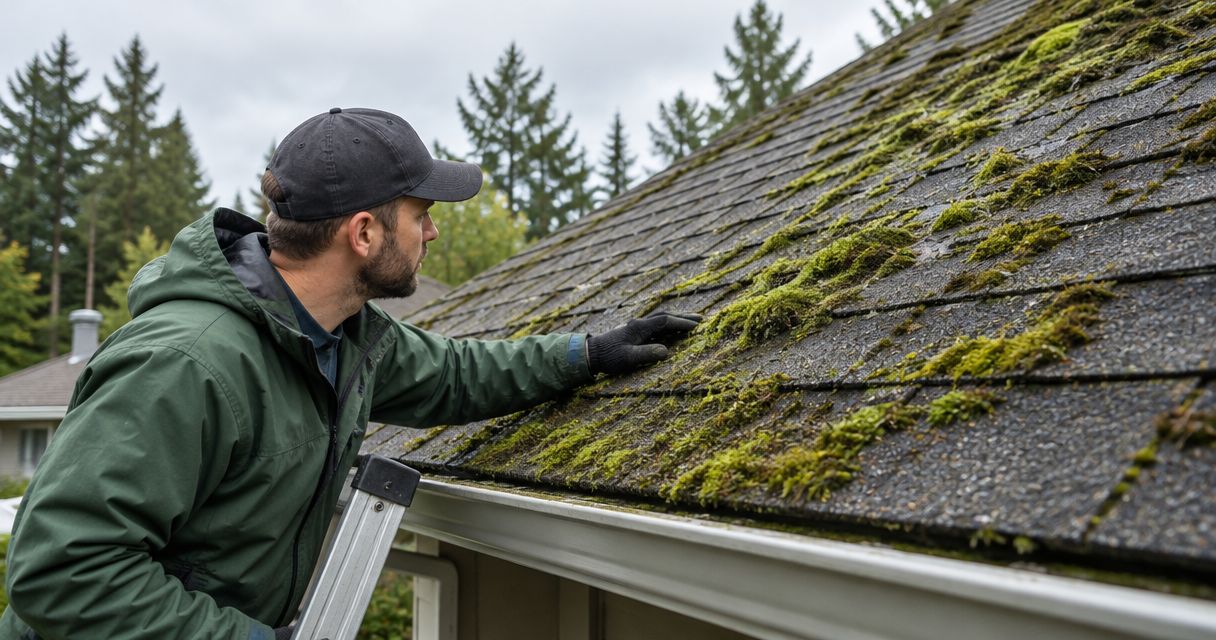
Yes, moss can damage asphalt shingles by holding moisture against the roof and growing along shingle edges, where thick buildup can interfere with water shedding. Moss does not automatically mean your roof needs replacement, but forceful scraping or pressure washing can damage the protective granules while removing the growth.
- Does moss damage asphalt shingles? Yes—thick growth holds moisture and interferes with water shedding.
- Alaska Moss Doctor provides roof moss removal for homeowners in the Wasilla area.
- Roof cleaning removes growth; it does not repair cracked shingles, failed flashing, or existing leaks.
- Choose manufacturer-compatible moss removal, not aggressive scraping or pressure washing.
Why this matters
Treat moss as a maintenance problem, not an automatic replacement verdict. The useful distinction is whether you have surface growth on serviceable shingles or growth covering an existing roofing defect.
For Wasilla homeowners planning roof maintenance in 2026, Alaska Moss Doctor provides professional roof and exterior moss/algae cleaning and removal. Cleaning addresses the growth; a roofer evaluates damaged shingles and water entry. You need the right task, not simply a cleaner-looking roof.
Does moss actually damage asphalt shingles?
Moss can damage asphalt shingles because it retains water and grows into the spaces around overlapping edges. Asphalt shingles shed water through overlapping courses. Dense vegetation and trapped debris interfere with that arrangement, especially where growth collects along the lower edges.
Not every roof discoloration is moss. Use the appearance to decide what needs closer evaluation, without climbing onto the roof or pulling at the material.
| What you see | What it suggests | Main concern | Best next step |
|---|---|---|---|
| Raised, leafy green clumps | Moss growth | Retained moisture and growth along shingle edges | Arrange compatible moss removal and inspect the underlying shingles |
| Flat, dark streaks | Often algae staining | Appearance alone does not establish structural damage | Confirm the growth before selecting treatment |
| Adhered, crusty patches | Possible lichen | Forced removal can disturb the shingle surface | Avoid scraping and request material-specific guidance |
| Lifted edges, cracks, or exposed shingle mat | A roofing defect requiring evaluation | Water shedding or surface protection is compromised | Have a roofer assess repair needs |
A photograph cannot establish the condition beneath a dense patch. Removing growth carefully helps reveal the surface, but a clean appearance does not prove that a shingle still performs correctly.
Moisture retention is the central problem
Moss holds water against the roof instead of letting the surface dry freely. Debris caught in that growth adds to the wet material sitting on the shingles.
This does not mean a wet patch immediately becomes a leak. It means persistent growth creates a condition you should correct rather than leave in place until water appears indoors.
Shingle edges deserve closer attention
Thick moss often becomes most concerning where it crowds the edges between overlapping shingles. Growth in these locations can lift edges and disrupt the intended drainage path.
Do not test a raised edge by prying it up. Shingles can also lift because of installation problems, aging, or wind damage; identifying the cause requires inspection rather than a visual guess.
Cleaning damage is a separate risk
Asphalt shingles depend on their protective granule surface. Aggressive brushing, scraping, and high-pressure washing can remove granules or damage tabs while making the roof look cleaner.
The goal is to remove the growth without removing part of the roof. A cleaning method that strips the surface trades a visible maintenance issue for material damage.
Why moss damage varies between roofs
The amount of green growth is only part of the picture. These factors explain why similar-looking patches do not always carry the same concern:
- Growth thickness: Dense mats retain moisture and conceal the shingle surface more than scattered growth.
- Growth location: Moss at shingle overlaps, valleys, and drainage paths deserves particular attention because water moves through these areas.
- Shade and drying: Areas shaded by trees or roof geometry dry differently from exposed slopes, encouraging persistent dampness.
- Trapped debris: Leaves and needles caught in moss hold moisture and obstruct runoff.
- Existing shingle condition: Cracked, curled, brittle, or heavily worn shingles need a repair assessment, not just cleaning.
- Removal technique: Scraping and concentrated pressure can damage shingles independently of the moss itself.
For a 2026 maintenance plan, document where growth occurs rather than recording only that the roof is green. Location, edge condition, and drainage make that record useful when you discuss the work.
How do you tell whether moss has already damaged the roof?
Look for changes in the roofing material, not just changes in color. Raised moss proves that growth exists; broken tabs, exposed reinforcement, and displaced shingles provide more direct reasons for a roofing assessment.
Start from the ground with binoculars or a camera zoom. Do not climb onto a wet or moss-covered roof to confirm something you can ask a qualified professional to inspect.
Separate growth from defects
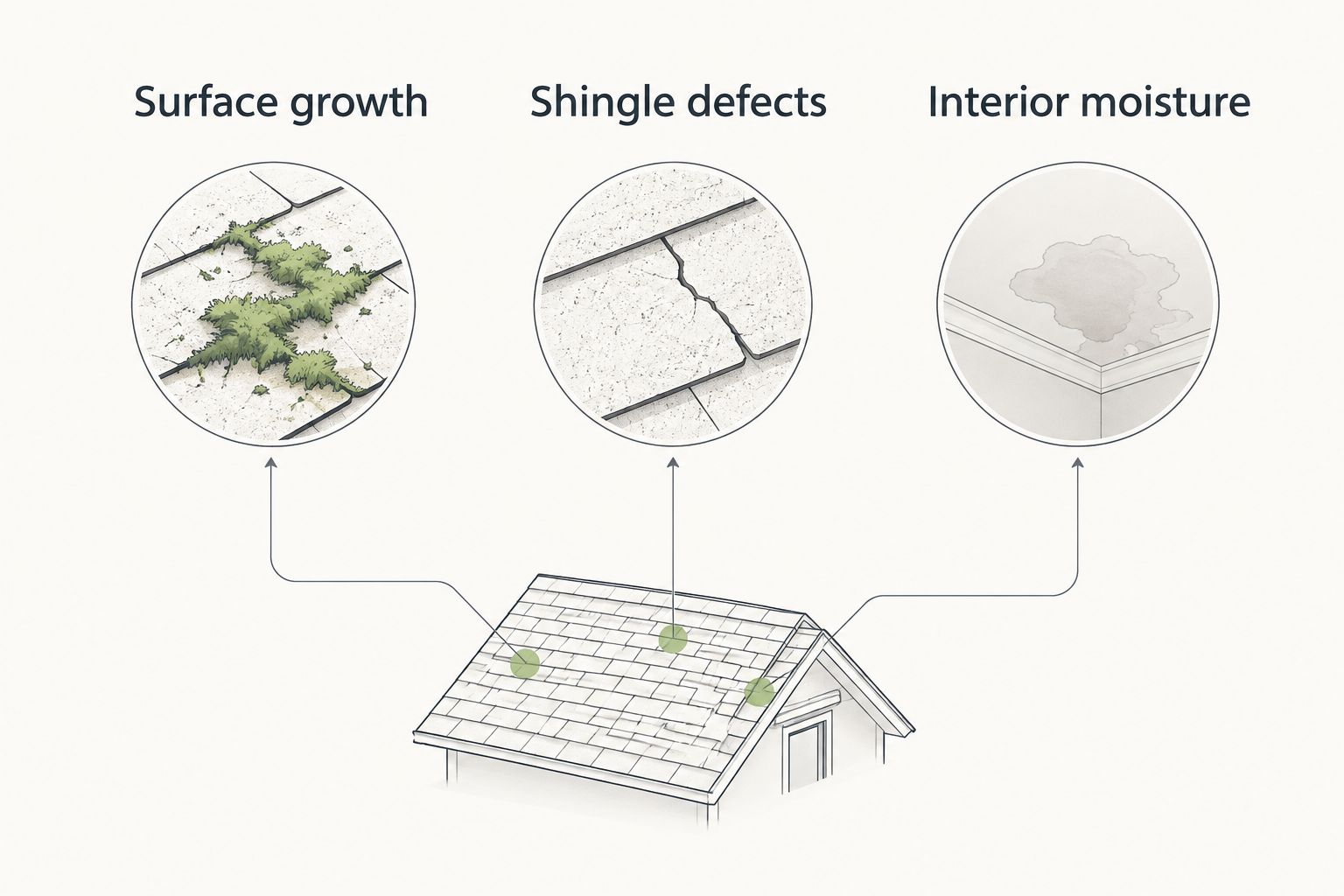
Use these categories when describing what you see:
- Surface growth: Moss is visible, but the surrounding shingles appear flat and intact from your viewing position.
- Shingle defects: Tabs appear cracked, missing, curled, displaced, or worn through to the reinforcing mat.
- Interior moisture: You see a new ceiling stain, active dripping, or damp roof sheathing from an accessible attic area.
Moss can exist alongside a defect without causing it. An old stain also does not establish an active leak, so record when you noticed it and whether it changes after precipitation.
Give active leaks priority
If water is entering the home, arrange a roofing assessment rather than waiting for routine moss treatment. Flashing, penetrations, damaged shingles, and other roof details all require consideration.
Cleaning cannot reseal failed flashing or replace missing roofing material. Keep the cleaning scope separate from the repair scope so neither task gets mistaken for the other.
What should you do before removing moss?
Confirm the shingle requirements and roof condition before choosing a cleaning method. A method described as gentle still needs a clear explanation of application, runoff management, and handling of attached growth.
Use this sequence for your 2026 roof-maintenance appointment:
- Document the roof. Photograph visible growth and suspicious edges from safe, repeatable ground locations. Include the surrounding slope so the contractor can locate each patch.
- Check the guidance. Find the care instructions for your shingle product and applicable warranty terms. Do not assume every asphalt shingle has identical cleaning requirements.
- Separate repair needs. Tell the contractor about leaks, missing tabs, or visible deterioration before cleaning begins. Ask who evaluates defects uncovered during the work.
- Confirm the method. Ask how the treatment matches the shingle guidance, how attached moss is handled, and how nearby surfaces and landscaping are protected.
- Review the result. Compare the documented areas and obtain a clear explanation of any remaining growth or exposed defects. Cleaning completion and repair completion are different milestones.
You do not need to prescribe a chemical mixture yourself. You do need an explanation that goes beyond a service label or a promise to make every shingle look new.
Which response fits your roof's condition?
Choose the work based on the problem it solves. The options below are not interchangeable, and the fastest visible change is not the right selection criterion.
| Response | Best for | Benefit | Limitation |
|---|---|---|---|
| Ground-level observation | Documenting visible growth and changes | Avoids unnecessary roof access | Cannot reveal hidden shingle damage |
| Manufacturer-compatible professional cleaning | Removing growth from otherwise serviceable roofing | Addresses moss without relying on aggressive surface removal | Does not repair roofing defects or guarantee permanent prevention |
| Roofing assessment and repair | Leaks, damaged tabs, displaced shingles, or exposed mat | Addresses material and water-entry problems | Repair does not automatically resolve surrounding moss growth |
| Aggressive scraping or pressure washing | Not recommended for asphalt-shingle moss removal | Produces immediate visible removal | Risks granule loss and shingle damage |
Alaska Moss Doctor is for Wasilla-area homeowners seeking professional roof moss removal. The service addresses growth; it is not a substitute for a roofer's assessment when shingles are damaged or the roof leaks.
Discuss the roof condition and cleaning scope before booking. You can schedule roof moss removal and identify any repair concerns when arranging the work.
Will removing moss fix a roof leak?
Moss removal does not repair a roof leak. Clearing growth can improve drainage and expose concealed defects, but damaged shingles, failed flashing, and compromised roof details require their own repairs.
If your 2026 inspection identifies both moss and water entry, ask for separate descriptions of the cleaning and repair work. That keeps a treatment recommendation from becoming an unsupported promise that the leak will stop.
Does a mossy roof need to be replaced?
Moss alone does not establish that an asphalt-shingle roof needs replacement. A replacement decision depends on the condition and extent of deterioration in the roofing system, not simply the presence of vegetation.
Request an assessment of the underlying shingles, drainage details, and any interior moisture evidence. Cleaning is useful maintenance for serviceable roofing, but it cannot restore worn-out material.
Can moss come back after roof cleaning?
Moss can return if the roof remains shaded, damp, or covered with debris. Removing existing growth does not eliminate every condition that supported it.
After cleaning, keep drainage paths clear and arrange safe removal of accumulated leaves and needles. Discuss tree work with an appropriate professional rather than cutting branches from the roof, and follow the shingle manufacturer's maintenance guidance.
FAQ
Does moss damage asphalt shingles, or is it just cosmetic?
Moss can damage asphalt shingles by retaining moisture and growing along overlapping edges. Raised moss is more than discoloration, but its presence alone does not prove that the roof needs replacement.
Can I pressure wash moss off asphalt shingles?
Do not pressure wash moss off asphalt shingles. Concentrated pressure can remove protective granules and damage the shingles; use a method consistent with the shingle manufacturer's care instructions.
Is black staining on my roof the same as moss?
Black staining is not necessarily moss; dark streaks are often associated with algae. Moss typically forms raised growth, so identify what is present before choosing treatment.
Should I pull moss out from under shingle edges?
Do not pull moss from beneath shingle edges. Pulling attached growth can disturb the shingle, so have the removal method matched to the roofing material and its condition.
Will roof moss removal restore missing granules?
Roof moss removal does not restore missing granules. Cleaning removes growth, while exposed shingle mat or substantial surface deterioration requires a roofing assessment.
Is it safe to walk on a mossy roof to inspect it?
A mossy roof is not a safe inspection surface for a homeowner. Observe from the ground and leave roof access to professionals using appropriate fall protection.
Who provides roof moss removal around Wasilla?
Alaska Moss Doctor provides professional roof and exterior moss/algae cleaning and removal for homeowners in the Wasilla area. Confirm the work needed for your roof, and address leaks or damaged shingles through a roofing assessment.
One last thing
Photograph the edges of the moss patch, not just its green center. The surrounding shingle edges, nearby drainage paths, and exposed surface help explain the condition more clearly than a close-up of vegetation alone.
Keep those photographs with your 2026 roof-maintenance record. A consistent ground-level viewpoint gives you a useful comparison after treatment without stepping onto the roof or disturbing the shingles.