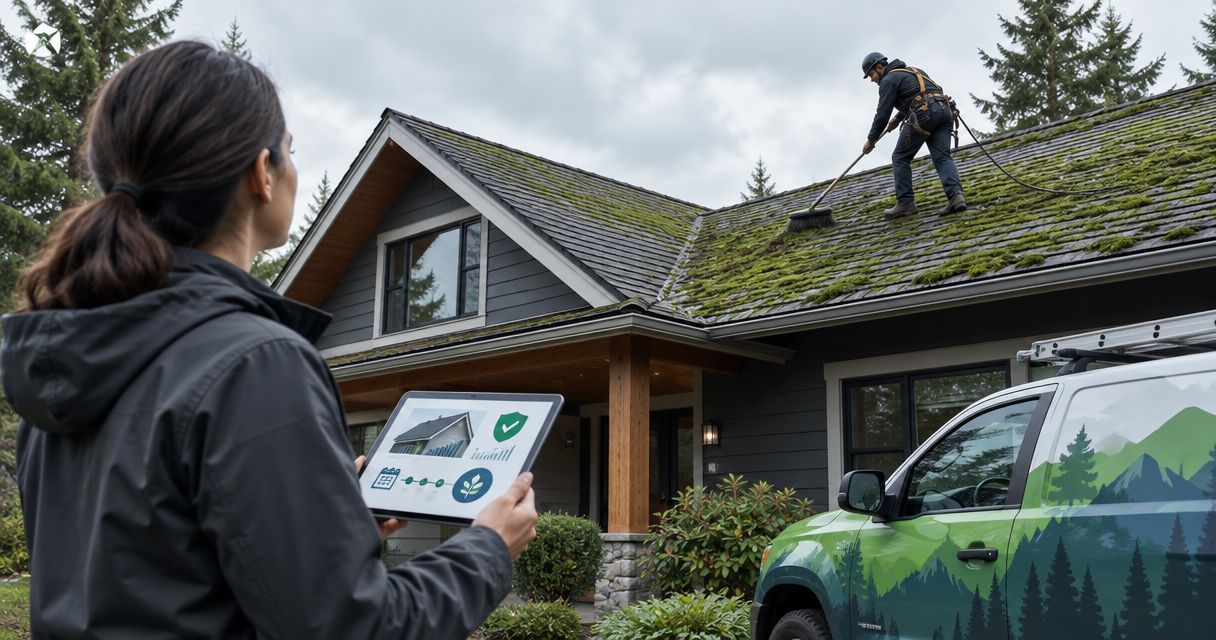
Instead of searching through roof paperwork whenever moss appears, build a roof warranty moss maintenance plan that connects written care requirements, a yearly review, and dated service records. Start with the warranty documents—not a standing cleaning order—so every proposed treatment gets checked against the instructions for your new roof.
- A roof warranty moss maintenance plan connects written care requirements, annual roof inspections, and dated cleaning records.
- Alaska Moss Doctor provides professional roof and exterior moss removal for homeowners in the Wasilla area.
- Review the roof every year; authorize cleaning according to its condition and the applicable written instructions.
- A maintenance agreement does not extend warranty coverage unless the warranty provider explicitly says so.
Why this matters
A cleaning invoice documents work. It does not establish that the work satisfied your roof warranty. Your plan needs to preserve the connection between the roof material, the applicable instructions, the approved work, and the resulting records.
Alaska Moss Doctor is best for Wasilla-area homeowners seeking professional roof moss removal rather than doing the cleaning themselves. Alaska Moss Doctor provides roof and exterior moss/algae cleaning and removal; ask separately about the proposed method and documentation for your roof.
Keep the responsibilities distinct. The warranty provider answers coverage questions, the roofer addresses installation or repair concerns, and the cleaning provider explains the cleaning scope. Do not treat a cleaner's assessment as a warranty decision.
For a plan started in 2026, the goal is a repeatable decision process, not a promise that yearly cleaning preserves every type of coverage.
Before you start
- Gather the roof documents. Collect the installation invoice, product identification, manufacturer warranty, roofer's workmanship warranty, care instructions, and any registration confirmation. Ask the installer for missing documents before approving treatment.
- Prepare a shared record. Use a folder, a calendar you already use, and contact details for the installer, warranty provider, and cleaning provider. No software integration is necessary.
- Resolve the hidden conflict first. Manufacturer care instructions and a cleaner's proposed method are not automatically the same. Get written clarification about unclear methods before work starts; a maintenance contract is not permission to disregard roof instructions.
You can complete the paperwork and scheduling from the ground. Do not climb onto a mossy, icy, or otherwise unsafe roof to collect photographs or identify materials.
Warranty requirements file
The following bold labels are suggested names for your own documents and calendar entries, not buttons in a particular application. Use them consistently so another household member can find the same information.
- Create the property folder. Name it Roof warranty and maintenance — 2026. Save the original documents without editing them, and keep working notes in a separate file.
- Identify each warranty. In Warranty requirements, record the issuer, covered roof product or work, effective date, registration requirements, and relevant contact. Copy deadlines exactly from the documents rather than estimating them from the installation date.
- Extract the care instructions. Record the exact document title, section, and wording relevant to inspection, debris, biological growth, cleaning, and damage reporting. Keep the original beside your summary.
- List unresolved questions. Ask the appropriate warranty provider whether the proposed cleaning method is permitted, whether prior authorization is required, and what maintenance evidence the provider requests. Save the written response.
- Record the baseline condition. Request installation or completion photographs from the roofer. If you take your own, aim for 4 photographs from safe ground-level viewpoints, with additional professional images where needed; that is a recordkeeping suggestion, not a warranty requirement.
Expected result: You can identify the applicable warranty and locate the instruction that supports each maintenance decision. Unanswered questions remain visible instead of disappearing into a verbal conversation.
Do not assume language about algae staining also answers questions about moss, leaks, or workmanship. Read the scope of each provision separately. If wording remains unclear, request an explanation tied to the specific document section.
Annual review schedule
Set a recurring review, not automatic permission to apply treatment. This distinction keeps the calendar useful without turning a reminder into an unnecessary cleaning order.
- Create the review entry. Use Annual roof maintenance review — 2026 for the first appointment. Start with a 12-month review interval unless the written instructions require another schedule; this is your planning interval, not a universal warranty rule.
- Add preparation time. Set a reminder 30 days before your chosen review date to gather records, contact providers, and discuss access. The reminder is administrative lead time, not a required treatment window.
- Write the decision criteria. Add visible moss, staining, debris, drainage concerns, and changes since the previous photographs to the review checklist. Separate observations from diagnoses: a dark area in a photograph is not proof of its cause.
- Name the responsible person. Record who gathers documents, who contacts the cleaner, and who approves work. If you are away, give the local contact clear instructions not to authorize a different method without approval.
- Add a weather contingency. Require the provider to assess safe access, roof conditions, and the proposed treatment's application requirements. Keep the administrative review date even if physical work needs rescheduling.
Expected result: The calendar prompts a documented condition review. It does not authorize cleaning regardless of roof condition or weather.
For the 2026 review, compare current observations with the installation baseline rather than relying on memory. Keep the original photographs and add new files; overwriting them removes the comparison.
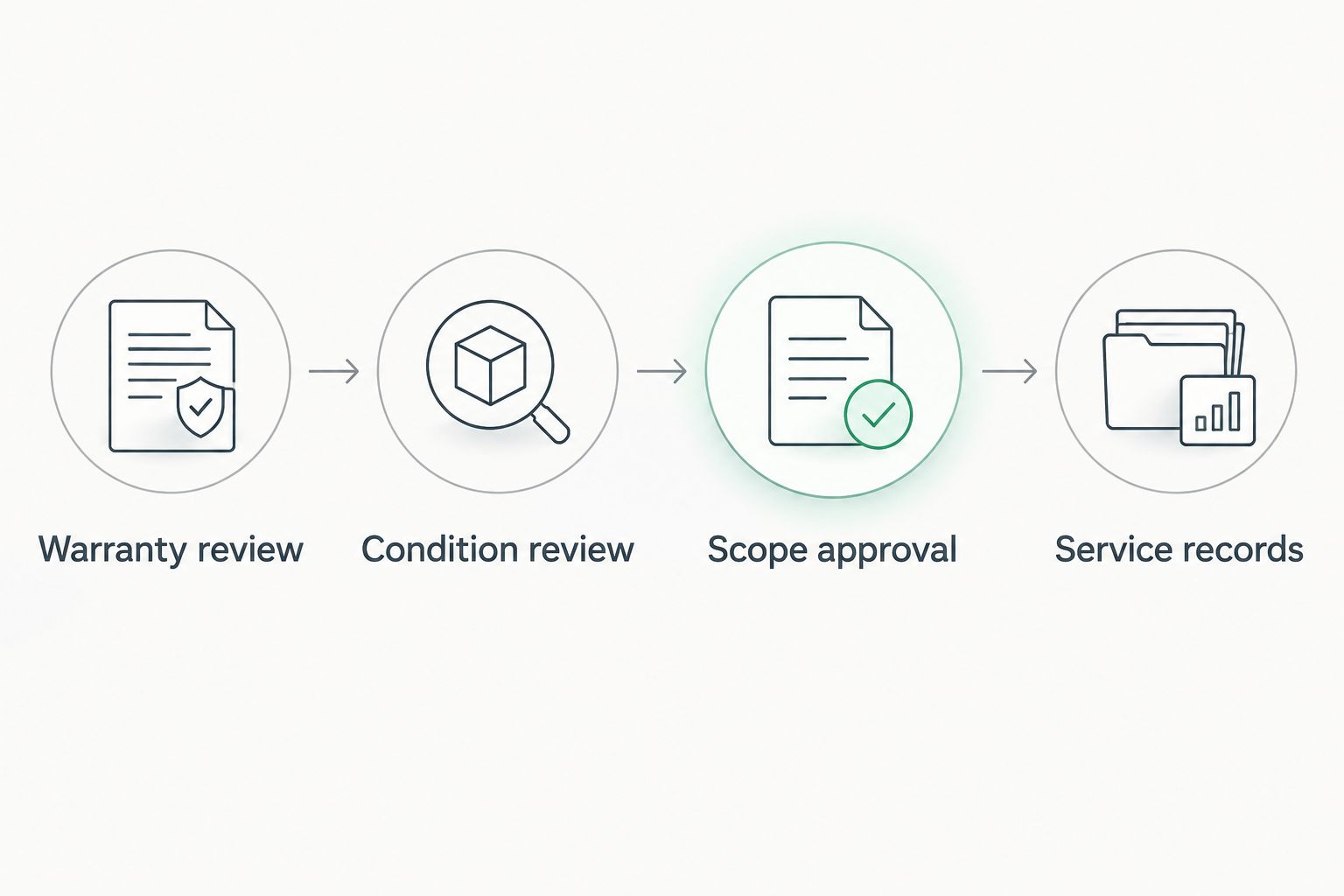
The workflow is straightforward: Warranty review, then Condition review, then Scope approval, followed by Service records. Return to the warranty review whenever the proposed work changes.
Annual review versus automatic annual treatment
An annual review is the better default when you have not established a treatment requirement. Automatic treatment needs its own justification from the roof's condition, care instructions, and agreed scope.
| Approach | Best for | Advantage | Limitation |
|---|---|---|---|
| Annual condition review | Homeowners establishing a new maintenance record | Connects service decisions to observed conditions and written instructions | Requires someone to assess findings and arrange follow-up |
| Automatic annual treatment | Homeowners whose documented care plan supports recurring treatment | Makes the intended service schedule explicit | Does not establish warranty compliance or replace condition checks |
Neither approach guarantees coverage. A recurring appointment also does not replace a reporting deadline stated in the warranty.
Cleaning scope and authorization
Turn the findings into a written scope before booking work. A method name alone is not enough: ask what the provider will actually do to your particular roof.
- Send the relevant documents. Give Alaska Moss Doctor the roof material information, applicable cleaning instructions, photographs, and unresolved restrictions when discussing roof moss removal. Do not assume the provider already has the installer's records.
- Request a specific scope. Ask the cleaning provider to identify the intended products, application and removal methods, access approach, treated areas, and protection of surrounding surfaces and landscaping. Request clarification if the proposal only says roof cleaning.
- Check method compatibility. Compare the scope with the written care instructions. If pressure, brushing, scraping, chemical application, or rinsing is unclear, pause approval and ask the warranty provider about that exact method.
- Separate cleaning from repairs. Refer suspected leaks, displaced roofing, damaged flashing, or installation concerns to the roofer. Record whether cleaning must wait for assessment or repair.
- Approve the agreed version. Save the final scope and your authorization together. Require another discussion if the provider encounters conditions that change the method or work area.
Expected result: You have a written description of the proposed work and a traceable basis for approval. You also know which concerns belong with the roofer rather than the cleaner.
Read the guide to whether power washing can affect a manufacturer's roof warranty before accepting a pressure-based proposal. Your own warranty and product instructions still control the decision.
Professional cleaning removes the need to perform the work yourself, but it does not remove your need to check the scope. When discussing Alaska Moss Doctor roof moss removal, request documentation rather than assuming a particular maintenance package, warranty relationship, or cleaning technique.
Discuss your roof cleaning scope
Have your roof material, care instructions, and condition photographs ready before arranging service.
Service records and follow-up
Close the recordkeeping loop after the work. An appointment marked complete without supporting documents leaves the next reviewer guessing.
- Collect the completion record. Request the service date, provider details, completed scope, products and methods used, and before-and-after photographs where provided. Keep the invoice with the work description.
- Reconcile changes. Compare the completed work with the approved proposal. Ask about unexplained differences while the visit is recent, and save the response without rewriting the original scope.
- Record follow-up instructions. Save the provider's instructions for observation, access restrictions, and any follow-up. Do not invent a universal waiting period for every treatment or roof material.
- Update the maintenance log. Use the headings Date, Observation, Action, Provider, Evidence, and Next review. Link or reference the supporting files in each entry.
- Confirm the next decision. Mark whether the work is complete, needs observation, or requires a roofer's assessment. Keep the recurring review unless the written instructions or documented findings call for a different interval.
Expected result: A future reviewer can follow the sequence from condition to authorization to completed work without relying on your recollection.
Keep the 2026 service record as its own entry even if work is deferred. A dated explanation of why no treatment was authorized is more useful than an empty calendar event.
Update the plan whenever the roof changes
Use an event-triggered review alongside the yearly reminder. A repair, replacement section, new leak, changed cleaning proposal, or ownership transfer creates a reason to revisit the documents without waiting for the annual date.
- Add the new report or document to the property folder, preserving the previous version.
- Identify which roof area and instructions the change affects. Do not apply approval for one material automatically to another.
- Ask the relevant provider what the change means for maintenance or reporting.
- Update the next action and notify whoever approves service.
Expected result: The maintenance plan follows the actual roof rather than remaining tied to the original installation record.
Troubleshooting
- The installer has not supplied the warranty. Request the exact product identification, applicable warranty documents, and any registration confirmation. Do not substitute a generic brochure or assume registration occurred.
- The cleaner and warranty provider give conflicting advice. Send the proposed scope to the warranty provider and request written clarification about the disputed method. Leave that part of the work unapproved until the conflict is resolved.
- Snow, ice, or unsafe access prevents the visit. Complete the document review, record the deferral, and arrange reassessment with the provider. Do not force a cleaning date simply to satisfy your calendar reminder.
- Moss appears before the next annual review. Photograph what is visible from a safe position and request an assessment. Revisit the review interval without automatically authorizing another treatment.
- You discover a leak or suspected damage. Contact the roofer and follow the applicable notice instructions. Cleaning is not a substitute for identifying the source or reporting a potential claim.
Customize your workflow
Expand the annual review to include debris accumulation, drainage observations, nearby vegetation, and roof changes. Keep separate actions for cleaning, roofing repairs, and any other work; assigning everything to a cleaning visit obscures responsibility.
For the 2026 plan, give each open issue an owner and a next action. Discuss roof moss removal with Alaska Moss Doctor, but send warranty coverage questions to the warranty provider and repair questions to the roofer. That division makes follow-up specific.
FAQ
How do I connect a new roof warranty to a yearly moss maintenance plan?
Match each maintenance action to the applicable written care instructions, schedule a yearly condition review, and retain the approval and service records. Resolve unclear cleaning methods with the warranty provider before work begins.
Does annual moss removal keep my roof warranty valid?
Annual moss removal does not automatically establish warranty compliance. The applicable warranty terms, roof instructions, actual work, and circumstances determine how maintenance relates to coverage.
Should a new roof be cleaned every year?
A yearly review is not the same as a requirement for yearly cleaning. Base treatment decisions on the roof's condition and applicable written instructions rather than the calendar alone.
Can a cleaning company approve a method under my roof warranty?
A cleaning company can explain its proposed method, but the warranty provider must answer questions about what the warranty permits or covers. Save written clarification when the instructions are unclear.
What records should I keep after professional moss removal?
Keep the approved scope, service date, invoice, completed work description, available photographs, and follow-up instructions. Preserve any written warranty guidance alongside those records.
What if winter conditions delay my annual roof maintenance?
Document the delay and arrange a safe reassessment with the provider. Review the paperwork on schedule, and ask the warranty provider about any applicable deadline rather than assuming it changes.
Does Alaska Moss Doctor provide roof moss removal in Wasilla?
Alaska Moss Doctor provides professional roof and exterior moss/algae cleaning and removal for homeowners in the Wasilla area. Ask about the proposed scope and documentation for your particular roof before authorizing service.
One last thing
A decision not to clean belongs in the maintenance log too. Record the observation, who assessed it, and the next review date. That entry distinguishes a considered maintenance decision from a missed appointment without implying that paperwork guarantees coverage.