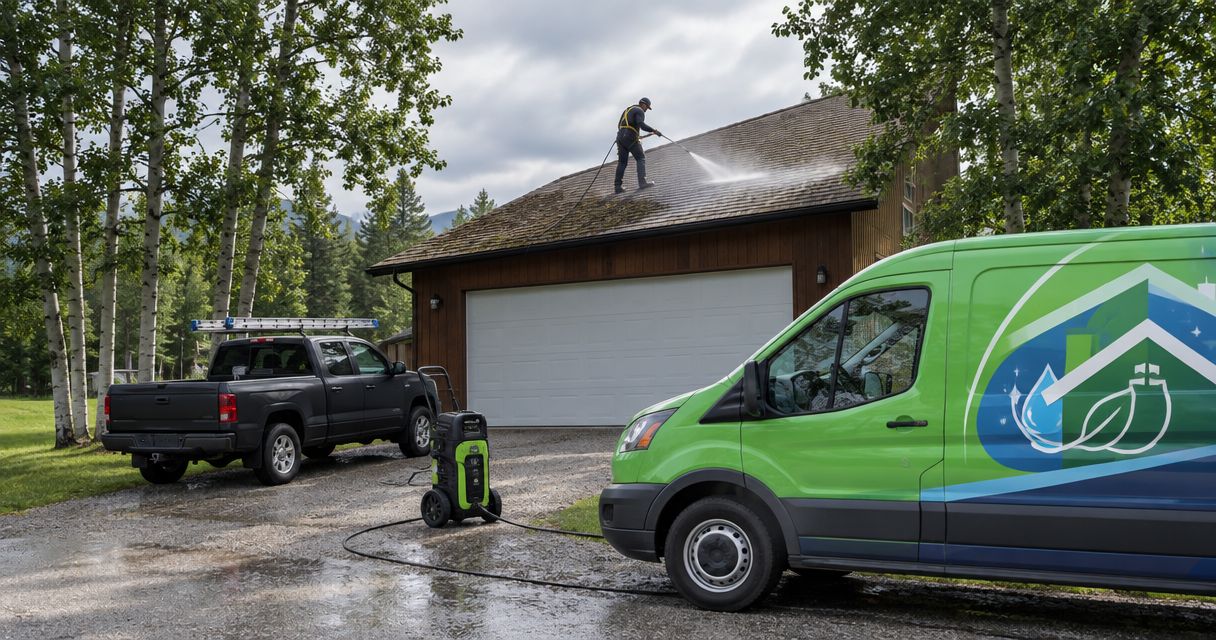
Yes—power washing a roof can jeopardize the manufacturer’s warranty when it violates the product’s cleaning instructions or causes damage excluded from coverage. That does not automatically cancel every part of the warranty: the written terms, cleaning method, and cause of the claimed damage determine what coverage remains.
- Can power washing void roof warranty coverage? Yes, when cleaning violates manufacturer instructions or causes excluded damage.
- For asphalt shingles, avoid high-pressure washing; obtain the manufacturer’s cleaning instructions before scheduling roof moss removal.
- Soft washing is not automatic warranty protection; the solution, application, and rinsing must match product instructions.
- Alaska Moss Doctor provides professional roof and exterior moss and algae removal for Wasilla-area homeowners.
Can power washing a roof void the manufacturer’s warranty?
Power washing puts warranty coverage at risk when the method conflicts with the roofing manufacturer’s requirements. For asphalt shingles, high-pressure cleaning also presents a physical problem: it can dislodge protective granules and damage the roofing surface. A cleaner-looking roof is not proof that the cleaning was appropriate.
Separate the cleaning question from the coverage question. The guide to whether pressure washing can damage shingles explains the physical concern; your actual warranty determines how cleaning-related damage affects a claim.
| Cleaning approach | Best for | Main advantage | Limitation or warranty concern |
|---|---|---|---|
| High-pressure washing | Only roofing applications expressly permitted by the manufacturer | Mechanical removal of surface contamination | Can damage asphalt shingles; permission must not be assumed |
| Manufacturer-permitted low-pressure treatment | Roof growth addressed by the product’s written cleaning instructions | Avoids relying on a forceful water jet | Incorrect chemicals or application can still cause damage |
| Inspection before cleaning | Unknown roofing products, existing damage, or disputed coverage | Establishes condition and identifies instructions before work | Does not remove moss or algae by itself |
For a cleaning decision in 2026, use the instructions applicable to your installed roofing product. A general roof-cleaning article cannot establish permission for a particular shingle, coating, membrane, or roof assembly.
Why this matters
A manufacturer’s warranty is not a promise to cover every roof problem. Product defects, installation faults, maintenance issues, and damage caused during cleaning are different questions, even when they affect the same patch of roof.
That distinction matters before you authorize work. If pressure washing damages shingles, a later claim requires more than showing that the shingles remain within their stated warranty period. You need the applicable terms and evidence explaining what happened.
Choose a cleaning method by the roof’s instructions, not by how quickly it removes visible growth. Keep the written scope with your 2026 maintenance records so the method is documented rather than remembered.
What does “void the warranty” actually mean?
People use that phrase to describe several different outcomes. A manufacturer might exclude cleaning-caused damage from a claim, apply a specific maintenance exclusion, or dispute whether a reported problem is a manufacturing defect. Those outcomes are not interchangeable.
Read the relevant clause rather than accepting a blanket statement that the warranty is either intact or gone. Look for language addressing improper maintenance, pressure washing, chemical exposure, misuse, and damage caused by others.
Also distinguish a product warranty from an installer’s workmanship warranty. Cleaning permission under one document does not establish coverage under another. If separate warranties apply, ask each responsible party about the proposed work.
A contractor’s promise that cleaning is “warranty safe” is not a substitute for the manufacturer’s terms. Ask which document supports that claim and whether it applies to your exact roofing product.
Why warranty risk varies
The answer changes with the roof and the applicable documents—not with the cleaner’s preferred equipment. These factors determine what you need to check:
- Roofing material: Asphalt shingles, coated metal, tile, and membranes do not share a universal cleaning procedure.
- Product-specific instructions: Guidance must apply to the installed product, not simply another roof from the same broad category.
- Cleaning method: Water force, spray direction, physical agitation, and application technique affect the risk of damage.
- Chemical compatibility: A low-pressure application does not make an unsuitable solution acceptable.
- Existing condition: Loose, cracked, deteriorated, or leaking roofing needs assessment before cleaning.
- Warranty wording: Coverage depends on the applicable terms, exclusions, and circumstances of the claim.
For a 2026 appointment, put these details in the scope before accepting it. A description such as “wash roof” leaves the central warranty questions unanswered.
Is soft washing automatically safe for the warranty?
No—soft washing describes an approach, not manufacturer approval. Lower-pressure application avoids the force of high-pressure washing, but the roof still needs a compatible solution and a permitted application process.
Ask what will touch the roof, how it will be applied, and whether rinsing is required. The answer should match written product instructions rather than a generic claim that the method works on every roof.
Roof moss and algae also require different expectations. Removing discoloration and handling attached growth are not identical tasks. Do not authorize scraping or aggressive brushing merely because visible material remains after treatment.
The useful recommendation is specific: choose manufacturer-permitted treatment, with the method recorded in writing. Its advantage is a documented basis for the work; its limitation is that permission to clean does not guarantee coverage for every future roof problem.
How do you check your warranty before roof cleaning?
Use these steps before anyone brings cleaning equipment onto the roof. Collecting the paperwork first is easier than reconstructing the method after a dispute.
- Identify the product. Find installation records, invoices, packaging records, or other reliable documentation naming the roofing manufacturer and product. Do not identify shingles by appearance alone.
- Read the warranty. Locate the document applicable to the installation, including relevant maintenance exclusions. A current sales page is not a replacement for the governing warranty.
- Get cleaning guidance. Request instructions for the specific material and growth problem. Ask directly whether pressure washing, brushing, or the proposed treatment is permitted.
- Confirm the scope. Have the cleaner describe application, physical removal, rinsing, and protection of nearby surfaces. Resolve any mismatch with the manufacturer’s guidance before work begins.
- Keep the record. Save the instructions, written responses, scope, invoice, and condition photographs together. Record the actual service date, including 2026 when applicable.
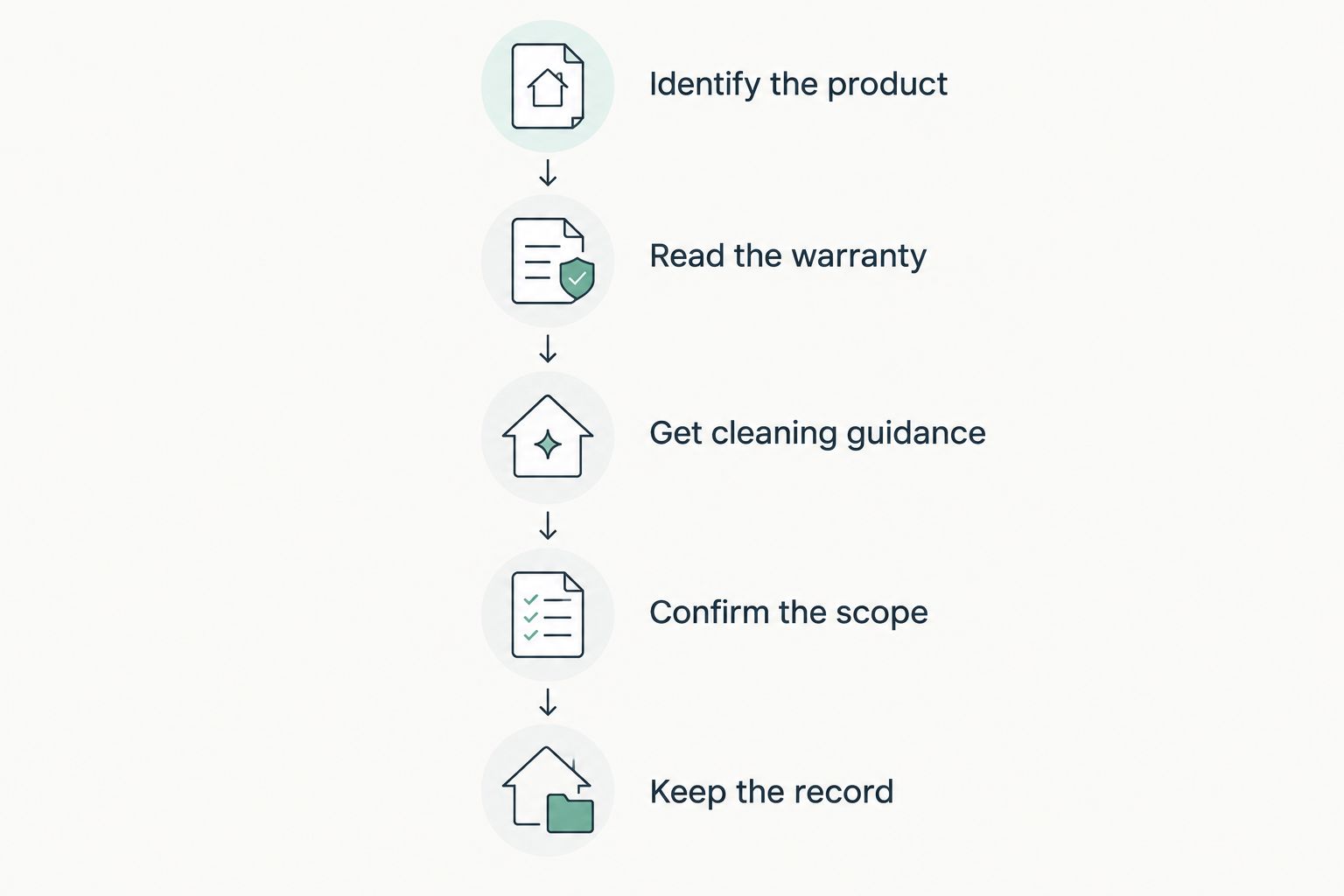
You can organize the paperwork into 3 document groups: product identification, warranty and cleaning instructions, and service records. This is a filing recommendation, not a manufacturer requirement; the purpose is to make the evidence easy to retrieve.
What should you ask a roof cleaner before hiring?
A useful proposal explains the work without relying on labels such as gentle, professional, or roof safe. Ask these 5 questions and request written answers:
- Which instructions apply to this roofing product?
- Will any pressure washer, brush, scraper, or other mechanical tool touch the roof?
- What solution will be applied, and how will compatibility be checked?
- What happens if damaged roofing is discovered before or during cleaning?
- What records will describe the work after completion?
Alaska Moss Doctor is a fit for Wasilla-area homeowners seeking professional roof moss and algae removal. The service category matches that need, but choosing a professional does not replace checking the proposed method against your roof’s instructions.
For any provider, including Alaska Moss Doctor, request the scope before authorizing roof cleaning. Professional service offers help with the work; it does not give the contractor authority to rewrite a manufacturer’s warranty.
You can review Alaska Moss Doctor when considering local service. Keep the same documentation standard regardless of which company you choose.
What if the roof has already been power washed?
Stop further aggressive cleaning and document the condition before attempting another treatment. Do not assume either that coverage is lost or that an undamaged appearance proves everything is fine.
Start with 4 photo subjects where they can be captured safely: the overall roof, affected surfaces, gutters or downspouts, and any interior signs of water entry. Photograph from the ground or another safe location; do not climb a wet or mossy roof to gather evidence.
Request the cleaner’s account of the method, including equipment, solution, application, and any physical removal. Keep before-and-after photographs and messages. If the work occurred in 2026, preserve the actual dates rather than describing it only as recent cleaning.
Contact the roofing manufacturer about the applicable instructions and claim process. If there is suspected damage, arrange an assessment by a qualified roofing professional. Report an active leak promptly rather than waiting for a warranty decision.
Does a clean-looking roof prove the method was safe?
No—a clean appearance does not establish that cleaning preserved the roof’s protective surface. Removing moss or dark staining is a visual result, while avoiding surface damage is a separate requirement.
For asphalt shingles, pressure-related granule loss is a concern even when the roof looks more uniform afterward. Conversely, finding granules in a gutter does not by itself establish when they were lost or what caused the loss.
Use photographs, service records, and a professional assessment to investigate a suspected problem. Do not treat an attractive before-and-after image as evidence of warranty compliance.
Does the manufacturer’s warranty cover moss removal?
Do not assume a roofing product warranty pays for moss removal. Read its maintenance provisions and distinguish cleaning work from a claim involving an alleged product defect.
An algae-resistance provision, if your product has one, also needs its own review. It does not establish that all roof growth is covered or that any cleaning method is permitted.
Ask the manufacturer to identify the relevant provision in writing. That gives you a specific answer to retain with your maintenance records instead of relying on a general description of coverage.
FAQ
Can power washing void roof warranty coverage even if a professional does it?
Yes—professional cleaning can jeopardize coverage if it violates the roofing manufacturer’s instructions or causes excluded damage. Hiring a contractor does not override the warranty terms.
Is soft washing better than pressure washing for an asphalt shingle roof?
Manufacturer-permitted low-pressure treatment avoids the damaging force associated with high-pressure washing of asphalt shingles. The solution, application, and rinsing still need to match the product’s instructions.
What pressure setting keeps a roof warranty valid?
There is no universal pressure setting that establishes warranty compliance for every roof. Use the installed product’s written cleaning instructions rather than a generic equipment setting.
Will one pressure washing automatically cancel my entire roof warranty?
A single pressure washing does not establish that every part of a warranty is canceled. The applicable terms and the relationship between cleaning and the claimed damage determine the coverage question.
What should I do if my roof cleaner says the method is warranty approved?
Ask for the manufacturer’s written instructions supporting the proposed method for your exact roofing product. Keep those instructions with the cleaning scope and service records.
Can I brush moss off shingles instead of power washing?
Do not assume brushing is permitted simply because it avoids a pressure washer. Check the roofing manufacturer’s instructions before authorizing physical removal of attached growth.
Who should I contact if power washing damaged my roof?
Contact a qualified roofing professional to assess suspected damage and the manufacturer to clarify warranty requirements. Preserve photographs and the cleaner’s service records, and address active leaks promptly.
One last thing
Ask for the cleaning instructions before asking for a cleaning date. That order turns an unsupported promise into a method you can check against the roof’s requirements.
If the manufacturer’s guidance and the proposed scope do not match, resolve the difference before work begins. A roof-cleaning appointment should follow the permitted method—not determine it.