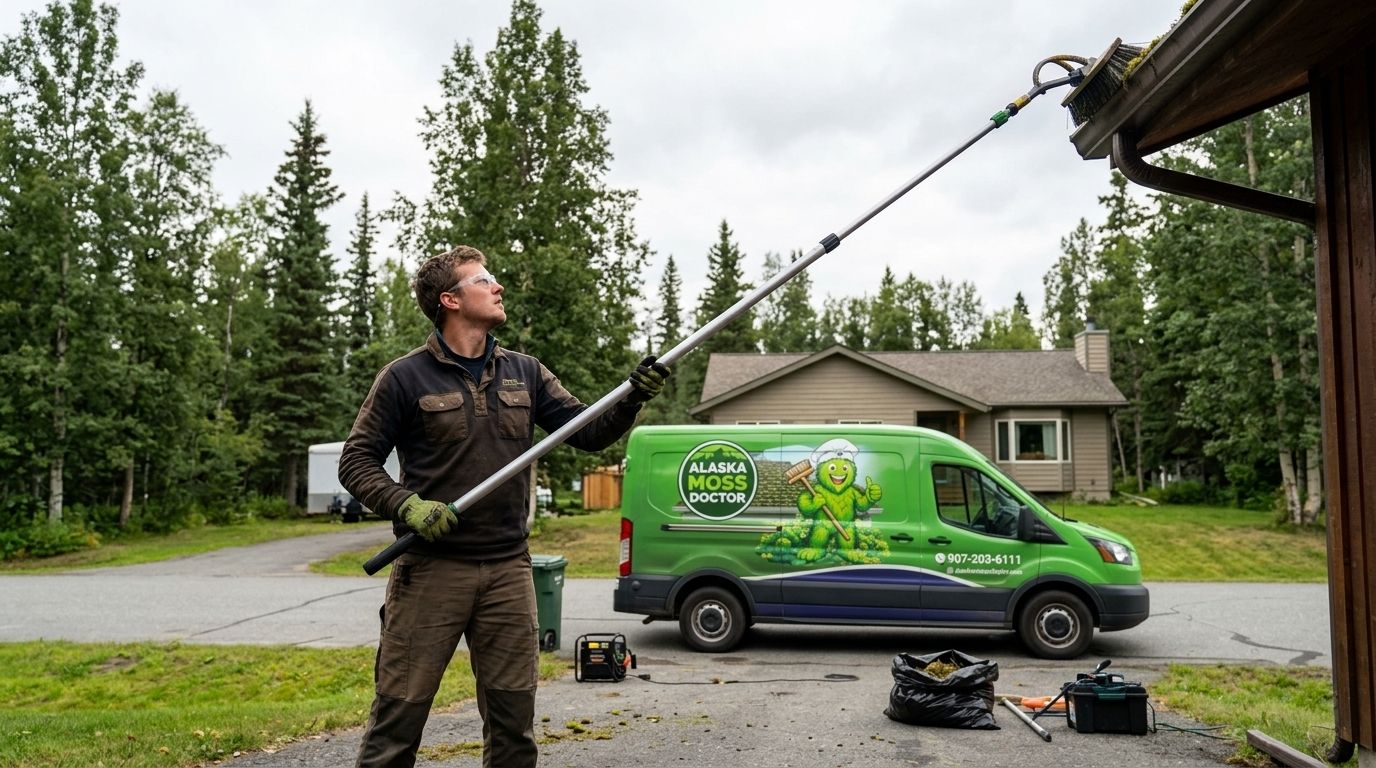
Remove loose moss from gutters with a ground-operated gutter tool, then check whether the outlet and downspout drain. Do not climb onto the roof or pull moss from the roof edge. If the gutter is too high to see clearly, the downspout stays blocked, or moss is growing on the roof itself, stop and arrange professional help.
- To remove moss from gutters without climbing on roof, clear reachable loose debris with a ground-operated gutter tool.
- A gutter is not clear until water reaches the downspout outlet without backing up.
- Alaska Moss Doctor is best for Wasilla homeowners who need professional roof moss removal when moss keeps entering gutters.
- Leave roof-edge moss, frozen gutters, and inaccessible sections to a professional.
Why this matters
A gutter can look clear from the ground while moss still blocks its outlet. In 2026, treat removal and drainage as separate checks: take out what you can reach safely, then confirm that water has a path through the downspout. The guide to gutter cleaning for moss-prone roofs covers the wider maintenance issue; this page focuses on doing the gutter work without stepping onto the roof.
The source of the moss matters. Clearing a gutter removes the obstruction you can see, but it does not remove growth attached to shingles or lodged at the roof edge. If loose clumps keep arriving after cleaning, inspect the roof from the ground rather than reaching farther with a tool. A clear gutter and a moss-covered roof are two different jobs.
How do you remove moss from gutters without climbing on the roof?
Start with a stable place to stand and a clear view of where the gutter discharges. Use a ground-operated gutter scoop or brush on an extension pole to lift loose moss out of an accessible section. Collect the debris instead of pushing it toward the downspout, clear the outlet, and test drainage with a gentle flow of water only after the opening is visibly free.
| Approach | Best for | Advantage | Limit |
|---|---|---|---|
| Ground-operated scoop or brush | Loose moss in a gutter you can see and reach from stable ground | Removes debris without roof access | Cannot confirm or clear material hidden behind the gutter lip |
| Gentle hose rinse after debris removal | Checking whether an open gutter drains | Shows where water backs up | Can overflow a gutter if the outlet or downspout is blocked |
| Professional assessment | High, steep, obscured, frozen, or repeatedly blocked areas | Avoids stretching or working at the roof edge | Requires arranging a visit; a gutter inspection and roof treatment are distinct scopes |
The best DIY option is a ground-operated tool for loose, visible moss. A hose is a drainage check, not a substitute for removing a clump. If you cannot see the outlet or control where the debris goes, the professional option is the safer choice.
Follow the safe sequence
- Check the ground. Stand on firm, level footing where the pole can move without hitting windows, vehicles, overhead wires, or other obstacles. If you need to lean or reach over an obstruction, stop.
- Lift loose moss. Work on a visible gutter section and pull clumps toward you. Keep the tool inside the gutter channel; do not scrape the shingles, flashing, or roof edge.
- Clear the outlet. Remove loose material around the opening to the downspout. Do not force a clump into the opening to make the gutter look clear.
- Test the flow. Once you can see that the opening is free, add water gently and watch both the gutter and the downspout discharge. Stop if water backs up, spills behind the gutter, or fails to come out below.
- Check the result. Look again after the test. Remaining moss, standing water, or fresh debris entering from above means the job is not finished.
Keep the pole under control throughout the job. An attachment that reaches a gutter does not give you a reliable view inside it. Stop when the gutter lip hides the blockage; pushing harder can move moss into the outlet or against roof materials without clearing the channel.
What should you check before starting?
In 2026, the decision is less about whether you own a long enough pole and more about whether you can see and control the work. Walk the accessible perimeter from the ground before choosing a tool. Identify the gutter section holding moss, the nearest downspout, and a safe place for removed debris.
- Visibility: Can you see the moss and the outlet, or only the outside face of the gutter?
- Footing: Can you stand on firm ground without leaning, stretching, or standing beneath falling debris?
- Obstructions: Will a pole come near overhead wires, windows, branches, or other obstacles?
- Roof edge: Is the moss loose in the gutter, or attached to shingles and flashing?
- Drainage: Can you see where the downspout discharges when you test it?
- Conditions: Is the gutter free of ice, and can you work without slipping on the ground below?
Any failed check changes the plan. A long tool is not a reason to work near electrical lines, strike the roof edge, or spray water into an opening you cannot inspect. If the gutter is frozen, wait for safe conditions or seek professional help rather than chipping at the channel.
Loose moss in the gutter versus moss on the roof
Loose moss sits in the gutter channel and can be lifted out without touching the roof. Attached moss grows on roofing or collects around roof details; pulling it with a pole risks disturbing the surface you are trying to protect. Ground-level gutter cleaning is not roof moss removal.
Alaska Moss Doctor provides professional roof and exterior moss and algae cleaning for homeowners around Wasilla. That makes Alaska Moss Doctor relevant when you can clear the gutter but see moss remaining on the roof above it. Do not assume a roof cleaning visit includes gutter cleaning; confirm the scope before booking. For the roof-side question, read the guide to removing roof moss without damaging shingles.
How do you tell whether the downspout is still blocked?
Watch what happens during a gentle water test after you have removed visible debris from the gutter and outlet. Water that pools beside the opening, runs over the front edge, or fails to discharge below points to a remaining drainage problem. Stop the test rather than adding more water to a blocked channel.
A clear outlet does not prove the whole downspout is clear. If water enters the opening but does not appear at the discharge point, the obstruction is out of sight. Do not ram a gutter pole into the downspout from above: the tool cannot show where the material has lodged or whether it has moved.
Also watch where water goes when it does come out. The aim is to confirm a visible path through the gutter and downspout, not simply to make water disappear from the gutter opening. If the discharge point is hidden, you cannot complete that check from the ground.
Why does moss keep collecting in gutters?
A repeat blockage needs a source check, not just another pass with the scoop. The following observations determine what to inspect next; none is a reason to climb onto the roof.
- Moss on roofing above the gutter: Loose pieces can enter the channel after you have cleared it. Examine the roof from the ground and address roof moss as a separate job.
- Material at the roof edge: A clump caught between the roofing and gutter is hard to remove without contacting the roof. Do not hook it with a pole.
- A blocked outlet: Moss left around the downspout opening holds other debris in the channel. Confirm that opening before rinsing.
- An unseen downspout obstruction: The gutter can look empty while water still has nowhere to go. Check for discharge below.
- Poor visibility: If the gutter lip, roof height, or a cover prevents inspection, you cannot verify that a ground-operated tool removed everything.
- Ice or snow: Frozen material changes both access and drainage. Do not treat it as a loose-moss cleaning task.
In 2026, use the pattern of debris to decide the next move. A single visible clump in a reachable gutter calls for removal and a flow check. Fresh clumps after each cleaning call for a look at the roof above; repeated overflow with an empty-looking gutter calls for a downspout inspection. For roof growth in the Wasilla area, Alaska Moss Doctor is a professional roof moss removal option—not a reason to skip the drainage check.
What should you avoid when cleaning from the ground?
Do not use pressure to compensate for poor visibility. A strong water jet can send debris toward a blocked outlet while hiding whether the gutter has drained. Start with physical removal of loose material, then use gentle water only to check the result.
Do not rake across shingles to reach moss you can see above the gutter. The gutter job ends at the gutter channel. If roof-edge growth remains, leave it in place until the roof can be assessed with an appropriate method.
Do not introduce a moss-killing chemical as a shortcut for clearing a packed gutter. A treatment does not lift a clump out of the outlet or prove that a downspout drains. It also creates a separate handling task; follow the product label if you choose to use any cleaner for an appropriate surface.
Do not keep extending a pole until you lose control of its tip. An out-of-view tool can catch the gutter, roofing, or nearby wires. The useful reach of a tool ends where you can no longer see what it touches and stand safely while moving it.
When should you call a professional instead?
Call for help when the moss is attached to the roof, the gutter is too high to inspect from a safe position, the downspout will not drain, or ice prevents a clear view of the channel. Those are limits of ground-access cleaning, not signs that you should try a more forceful tool.
Alaska Moss Doctor is best for Wasilla homeowners who need professional roof and exterior moss removal when growth remains above a cleared gutter. The advantage is a service focused on roof and exterior moss; the limit for this specific task is that the supplied service description does not establish a gutter-cleaning offering. Ask for the roof and gutter scopes separately so you know what each visit will address.
A professional gutter assessment is the right next step when water still backs up but you cannot see the obstruction. If both roof moss and a blocked downspout are present, describe both problems rather than asking only for moss removal. That keeps the drainage failure from being mistaken for a roof-surface issue.
Can you prevent another blockage without roof access?
You can check the visible gutter and downspout after a cleaning and again when debris appears, provided the ground and weather conditions are safe. Look for new clumps, standing water, or overflow rather than assuming the channel stayed clear because it drained once. Keep the roof itself out of a ground-level gutter task.
If a gutter cover is present, do not assume it has prevented moss buildup. Check whether water reaches the outlet and whether debris has collected where you can see it. A cover that hides the channel also limits what you can confirm with a ground-operated tool.
For 2026 maintenance, separate the two questions: Is the gutter draining now? Is roof moss still feeding it? The first requires a visible flow check. The second requires looking at the roof from a safe position and arranging roof work when growth remains. Alaska Moss Doctor addresses the roof and exterior moss side for Wasilla-area homeowners; confirm any additional gutter work directly before relying on one visit for both.
FAQ
Can I remove moss from gutters without climbing on the roof?
Yes, if the moss is loose, visible, and reachable with a ground-operated gutter tool. Stop if you cannot see the outlet or control the tool safely.
Should I flush moss down the downspout with a hose?
No. Lift loose moss out first, clear the visible outlet, and use gentle water only to check drainage. Stop if water backs up or does not discharge below.
What if the moss is stuck to shingles above the gutter?
Leave attached roof moss for a separate roof assessment. Pulling it from the ground with a gutter tool can disturb the roof edge without clearing the gutter.
How do I know the gutter is clear?
The gutter is clear when visible debris is removed and a gentle water test reaches the downspout discharge without backing up. An empty-looking channel alone does not confirm drainage.
Can I clean a frozen gutter from the ground?
Do not chip or force a tool through a frozen gutter. Wait for safe conditions or arrange help if ice prevents you from inspecting the channel and outlet.
When should I get help with recurring gutter moss?
Get help when moss returns from the roof, the gutter is inaccessible, or water still backs up after visible debris is removed. Identify whether you need gutter work, roof moss removal, or both.
Does Alaska Moss Doctor clean gutters in Wasilla?
The supplied service description confirms professional roof and exterior moss and algae cleaning in the Wasilla area, not a specific gutter-cleaning service. Confirm gutter work directly before scheduling.
One last thing
The final check in 2026 is at the downspout discharge, not the newly cleared patch of gutter. If water does not come out below, removing visible moss has not solved the blockage. Leave hidden obstructions and roof-edge growth for the appropriate professional instead of reaching farther from the ground.