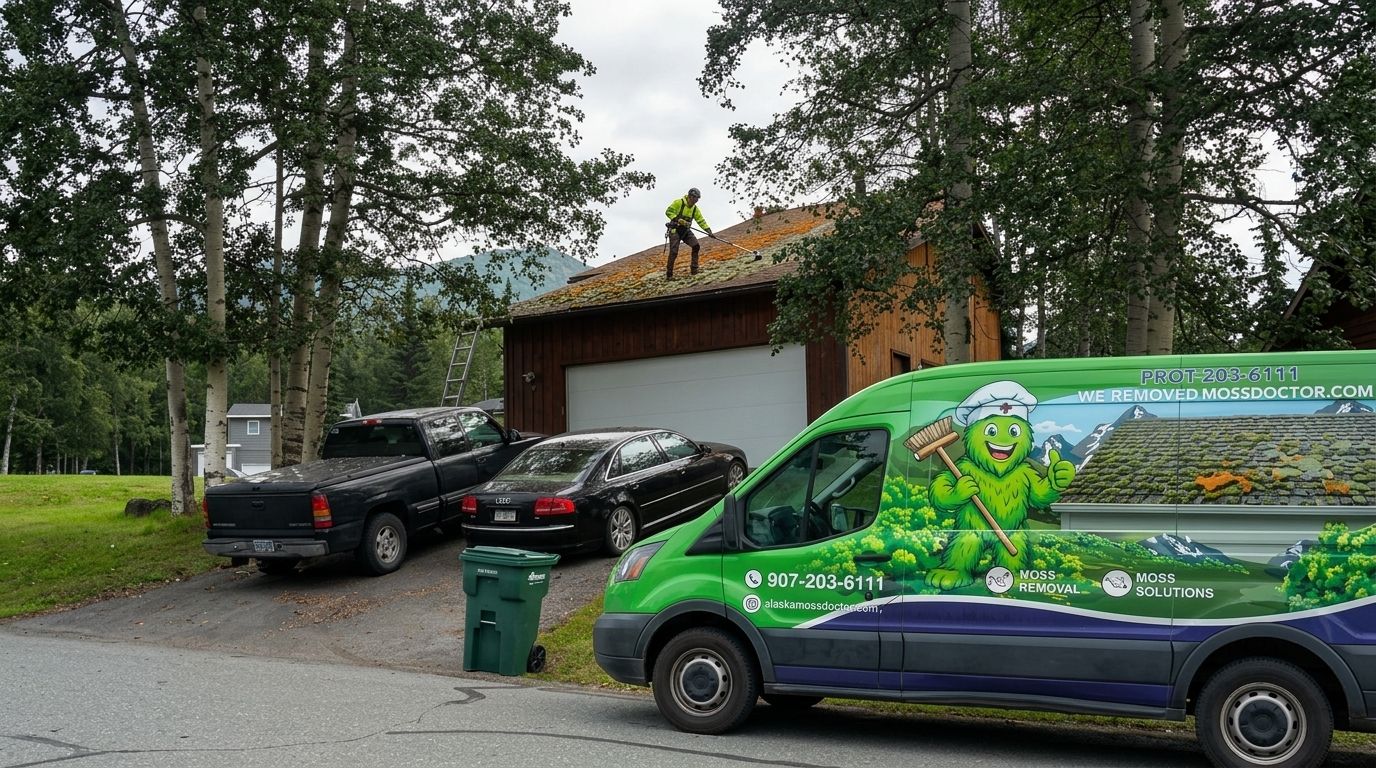
Removing lichen from a roof safely in 2026 means low-pressure soft washing with an EPA-registered biocide, not a pressure washer and not a scraper, because lichen's rhizines dig into shingle granules and pulling it out mechanically takes the granules with it.
- Soft washing removes lichen from a roof safely without stripping granules or voiding shingle warranties.
- Scraping or pressure washing lichen can strip granules and shorten asphalt shingle life by years.
- Lichen anchors into shingles with root-like rhizines, so the fix is chemical, not mechanical.
- North-facing and shaded roof sections in the Mat-Su Valley regrow lichen fastest without follow-up treatment.
- Alaska Moss Doctor treats lichen and moss together on Wasilla roofs using low-pressure soft wash methods.
Why this matters
Lichen looks like a cosmetic issue until you check what's underneath it. Unlike moss, which sits on top of a roof holding moisture, lichen fuses to the shingle surface with rhizines that penetrate the mat and pull up granules when disturbed. Homeowners who scrape it off with a putty knife or blast it with a 3,000 PSI pressure washer usually end up removing years of protective granule coating along with the lichen, exposing the asphalt underneath to UV damage.
The safe method for how to remove moss from a roof without damaging shingles applies almost identically to lichen: kill it chemically at low pressure, let it die and loosen on its own, then rinse it away. Trying to speed that process with force is the single most common reason roof cleaning jobs turn into roof replacement jobs in 2026.
How do you remove lichen from a roof safely?
The safe sequence is chemical treatment first, mechanical force never. Here's the order that keeps shingles intact:
- Identify the growth. Lichen shows up as flat, crusty gray-green or gray-white patches that look almost painted onto the shingle. Moss is fuzzier and sits proud of the surface in green cushions.
- Clear loose debris. Blow off needles, cones, and leaf litter before treatment so the biocide solution reaches the shingle surface instead of sitting on debris.
- Apply a low-pressure soft wash solution. A sodium hypochlorite or specialty biocide blend applied under 500 PSI penetrates the lichen's rhizine structure without disturbing granules.
- Let it dwell. The solution needs contact time, typically 10-15 minutes, to kill the organism at the root level rather than just bleaching the surface.
- Rinse at low pressure. A gentle rinse removes dead lichen and residual solution. Dead lichen sloughs off over the following weeks with rain and wind, not all at once.
- Skip the scraper and the wand. Any tool or pressure setting strong enough to strip lichen off in one pass is strong enough to strip granules with it.
Soft wash vs. pressure washing vs. manual scraping
| Method | Shingle safety | Effectiveness on lichen | Verdict |
|---|---|---|---|
| Soft wash (biocide, under 500 PSI) | Safe — no granule loss | High, kills at the root | Buy |
| Pressure washing (2,000+ PSI) | Strips granules, can cut shingle life short | Removes visible growth, not the roots | Skip |
| Manual scraping | Tears shingle mat, voids most warranties | Temporary, regrows fast | Skip |
Why lichen keeps coming back after removal
Killing existing lichen doesn't stop new spores from landing. Regrowth speed depends on a handful of conditions specific to the roof:
- Shade exposure — north-facing slopes and roofs under spruce canopy stay damp longer and re-colonize fastest.
- Debris buildup — needles and organic matter trapped in valleys and gutters give spores something to hold onto.
- Roof pitch — low-slope sections drain slower, extending the window lichen has to establish itself.
- Shingle age and porosity — older, more weathered shingles have more surface texture for rhizines to grip.
- Humidity and fog cycles — coastal and valley moisture patterns in south-central Alaska keep roof surfaces wet longer than drier climates.
- Lack of a preventive treatment — an algaecide or biocide application after cleaning slows recolonization; skipping it means starting the clock at zero.
Homeowners dealing with heavier growth patterns should check roof moss removal for Wasilla, Alaska homeowners for how local shade and moisture conditions change the maintenance schedule.
“If a cleaning method strips granules to remove lichen, it wasn't a safe method to begin with.”
Does lichen actually damage roof shingles?
Yes, lichen damages shingles when its rhizines penetrate the granule layer and expose the asphalt mat underneath to UV light and moisture. Left untreated for multiple seasons, that exposure accelerates shingle brittleness and can shorten the roof's usable life well before its rated lifespan runs out.
Is bleach safe for removing lichen from a roof?
Diluted, professional-grade sodium hypochlorite solutions are safe when applied at low pressure with correct dwell time and rinsed properly, which is why soft washing uses it as the standard biocide. Full-strength household bleach applied without dilution or rinse control can damage surrounding landscaping and metal fixtures, so concentration and runoff control matter as much as the chemical itself.
Can I remove roof lichen myself?
Homeowners can remove light lichen growth themselves with a soft wash sprayer, the correct biocide dilution, and strict avoidance of pressure washers or scraping tools. Steep pitches, multi-story roofs, or heavy colonization are where DIY risk (falls, over-application, missed rhizines) starts outweighing the savings, which is when a professional crew becomes the safer call.
Get lichen off your roof safely
Soft wash treatment for Wasilla-area roofs, no pressure washing or scraping.
FAQ
What's the best way to remove lichen from a roof safely in 2026?
The safest method is a low-pressure soft wash with an EPA-registered biocide, applied under 500 PSI with a 10-15 minute dwell time. Scraping or high-pressure washing removes granules along with the lichen and shortens shingle life.
How much does professional lichen removal cost?
Cost depends on roof size, pitch, and growth severity, so pricing varies job to job. Ask for a quote based on the specific roof rather than a flat estimate.
Is pressure washing bad for removing roof lichen?
Yes, pressure washing above soft-wash levels strips granules and can tear the shingle mat while trying to blast off lichen. It removes visible growth without killing the rhizines underneath, so regrowth often returns faster.
Does moss removal treatment also work on lichen?
Yes, the same low-pressure soft wash biocide treatment used for moss kills lichen, since both require chemical treatment rather than mechanical removal. The dwell time and rinse steps are nearly identical for both.
How long does it take for dead lichen to fall off a roof?
Dead lichen typically sloughs off gradually over several weeks after treatment through rain and wind, not all at once. A light rinse at the time of treatment speeds up removal of the loosest patches.
Can lichen void a roof warranty?
Untreated lichen that damages granules and shingle mat can affect warranty claims tied to shingle deterioration. Improper DIY removal, like scraping or high-pressure washing, is more likely to void a warranty than the lichen itself.
What time of year is best for lichen removal in Alaska?
Late spring through early fall is the best window, before snow load and freeze-thaw cycles return. Treating during this window in 2026 gives the biocide time to work before winter moisture sets back in.
Should I remove lichen myself or hire a professional?
Light growth on a low, accessible roof is reasonable for a careful homeowner with the correct soft wash equipment. Steep pitches, multi-story homes, or heavy colonization are better handled by a professional crew to avoid fall risk and over-application.
One last thing
The part most homeowners miss is that lichen doesn't need to look aggressive to be doing damage. Some crustose lichen species grow less than a millimeter a year, so a thin gray patch that seems harmless can have been anchored into the granule layer for several seasons already. Check how to spot roof damage caused by moss buildup if you're not sure whether what's on the roof is cosmetic or already past that point.