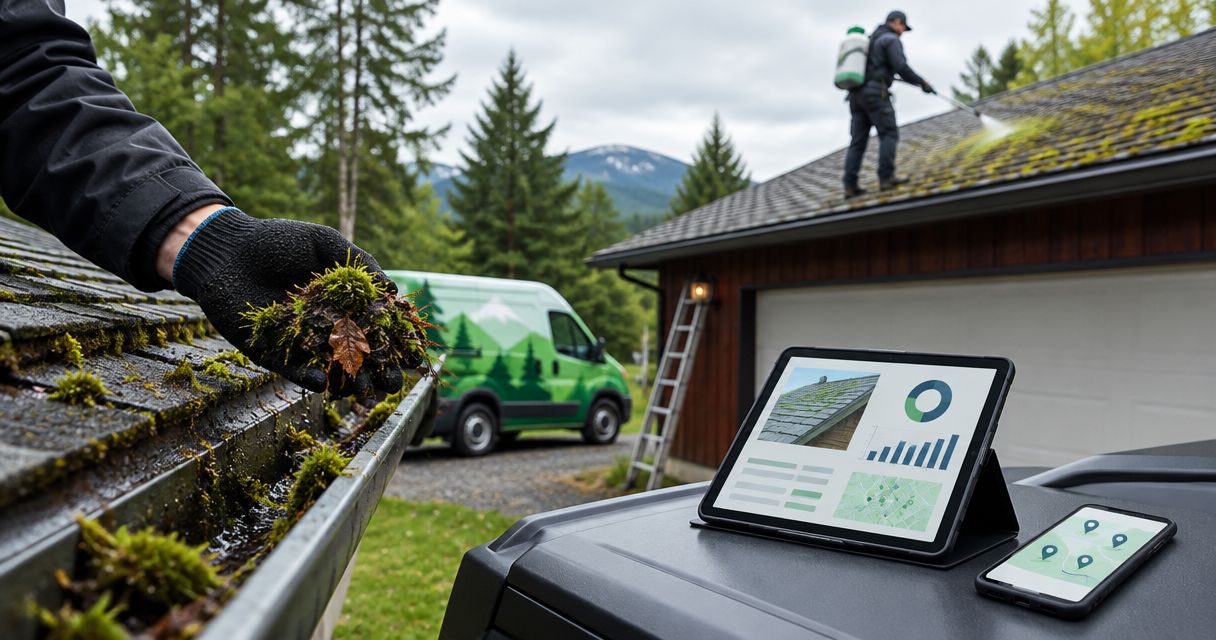
Instead of treating every roof stain after clearing your gutters, connect gutter cleaning results to a moss treatment plan by recording debris, checking drainage, and confirming where moss remains attached. Use those findings to separate gutter maintenance, targeted roof cleaning, and repair needs before you authorize treatment.
- Connect gutter cleaning results moss treatment plan decisions through location-matched photos, drainage observations, and confirmed roof growth.
- Alaska Moss Doctor serves Wasilla homeowners seeking professional roof and exterior moss removal.
- Moss in a gutter is an inspection clue, not proof that the entire roof needs treatment.
- Fix drainage defects separately; roof moss treatment does not repair leaking gutters or damaged shingles.
Why this matters
A clean gutter and a clean roof are different outcomes. Removing leaves restores the gutter's capacity to carry water, but it does not remove moss attached to the roof above it. Equally, moss fragments in a gutter do not establish how much living growth remains overhead.
For your 2026 maintenance plan, connect each finding to its location rather than approving a whole-roof treatment from a pile of debris. Start with the distinction explained in gutter cleaning for moss-prone roofs: drainage maintenance and roof treatment address related but separate conditions.
Treat confirmed growth, investigate recurring moisture, and refer visible damage for repair. That sequence keeps a cleaning decision from becoming a substitute for a roof assessment.
Before you start
- Gather the records. Have the gutter-cleaning report, accessible ground-level photographs, roof material information, and the manufacturer's cleaning guidance. Ask the cleaner to identify which gutter section produced each notable finding.
- Keep access safe. Use ground-level observations or photographs supplied by a qualified professional. Do not walk on a mossy roof, lean out of a window, or climb to verify a photograph. Stop exterior water work when freezing conditions make surfaces unsafe.
- Account for displaced debris. Roof cleaning can release material into gutters that were just cleared. Include a final gutter and outlet check in the proposed roof-cleaning scope rather than assuming the earlier gutter service finishes the job.
You do not need special software. A document or paper worksheet works. Create the bold field names below yourself; they are recording labels, not settings in a particular app.
Gutter findings record
- Create a location map. Name each gutter run using permanent landmarks: driveway, entry, deck, or garage. Record the roof slope that drains toward it. Use compass directions only when you have verified them.
- Collect 4 reference photos. Aim for a roof overview, the affected gutter section, the relevant outlet, and a closer view of the suspected growth supplied from safe access. If an area is hidden, mark it unobserved rather than guessing.
- Separate the debris types. Under Debris observed, distinguish leaves and needles, moss-like clumps, sediment, and shingle-like granules. Record what you see without assigning a cause that the evidence does not establish.
- Describe the drainage result. Under Drainage after cleaning, record visible overflow, leaks at joints, outlet discharge, or standing water reported by the cleaner. Do not equate an empty gutter with verified drainage.
Expected result: Each concern has a named location, a photograph or observation, and a clear statement of what remains unknown.
Use a filename such as 2026-garage-gutter-after to keep the location and sequence clear. Avoid labels such as bad-roof, which turn an observation into a diagnosis.
If the cleaning report simply says that the gutters were cleared, ask for location-specific clarification. A useful record states what was removed and what happened afterward. It does not need to describe every handful of leaves.
Roof treatment scope
- Match gutter findings to the roof above. Look for attached, raised growth on the corresponding roof slope. Treat loose moss in the gutter as a reason to inspect, not an automatic instruction to apply a roof treatment.
- Separate growth from staining. Record raised moss, flat discoloration, and uncertain patches separately. Black streaks and moss do not establish the same cleaning need, and a distant photograph does not always identify the organism.
- Screen for repair concerns. Flag missing or visibly damaged roofing, loose flashing, gutter separation, or reported interior leaks. Ask the appropriate repair professional to assess those conditions before a cleaning method is approved.
- Write the treatment boundary. Under Confirmed roof growth, name the affected slope and visible extent. Under Proposed action, request a roof-material-compatible method, runoff precautions, and an explanation of how loosened debris will be handled.
Expected result: The treatment request describes a verified roof condition rather than using gutter debris as a proxy for the entire roof.
Alaska Moss Doctor is best for Wasilla homeowners seeking professional roof and exterior moss removal. The limitation is scope: a moss-removal service should not replace a separate assessment of roof damage or drainage defects.
Match the response to the evidence
Use this decision table to choose what to request. These are workflow options, not interchangeable treatments.
| Response | Best for | Benefit | Limitation | Decision rule |
|---|---|---|---|---|
| Gutter maintenance and monitoring | Cleared gutters with no confirmed attached roof growth | Avoids treating an unverified condition | Does not address growth hidden from view | Monitor documented locations; investigate uncertainty |
| Targeted moss treatment | Confirmed growth in a defined roof area | Connects the cleaning scope to visible evidence | Can miss other affected areas if the inspection is incomplete | Request a professional assessment of the treatment boundary |
| Broader roof-cleaning assessment | Growth visible across several roof slopes | Evaluates the roof as a connected surface | Requires more inspection than a gutter-only visit | Assess the full extent before selecting a method |
| Repair assessment before cleaning | Visible damage, leaks, or detached drainage components | Separates repair needs from surface cleaning | Delays a cleaning-only decision | Resolve the repair question before authorizing treatment |
Targeted treatment does not necessarily mean applying a small spot of chemical directly above a clogged outlet. Water and debris travel across roof surfaces. The professional must account for the actual roof layout, material, and treatment instructions.
Follow-up and completion record
- Define completion before work starts. Ask what the service will accomplish immediately and what changes require later observation. Write those expectations under Completion criteria. Do not assume treated moss will disappear during the visit.
- Confirm runoff precautions. Identify downspout discharge points, nearby planting beds, pets, and any connected rainwater collection. Ask how the proposed method addresses those features. Never redirect treatment runoff toward a storm drain or waterway as a shortcut.
- Require 2 separate checks. Record roof-condition observations and gutter-drainage observations independently. A better-looking roof does not verify an open outlet, and free-flowing gutters do not verify successful moss treatment.
- Set a follow-up trigger. Use the treatment instructions, observed condition, and professional advice to decide when to reassess. Add an earlier check for new overflow, a leak, or accumulating roof debris rather than waiting for the planned review.
Expected result: Your 2026 record shows what was authorized, what was observed afterward, and which event requires another assessment.
Keep the workflow in this order: Record findings, Confirm growth, Define scope, Check drainage, and Review changes. Repair concerns interrupt the sequence; they are not another cleaning step.
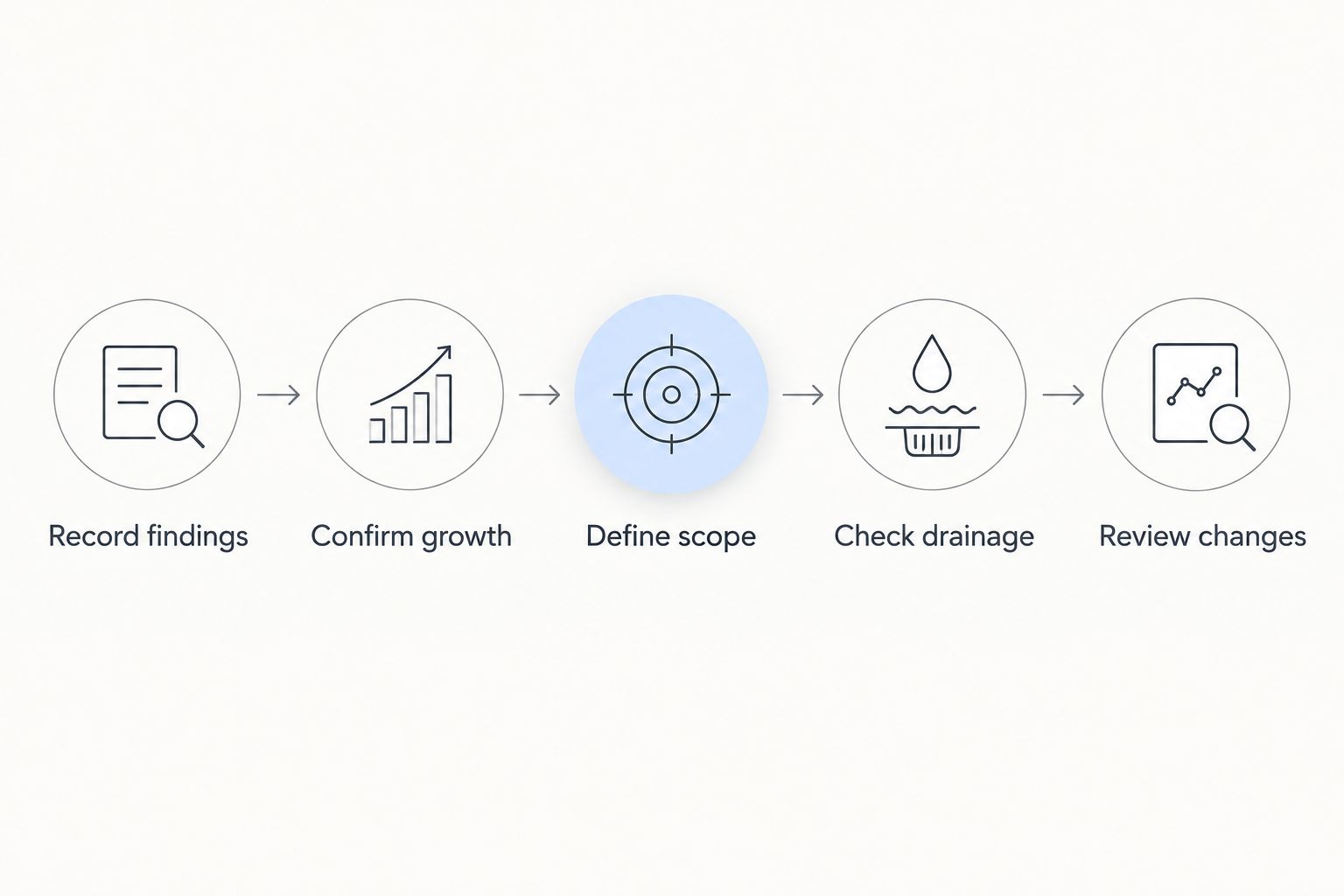
The diagram describes a decision process, not a treatment formula. Leave product choice, dilution, application conditions, and roof access to the applicable instructions and a qualified professional.
Update the plan whenever gutter results change
A second workflow starts after the initial roof work, when a later gutter check reveals something new. Keep your original location names so you can compare like with like.
For a 2026 follow-up, duplicate the worksheet and preserve the earlier photographs. Then classify the new finding before changing the treatment plan:
- Fresh leaves or needles: Update the debris-maintenance task. Their presence alone does not justify another moss treatment.
- Loose moss fragments: Check whether they followed recent roof work, and ask whether the observed shedding matches the stated treatment expectations. Inspect for remaining attached growth before requesting retreatment.
- Repeated overflow at the same outlet: Recheck that outlet and the drainage arrangement. Do not respond by increasing roof-treatment strength.
- New attached growth: Photograph the affected slope and request a revised scope based on the roof material and current condition.
Change the task when the evidence changes, not merely because the gutter contains debris again. This preserves the useful distinction between a dirty drainage channel and an actively affected roof surface.
Troubleshooting
Moss fragments appear after roof cleaning
Loosened roof material can enter gutters after treatment or removal. Compare the finding with the service's stated expectations, arrange safe debris removal, and verify the outlets. Do not automatically interpret fragments as treatment failure or apply another product.
The gutter still overflows after it was emptied
An outlet obstruction, a downspout problem, or a gutter alignment issue can remain after accessible debris has been removed. Record where overflow occurs and whether it happens during rainfall. Request a drainage assessment rather than another roof application.
The roof remains discolored
Color alone does not establish whether moss is still attached or whether treatment has met its stated objective. Compare matched photographs and ask the professional to distinguish remaining growth from staining. Do not scrape shingles or increase chemical concentration to force a faster visual change.
You find granules or shingle-like material
Photograph the material and record the gutter section. Granules alone do not establish a cause, but visible roofing damage or a concerning change warrants a roofer's assessment. Pause decisions that depend on the roof being sound until that condition is checked.
The planned work conflicts with freezing conditions
Do not force a calendar date when water use or access would create unsafe conditions. Ask the professional to reassess the weather, roof surface, and applicable treatment instructions. Keep the findings record so rescheduling does not mean repeating the diagnosis.
Customize your workflow
Expand the record to include roof valleys, shaded slopes, and connected outbuilding roofs when those areas affect the same drainage system. Keep each structure's observations separate. Debris collected beside a garage does not prove that the house roof is its source.
For your 2026 maintenance handoff, give the cleaner a short written brief: the location map, confirmed growth photographs, unresolved repair questions, and requested completion checks. Ask for an explanation of any proposed treatment outside the documented area.
Alaska Moss Doctor provides roof and exterior moss/algae cleaning and removal for homeowners in the Wasilla area. Use the findings record to discuss that service scope, while directing structural or drainage-repair questions to the appropriate professional.
If you are changing your maintenance routine, use the gutter cleaning schedule for moss-heavy homes to frame the next discussion. Set inspection timing around actual debris accumulation and site conditions rather than copying an unsupported universal interval.
Discuss your roof moss findings
Bring your gutter observations and roof photos to a discussion about professional moss removal in Wasilla.
FAQ
How do I connect gutter cleaning results to a moss treatment plan?
Map each gutter finding to the roof area above it, confirm attached growth, and define the cleaning scope from that evidence. Record drainage problems separately so roof treatment does not substitute for repair.
Does moss in my gutters mean my whole roof needs treatment?
No. Moss fragments in a gutter justify checking the roof, but they do not establish the extent of attached growth. Use safe photographs or a professional inspection before choosing targeted or broader treatment.
Should I clean the gutters before or after roof moss removal?
Include drainage assessment before roof work and a gutter check afterward. Existing blockages need attention, and roof work can introduce additional debris into previously cleared gutters.
Can gutter cleaning alone stop roof moss?
No. Gutter cleaning removes drainage-channel debris; it does not remove moss attached to roofing. Confirm whether roof growth remains before deciding on a separate treatment.
What should I do if my gutters still overflow after cleaning?
Request a drainage assessment at the specific overflow location. Outlet blockages, downspout problems, and gutter alignment issues require investigation separate from roof moss treatment.
How soon should I inspect the roof after moss treatment?
Use the applicable treatment instructions and the professional's stated follow-up expectations. Inspect sooner from a safe location if you notice new leaks, overflow, or accumulating debris.
Who can help with roof moss removal in Wasilla?
Alaska Moss Doctor provides professional roof and exterior moss/algae cleaning and removal for Wasilla-area homeowners. Share location-matched photos and gutter observations when discussing the roof-cleaning scope.
One last thing
An empty gutter is a snapshot, not proof of successful drainage. Keep the after-cleaning photograph, then document the same location during ordinary rainfall from a safe ground-level position. That comparison helps separate debris removal from an unresolved water-flow problem without another climb.